Guide
What Is Content Licensing: A Guide to Monetizing Your Work
Content licensing is really just a formal agreement that lets someone use content that another person created. The original creator is called the licensor, and the person or company using the content is the licensee.
Think of it like renting out your creative property. You still own it, but someone else pays you for the right to use it according to a specific set of rules.
The Foundation of Content Licensing Explained
At its heart, content licensing is a partnership built on a simple exchange. The creator gets their work seen by a new audience (and usually gets paid), while the user gets high-quality content without the massive cost and time it takes to make it from scratch. This entire relationship is guided by a licensing agreement, which is the official rulebook for how everything works.
Let's say you're a photographer with an amazing portfolio of cityscapes. A travel magazine wants to use one of your photos for its cover. Instead of selling the photo outright and giving up all future rights, you license it to them.
The agreement might state that the magazine can use that one photo, for one month, only on their print cover, and only in North America. You still hold the copyright, which means you can license that same photo to a different company for a website banner or a book cover later on.
Key Components of a Content Licensing Agreement
To really get a handle on this, it helps to break down the key pieces that make up any licensing deal. This table shows the fundamental elements that define the scope and limitations of the agreement, removing any confusion for both sides.
Component | What It Defines | Example |
|---|---|---|
Scope of Use | How the content can be used. | Digital use only (e.g., on a website, but not in print). |
Exclusivity | Who can use the content. | An exclusive license means only the licensee can use it. |
Duration | How long the permission lasts. | A one-year term from the date the agreement is signed. |
Territory | Where the content can be used. | Usage rights are limited to the United States and Canada. |
Compensation | How the creator gets paid. | A one-time flat fee or ongoing royalties (a percentage of sales). |
These components are the building blocks of every license. Whether it's a single stock photo or a full-length movie, these terms protect everyone involved.
Why This Agreement Matters
Without a clear licensing agreement, using someone else's work is a huge legal gamble that can lead straight to a copyright infringement lawsuit. The agreement draws clear lines in the sand, protecting the creator's intellectual property while giving the user the legal confidence to publish the content.
A content license is essentially a permission slip. It's the creator saying, "Yes, you can use my work, but only in this way, for this long, and in this place."
This structure is what makes the legal and commercial exchange of creative work possible. It’s also the foundation for business models like PLR, which gives you even broader rights to modify and rebrand content. If that sounds interesting, you can learn more by exploring what is private label rights in our detailed guide. Getting this foundational concept down is critical before we jump into the different types of licenses out there.
Exploring Different Types of Content Licenses
Now that you've got the basic idea of a content licensing agreement, it's time to dive into the different flavors you'll run into. Not all licenses are created equal—far from it. Each type comes with its own unique set of permissions, restrictions, and costs, all designed for specific situations. Getting this choice right is a game-changer for both creators and the people using the content.
Think of it like choosing how to get around town. Sometimes, a bus ticket is all you need. It's non-exclusive, gets you where you're going, and you share the ride with plenty of other people. Other times, you need to hire a private car. It's exclusive, giving you total control over the journey, but it comes at a premium.
This simple map shows that core relationship in action—a licensor grants permission, and a licensee gets the rights to use the content.
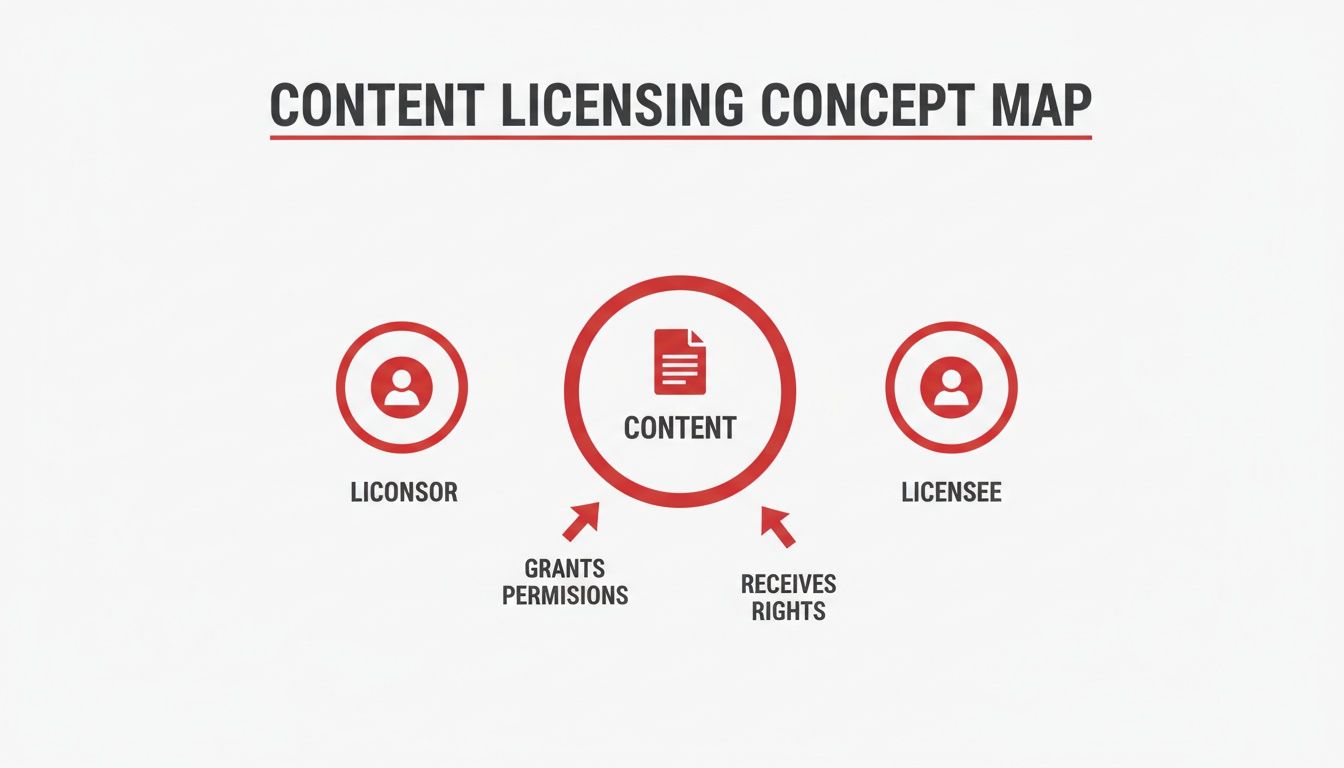
At its heart, every license is just a bridge connecting the person who made the content with the person who wants to use it. The agreement just lays out the rules of the road.
Exclusive vs. Non-Exclusive Licenses
The first major fork in the road is exclusivity. This one factor dramatically changes the value of a license and dictates who else can use the content. It’s the difference between being the only person with a key versus one of many.
An exclusive license hands over the rights to a single licensee. Once that deal is inked, the creator can't license that same piece of content to anyone else for the entire term of the agreement. You see this a lot with high-stakes uses, like a major brand securing an image for a national ad campaign. They pay for the peace of mind that no competitor can touch it.
On the flip side, a non-exclusive license lets the creator license the same content to multiple people at the same time. This is the engine that powers most stock photo websites. Tons of people can buy and use the same image, which keeps the price low and accessible for everyone.
Royalty-Free vs. Rights-Managed Models
Digging a bit deeper into the non-exclusive world, two models really dominate the scene, especially for visual media like photos, videos, and music.
Royalty-Free (RF): This is the most common and straightforward option out there. You pay a one-time flat fee to use the content multiple times for all sorts of permitted uses, and you never have to pay an extra dime in royalties. A startup could buy a royalty-free photo and plaster it on their website, social media, and sales brochures without any extra charges. Simple.
Rights-Managed (RM): This model is all about control and specificity. The price is calculated based on exactly how the content will be used—the industry, where it will be placed, for how long, and in what geographic region. A magazine licensing a photo for its cover for a single print run in North America would pay a fee for just that specific use. If they decide later to feature it on their website, they’d need to go back and purchase an additional license.
Rights-managed licenses offer greater control and exclusivity for specific projects, while royalty-free licenses provide flexibility and simplicity for everyday content needs.
The impact of these models is massive. Licensing isn't some small niche; it's a global economic powerhouse. In fact, Licensing International reported that global sales of licensed products and services hit an eye-watering $369.6 billion in 2024. This shows how licensing fuels everything from blockbuster merchandise to the articles you read online. For more on the entertainment licensing market specifically, you can dig into this comprehensive report.
Open-Source and Rebranding Licenses
Finally, we have licenses built not just for using content, but for modifying, sharing, and even rebranding it. These are particularly popular with entrepreneurs, developers, and educators who need maximum flexibility.
Creative Commons (CC) licenses are a family of public copyright licenses that allow for the free distribution of an otherwise copyrighted work. Creators can pick from different CC licenses to spell out how others can use, share, and build on their work, often just asking for a simple attribution in return. This model has been huge for fostering collaboration and the open sharing of knowledge.
Private Label Rights (PLR) licenses are a content entrepreneur's best friend. They grant the buyer extensive permissions to alter, rebrand, and sell the content as if it were their own. An online business owner could purchase a PLR ebook, slap their own branding on it, and sell it directly on their website. It’s a powerful shortcut for creating products, allowing businesses to launch courses, guides, and other resources in a fraction of the time.
To make sense of it all, here’s a quick breakdown of how these common license types stack up.
Comparing Common Content License Types
This table breaks down the most common licensing models to help you figure out which one fits your project's needs and budget.
License Type | Key Feature | Best For |
|---|---|---|
Exclusive | Only one licensee can use the content for a set period. | High-impact campaigns where brand differentiation is critical. |
Non-Exclusive | Multiple people can license and use the same content. | Everyday content needs where budget is a primary concern. |
Royalty-Free (RF) | Pay a one-time fee for broad, perpetual usage rights. | Businesses needing versatile content for multiple marketing channels. |
Rights-Managed (RM) | Pay based on specific usage (duration, region, medium). | Specific, high-value placements like book covers or ad billboards. |
Creative Commons (CC) | Free to use with certain conditions, like attribution. | Non-commercial projects, educational content, and collaborative work. |
Private Label Rights (PLR) | Rebrand, modify, and sell the content as your own. | Entrepreneurs wanting to create and sell digital products quickly. |
Choosing the right license comes down to balancing your budget, your need for exclusivity, and how much flexibility you want. Once you understand these core types, you're in a much better position to negotiate deals that work for you.
The Business Case for Content Licensing
Knowing the mechanics of content licensing is one thing, but really getting its strategic value is what separates stalled projects from growing businesses. For both creators and the companies that need their work, licensing isn't just a simple transaction. It's a powerful way to build partnerships, save precious resources, and crack open entirely new avenues for growth.
Think of it as the engine that allows a single creative work to generate value long after it was first made.
When you approach it the right way, content licensing becomes a true win-win. Creators get to monetize work they've already completed, expanding its reach and impact. At the same time, businesses get instant access to high-quality, ready-made assets that fill their content gaps. This simple exchange fuels a cycle where everyone benefits from each other's strengths.
Advantages for Content Creators
For the licensor—the artist, writer, or photographer—licensing transforms a creative portfolio from a simple collection of assets into a scalable business. It creates a clear path to earning revenue without getting stuck on the hamster wheel of constantly needing to produce something new.
The biggest win here is the creation of passive income streams. Once a photo, article, or video is out in the world, it can be licensed again and again to different clients. That means it keeps earning money long after the initial effort is done. This is a game-changer for anyone trying to build a more sustainable creative career.
Licensing also offers incredible brand reach. Imagine a travel blogger licensing their photo library to a national tourism board. Suddenly, their work isn't just on a personal blog—it's front and center in a major campaign, reaching millions and instantly boosting their authority in the travel space.
This kind of strategic exposure does more than just earn a licensing fee; it builds a reputation. Each time your content is licensed by a reputable brand, it serves as a powerful endorsement of your quality and expertise.
Ultimately, this model lets creators do what they do best: create. Instead of pouring all their energy into marketing and sales for every single piece of content, a smart licensing system works for them in the background. If you're looking for more ways to diversify your earnings, our guide on how to create multiple income streams is packed with actionable ideas.
Advantages for Businesses and Brands
For the licensee—the business, marketer, or publisher—licensing is the answer to one of today's most relentless challenges: the constant demand for fresh, high-quality content. It's an efficiency play that saves two of a business's most valuable assets: time and money.
Just think about the alternative. Creating a professional-quality video, a series of high-resolution images, or a well-researched ebook from scratch demands a huge investment in talent, equipment, and hours. Licensing lets a business sidestep that entire, costly process.
Here are the main benefits for businesses on the buying side:
Cost and Time Savings: Licensing is almost always cheaper and faster than producing original content. A company could acquire a year's worth of social media images for what it would cost to organize a single professional photoshoot.
Access to Top-Tier Talent: Small businesses can get their hands on world-class creative work that would otherwise be way outside their budget. This allows them to punch above their weight and compete with much larger players.
Borrowed Credibility: By licensing content from a respected expert, a brand can instantly borrow that creator's authority. A fintech startup that licenses an article from a well-known economist immediately gains a layer of trust with its audience.
This isn't just a small-scale tactic; it's a massive global industry. The broader Content Licensing and Distribution market was valued at around $400 billion in 2024 and is on track to double to roughly $800 billion by 2032. This explosive growth is happening because businesses of all sizes are recognizing the immense value here. You can dig into more data on this trend in this in-depth market analysis.
It's clear proof that knowing what content licensing is—and how to use it—is a vital business skill.
How to Price and Negotiate Licensing Deals
Figuring out the money side of a content licensing deal can feel like walking a tightrope. If you're the creator, you're terrified of undervaluing your hard work. If you're the one licensing it, you're worried about overpaying for rights you don't even need. The real goal here is to find that sweet spot—a fair price that reflects what the content is actually worth and how it's going to be used.
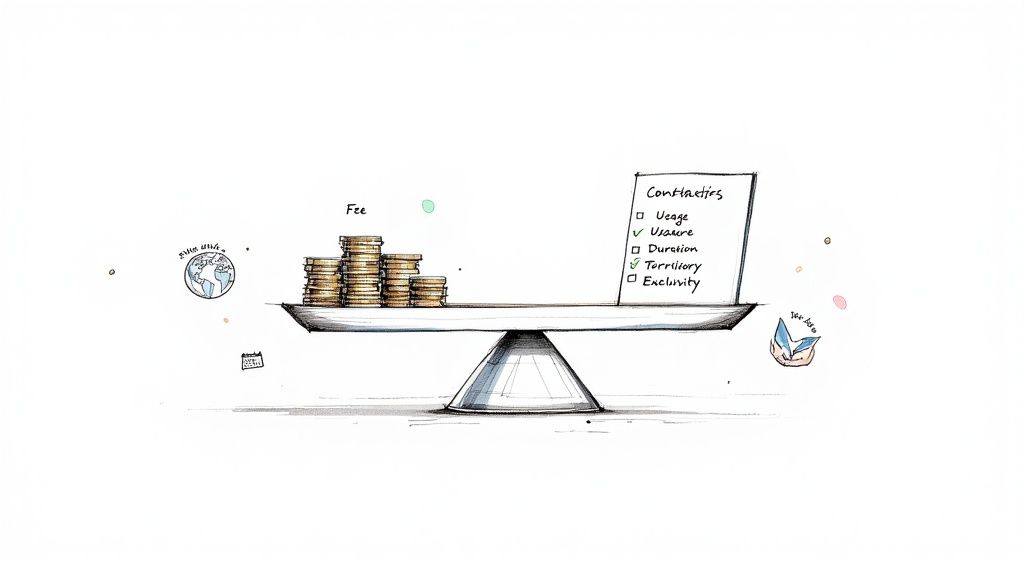
Striking this balance starts by getting familiar with the common ways these deals are priced. Each model fits a different situation, and knowing which one to use is the first real step toward a negotiation that doesn't end in headaches.
Common Pricing Models Unpacked
Let’s be clear: pricing isn't a simple, one-size-fits-all formula. The right model is all about the content itself, its intended use, and what both people are trying to achieve. Most deals fall into one of three buckets.
Flat Fee: This is as straightforward as it gets. The licensee pays one single, upfront price for the specific rights laid out in the agreement. It’s clean and predictable for everyone, making it perfect for things like royalty-free stock photos or a one-time use license for a blog post.
Royalty: With this model, the creator gets a percentage of the revenue their content helps generate. This is the standard in publishing, where an author might earn 10-15% on book sales. You also see it with merchandise, where an artist gets a cut every time a t-shirt with their design is sold.
Hybrid Model: This approach is a mix of the first two, combining a flat fee with ongoing royalties. A creator might get an upfront advance (the flat fee) plus a smaller royalty down the line. This gives the creator some cash right away while still letting them share in the content's long-term success.
Picking the right model lays the groundwork for the whole financial chat. From there, the final number is shaped by a handful of make-or-break factors that truly define the license's value.
Key Factors That Influence Price
The price tag on a license is directly tied to the permissions you’re handing over. The more rights the licensee wants, the higher the cost. Think of it like adding toppings to a pizza—every extra ingredient bumps up the final price.
Here are the main variables that move the needle on a license's value:
Exclusivity: An exclusive license means the creator can't license that same content to anyone else. Because it locks up the content, it's always the most expensive option. A non-exclusive license, which lets multiple people use it, is way more affordable.
Usage Scope: Where and how will the content be used? The rights for a global TV commercial are going to cost exponentially more than the rights for a small company’s local website.
Duration: How long is the license good for? A one-year term will be significantly cheaper than a license that grants perpetual or lifetime rights.
Territory: The geographic area where the content can be used is a huge factor. A license for use in a single country is a lot less expensive than one for worldwide distribution.
A successful negotiation isn't about one side winning. It's about clearly defining value based on these factors to arrive at a price that feels fair and beneficial for both the licensor and the licensee.
Getting a handle on these levers is your homework before you even start talking numbers. They give you a solid framework for justifying your price—or your offer.
Practical Negotiation Tips for Both Sides
Once you've got a grip on pricing models and value factors, you can walk into negotiations feeling confident. Whether you’re the creator or the buyer, the end goal is the same: secure a deal that protects your interests and gets you what you need.
For Licensors (Content Creators):
Know Your Worth: Do your research. See what similar content licenses go for in your industry. Be ready to explain what makes your content valuable—is it the high engagement it gets, your unique perspective, or its professional quality?
Start with a Term Sheet: Before you get bogged down in a full contract, outline the big stuff (scope, duration, fee) in a simple document. This makes sure you’re both on the same page from the very beginning.
Think Beyond the Fee: If a licensee's budget is tight, don't be afraid to negotiate for non-monetary value. You could ask for prominent attribution, a high-quality backlink to your site, or a glowing testimonial.
For Licensees (Content Users):
Be Specific About Your Needs: Don't pay for rights you’ll never use. Clearly define exactly how and where you plan to use the content to keep from overpaying for a license that’s way too broad for your goals.
Ask for Tiered Pricing: If it makes sense, ask for a few options. For example, get quotes for a one-year license, a three-year license, and a perpetual license. This lets you see which one offers the best long-term value.
Always Get It in Writing: A verbal agreement is just a future misunderstanding waiting to happen. Make sure every single detail you discussed is captured in a formal, signed licensing agreement. It's the only way to protect yourself later on.
Navigating the Legal Essentials of Licensing
A handshake and a promise feel good, but when it comes to your content, a solid, written agreement is your best friend. This legal document isn’t just a formality; it’s the official rulebook that prevents misunderstandings, protects both you and the person licensing your work, and turns a potential partnership into a secure business deal.
Without one, you're operating on assumptions. That's a minefield of ambiguity that almost always leads to confusion, or worse, costly disputes down the line. Think of the licensing agreement as the architectural blueprint for your partnership. It lays out every part of the deal so everyone knows their exact rights and responsibilities from day one.
A Practical Checklist for Your Agreement
Every licensing contract should be a rock-solid document that leaves zero room for interpretation. While you should always have a lawyer review the final version, understanding the core components empowers you to ask the right questions and spot potential red flags yourself.
Your agreement should act as a clear guide for everyone involved, much like the terms and conditions that govern the use of a service.
Here is a checklist of the absolute must-haves:
Precise Definition of Content: The agreement needs to state exactly what content is being licensed. Is it a single photograph? A pack of ten articles? That specific video clip from last Tuesday? Vagueness here is a recipe for disaster, as it could lead to the licensee using content you never intended to sell.
Clear Scope of Rights: This is where you detail how the content can be used. Will it be on a website, in a print magazine, or as part of a social media campaign? Get specific about the medium, because where and how it's used directly impacts its value.
Exclusivity Clause: Is this an exclusive or non-exclusive license? An exclusive license means you can't license that same content to anyone else for the duration of the term, and it should absolutely command a much higher fee.
Duration and Territory: Your agreement must state the exact start and end dates of the license. It also needs to define the geographical territories where the content can be used—for example, "North America only" versus "worldwide."
Payment Terms: Lay out the money details with no ambiguity. State the exact fee (whether it's a flat rate or a royalty percentage), the payment schedule, and how you want to be paid.
Protecting Yourself from Common Pitfalls
Even with a checklist, a couple of legal clauses are often overlooked but are absolutely critical for protecting you. These are the safety nets that can save you from a world of legal headaches.
The most critical, and often forgotten, elements in a licensing agreement are the warranties and indemnification clauses. These sections determine who is responsible if something goes wrong, such as a copyright claim from a third party.
Warranties are basically promises made by the licensor (you, the creator) confirming you are the rightful owner of the content and have the full authority to license it out.
Indemnification is a clause that protects one party from liability if the other party's actions—or content—lead to a lawsuit. For instance, if you provide a photo you didn't actually have the rights to, the indemnification clause would require you to cover the licensee's legal costs when they get sued. Learning how to legally use book cover photos is a great real-world example of where these details become incredibly important.
Ignoring these elements or using fuzzy language is how a profitable deal turns into a legal nightmare. Always verify ownership and make sure every single term is crystal clear before you sign anything.
The Future of Licensing in an AI-Driven World
Content licensing isn't some dusty, static field—it's evolving at digital speed, with new tech constantly rewriting the rules of the game. The rise of artificial intelligence, in particular, is creating both thorny challenges and incredible new opportunities for creators and businesses. This shift means we have to look ahead at where licensing is going next.
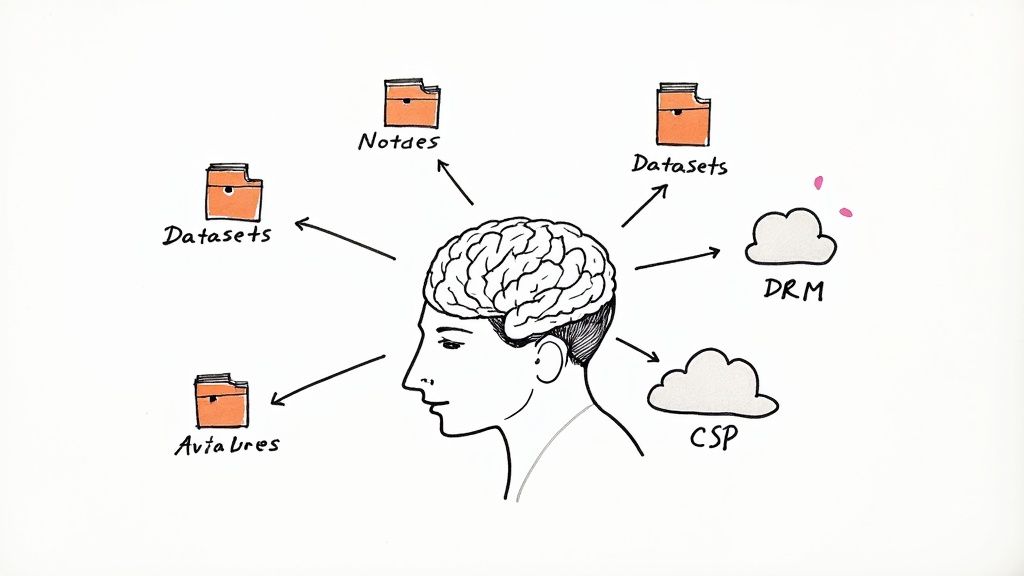
It's impossible to ignore the dual impact of AI. On one hand, generative AI tools are pushing legal frameworks to their absolute limits, raising complicated questions about copyright and originality. On the other hand, AI is carving out entirely new categories of licensable assets that never existed before.
AI and the New Licensing Frontier
Think about the massive datasets needed to train AI models. These enormous collections of images, text, and data have become incredibly valuable assets in their own right. Companies are now actively licensing these datasets to build and refine their AI systems, opening up a brand-new revenue stream for anyone holding large, well-organized libraries of information.
This creates a whole new dynamic. The value is no longer just in a single creative work but in the collective power of thousands or even millions of assets. For creators, this means that back-catalog of content you've been sitting on could suddenly have a new life as part of a training dataset for the next big AI model.
In this new era, the very definition of "content" is expanding. Licensing agreements are no longer just for photos and articles; they're for the foundational data that powers intelligent systems.
To really get a handle on what this means for the future, you have to stay informed about developments in the emerging field of AI law. This area of the law is changing fast and will directly shape how creators get paid and how AI-generated works are treated under copyright.
The Technology Powering Modern Licensing
Keeping up with these changes requires some serious tools. Modern licensing has moved way beyond tracking deals in a spreadsheet. Today, the industry relies on sophisticated technology to manage, distribute, and protect content at a massive scale.
Two key pieces of tech are leading the charge:
Digital Rights Management (DRM): This is the tech designed to control how digital content gets used. DRM systems can prevent unauthorized copying, limit viewing to a certain number of devices, and generally make sure that usage sticks to the terms of the license.
Content Services Platforms (CSPs): Think of these as the comprehensive software solutions that help organizations manage the entire content lifecycle. From storage and metadata tagging to distribution and analytics, CSPs provide the backbone needed to run a modern licensing operation efficiently.
The investment pouring into these platforms shows just how seriously businesses are taking content management. The global Content Services Platforms market was valued at USD 68.33 billion in 2024 and is projected to skyrocket to USD 302.77 billion by 2034. That signals massive enterprise spending on the tools that make all of this work. As technology redefines what content is, the tools we use to manage it are becoming more critical than ever.
Your Content Licensing Questions, Answered
Once you get the hang of the basics, the real-world questions start popping up. Let's tackle some of the most common ones that entrepreneurs run into when they start licensing content.
What Happens If Someone Steals My Licensed Content?
It's a frustrating scenario: you find out someone is using your content without permission, or a paying licensee is breaking the rules of your agreement. This is a classic case of copyright infringement.
Your first move is usually to send a formal cease and desist letter. This isn't just an angry email; it's a legal notice that clearly identifies who you are, what content is being used improperly, and demands they stop immediately. If it's a licensee, you'll want to reference the specific terms they're violating.
If they ignore you, it's time to bring in the pros. An intellectual property lawyer can help you escalate the matter and explore your next steps.
Do I Need a Lawyer for Every Licensing Deal?
Not necessarily, but it's smart to know when to call one. For a simple, non-exclusive license using a standard template you trust, you can often handle it yourself, especially if the stakes are low.
However, if you're negotiating exclusive rights, a long-term partnership, or any deal involving significant money, getting a lawyer involved is highly recommended. They're trained to spot tricky clauses and ambiguous language that could cost you a fortune down the road. Think of it as an investment in preventing future headaches.
Can I Modify Content That I License?
This is a big one, and the answer is always: it depends entirely on the license agreement. You can't just assume you have the right to make changes.
Some licenses, like Private Label Rights (PLR), are built for modification. They practically expect you to edit, rebrand, and make the content your own.
On the other hand, many standard licenses will have a strict "no modifications" or "no derivative works" clause. Always, always check the fine print before you touch a single word. Making unauthorized changes is a surefire way to land in hot water.
What Is a Content Licensing Agency?
Think of a content licensing agency as a matchmaker. They connect creators who have great content (licensors) with businesses that need it (licensees). Familiar examples include stock photo sites or music licensing platforms that artists use to get their work in front of a massive audience.
The agency handles all the heavy lifting—the marketing, the negotiations, the legal paperwork—and in return, they take a cut of the licensing fee.
For creators, it’s a gateway to a much bigger market without having to do all the sales outreach themselves. For businesses, it’s a one-stop shop to find high-quality, pre-vetted content that’s ready to use legally. It simplifies the entire process for everyone involved.