Guide
How to Create Multiple Income Streams

Building multiple income streams isn't about collecting a random assortment of side hustles. It’s a deliberate strategy that involves identifying your core skills, picking the right mix of active and passive revenue models, and then launching and scaling each new stream one by one. The real goal is to construct a resilient financial ecosystem.
Why Multiple Income Streams Aren't Just a "Nice-to-Have" Anymore
Let's be real—relying on a single paycheck feels riskier than ever. Between market swings, surprise layoffs, and the ever-climbing cost of living, the old one-job model just feels fragile. This is exactly why creating multiple income streams has gone from a trendy ambition to a core strategy for anyone seeking financial stability and a little more freedom.
The entire world of work is shifting under our feet. With the rise of the creator and gig economies, the opportunities to earn are no longer locked into a 9-to-5 box. If you have a skill, a passion, or an audience, you can build new revenue channels right from your laptop.
But this isn't just about piling up more cash. It's about building financial resilience. When one income source has a slow month, the others can pick up the slack, creating a safety net that genuinely lowers your stress levels.
The Power of a Revenue Ecosystem
The smartest entrepreneurs don't just juggle disconnected jobs. They build a "revenue ecosystem" where each income source actually supports and strengthens the others, creating a powerful compounding effect.
Think about a graphic designer whose main gig is client work (that’s their active income). They could start layering in other streams:
Digital Products: Sell pre-made design templates and icon packs on a marketplace.
Online Course: Launch a course teaching the fundamentals of brand design.
Affiliate Marketing: Recommend the design software and tools they use every single day.
Coaching: Offer one-on-one portfolio reviews for aspiring designers.
See how it all connects? The client work builds their reputation, which helps sell the course. The templates act as a low-cost entry point for new customers, who might eventually buy coaching. Each stream feeds the others, turning separate efforts into a powerful, interconnected financial engine.
The goal isn't to work more hours; it's to make your existing efforts work harder for you. By diversifying, you're not just adding income—you're building a more robust, adaptable, and antifragile career.
The Creator Economy Proves This Model Works
This isn't just theory; it's a proven model, and the creator economy is the perfect case study. The data is clear: successful creators rarely depend on a single paycheck. In fact, nearly 70% of content creators operate multiple income streams, mixing and matching strategies like brand sponsorships, subscriptions, and direct sales.
This diversified approach is incredibly effective. For creators who use them, subscription models alone generate an average income of around $94,731 annually. It just goes to show how a mixed revenue strategy has become a cornerstone of modern entrepreneurship. If you want to see how this plays out in the real world, you can explore more creator economy statistics.
Laying Your Foundation With an Income Stream Blueprint
Jumping into new ventures without a plan is a fast track to burnout. Before you can build out a full suite of income streams, you need a blueprint—a strategic framework that makes sure your efforts are focused, sustainable, and actually get you closer to your long-term goals.
This isn't about chasing every shiny new opportunity you see on social media. It's about building a solid, intentional foundation first.
The whole process starts with a practical self-audit. Forget what's trending for a moment and look inward at your unique assets. What skills have you already developed in your career or hobbies? What topics do you get genuinely excited about? And be honest: how much time and capital can you realistically invest each week? The answers are the building blocks of your entire revenue ecosystem.
This is what transforms your financial picture from one of high risk to one of resilience and freedom.
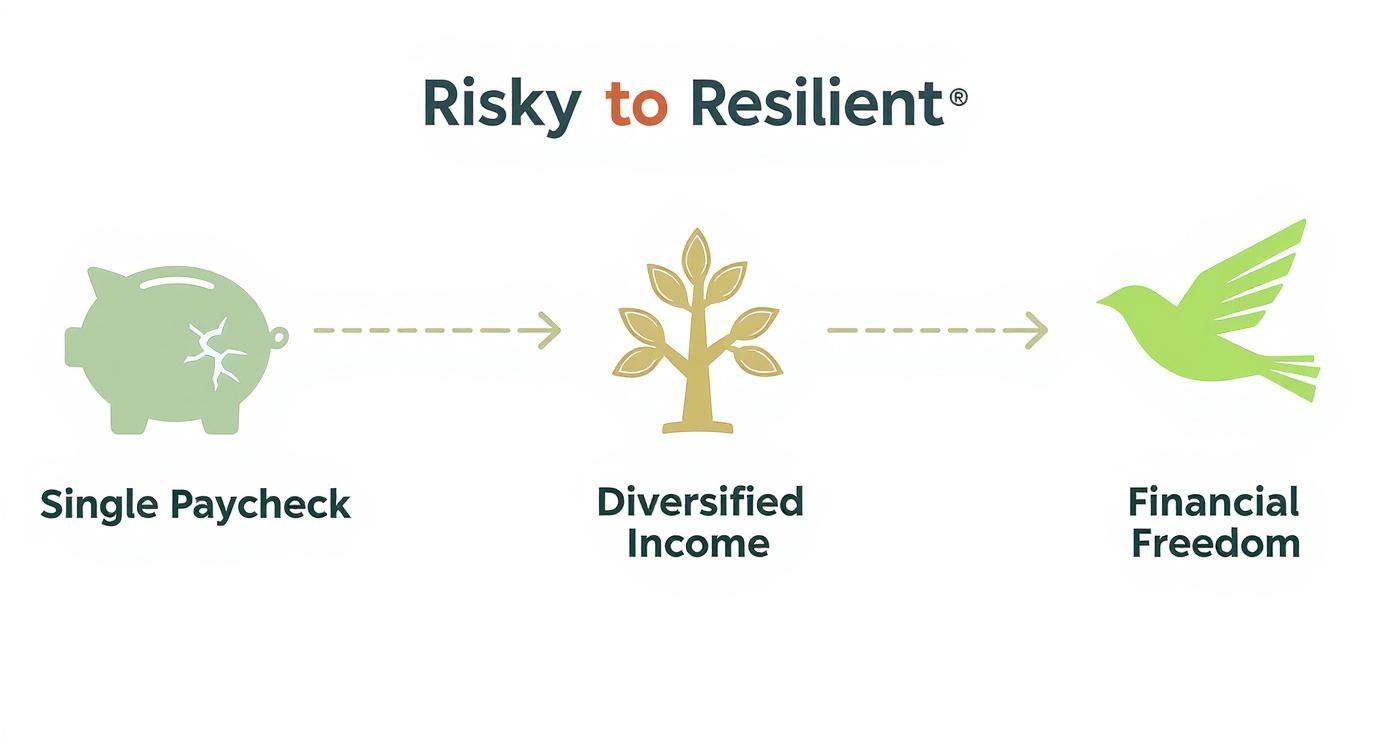
The key takeaway here isn't just about adding more money. It's about making a strategic shift away from a single point of failure to build a much more secure financial future.
Pinpoint Your Core Pillar
Every successful income portfolio I've ever seen is built around a core pillar. This is your primary area of expertise, your most engaged audience, or your most established asset. Think of it as the central theme that connects all your future income streams, making each new one easier to launch than the last.
A perfect example is a flower farmer. Her core pillar is her deep knowledge of growing specific, high-demand flowers. From that single pillar, she can branch out in multiple directions:
Active Income: Selling fresh bouquets at a local farmers' market.
Scalable Products: Selling dahlia tubers and peony roots online to a national audience.
Community/Services: Offering ticketed on-farm "u-pick" events or private workshops.
One farmer, Lynsey Taulbee of Muddy Acres Flower Farm, pulls in over $250,000 annually from less than an acre by doing exactly this. She doesn't just sell flowers; she sells products and experiences related to them, turning one core skill into multiple revenue channels.
Your core pillar is your launchpad. It provides the credibility, audience, and knowledge base you need to build complementary income streams that make sense together.
Map Your Skills to Market Needs
Once you've locked in your pillar, the next step is to brainstorm how your skills can solve specific problems for a specific audience. I call this a "skills-to-market map," and it's a simple but powerful exercise to connect what you do with what people will actually pay for.
Grab a piece of paper and create two columns. In the first column, list every skill you have, both professional and personal—from project management and graphic design to baking sourdough or organizing closets. In the second column, list the problems those skills can solve.
Example Skills-to-Market Map
My Skill Set | Problems I Can Solve |
|---|---|
Expert in Excel | Businesses struggling with messy data or inefficient tracking. |
Talented Photographer | Brands needing high-quality product photos for their websites. |
Passionate Gardener | Homeowners who want a beautiful garden but don't know where to start. |
This exercise forces you to think like an entrepreneur, translating your abilities into tangible value. It helps you see clear pathways to monetization, moving from abstract skills to concrete product or service ideas. If you're drawing a blank, exploring various extra income strategies can give you a ton of ideas to get started.
Choose a Model that Fits Your Goals
Not all income streams are created equal. Some demand your constant attention, while others can generate money while you sleep. Choosing the right model is about aligning the opportunity with your goals, available time, and desired lifestyle. There's no single "best" option—only the best option for you.
Comparing Popular Income Stream Models
Here’s a quick breakdown of some common models to help you see how they stack up in terms of effort and potential.
Income Model | Initial Time Investment | Passive Potential | Scalability | Example |
|---|---|---|---|---|
Freelancing/ Coaching | Low | Low | Low | A web designer building sites for clients. |
Digital Products | High | High | High | Selling a pre-recorded course or an ebook. |
Affiliate Marketing | Medium | High | High | A blogger earning commission on recommended products. |
Memberships | High | Medium | Medium | A creator offering exclusive content for a monthly fee. |
E-commerce | Medium | Medium | High | Selling handmade goods through an online store. |
Looking at this, you can see the clear trade-offs. A freelancer can start earning money quickly, but their income is directly tied to the hours they work. Someone creating a digital product puts in a lot of work upfront for the potential of scalable, passive revenue down the road.
By creating a blueprint that strategically mixes these different income types, you build a financial structure that is both profitable and resilient, setting the stage for true long-term success.
With a solid blueprint in your back pocket, it’s time to shift from planning to doing. The sheer number of options can feel a bit paralyzing, but remember the goal: you're not picking a perfect, forever income stream. You’re just choosing the right first step—one that aligns with your core business and builds momentum.
Think of it like planting a tree. You're selecting the first branch, and it needs to be strong enough to support itself and, eventually, help new branches grow. Let's dig into the most common and effective channels and break down what it really takes to make each one work.
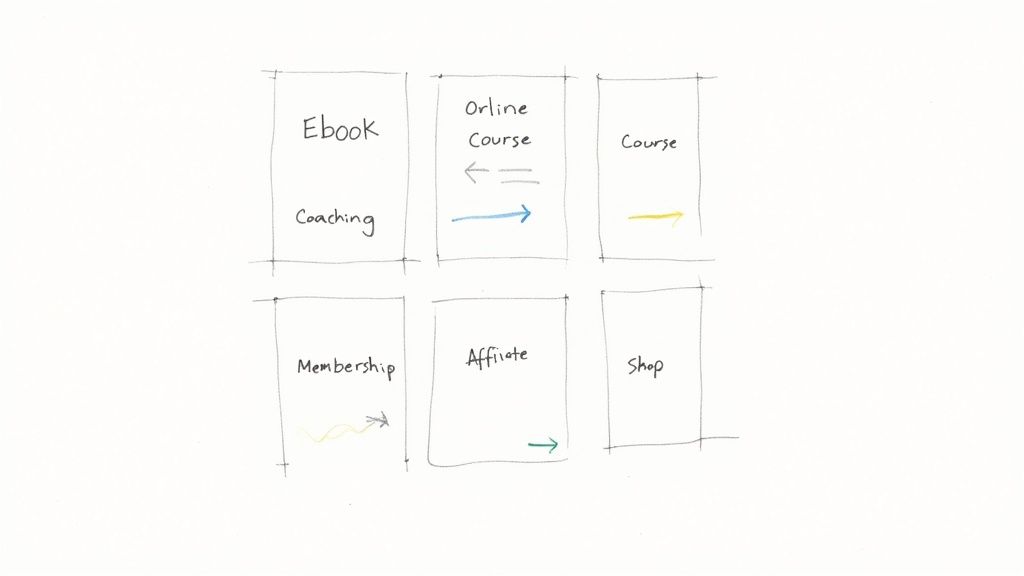
The Power of Digital Products
Digital products are incredible assets you create once and can sell over and over with minimal ongoing effort. This model is a cornerstone for creators looking to build scalable revenue because it completely decouples your time from your income.
Common examples include:
eBooks and Guides: A deep-dive into a topic you've totally mastered.
Templates and Presets: Think Notion, Canva, or Lightroom.
Toolkits and Spreadsheets: Practical resources that solve a very specific problem.
Yes, the initial time investment can be high, but the payoff is a highly scalable asset. Imagine a freelance writer creating an eBook of client proposal templates. It could keep generating sales long after the writing is done. This approach is perfect if you have deep expertise and want to package it up.
Online Courses and Coaching
If you prefer a more hands-on way to share your expertise, online courses and coaching are powerful options. These models let you monetize your skills directly by teaching others what you know.
Online courses package your knowledge into a structured learning experience, usually with video lessons and worksheets. Coaching, on the other hand, offers personalized, one-on-one guidance. A fitness expert, for instance, might sell a pre-recorded workout course as a scalable product and offer high-ticket personal coaching for clients who want that tailored support.
The real beauty of these models is the tiered structure. You can offer a low-cost course to a wide audience and premium coaching to a smaller, more dedicated group. This lets you capture different segments of your market.
While both demand significant upfront work, they establish you as an authority in your field. That authority becomes a valuable asset that makes launching future income streams much, much easier.
Memberships and Communities
The membership model is all about charging a recurring fee—monthly or annually—for access to exclusive content, a private community, or ongoing services. This is a fantastic way to generate predictable, recurring revenue, which is a total game-changer for financial planning.
A business strategist, for example, could create a membership offering a monthly masterclass, a private community for networking, and a library of downloadable resources. This provides continuous value that justifies the subscription fee. It does require consistent effort to keep members around, but it also fosters a loyal audience you can serve for years.
The key to a successful membership is a laser focus on community and transformation. People will pay for access, but they'll stay for the connections and the results they get.
Monetizing Through Affiliate Marketing
Affiliate marketing is simply earning a commission by promoting other people's or companies' products. You find a product you like, promote it, and earn a piece of the profit for each sale you generate.
This is an excellent entry point for new creators because you don't have to build your own product from scratch. A blogger who writes about sustainable living can include affiliate links to eco-friendly products they genuinely use and recommend. Every time a reader buys through their link, the blogger earns a small commission at no extra cost to the buyer. For anyone just starting out, learning https://www.entrepedia.co/blog/how-to-create-passive-income-streams this way is a great first step.
Just remember, the model’s success hinges entirely on trust. Your recommendations have to be authentic to maintain credibility with your audience.
E-commerce and Physical Products
While digital products offer incredible scalability, e-commerce lets you sell tangible goods. This could be anything from handmade crafts on Etsy to dropshipping products through a Shopify store.
This model is perfect for anyone with a knack for creating physical items or curating products for a specific niche. A talented artist could sell prints of their work online, turning their creative passion into a direct source of revenue.
The logistics of inventory, shipping, and customer service can be more complex than with digital goods, no doubt. But the satisfaction of delivering a physical product to a customer's doorstep is a unique reward that builds a really strong brand connection. And when you're exploring different revenue avenues, strategies like generating passive income with stock options also fall into the category of asset-based income, which can be just as powerful as selling products.
How to Launch and Scale Your New Income Streams
You've picked an idea. Now for the hard part: actually making it happen.
The thought of adding another thing to your already packed schedule can feel paralyzing. But launching a new income stream isn't about finding more hours in the day—it's about making smart, focused moves that build momentum without leading to burnout.
The biggest mistake I see creators make is trying to launch three or four new streams at the same time. They get a rush of excitement from all the possibilities, spread themselves way too thin, and then wonder why nothing takes off.
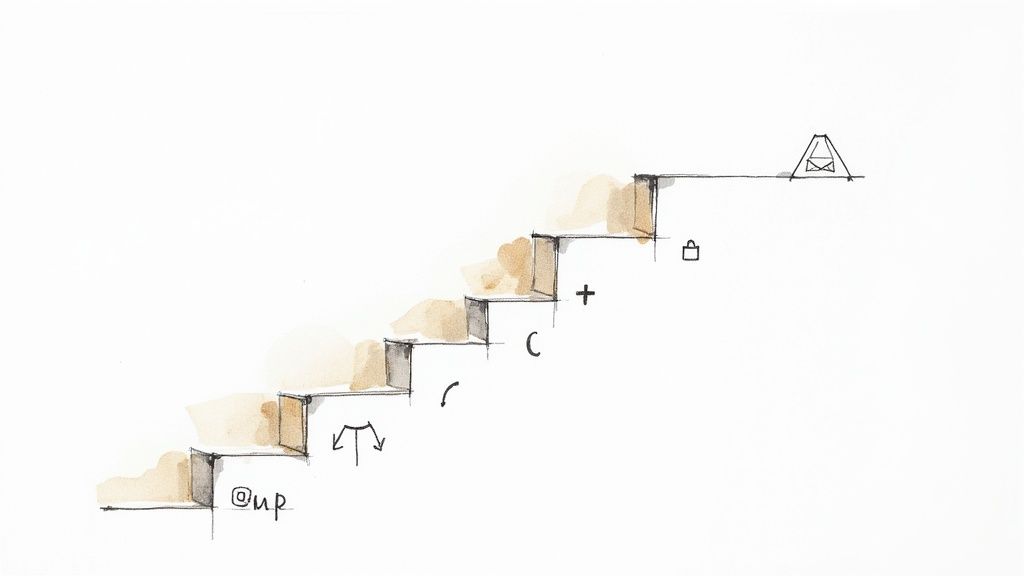
Here's the secret: focus on one new stream at a time. Get it launched, get it stable, and get it bringing in reliable revenue. Only then should you even think about adding the next one. This one-by-one approach builds a solid foundation and, just as importantly, builds your confidence.
Start With a Minimum Viable Product
Perfectionism is the enemy of progress, especially when you're launching something new. Don't spend the next six months building the "perfect" online course that no one might want. Instead, create a Minimum Viable Product (MVP).
An MVP is the simplest, leanest version of your idea that you can take to market to see if people will actually pay for it. It lets you get real feedback from paying customers fast, so you can improve your offer based on what they actually want, not what you think they want.
Here's what this looks like in the real world:
Instead of a 20-module course: Launch a paid, live 90-minute workshop.
Instead of complex software: Create a simple but powerful spreadsheet template that solves the main problem.
Instead of a full ebook: Sell the first two chapters as a low-cost guide to check for interest.
This strategy dramatically lowers your upfront risk and time commitment. You learn faster, adapt quicker, and avoid burning months on an idea that doesn't have legs. Once your MVP is making money, you can confidently invest more into building out the full-scale version.
Your goal with an MVP isn’t to launch a cheap or unfinished product. It’s to laser-focus on the core value you’re offering and deliver it effectively to see if it resonates with real people.
Master Your Time With Blocking and Batching
When you're juggling your main business and a new income stream, time management becomes your superpower. Two dead-simple techniques will make all the difference: time blocking and task batching.
Time blocking is when you schedule specific, non-negotiable blocks of time in your calendar for your new project. Instead of a vague "I'll work on my side hustle this weekend," you block out "Saturday, 9 AM - 12 PM: Write eBook Chapter 3." This turns a fuzzy intention into a real commitment.
Task batching is all about grouping similar tasks together and knocking them out in one go. For example, don't answer emails every time a notification pops up. Instead, set aside two 30-minute blocks per day to clear your inbox. This avoids context-switching, a massive productivity killer. For a detailed guide on structuring your efforts, check out The Side Hustler's Blueprint, which is packed with systems for this.
Automate to Liberate Your Time
As your new stream grows, you'll hit a ceiling where you simply can't do everything yourself. This is where automation becomes your best friend. The idea is to build systems that run in the background, freeing you up to focus on the stuff that actually grows the business.
You don't need a complicated or pricey tech setup to get started. A few key tools can do the heavy lifting:
Email Marketing: Use a platform like ConvertKit or MailerLite to automate welcome emails, deliver your digital products, and nurture your audience without you having to write every single message.
Payment Processing: Let tools like Stripe or Gumroad handle the transactions, sales tax, and receipts. This alone can save you hours of admin headaches.
Content Delivery: If you're selling a course or membership, platforms like Podia or Teachable manage user access, host your content, and handle the recurring billing on autopilot.
By launching a lean MVP, being intentional with your schedule, and automating the repetitive stuff, you can build and scale new income streams without the chaos. It’s a systematic approach that lets you build real, sustainable momentum, one success at a time.
Managing Risks and Avoiding Common Pitfalls
Let’s be real for a minute. Building an empire of income streams is an incredible journey, but it’s not all passive income notifications and four-hour workweeks. The internet loves to show off the highlight reel, but it conveniently hides the messy reality of burnout, unexpected cash flow gaps, and ideas that just… fizzle out.
To build something that lasts, you have to be smart about the risks. This isn’t about being negative; it's about being a resilient entrepreneur who knows how to navigate the bumps in the road. By getting ahead of these challenges, you can build a financial ecosystem that doesn’t just grow—it endures.
Beware of Shiny Object Syndrome
The single biggest threat to your progress is something every creator faces: Shiny Object Syndrome. It’s that constant temptation to jump from one exciting new idea to the next without ever giving any of them the focus needed to actually make money.
One week you’re all-in on an eBook. The next, you’re convinced a new TikTok affiliate strategy is the secret. Before you know it, you're diving into dropshipping. This scattered approach is a surefire recipe for exhaustion, leaving you with a portfolio of half-finished projects that generate zero revenue.
The trick is to commit. Pick one new stream, see it all the way through to profitability, and only then start thinking about adding another.
True momentum comes from focus, not frantic activity. Pick a path, walk it until you reach your destination, and only then look at a new map.
Protect Yourself Legally and Financially
The second you start earning income outside a traditional job, you’re running a business. You absolutely have to treat it that way. One of the most common—and dangerous—mistakes is mixing your personal and business finances.
To save yourself from a world of future headaches, create a clean separation from day one:
Open a separate business bank account. All business income goes in, and all business expenses come out. This simple step makes bookkeeping and tax season infinitely less painful.
Consider an LLC. A Limited Liability Company (LLC) can shield your personal assets (like your house and car) if your business ever runs into legal trouble.
Track everything. Use simple accounting software or even just a dedicated spreadsheet to keep meticulous records of your income and expenses for each individual stream.
These steps aren’t the glamorous part of entrepreneurship, but they are non-negotiable for building a professional and sustainable operation.
Manage Inconsistent Cash Flow
Most new income streams don’t come with a steady, predictable paycheck, especially at the start. You might have a massive launch month followed by a much quieter period. This kind of volatility can be incredibly stressful if you’re not ready for it.
The explosion of side hustles has made this a familiar challenge for millions. In the U.S. alone, over 36% of adults have a side hustle, but the income is often unpredictable. The global side hustle economy was valued at a staggering $556.7 billion and is projected to keep climbing, which shows just how many people are navigating this new financial reality. You can dig deeper into these trends with these detailed side hustle statistics.
A practical way to handle this is to create a "business buffer" fund. Your goal should be to set aside 3-6 months of business operating expenses in that separate business account. This fund is your safety net. It allows you to cover costs during the slow months without panicking or raiding your personal savings, giving you the breathing room to make smart decisions instead of desperate ones.
Answering Your Top Questions
Stepping into the world of multiple income streams always brings up a few practical questions. It's totally normal. Getting clear answers is often the one thing standing between feeling stuck and actually moving forward.
Let's clear up some of the most common questions we hear from creators and entrepreneurs so you can start building your revenue ecosystem with confidence.
How Many Income Streams Should I Have?
There's no magic number here, but a great target for most people is three to five diversified streams. The real goal is quality over quantity. Five shaky, low-effort income sources will burn you out faster than two or three stable, well-managed ones.
The smartest way to do this is sequentially. Start with your main income source, get it solid, then add one new stream. Pour your energy into making it profitable. Only when that stream is running smoothly should you even think about adding another.
Think of it like building an ecosystem where each part supports the others, not just collecting a random bunch of jobs. This is how you create multiple income streams without losing your mind.
The goal isn't just to add more; it's to add strategically. Each new stream should either support your existing ones or require a different type of effort, creating a balanced and resilient financial structure.
Can I Start With No Money?
Absolutely. This is probably the biggest myth that holds people back. The truth is, some of the most profitable income streams are service-based, meaning they rely on your skills and time—not a pile of cash.
You can get started right away with things like:
Freelance Services: Offer up skills you already have, whether that’s writing, graphic design, managing social media, or being a virtual assistant.
Affiliate Marketing: Talk about products you already use and love on your blog or social media. You earn a commission without ever touching the product yourself.
Simple Digital Products: Use free tools like Canva or Google Sheets to create valuable templates, checklists, or planners that solve a specific problem.
The strategy is simple: start with a low-cost, high-skill option. Once that starts bringing in money, you can reinvest a little bit into more ambitious projects, like launching an online course or an e-commerce store.
What Is the Difference Between Active and Passive Income?
Getting this distinction is fundamental to building a smart income portfolio. Active income is money you earn from your direct, ongoing effort. It’s your salary from a 9-to-5 or the fees you charge for freelance work. If you stop working, the money stops coming in. Simple as that.
Passive income is different. It requires a lot of work upfront, but then it continues to generate revenue with minimal ongoing effort. Think of creating an online course once and selling it for years, writing an ebook, or investing in dividend stocks.
Now, "set it and forget it" income is mostly a myth. Most passive streams need some maintenance, but they don't demand your constant, hour-by-hour attention like a job does. A truly healthy financial plan almost always includes a smart mix of both.