Guide
What Is Content Marketing Strategy and How Do You Build One

So, what exactly is a content marketing strategy? Think of it as your business’s blueprint for using valuable content to attract, engage, and ultimately win over your ideal audience. It’s the documented plan that makes sure every blog post, video, or social media update has a clear purpose, tying all your efforts back to real business goals.
From Random Acts of Content to a Growth Engine
Let's be honest. A lot of businesses are doing content marketing, but very few have a genuine content marketing strategy. That single difference is what separates making noise from building a predictable, revenue-generating machine for your brand.
Imagine you're trying to build an engine. Just buying parts at random—a piston one day, a spark plug the next—is "doing" content. You might publish a blog post this week and a random graphic next week, hoping it all magically comes together to move your business forward. A strategy, on the other hand, is the architectural blueprint. It ensures every single piece is designed to work in perfect harmony with the others.
A documented strategy gives you that essential framework, answering a few critical questions:
Who are you creating this for? (Your target audience)
Why are you creating it in the first place? (Your business goals)
What kind of content will you make? (Your content pillars and formats)
Where will you share it? (Your distribution channels)
How will you know if it's working? (Your key performance indicators)
The Difference Between Activity and Strategy
Without this blueprint, you're just throwing tactics at the wall. You might get a lucky traffic spike here and there, but your growth will feel random and unpredictable. A strategy transforms hopeful spending into a systematic approach that builds momentum over time. Understanding this is key to unlocking the true power of content marketing for B2B.
To see how this plays out in the real world, let's look at a quick comparison.
Content Marketing vs Content Marketing Strategy
Aspect | Ad-Hoc Content Marketing | Strategic Content Marketing |
|---|---|---|
Focus | Creating content when inspiration strikes. | Creating content with a specific purpose. |
Goals | Vague, like "get more traffic" or "increase engagement." | Clear, measurable goals (e.g., "generate 50 leads per month"). |
Audience | A general idea of who the customer is. | Deeply understood audience personas with defined pain points. |
Process | Reactive and inconsistent publishing schedule. | Proactive, planned content calendar tied to campaigns. |
Measurement | Relies on vanity metrics (likes, shares). | Tracks KPIs that impact revenue (leads, conversions, ROI). |
Outcome | Unpredictable results and wasted effort. | Consistent, compound growth and a clear return on investment. |
The table makes it clear: one path leads to burnout, the other to building a real business asset.
This strategic approach is no longer optional. The global content marketing industry is projected to hit a staggering $107 billion by 2026, a massive jump showing just how critical it's become. It’s why 82% of businesses already use content marketing—they know it builds lasting customer relationships in a way old-school advertising just can't. You can dig into more of these trends and discover why a documented plan is so crucial.
A content strategy isn't about creating more content; it's about creating the right content, for the right people, at the right time, with a clear and measurable objective.
At the end of the day, a content marketing strategy is simply the deliberate plan that turns your scattered content activities into a unified engine that drives sustainable audience growth and real business success.
The 7 Pillars of a Winning Content Strategy
A powerful content engine isn’t built on random acts of creation—it's built on a solid foundation. If you want to build a machine that brings in leads and customers consistently, you need to understand its core components. These seven pillars are the essential framework for any content strategy that actually works, turning abstract ideas into concrete, actionable steps.
Think of these pillars as the blueprint that guides your audience from stranger to loyal fan. This visual map shows how it all works together.
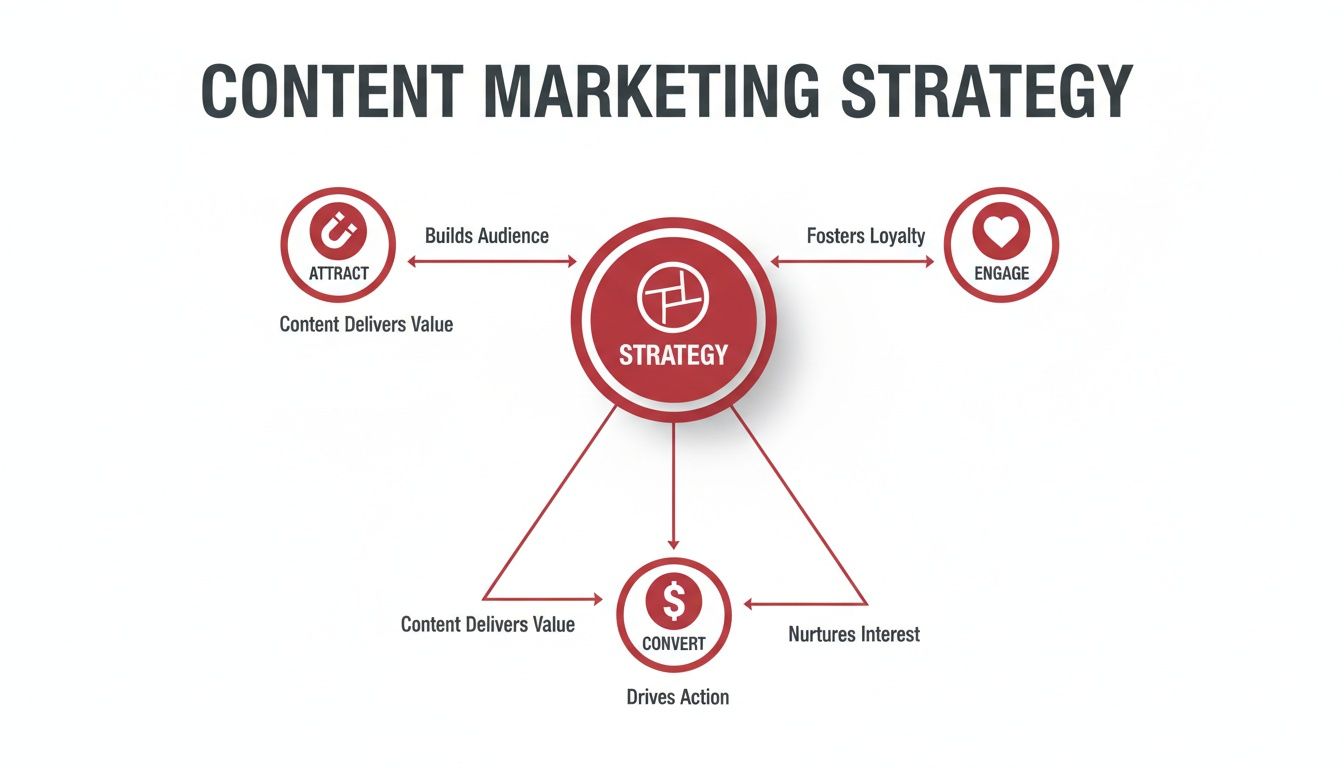
As you can see, a real strategy is a journey. Let's break down the seven pillars that make this journey happen.
1. Define Your Audience Personas
Before you write a single word, you have to know exactly who you're talking to. This is non-negotiable. Creating detailed audience personas—basically, semi-fictional profiles of your ideal customer—is step one.
Don't just stop at basic demographics like age and location. Dig deeper. What are their biggest professional headaches? What are their career goals? Where do they hang out online to find information? When you truly understand what keeps them up at night, you can create content that feels like the perfect answer, building instant trust.
2. Set SMART Business Goals
Your content needs a job to do, and that job must connect directly to your business goals. Vague targets like "get more traffic" are completely useless. Instead, use the SMART framework to set goals that are clear and motivating.
Specific (What, exactly, are you trying to achieve?)
Measurable (How will you know if you've succeeded?)
Achievable (Is this realistic with the team and budget you have?)
Relevant (Does this actually help your bigger business objectives?)
Time-bound (What's the deadline?)
A real SMART goal sounds like this: "Increase organic blog traffic by 20% in the next quarter by publishing four SEO-optimized articles targeting specific long-tail keywords." Now your team has a clear finish line to run toward.
3. Build Content Pillars and Topic Clusters
To really own a topic and dominate search rankings, you have to think bigger than just one-off keywords. A content pillar is a massive, comprehensive piece of content on a broad subject that matters to your audience. From that main pillar, you create smaller, related articles—a topic cluster—that all link back to it.
This structure tells search engines that you're an authority on the subject. For example, a pillar page on "Digital Nomad Productivity" could be surrounded by cluster posts like "Best Time-Tracking Apps for Freelancers" and "How to Set Up an Ergonomic Home Office." For entrepreneurs who want to fast-track this, you can find a ton of helpful resources on https://www.entrepedia.co/plr-digital-products/content-pillar-creation-checklist to build that authority much faster.
This organized approach isn't just great for SEO. It also creates a logical, binge-worthy experience for your visitors, keeping them on your site as they explore related topics.
4. Select the Right Formats and Channels
Your audience doesn't live in just one place online, so your content shouldn't either. Your persona research should tell you where they hang out and what kind of content they prefer. Are they scrolling TikTok for quick video tips, listening to deep-dive podcasts on their commute, or reading detailed blog posts?
Focus your energy where your audience already is. A B2B software company might kill it with LinkedIn articles and technical webinars, while a fashion brand will probably find its home on Instagram Reels and Pinterest.
5. Design a Repeatable Creation Workflow
Consistency is the engine of content marketing, and a documented workflow is the fuel that keeps it running. Map out every single step of your production process—from brainstorming ideas and keyword research all the way to writing, editing, design, and final approval.
Assign clear roles to everyone on the team and use a project management tool to keep it all organized. A solid system eliminates bottlenecks, maintains quality, and makes it possible to scale up your content creation without everything falling apart.
6. Create a Robust Distribution and Promotion Plan
Here's a hard truth: creating great content is only half the battle. If nobody sees it, it might as well not exist. Your strategy absolutely must include a plan for getting it in front of people. Hitting "publish" and hoping for the best is not a plan.
Detail how you'll push content across your owned channels (your email list, social profiles), earned channels (PR, guest posts), and paid channels (social ads, influencer marketing). A core part of any winning strategy is creating content so good that other people want to share it, which is the secret to learning how to get backlinks for SEO and building real authority.
7. Establish Your Measurement and KPIs
Finally, a strategy without measurement is just a guess. You need to define your Key Performance Indicators (KPIs) to track what’s working and what’s a waste of time. These KPIs should tie directly back to your SMART goals.
If your goal is brand awareness, you'll track metrics like organic traffic, social media reach, and keyword rankings. If it's lead generation, you'll be watching email sign-ups and content downloads. Looking at this data regularly is what allows you to double down on the wins and cut the losses before they drain your budget.
Your Step-By-Step Content Strategy Framework
Moving from theory to actually getting things done is where most entrepreneurs get stuck. A brilliant content marketing strategy isn't just a list of good ideas; it’s a repeatable process. This framework breaks the whole journey down into four clear, actionable phases, turning your big goals into a plan you can actually follow.
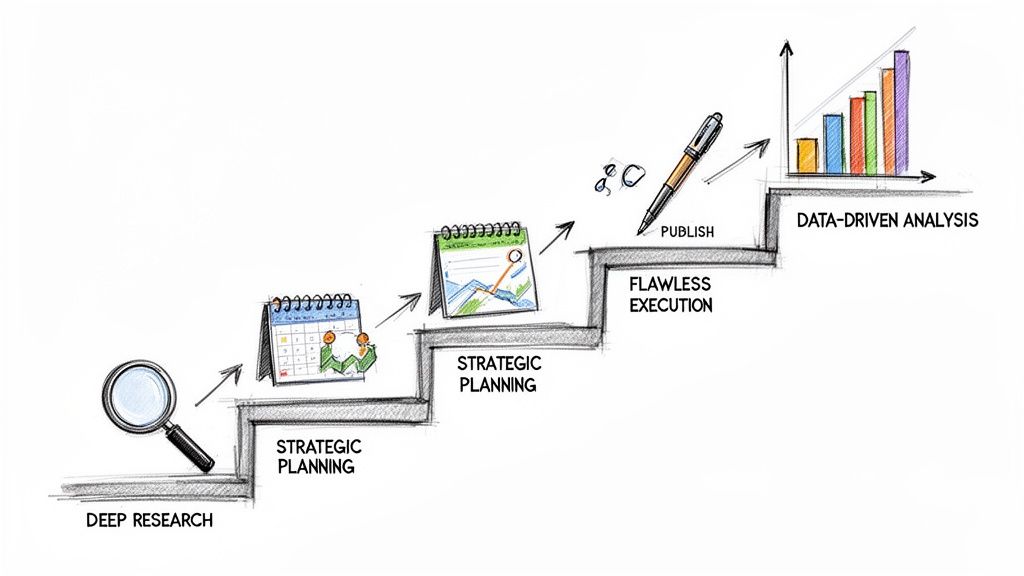
Think of this as your assembly line for producing high-impact content. Each phase builds on the last, creating a system designed for steady results, not just a few lucky wins.
Phase 1: Deep Research
Every single successful content strategy is built on a rock-solid foundation of understanding. Before you write a single word, you have to become an expert on your audience and the competitive landscape. This first phase is all about gathering intelligence so your decisions are driven by data, not just gut feelings.
Your focus here is on three things:
Audience Interviews: Go way beyond basic personas. Actually talk to your real customers and prospects. Ask them about their biggest frustrations, what content they already love, and what they’re searching for. This firsthand insight is pure gold.
Competitor Analysis: Pinpoint your top 3-5 competitors and take their content apart. What topics are they owning? Which formats get them the most engagement? More importantly, where are the gaps you can fill?
Keyword & Topic Discovery: Use SEO tools to find out what your audience is actively typing into Google. Look for the questions they’re asking, the problems they need to solve, and the opportunities you have to create content that meets them right where they are.
By the end of this phase, you should have a crystal-clear picture of who you're creating for and what they desperately need to know.
Phase 2: Strategic Planning
Okay, with your research done, it's time to draw up the blueprint. This is where you connect your audience's needs directly to your business goals, mapping out a clear path from A to B. If you skip this planning stage, your execution will feel chaotic and you’ll waste a lot of time and money.
This is why having a documented strategy is so important. While only about 37-47% of marketers have a formal plan, the ones who do report far greater success. The best content today is conversational and story-driven—a mix of videos, social media, and real testimonials that absolutely requires a solid plan to pull off. While most businesses use blogs (76%) and social media (56%), the real winners are those who are also increasing their budgets, showing a clear link between strategic investment and results. You can find more on the latest content marketing statistics and trends to see what’s working now.
Here’s what to do in this phase:
Map Your Content Pillars: Based on your research, define 3-5 broad topic areas you want to be known for. These pillars become the bedrock of your content calendar and help you build authority in your niche.
Create a Functional Content Calendar: This is your command center. Plan out your content for at least the next month (a full quarter is even better), including topics, formats, who’s creating it, and when it goes live. A clear calendar stops the last-minute scramble.
Allocate Your Resources: Get real about your budget and your team's bandwidth. Decide how much time and money you can commit to creation, promotion, and any tools you might need. A defined budget keeps you on track and makes your efforts sustainable.
Phase 3: Flawless Execution
This is where the rubber meets the road. With a solid plan in your hands, your team can finally focus on what they do best: creating and promoting exceptional content. The goal here isn't just to hit "publish," but to produce assets that are genuinely valuable and optimized to be found.
Your execution workflow should be a well-oiled machine:
Craft SEO-Optimized Content: Every single piece of content, from a blog post to a video script, should be created with search engines in mind. This means using your target keywords naturally, writing meta descriptions that make people want to click, and structuring your content so it’s easy to read.
Launch Promotion Campaigns: Publishing is just the start. For every piece of content you create, have a mini-launch plan ready to go. This should include sharing it with your email list, posting it across all your relevant social channels, and maybe even reaching out to others who might be interested in sharing it.
Phase 4: Data-Driven Analysis
Finally, no content strategy is complete without a feedback loop. The analysis phase is where you measure your performance against the goals you set back in Phase 2. This is where you learn from the data and tweak your approach for continuous improvement, turning a static plan into a living, breathing strategy.
You should be regularly reviewing the key performance indicators (KPIs) that are tied to your goals. Are you trying to boost traffic, get more leads, or drive sales? Track the metrics that actually matter and don't get sidetracked by vanity numbers. Use this data to double down on what’s working and cut what isn’t. This cycle of research, planning, execution, and analysis is the engine that drives sustainable growth.
To help you get started faster, you can also use our detailed content marketing strategy template to organize all your efforts in one place.
Content Strategy Action Plan Template
To help you put all of this into practice, here's a simple table you can copy and fill out. It covers the core components we’ve discussed and will give you a solid starting point for your own documented strategy.
Component | Your Goal/Definition | Key Action Items | How Entrepedia Helps |
|---|---|---|---|
Audience Persona | Define your ideal customer: their pains, goals, and where they hang out online. | - Conduct 3-5 customer interviews. | Use our Persona Worksheets to guide your research and build a detailed profile of your ideal customer. |
Business Goals | What business objective will this content support? (e.g., Lead Gen, Brand Awareness) | - Define 1-2 primary KPIs. | Our Goal-Setting Guides help you connect content efforts to measurable business outcomes like revenue and growth. |
Content Pillars | What are the 3-5 core topics you want to own in your niche? | - Brainstorm topics from audience research. | Access our PLR Ebooks in key niches to instantly establish authority on your core pillar topics. |
Channels | Where will you publish and distribute your content? (e.g., Blog, YouTube, LinkedIn) | - Choose 1-2 primary channels to start. | Get Social Media Templates and Promotional Checklists to ensure your content gets seen on the right platforms. |
Measurement (KPIs) | How will you track success? (e.g., Organic Traffic, Leads, Conversion Rate) | - Set up Google Analytics goals. | Our KPI Tracking Dashboards make it easy to monitor performance and see what's driving results. |
This template is designed to be a living document. Revisit it quarterly to make sure your strategy stays aligned with your business goals and your audience’s needs.
Real-World Examples of Great Content Strategies
Theory is great, but seeing a winning content strategy in action is where the lessons really sink in. To make these ideas less abstract, let’s pull back the curtain on the playbooks of three very different businesses. We won't just look at what they create; we'll break down why their approach is so effective, tying each example back to the core pillars of a solid strategy.
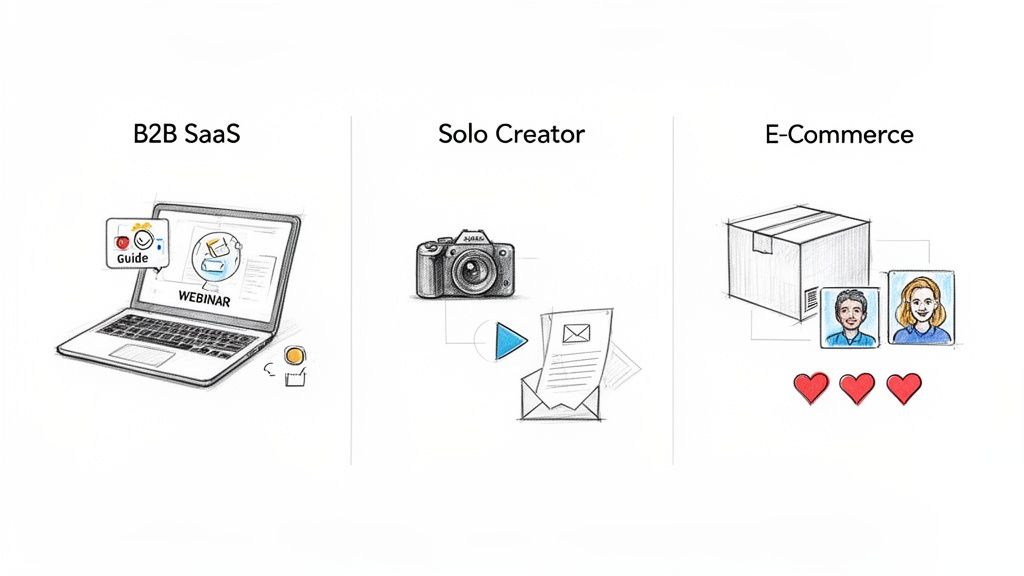
Each of these brands figured out who their audience was and then built an engine to serve them relentlessly. Let's dive in.
The B2B SaaS Authority Playbook
Take a B2B software giant like HubSpot. Their entire marketing model is built on becoming the ultimate educational resource for anyone in marketing and sales. They don't just sell software; they teach their audience how to win at their jobs.
Their strategy is a masterclass in using content pillars to build authority. They create massive, in-depth guides and free certification courses on topics their audience—marketing managers and small business owners—is desperate to master, like SEO, email marketing, and social media.
This single approach nails several key goals at once:
Dominates Search: Their pillar content ranks for thousands of high-intent keywords, driving a continuous, massive flow of organic traffic.
Generates Qualified Leads: To get their best content (like ebooks and webinars), you hand over your email, turning anonymous visitors into warm leads.
Builds Unshakeable Trust: By consistently delivering immense value for free, they become the go-to source. When a need for software arises, they're the obvious choice.
This strategy works because it prioritizes educating the audience over direct selling. It’s a long game that builds a powerful moat of authority, making it incredibly difficult for competitors to challenge them on Google.
The Solo Creator Community Engine
Now, let's pivot to a solo creator who built a thriving business, like Ali Abdaal. He started out making YouTube videos packed with practical advice on productivity and studying. His whole strategy was built around two core channels where he could deliver huge value directly to his audience.
His main channel, YouTube, acts as the top of his funnel. He creates highly practical, well-researched tutorials that answer the exact questions his audience is searching for. This content is engineered for discovery and for building a loyal subscriber base.
From there, he uses a high-value weekly email newsletter as the next step in the journey. This is where he deepens the relationship, shares more personal insights, and eventually promotes his paid courses. By focusing his efforts, he created a powerful, self-sustaining ecosystem that turns casual viewers into dedicated customers.
The E-commerce Brand Storytelling Machine
Finally, let’s look at an e-commerce brand like Glossier. They completely redefined beauty marketing by shifting the spotlight from polished models to authentic, real-world users. Their strategy is all about community and user-generated content (UGC).
Glossier’s content doesn't feel like an ad. Instead, they use their social media channels, especially Instagram, to show real customers using their products in everyday life. They actively encourage their community to share photos and stories, effectively turning their customer base into a massive, authentic marketing team.
This approach is so powerful because it builds social proof and makes the brand feel relatable. When a potential buyer sees someone who looks just like them loving a product, it feels far more trustworthy than a perfectly staged ad. They mastered the art of making their customers the heroes of the story, creating a fiercely loyal community that drives both engagement and sales.
Common Mistakes That Can Derail Your Strategy
Even the most brilliant ideas can get wrecked by a few common, avoidable mistakes. A great content marketing strategy isn't just about what you do—it's also about what you don't do. Steering clear of these frequent blunders will protect your investment of time, energy, and budget.
Many businesses fall into the "more is better" trap. They start churning out endless blog posts and social media updates, hoping that sheer volume will magically lead to success. This approach almost always leads to burnout and a flood of mediocre content that fails to capture anyone's attention.
The fix? Shift your focus from quantity to quality. Instead of cranking out five average articles, pour that same effort into one exceptional, in-depth pillar post. A single, high-impact piece that you promote relentlessly will deliver far better results than a dozen forgotten ones.
Creating in a Vacuum and Forgetting to Promote
Another critical error is hitting "publish" and thinking your job is done. You can create the most valuable content in the world, but if no one ever sees it, it delivers zero value to your business. Forgetting that distribution is at least half the battle is a surefire way to waste all your hard work.
To fix this, bake promotion directly into your workflow. For every hour you spend creating content, plan to spend at least that much time getting it in front of people. This means sharing it with your email list, posting it across your social channels, and reaching out to relevant communities or influencers who might find it useful.
This quality-over-quantity mindset is becoming the new standard. Agencies have seen a 62% surge in demand for content services as 83% of businesses now favor publishing higher-quality content less often. For entrepreneurs, using ready-made assets like PLR can speed this up, freeing you to focus on strategic promotion instead of costly creation from scratch. Discover more about these content marketing stats.
Overlooking SEO and Lacking a Clear CTA
Ignoring the fundamentals of Search Engine Optimization (SEO) is like building a beautiful store with no roads leading to it. You might have amazing products (your content), but your ideal customers will never find you. Every piece you create should be built with search intent in mind, targeting keywords your audience is actively looking for.
Finally, a surprisingly common mistake is creating content that doesn't ask the reader to do anything. Without a clear Call-to-Action (CTA), you leave potential leads and customers hanging, wondering what to do next. Every article, video, or post should guide them toward a specific, logical next step.
Your content's job isn't just to inform; it's to guide. Tell your audience exactly what to do next, whether it's downloading a guide, subscribing to your newsletter, or booking a consultation.
By avoiding these common errors—prioritizing quality, planning for distribution, integrating SEO, and including a clear CTA—you transform your content from a hopeful expense into a predictable and powerful growth engine for your brand.
How to Measure the Success of Your Content Strategy
Creating content without a measurement plan is like driving in the dark with no headlights. You might be moving, but you have no idea if you're actually getting closer to your destination. A truly successful content marketing strategy is data-driven, which is just a fancy way of saying you can prove its value and make smarter decisions.
This means you have to look past the "vanity metrics" like social media likes. Sure, they feel good, but they don’t tell you if your content is actually helping the business grow. The real game-changer is focusing on Key Performance Indicators (KPIs) that are tied directly to your core business goals.
Matching KPIs to Your Business Goals
The right KPIs depend entirely on what you're trying to achieve with your content in the first place. Think of them as the scoreboard for your efforts. When you group your metrics by your main objectives, you get a crystal-clear picture of what’s working and what’s not.
Let's break it down by focusing on four primary business goals:
Brand Awareness: The goal here is simple: get your brand in front of more of the right people. You're building recognition and planting your flag. The metrics to watch are organic traffic, keyword rankings, and social media reach.
Lead Generation: This is all about turning anonymous visitors into potential customers. You're capturing their contact info so you can start building a relationship. Track KPIs like new email subscribers, gated content downloads, and form submission rates.
Sales and Revenue: Ultimately, your content needs to help drive sales. This is where you connect your marketing efforts directly to the bottom line. Measure things like conversion rates from your blog posts, content-attributed sales, and the overall customer acquisition cost.
Audience Engagement: This shows you how much your audience actually values what you're creating. High engagement is a sign that you’re building a loyal community, not just a list of followers. Look at metrics like time on page, bounce rate, and comments or shares per post.
Using Analytics to Prove Your ROI
Tools like Google Analytics are your best friend here. They let you track almost every KPI that matters, from where your traffic is coming from to which specific articles are driving the most conversions. Setting up custom goals in your analytics platform is absolutely essential for demonstrating a clear return on investment (ROI).
A strategy without measurement is just a guess. By tracking the right KPIs, you transform your content from an expense into a predictable, revenue-generating asset that you can confidently invest in.
This data gives you the power to double down on what works and stop wasting time and money on what doesn't. It allows you to have data-backed conversations with partners or stakeholders and prove the tangible value your content delivers.
For those looking to go deeper, our guide on Content Marketing Analytics and ROI provides frameworks and tools to help you master this crucial step. By analyzing your performance, you can continuously refine your approach, ensuring your content strategy not only works but gets better over time.
Your Content Strategy Questions, Answered
Even with the best plan in hand, a few questions always seem to surface. It's completely normal. Let's tackle some of the most common ones I hear so you can move forward with total confidence.
How Long Until I See Results?
This is always the first question, and I'll give you the straight answer: it takes time. Think of content marketing like planting a tree, not flipping a switch. You're building a genuine asset—an audience that knows, likes, and trusts you—and that relationship doesn't just appear overnight.
As a general rule, you can start to see meaningful traction, like a steady flow of organic traffic and consistent leads, within 6 to 12 months of sticking to your plan. You'll likely see smaller wins sooner, like a jump in social media engagement or a trickle of new email sign-ups, but the real, compounding growth comes with patience and persistence.
Can I Do This on a Small Budget?
Absolutely. A tight budget doesn't kill your content strategy; it just makes you more creative and focused. Instead of trying to be everywhere at once, you have to be smarter about where you put your energy and resources.
Here’s how to make a big impact with a small budget:
Go deep, not wide: Pick one channel and own it. Master your blog and SEO before you even think about launching a YouTube channel, a TikTok account, and a podcast simultaneously.
Repurpose relentlessly: Squeeze every drop of value out of your work. One solid blog post can be sliced and diced into a dozen social media updates, a simple infographic, an email newsletter, and even a short video script.
Lean into what you know: Your expertise is your most valuable, and cheapest, asset. Starting with high-quality articles that share what you know is the most cost-effective way to build authority.
What Is the Most Important Part of the Strategy?
If I had to boil it all down to one non-negotiable element, it would be this: deeply, truly understanding your audience. Every other decision you make—the topics you cover, the formats you use, the channels you post on—flows directly from knowing who your customer is, what keeps them up at night, and what they actually need from you.
Without a crystal-clear picture of your audience, even the most beautifully produced content will fall on deaf ears. It’s the foundation. Get this right, and everything else falls into place.
How Often Should I Update My Strategy?
Your content strategy should be a living, breathing document—not something you write once, print out, and stick in a drawer. The market shifts, your customers' needs change, and new platforms pop up. You need to adapt.
Plan on doing a full, top-to-bottom review and refresh of your strategy at least once per year.
But don't wait a full year to make adjustments. You should be checking in on your performance data and making smaller, smarter pivots on a quarterly or even monthly basis. This lets you double down on what’s working and cut what’s not, keeping your efforts sharp and your results on track.