Guide
How to Create a Customer Journey Map

To create an effective customer journey map, you need to visualize every single interaction a person has with your brand—from the moment they first hear about you to when they become a loyal advocate. This isn't just an exercise in flowcharting; it's about defining your goals, understanding your customers through personas, and mapping out every stage and touchpoint.
The result is a powerful strategic tool that shines a light on hidden pain points and uncovers massive opportunities for growth.
Why a Customer Journey Map Is Your Most Valuable Asset
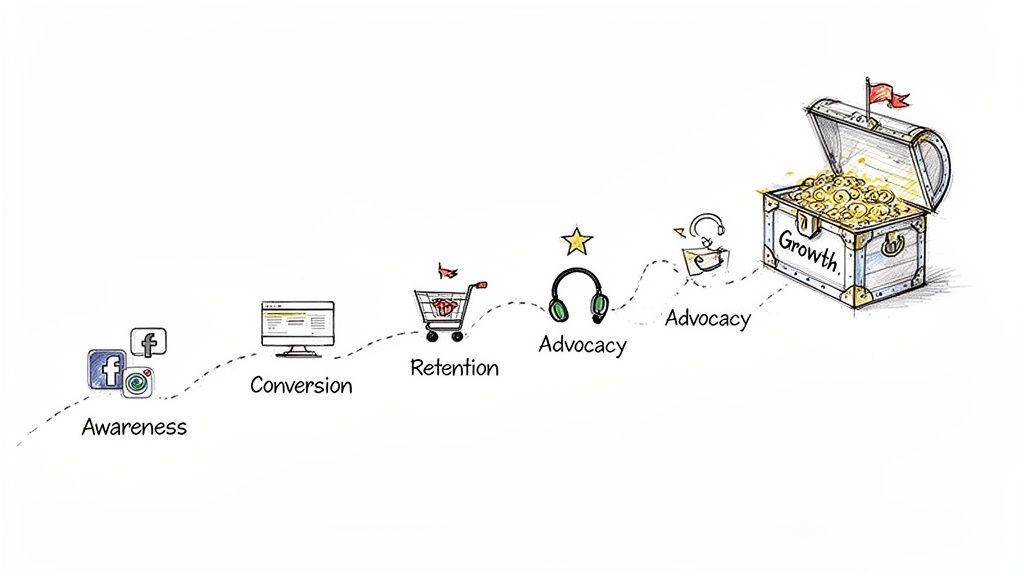
Let's be honest—the thought of creating another marketing document can feel like a chore. But a customer journey map is different. It's not just a diagram; it's a strategic guide that reveals exactly where your business is winning and where you might be losing people.
This process forces you to walk in your customer’s shoes. It gives you an empathetic, outside-in perspective that is so often missing from internal strategy meetings. You move beyond abstract theory and dive into the practical, day-to-day reality of your customers' experiences. By building one, you transform raw data and scattered feedback into a visual story.
Before we dive into the "how," let's quickly review the key pieces you'll be putting together. This table breaks down the core components of a customer journey map, explaining what each one is and why it's so important for your business.
Core Components of a Customer Journey Map
Component | What It Is | Why It Matters for Your Business |
|---|---|---|
Customer Persona | A semi-fictional character representing your ideal customer. | Ensures you're mapping the journey for a real type of person, not a generic audience. |
Stages | The major phases a customer goes through (e.g., Awareness, Conversion). | Provides a high-level structure to organize the entire experience. |
Touchpoints | Specific interactions within each stage (e.g., reads a blog, talks to sales). | Helps you pinpoint exact moments of success or failure. |
Actions & Thoughts | What the customer is doing and thinking at each touchpoint. | Reveals the "why" behind their behavior and decisions. |
Emotions | The feelings a customer experiences (e.g., frustrated, delighted, confused). | Uncovers the emotional highs and lows that drive loyalty or churn. |
Pain Points | Moments of friction, frustration, or confusion. | Highlights the most urgent problems you need to solve. |
Opportunities | Ideas for improvement and innovation based on pain points. | Turns insights into an actionable plan for growth. |
Think of these components as the building blocks of your map. As you work through the steps in this guide, you’ll see how each piece connects to create a complete picture of your customer's experience.
Shifting Focus From Sales to Experience
The biggest benefit of journey mapping is the mental shift it forces. Instead of just focusing on closing a deal, you start to see the entire relationship. This broader view is critical because customers no longer separate products from the experience of buying and using them.
In fact, studies show that up to 80% of customers now consider their experience with a company to be just as important as its products or services.
A journey map helps you:
Pinpoint Friction: Identify exactly where customers get frustrated, confused, or drop off.
Discover Opportunities: Uncover moments where a small tweak could create a huge positive impact.
Align Your Team: Give your marketing, sales, and support teams a single, shared vision of the customer experience.
A customer journey map without emotion is just a flowchart. Its real power comes from capturing the human element—the thoughts, feelings, and frustrations—at each step of the process. This is what turns a simple diagram into a powerful tool for genuine business improvement.
A Practical Blueprint for Growth
Ultimately, learning how to create a customer journey map gives you a clear path to sustainable growth. You’ll be equipped to make smarter decisions, from optimizing your marketing funnels to refining product features. Think of it as a blueprint that highlights the weak spots in your foundation and shows you precisely where to invest your resources for the best return.
Before you even think about sketching out a single touchpoint, you need to lay a solid foundation. An effective customer journey map isn't just a pretty diagram; it’s a strategic tool built on two things: clear goals for the map itself and realistic, well-researched customer personas.
Skipping this prep work is like starting a road trip without a destination. You’ll just end up burning gas and going nowhere.
Define Your Map's Core Objective
First things first: why are you even making this map? Generic goals like "improve the customer experience" are nice, but they're too vague to be useful. You need to tie your map's purpose to a specific, measurable business outcome.
This focus will guide every decision you make, ensuring your final map is a tool for action, not just a flowchart to hang on the wall.
Here are a few examples of concrete, actionable goals I've seen work well:
Reduce cart abandonment by 15% in the next quarter by finding the friction points in our checkout flow.
Boost free trial to paid conversion by 10% by figuring out where new users get stuck during onboarding.
Improve our Net Promoter Score (NPS) for support tickets by mapping the post-purchase experience to find common frustrations.
Shorten the B2B sales cycle by pinpointing where leads stall out in the consideration stage.
When you set a specific goal like this, it forces you to analyze the journey through a very particular lens, which makes your insights far more powerful.
Crafting Personas That Feel Real
Once you know why you're building the map, you need to define who is taking this journey. This is where customer personas come in. A persona is basically a character sketch of your ideal customer, built from real data and research.
The point isn't to create a dry list of demographics. It's to build a profile of a person with real motivations, frustrations, and goals. This empathy is what makes a journey map truly click.
To build a persona that feels like a real person, you need to blend different kinds of data. For instance, a course creator might find that up to 80% of customers now see the experience as being just as important as the product itself. The journey from a seeing a social media story to buying a course can have anywhere from 20 to 500 touchpoints, which shows just how deep you need to go.
Gathering the Right Information
To breathe life into your personas, you have to get insights straight from the source—your customers. This means doing a bit of detective work using a mix of methods.
Quantitative Data: This is the "what." Dive into your analytics to spot patterns. Look at things like website traffic, conversion rates on key pages, and user engagement metrics. It gives you the hard numbers.
Qualitative Data: This is the "why." This is where you uncover the human story behind the numbers. You need to talk to people. Conduct interviews, send out targeted surveys, and sift through support tickets and online reviews.
For the qualitative stuff, a structured approach is key. A well-designed interview plan helps you ask the right questions to get beyond surface-level answers. If you're not sure where to start, this guide on creating a customer research interview protocol can help you structure those conversations.
Putting it all together, a persona for a freelance graphic designer might look something like this:
Demographics: "Alex, 28, lives in a mid-sized city, works from a home office."
Goals: "Wants to land larger, more consistent client projects to create a stable income."
Frustrations: "Struggles with admin tasks and finding a reliable project management tool that isn't bloated."
Motivations: "Driven by creative freedom and building a strong professional portfolio."
With a clear goal in mind and a realistic persona like Alex to focus on, you're ready to start mapping the actual journey. You now have the context to look at every stage from a truly customer-centric perspective.
Mapping The Journey Stage By Stage
Alright, you've got your goal and your persona. Now for the fun part: bringing the map to life. This is where we move from abstract ideas to a concrete picture of the customer experience by plotting out every single interaction someone has with your brand.
While a customer’s path is rarely a straight line these days, thinking about it in distinct stages gives us a solid framework. It helps organize the chaos and ensures we don't miss anything critical.
The Five Core Stages of The Customer Journey
Think of these as the major chapters in your customer's story. Each one serves a different purpose and brings out unique thoughts, feelings, and actions from the customer's point of view.
Awareness: This is that "aha!" moment. A potential customer realizes they have a problem and stumbles upon your brand as a possible solution. They're not buying yet; they're just starting to look around.
Consideration: Now, they're in research mode. They're actively comparing your products to your competitors, digging into reviews, and trying to figure out what’s the best fit for them.
Decision: The choice is about to be made. They’ve narrowed down the options and are looking for that final nudge—that last piece of info or reassurance—to click "buy."
Retention: The journey doesn’t stop at the sale. This stage is all about their experience using your product. The goal is to make sure they get real value, turning them into a repeat customer.
Advocacy: This is the ultimate win. A satisfied customer evolves into a loyal fan who not only keeps buying but actively tells their friends about you.
Knowing these stages is the first step. The real magic happens when you start identifying the specific touchpoints within each one.
Identifying Every Single Touchpoint
A touchpoint is any time a customer interacts with your business. It could be seeing one of your ads, getting a shipping confirmation, or even just hearing about you from a friend. Brainstorming these is absolutely essential if you want a map that reflects reality.
To really get a grip on this, you have to appreciate the full customer experience journey and see how every little interaction builds on the last. The sheer number of these interactions can be mind-boggling.
Take an entrepreneur using Entrepedia's PLR content to launch a new digital product. Today's consumers engage with over 130 mobile touchpoints daily. That’s not just a statistic; it’s a reality check. Your map needs to account for how your audience finds your lead magnet, scrolls through your social proof, and finally decides to buy your course. And with up to 67% of customers using multiple channels for a single transaction, you have to connect the dots between website visits, email opens, and social media DMs.
This is why starting with a clear persona and goals is so important, as this flow chart illustrates.
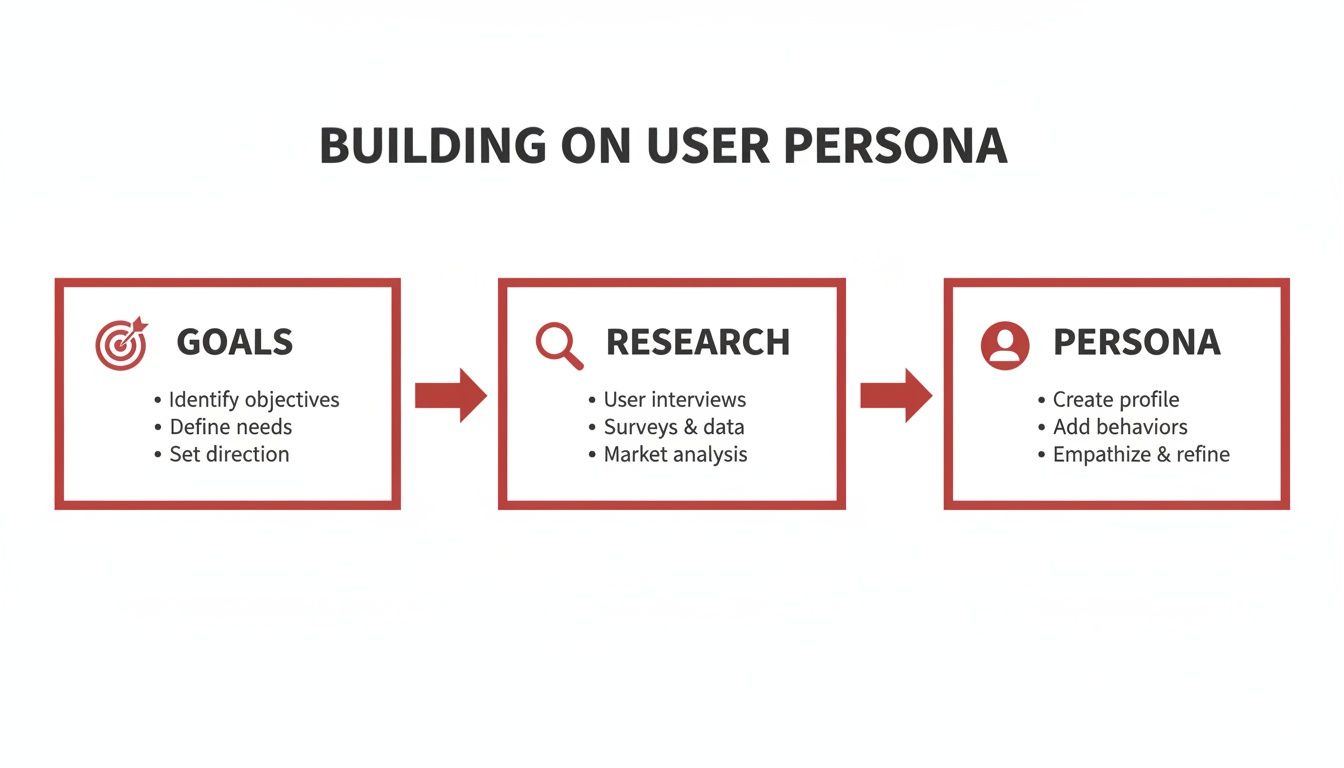
A great map is always built on a solid foundation of research—knowing who your customer is and what you're trying to achieve.
Real-World Examples of Touchpoints
Let's make this tangible. Imagine our persona, "Alex the Freelancer," needs a better project management tool. Here’s what their touchpoints might look like.
Awareness Touchpoints:
Sees a targeted ad for your tool on LinkedIn.
Reads your blog post, "5 Ways Freelancers Can Streamline Client Work."
Hears your tool mentioned on a design podcast.
Consideration Touchpoints:
Visits your website's features page.
Compares your pricing plans with two other competitors.
Downloads a free "Client Proposal Template" from your site.
Reads customer reviews on a third-party site like G2 or Capterra.
Decision Touchpoints:
Signs up for a 14-day free trial.
Watches a video tutorial on setting up their first project.
Asks a chatbot a specific question about integrations.
Receives a follow-up email with a limited-time discount.
A common mistake is only mapping the touchpoints you control, like your website. A truly effective map also includes indirect touchpoints—review sites, social media mentions, and word-of-mouth—which often carry the most weight in a customer's decision.
To give you a better idea of how varied touchpoints can be, here’s a quick breakdown for a typical online business.
Touchpoint Examples Across Customer Journey Stages
Journey Stage | Online Touchpoints | Offline/Personal Touchpoints |
|---|---|---|
Awareness | Social media ads, blog posts, podcast sponsorships, search engine results | Word-of-mouth referral, seeing a product at a trade show |
Consideration | Product comparison pages, customer reviews, case studies, free downloadable guides | Speaking with a sales representative, product demo |
Decision | Free trial sign-up, checkout page, promotional emails, live chat support | In-store purchase, phone call to confirm details |
Retention | Onboarding emails, customer support tickets, satisfaction surveys, loyalty program | Thank-you card in package, follow-up call from account manager |
Advocacy | Referral program invitations, requests for reviews, social media shout-outs | Sharing their positive experience with friends or colleagues |
This table just scratches the surface, but it shows how different interactions fit into each stage of the journey.
The goal is to be exhaustive. Get your team in a room (virtual or physical) and brainstorm every possible interaction. Don't filter anything yet—just get it all out on sticky notes or a whiteboard. For a head start, check out our guide on the 21 customer touchpoints that build successful digital businesses. Once you have a massive list, you can start organizing them under the right journey stages. This becomes the skeleton of your customer journey map.
Adding Emotion to Uncover Pain Points and Opportunities
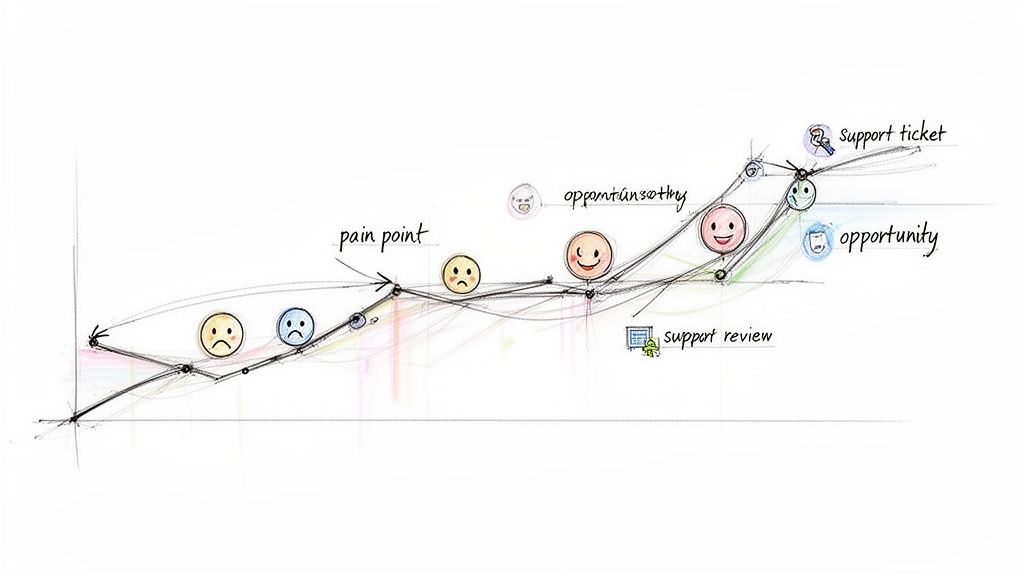
So far, you’ve built the skeleton of your map—the stages and touchpoints. That structure is essential, but let’s be honest: a journey map without emotion is just a flowchart. Its real power comes alive when you start capturing the human element: your customer's thoughts, feelings, and frustrations at each step.
This is the part where you graduate from a simple process diagram to a strategic tool that can genuinely improve your business. It's how you uncover the why behind customer actions, revealing those critical moments that either forge loyalty or send people running straight to a competitor.
Digging for Emotional Data
To understand how your customers feel, you need to put on your detective hat. These emotional insights rarely show up in a neat report; you have to actively hunt for them in the places where customers are being brutally honest.
Think about the goldmine of information you might already have sitting around. Support tickets are a fantastic place to start. Look for recurring themes—are customers constantly getting tripped up on your pricing page? Are they frustrated by a specific feature during onboarding?
Next, comb through online reviews, social media comments, and community forums. Pay close attention to the specific language people use. Words like "confusing," "disappointed," or "finally!" are direct windows into their emotional state at a particular touchpoint.
A single, heartfelt review that says, "I was so relieved when I found this feature," tells you more about a 'moment of truth' than a dozen generic five-star ratings. These are the moments you need to pinpoint.
You can also be more direct by using targeted surveys. Ditch the broad satisfaction questions and ask pointed ones like, "What was the most frustrating part of our checkout process?" or "At what point did you feel most confident about your purchase?"
Identifying Moments of Truth
As you gather this qualitative data, patterns will start to emerge. You’ll notice that certain interactions are disproportionately important. These are your moments of truth—the make-or-break points that have the biggest impact on a customer's perception of your brand.
A moment of truth could be:
A Positive Peak: The seamless onboarding experience that makes a new user feel brilliant and empowered.
A Negative Valley: The confusing error message on a form that makes them feel stupid and ready to quit.
A Moment of Indifference: The generic, uninspired thank-you email that does absolutely nothing to build a connection after a purchase.
The goal here is to identify these highs and lows for each stage of the journey. For instance, a customer might feel hopeful during the Awareness stage, but their emotion could nosedive to frustration during Consideration if they can't find clear answers on your website.
Visualizing the Emotional Journey
Once you’ve identified these feelings, it's time to add them to your map. This is often done with a simple line graph that tracks the customer's emotional state over time. The line moves up for positive feelings like excitement and confidence, and it dips down for negative ones like confusion and frustration.
This visual representation is incredibly powerful. It allows anyone on your team, from the CEO to a junior developer, to see at a glance exactly where the customer experience is breaking down. That sharp dip in the graph during the Decision stage becomes an undeniable signal that something needs to be fixed.
Pivoting from Pain Points to Opportunities
Here’s where the magic really happens. Every single pain point you identify is a hidden opportunity. This is the final, crucial part of the process: turning problems into actionable solutions.
For every negative emotion or frustration you’ve plotted, gather your team and ask a simple question: "How can we fix this?" Frame each pain point not as a failure, but as a chance to innovate and improve.
Here's how that pivot works in practice:
Pain Point: "Customers are anxious because they don't get a shipping confirmation for 24 hours."
Opportunity: "Implement an instant order confirmation email and a follow-up SMS when the item ships."
Pain Point: "Users feel overwhelmed by all the features in our free trial."
Opportunity: "Create a guided, step-by-step onboarding tour that highlights just three key features to get them started."
By systematically turning each emotional valley into a concrete action item, your customer journey map becomes a strategic road map for improvement. It’s no longer just a document that describes the customer's experience; it’s a living blueprint for making that experience better.
Bringing Your Map to Life and Putting It into Action
You've done the heavy lifting—the research is complete, and you've mapped out your customer's emotional rollercoaster. Now it's time to bring everything together into a visual customer journey map. This is the moment where all those scattered data points and interview notes become a clear, compelling story that your entire organization can actually understand and use.
Don't get too hung up on the format. The most important thing is clarity and accessibility. For a startup, a physical whiteboard plastered with sticky notes is a fantastic, hands-on way to brainstorm and build your first map. If you're in a larger organization, you might prefer dedicated software like Miro or Lucidchart to create a more polished document that’s easy to share.
From Document to Action Plan
Let’s be honest: a beautifully designed map that just sits in a folder is completely useless. The real magic happens when you use it to drive meaningful change in your business. This is about moving from a pretty picture to a practical activation plan.
Start by getting key stakeholders in a room—think marketing, sales, product, and customer support. Walk them through the entire journey, calling out the specific emotional peaks and valleys you discovered. This single act of creating a shared understanding is the first step toward breaking down departmental silos and getting everyone to think about the customer first.
The most powerful maps act as a connective tissue for siloed departments, proving their ROI by tying specific improvements directly to analytics. It’s about creating a single source of truth for the customer experience.
Assigning Ownership and Driving Change
Once your team is on the same page, you have to assign ownership for each pain point you've identified. It’s a simple rule: an issue without an owner will never get fixed. This step transforms vague problems into concrete tasks with clear accountability.
I recommend creating a simple action register. It doesn't need to be complicated. Just list:
The Pain Point: A quick description of the issue (e.g., "Users are confused by the pricing page").
The Proposed Solution: The opportunity you found (e.g., "Simplify pricing tiers and add an FAQ section").
The Owner: The person or team responsible for the fix (e.g., "Product Marketing Team").
A Deadline: A realistic timeline for getting it done.
This approach keeps your insights from fading away after the big presentation. It creates a system for continuous improvement, turning your map into a living document that guides day-to-day work. To build a robust process around this, you'll need a solid way to gather ongoing feedback. Our guide on setting up a customer feedback collection system gives you a structured framework for just that.
Integrating Insights Across the Business
True success comes when the journey map’s insights are woven into the fabric of your operations. A common mistake is focusing on fixing isolated touchpoints, which can lead to a 15-20% lower satisfaction rate because it ignores the customer's overall experience. For instance, Gartner research shows that 61% of B2B buyers now prefer a rep-free digital buying process. That kind of insight can completely reshape your sales and marketing strategy.
Your map should directly inform:
Marketing: When you understand the questions customers have at each stage, you can create much more relevant content, from top-of-funnel blog posts to perfectly timed case studies.
Sales: Your sales team can use the map to anticipate objections and tailor their conversations to address the specific frustrations a persona is feeling.
Product Development: The pain points you uncover are a goldmine for your product roadmap, clearly highlighting the features and improvements that will have the biggest impact on user happiness.
By treating your customer journey map as an active, strategic tool, you ensure it delivers lasting value. For more inspiration on how to turn insights into action, check out these actionable customer journey mapping examples. They offer a fantastic look at how different companies have made their maps come to life.
Common Questions About Customer Journey Mapping
Even with a clear roadmap, jumping into journey mapping for the first time can leave you with a few nagging questions. That's completely normal. You want to make sure you're getting the practical details right.
Let's clear up some of the most common questions we hear. Think of this as a quick FAQ to give you that last bit of confidence before you dive in.
What Is the Difference Between a Customer Journey Map and a User Flow?
It's easy to mix these two up, but they play very different roles.
A user flow is tactical and narrow. It’s a technical diagram showing the literal clicks and steps someone takes to do one specific thing on your site or in your app. Think of the exact sequence for a checkout process or signing up for a trial.
A customer journey map, however, is strategic and looks at the big picture. It visualizes the entire relationship a person has with your brand, often stretching across different channels and a long period of time.
A user flow is about the how—how someone completes a task. A customer journey map is about the why and how they feel—why they are on this journey and what emotions they experience along the way.
The journey map digs into the customer's feelings, motivations, and frustrations, which a user flow almost never does. This is what makes it such a powerful tool for understanding the real customer experience.
How Often Should I Update My Customer Journey Map?
Your map should be a living document, not a "set it and forget it" file that collects digital dust. The customer experience is always changing, so your map needs to keep up.
A good rule of thumb is to formally review and update your map at least once or twice a year.
But you should also pull it out anytime a major business change happens. This could be things like:
Launching a new product or service: This creates a brand new journey that needs to be understood and mapped.
A major website redesign: This will completely change key touchpoints and interactions.
Shifting customer behavior: If your analytics are showing new patterns, it's time to find out why and update the map.
New customer feedback: A sudden wave of similar complaints or praise is a clear signal that the experience has changed.
The goal is to make sure your map always reflects what your customers are actually experiencing now, not what they were doing a year ago.
Do I Need Expensive Software to Create a Customer Journey Map?
Absolutely not. Especially not when you're just getting started.
While there are specialized platforms out there for managing super complex maps in large companies, you can create an incredibly effective map using simple tools you already have. The value of your map comes from your research and insights, not the fancy software you use.
Plenty of great journey maps start on a physical whiteboard with a pack of sticky notes. It’s a fantastic way to get a team brainstorming together.
Other great starting points include:
Spreadsheets: Tools like Google Sheets or Excel are perfect for organizing stages, touchpoints, and emotions in a simple grid.
Presentation Software: You can use slide tools to create clean, shareable visuals of the journey.
Simple Design Tools: Free or low-cost platforms like Canva have templates that can get you started in minutes.
Start simple and focus on the quality of your data. You can always move to a more specialized tool later on if you feel the need.
Can a Solopreneur Benefit from Journey Mapping?
Yes, and it’s a huge benefit. In fact, for solopreneurs and small teams, journey mapping is arguably even more critical.
When you're running everything yourself, you have limited time, money, and energy. You can't afford to waste a single bit of it on things that don't actually matter to your customers.
A customer journey map is a powerful focusing tool. It shows you the exact moments that make or break the customer experience, letting you aim your marketing and support efforts where they’ll have the biggest impact. It helps you stay relentlessly focused on your customer, which is a massive competitive advantage against bigger, slower companies.
By understanding your customer's path, you can make smarter, more strategic decisions that lead directly to growth.