Guide
Unlocking Profit with Master Resale Rights

Think of Master Resale Rights (MRR) as getting the keys to the entire business, not just the product. It gives you the power to sell a digital product to your customers, but here's the kicker: you can also sell them the right to sell it, too.
This single clause creates a powerful ripple effect. Your customers don't just become users; they can become distributors themselves, opening up entirely new streams of income and audiences.
What Are Master Resale Rights and How Do They Work?
Let's break it down with a simple analogy. Imagine you buy an amazing digital guide on how to start a podcast.
With basic resale rights, you could sell that guide to people who want to learn podcasting. Simple enough.
But with master resale rights, you can sell the guide and you can sell other entrepreneurs the permission to sell that very same guide. You’re not just selling a product; you’re selling a ready-made business opportunity.
That’s the core of MRR. The original creator packages their e-book, course, or software with a specific license that spells out the rules. When you buy it, you're not just getting a file; you're getting a specific set of permissions.
The Two Streams of Income
The real beauty of the MRR model is that it opens up two completely different ways to make money from a single product. This is why so many entrepreneurs love it—it’s a shortcut to building a product catalog without creating everything from scratch.
Direct-to-Consumer Sales: This is the most obvious path. You sell the product directly to someone who just wants to use it. Think of a small business owner buying your podcasting guide to finally launch their show. They use the information but can't sell the guide themselves.
Selling the Resale Rights: This is where the magic happens. You sell the same product to another entrepreneur who sees its value. They get to use it, but more importantly, they get the license to sell it to their audience. They're buying an asset for their own business.
This second stream is what makes MRR so scalable. Suddenly, your customer base isn't just end-users. It includes other marketers and creators who want a proven product to add to their own stores.
An MRR product is basically a "business-in-a-box." You’re not just offering a tool or some information; you're handing someone a complete asset they can use to generate revenue. That makes it an incredibly powerful and valuable offer.
Visualizing the MRR Chain
The best way to picture this is as a distribution chain where you become a critical link. The original creator kicks things off, and you get to decide where the chain goes next.
Creator: Builds the product and drafts the MRR license.
You (The MRR Holder): You buy the product and the rights from the creator.
Your Customer (New Reseller): They purchase the product and the resale rights from you.
Their Customer (End User or another Reseller): And so the chain continues.
Except for the final person who just uses the product, everyone in the chain has the chance to profit from selling both the product and its rights. This model helps a product reach new markets incredibly fast, since every new reseller brings their own unique audience. It's a system built on a network effect, letting you drive sales far beyond what you could ever achieve alone.
Decoding The Language of Digital Licensing
When you get into the world of digital products, you have to understand the rules of the game. You're not just buying a file when you acquire a product to sell; you're buying a license that spells out exactly what you can and can't do with it. These licenses—Resale Rights (RR), Master Resale Rights (MRR), and Private Label Rights (PLR)—create a clear hierarchy of permissions and power.
Let's use a simple analogy. Think of it like real estate. Basic Resale Rights are like renting an apartment. You can live in it (sell the product), but you can't sublet it or knock down a wall. Master Resale Rights are like owning a condo; you can live in it and you can rent it out to tenants (sell the rights to others), but you still can't gut the kitchen. And finally, Private Label Rights are like owning the whole building and the land it sits on. You can live there, rent it out, and completely remodel it from the studs up.
Basic Resale Rights: The Starting Point
The simplest and most common license is Basic Resale Rights (RR). This license gives you permission to sell a digital product directly to an end-user, and that's it.
Once your customer buys it, the chain stops with them. They can use the e-book, watch the course, or work with the templates, but they have zero permission to turn around and sell it to anyone else. You keep 100% of the profit from your sales, but you can't pass on any selling rights.
This is the ground floor of digital product licensing—a straightforward way to add an offer to your store without any extra layers of complexity.
Master Resale Rights: The Power to Empower
As we've touched on, Master Resale Rights (MRR) are a major step up. This license hands you two key abilities. First, just like with basic RR, you can sell the product directly to your customers. Second, and this is the important part, you can also sell the product along with the resale rights to other entrepreneurs.
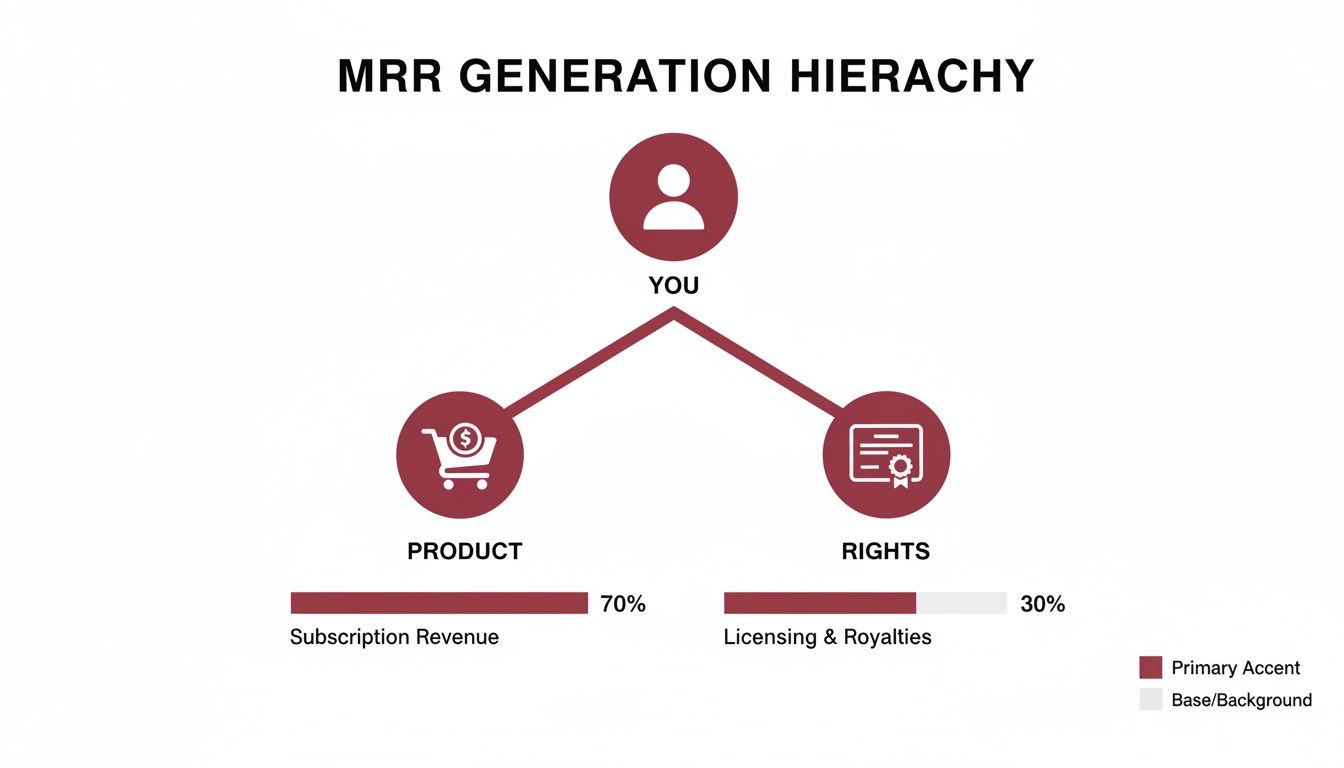
This means your customer gets the product and the permission to sell it to their own audience. Depending on the specific license, they might get basic RR or even the master resale rights themselves, allowing the chain to continue. The one thing you almost always cannot do is alter the product. The content, branding, and name have to stay exactly as they were when you got them.
Private Label Rights: The Ultimate Creative Control
Sitting at the top of the licensing pyramid is Private Label Rights (PLR). PLR is what gives you the most freedom. It's the only license that typically allows you to edit, rebrand, and even claim authorship of the content.
With PLR, you have the green light to:
Change the title to perfectly match your brand's voice.
Rewrite entire sections to inject your own expertise and stories.
Slap your name and logo on it as the creator.
Bundle it with other products to create completely new, high-value offers.
Essentially, PLR lets you treat the original content as a foundation—a high-quality template you can transform into a truly unique asset for your business. For a deeper look at how this works, our guide on what is content licensing breaks it all down.
The core difference really comes down to modification and attribution. With MRR, you're a distributor of someone else's finished product. With PLR, you become the creator of a new, customized one.
To make these distinctions crystal clear, let's put these three powerful licensing models side-by-side.
License Comparison: MRR vs. PLR vs. Basic Resale Rights
Here’s a simple breakdown to help you see exactly what each license allows you to do. Think of this as your cheat sheet for understanding the permissions you're getting.
Feature | Basic Resale Rights (RR) | Master Resale Rights (MRR) | Private Label Rights (PLR) |
|---|---|---|---|
Sell Product to End-Users | Yes | Yes | Yes |
Pass Resale Rights to Customers | No | Yes | Often, depends on license |
Edit or Modify Content | No | No | Yes |
Claim Authorship | No | No | Yes |
Rebrand with Your Logo | No | No | Yes |
Best For | Quickly adding a single product to your store. | Building a "business-in-a-box" offering. | Creating unique, branded content. |
As you can see, the right license depends entirely on your business goals. Whether you want to make a quick sale, empower other sellers, or create a signature product, understanding these differences is the first step to building a profitable digital product business.
How to Find And Vet Profitable MRR Products
Jumping into master resale rights is exciting, but your success really boils down to one critical skill: picking the right products. Not all MRR opportunities are created equal. A great product can become a cornerstone of your business, while a bad one is just digital clutter that costs you time and money.
Think of yourself as a curator for your audience. Your job is to sift through all the noise and find digital assets that are genuinely valuable, high-quality, and—most importantly—in demand. This vetting process protects your investment and, even more crucial, your reputation with your customers.
Where to Find Reputable MRR Products
Your search should start in established marketplaces and with well-known creators who have a track record of producing quality work. Steer clear of anonymous sellers or outdated forums, as these are often hotspots for low-quality or even pirated content.
Here are a few reliable places to begin your search:
Specialized MRR/PLR Marketplaces: Websites dedicated to licensed digital products are your best bet. These platforms often vet their creators and provide clear, standardized license agreements.
Individual Creator Stores: Many successful digital product creators sell MRR licenses for their own courses or e-books directly from their websites. Following thought leaders in your niche can lead you to exclusive, high-quality opportunities.
Membership Sites: Some platforms offer access to a library of MRR products for a monthly or annual fee. This can be a cost-effective way to source multiple products, but the quality can vary, so you still need to do your homework.
Key Criteria for Vetting Any MRR Product
Once you find a potential product, it's time to put it under the microscope. Don't get swayed by a slick sales page alone. A thorough evaluation now will save you from major headaches down the road.
Your evaluation should focus on three core areas: market demand, the quality of the content itself, and the specific terms of the license.
1. Assess True Market Demand A product is only profitable if people actually want to buy it. Look for clear signs of existing interest and a well-defined target audience. Ask yourself: does this product solve a painful, specific problem for a clear group of people?
2. Scrutinize Content Quality This one is non-negotiable. If the product is poorly written, outdated, or just doesn't deliver real value, it will reflect badly on you. Always purchase and review the product yourself before you even think about selling it to your audience.
3. Read the License Carefully Never assume you know what an MRR license allows. Every creator sets their own terms. You need to look for potential restrictions that could limit how you can sell the product, such as:
Price Floors: A minimum price you must sell the product for.
Platform Restrictions: Rules that might prevent you from selling on sites like Etsy or Amazon.
Bundling Prohibitions: Clauses that stop you from packaging the product with other offers.
The license agreement is your single source of truth. It dictates exactly what you can and can't do. Ignoring the fine print is one of the fastest ways to get into legal trouble or devalue your investment.
The rising popularity of resale models highlights a massive consumer appetite for pre-owned or licensed goods. Just look at the physical world: the global resale apparel market surged from $141 billion in 2021 to an estimated $256 billion in 2025—an 82% increase. While digital products are different, this trend shows a powerful underlying consumer behavior you can tap into.
Ultimately, choosing the right MRR product is a blend of smart market analysis and strict quality control. For more ideas, you might be interested in our list of popular products with master resell rights that are currently performing well. Taking the time to properly vet your options is how you build a sustainable, profitable business from the ground up.
Your Blueprint for Launching an MRR Product
Okay, let's move past the theory. Turning a digital asset with master resale rights into a real income stream is where the rubber meets the road. Don't worry, this isn't nearly as complicated as it sounds. If you follow a clear, step-by-step blueprint, you can take a product you just acquired and get it in front of the right people, fast.
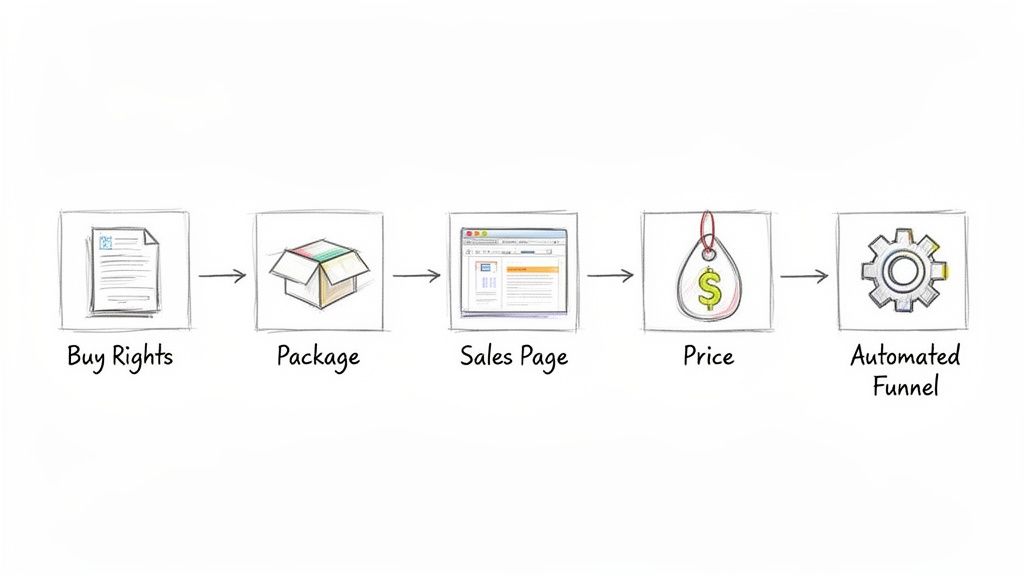
We'll walk through this together, breaking down what feels like a huge task into simple, actionable steps. This is the exact path successful entrepreneurs take to turn an MRR license into a profitable side hustle or even a full-time business.
Step 1: Strategically Package Your Product
Even though you can't alter the core MRR product itself, you have total control over its presentation. Your first mission is to wrap it in a compelling package that fits your brand and speaks directly to your ideal customer. Think of it as creating an irresistible offer around the main product.
Before you do anything else, you absolutely must know who you're selling to. Seriously, everything flows from this. Getting a handle on identifying your target audience is non-negotiable, as it will shape your branding, your sales copy, and your marketing.
Once you know who you’re talking to, start thinking about bonuses. If you're selling an MRR e-book on social media marketing, why not create a simple content calendar template or a checklist for optimizing a profile? These little add-ons massively boost the perceived value and make your offer the obvious choice.
Step 2: Write Compelling Sales Copy
Your sales page is your 24/7 digital salesperson. Its only job is to convince visitors that your product is the exact solution they’ve been searching for. To do that, your copy needs to be persuasive, crystal clear, and focused on the benefits, not just a list of features.
Kick things off with a powerful headline that grabs attention and states the product's main promise. From there, use subheadings and bullet points to break up the text and make it super easy for people to scan.
Most importantly, sell the transformation. Don't just say, "this e-book has 10 chapters." Instead, paint a picture of what the reader will be able to do after they've gone through it. Think: "Learn how to double your engagement in 30 days."
Your sales copy should answer one fundamental question for the potential buyer: "What's in it for me?" Every single sentence should be geared toward demonstrating the value and the positive change they'll experience.
Step 3: Develop a Smart Pricing Strategy
Pricing an MRR product can feel a little tricky. You want to capture its true value without scaring people away. The good news is that the MRR license often specifies a minimum selling price, which gives you a solid floor to start from.
A smart approach is value-based pricing. Stop and think about the problem this product solves. How much is that solution worth to your customer? If the product saves them 10 hours of work a week or helps them land one new client, its value is way higher than the price of a simple e-book.
You could also consider a couple of pricing tiers. Maybe you offer the core MRR product at one price, and a "premium package" with your exclusive bonuses for a little more. This gives customers a choice and is a proven way to increase your average order value.
Step 4: Build Your Automated Sales Funnel
A sales funnel is just the path you guide a customer through, from the moment they hear about you to the second they buy. For an MRR product, you can keep this incredibly simple and—best of all—automated. This is how you make sales while you sleep.
Here’s what a basic, effective funnel looks like:
Traffic Source: This is where customers discover you (think social media, your blog, or an email list).
Sales Page: The page you built in step two that does all the heavy lifting.
Checkout Page: A simple, secure page where the customer enters their payment info.
Delivery System: An automated email that instantly sends the customer their digital product and any bonuses the moment their purchase goes through.
Platforms like Gumroad, SendOwl, or Stan Store are fantastic for this because they handle the entire checkout and automated delivery process for you. Set this up once, and your business can practically run on autopilot, freeing you up to focus on marketing and finding your next big MRR win.
Smart Marketing Strategies for Your MRR Products
Having a great MRR product is only half the battle. Getting it in front of the right audience—that's what actually drives revenue. The good news is you don't need a massive budget to make a serious impact. With a few smart, focused marketing tactics, you can connect your offer with eager buyers and build real momentum.
The key is to think like a digital entrepreneur and put your energy where it counts. This means tapping into assets you already have, creating valuable content that pulls customers in naturally, and building systems that let others sell for you.
Let's break down the most effective, low-cost strategies to get your product moving.
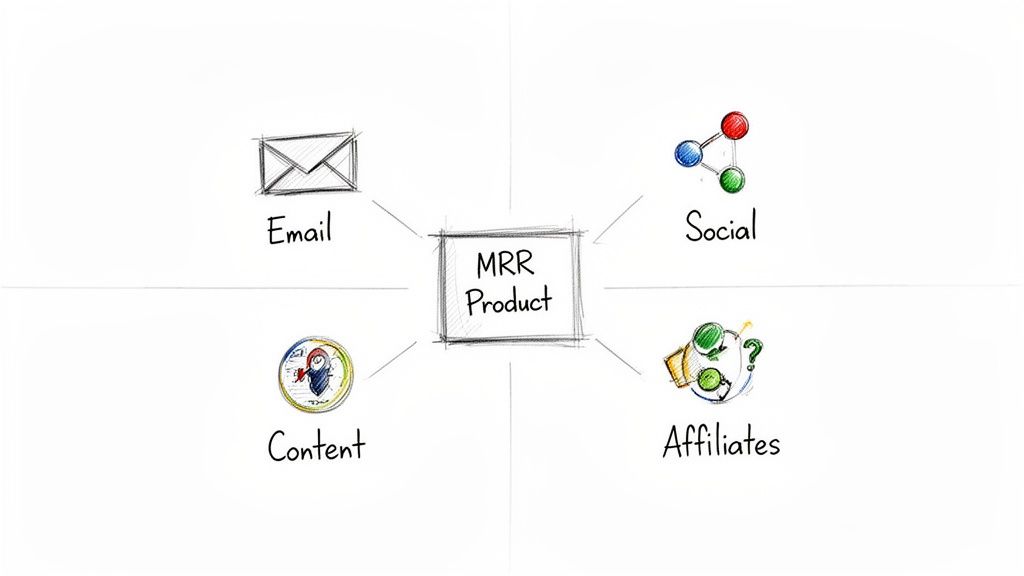
Leverage Your Existing Email List
Your email list is your single most valuable marketing asset. Period. Unlike social media followers, these are subscribers who have explicitly given you permission to show up in their inbox. This direct line of communication is absolute gold for launching a new master resale rights product.
A simple launch sequence to your list can generate your first sales almost instantly. Just announce the product, explain the benefits, and make a clear call to action. Because you’ve already built trust with this audience, their conversion rate will be miles ahead of any cold traffic.
You can learn more about how to turn leads into paying customers using digital products as strategic lead magnets to grow that list even faster.
Create Targeted Social Media Campaigns
Social media isn't just for posting random updates; it's a powerful engine for finding and engaging your ideal customers. Ditch the generic posts and start creating targeted campaigns that speak directly to the problems your MRR product solves.
Create "Problem-Aware" Content: Post short videos or carousels that zero in on the exact challenge your audience faces. If your MRR product is a financial planner, create content about the stress of managing a budget.
Showcase the Transformation: Use testimonials or case studies (even hypothetical ones work great) to paint a picture of what life looks like after using the product.
Run Highly Targeted Ads: Even a tiny ad budget can go a surprisingly long way. Target users based on interests that align with your product, like "small business owners" or "online course creators."
Use Content Marketing to Attract Organic Traffic
Content marketing is the long game that pays dividends for years to come. By creating genuinely helpful blog posts, guides, or videos related to your MRR product's niche, you attract people who are actively searching for solutions online. This automatically positions you as an expert and builds trust long before you ever ask for the sale.
This strategy taps directly into how people buy today. A comprehensive survey found that 62% of Gen Z and millennial consumers look for an item secondhand before buying it new. While they're talking about physical goods, this mindset perfectly aligns with the value of a ready-made digital product. You can read more about these insights into secondhand consumer trends.
Your content should act as a bridge. It meets customers where they are—searching for answers—and naturally guides them toward the solution your MRR product provides.
Build a Simple Affiliate Program
Why do all the selling yourself? An affiliate program empowers other people to promote your product in exchange for a commission on every sale they bring in. This is one of the most effective ways to scale your reach without piling more work on your own plate.
You don't need complicated software to get started. Many digital product platforms have built-in affiliate features. Just provide your affiliates with unique tracking links, some promotional materials to make their job easier, and a clear commission structure. This turns your happy customers and industry peers into a motivated sales force, multiplying your marketing efforts exponentially.
Common MRR Mistakes and How to Avoid Them
Venturing into master resale rights can be an absolute goldmine, but that success often comes down to knowing which traps to avoid. Too many entrepreneurs dive in headfirst, full of excitement, only to stumble over a few common missteps that can sink their efforts fast.
If you know what these pitfalls are ahead of time, you can protect your investment, build a brand people trust, and just plain make smarter decisions. Let’s walk through the most frequent mistakes I see and the simple ways to sidestep them, making sure your MRR journey is a profitable one.
Misreading the License Fine Print
The single biggest mistake—and the most costly—is failing to actually read the license agreement from top to bottom. A lot of sellers just assume all master resale rights licenses are the same, but they can vary wildly. This one oversight can lead to a world of hurt, from pricing violations to accidentally distributing the product illegally.
Before you even think about selling, you need to become a detective and scrutinize the terms for specific rules:
Minimum Pricing: Is there a price floor? Many licenses require you to sell the product at or above a certain price. Going below it devalues the product for everyone and is a surefire way to get your license revoked.
Bundling Restrictions: Can you package this product with other offers? Some licenses forbid bundling because they want to protect the product's standalone value.
Giveaway Rules: Are you allowed to offer the product for free as a juicy lead magnet to build your email list? Many MRR licenses explicitly say no to prevent the market from getting watered down.
Ignoring these details isn't just a rookie move; it can have real legal consequences and tarnish your business reputation before you even get going.
Ignoring Market Saturation
Another classic blunder is jumping on a product that has already flooded the market. Sure, a popular product shows there's demand, but if thousands of other people are selling the exact same thing, you’re just entering a race to the bottom on price and struggling to get noticed.
Your goal isn't just to sell a product; it's to build a sustainable business. Choosing an oversaturated item makes it nearly impossible to stand out and establish a unique brand presence.
Instead of chasing what everyone else is selling, hunt for high-quality products in less crowded niches. A valuable product that isn't everywhere gives you a much better shot at capturing a dedicated audience and building real authority. And please, avoid sketchy shortcuts that promise instant visibility but end up hurting you, like buying Product Hunt upvotes for a launch. Genuine value and authentic engagement are what build a business that lasts.
Your Top Master Resale Rights Questions, Answered
Jumping into the world of digital product licensing can feel a little confusing at first. Let's clear up some of the most common questions about master resale rights so you can move forward with total confidence.
Can I Change or Edit an MRR Product?
This is a big one, and the short answer is almost always no. The power to edit, rebrand, or change content is the hallmark of a Private Label Rights (PLR) license, not MRR. Most master resale rights agreements are very clear: you must sell the product exactly as you received it.
There’s a solid reason for this rule. It protects the original creator's hard work and makes sure the product quality stays consistent no matter who is selling it. This actually helps you by preserving the product's value and reputation in the market.
Do I Owe Royalties on My Sales?
Here’s the best part of the MRR model: you keep 100% of the profits. Once you make that initial one-time purchase for the product and its license, you’re done. You never have to pay ongoing commissions or royalty fees back to the original creator.
Every single sale you make goes straight into your pocket. This applies whether you're selling to a final customer or another entrepreneur who wants to buy the resale rights from you. It’s a clean, simple financial structure that makes it a powerful way to generate revenue.
The core appeal of MRR is simple: you own your profits. Buy the rights once, and every dollar you earn from that product is yours to keep, forever.
Is Selling MRR Products a Legal Business Model?
Absolutely. Selling products with master resale rights is a completely legal and legitimate business model. But its legality hinges on one critical detail: you must follow the terms in the license agreement to the letter.
Think of that document as your legal playbook. Always read it carefully before you start selling so you know exactly what your rights, restrictions, and obligations are. As long as you play by those rules, you’re running a compliant and valid business.