Guide
Marketing an Ebook: A Proven Blueprint to Build Funnels and Boost Sales

A successful ebook doesn't just appear out of nowhere. The marketing starts long before you ever hit "publish," and it all hinges on a deep understanding of your ideal reader and a message that cuts through the noise.
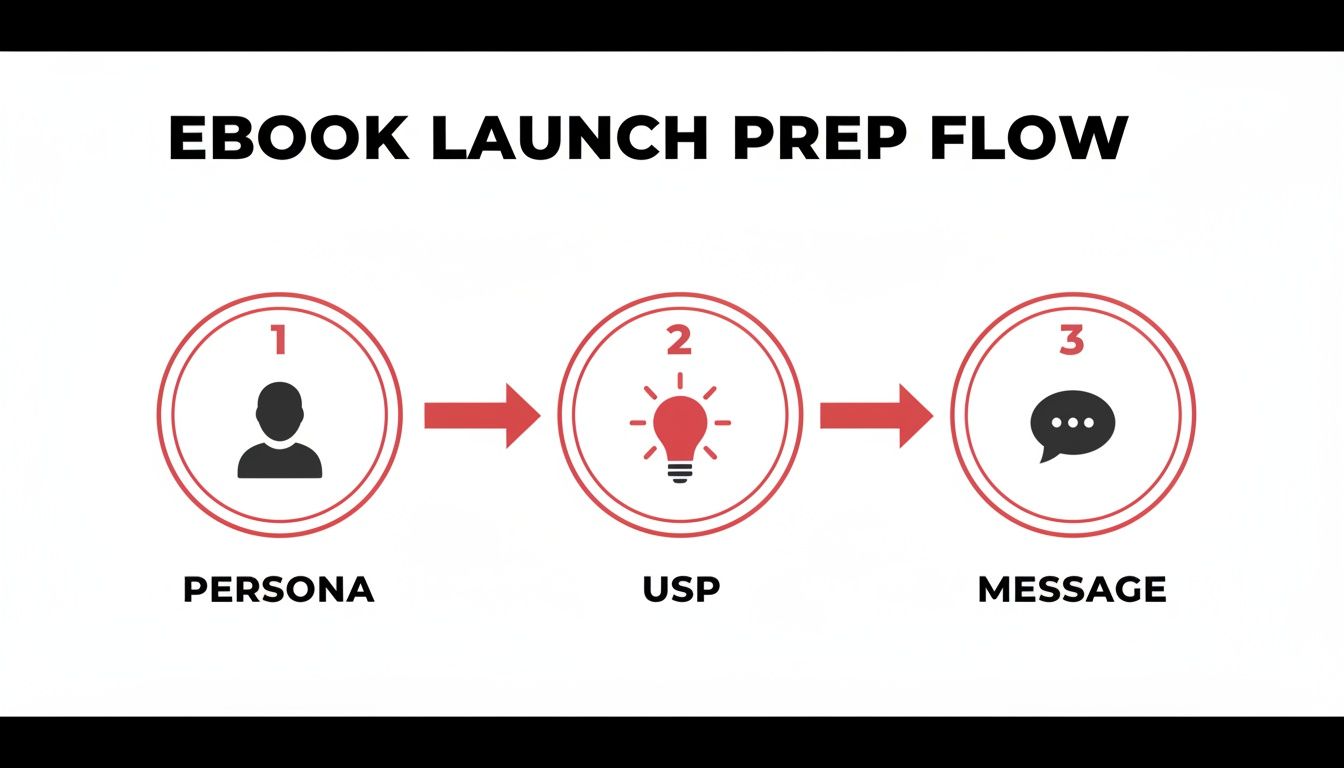
This initial work is where the magic happens. You’ll create a detailed reader persona to get inside their head and craft a unique selling proposition (USP) that makes your ebook the only logical choice for them.
Laying the Groundwork for a Profitable Ebook Launch
So many authors get caught up in the writing and design, leaving marketing as a last-minute scramble. That’s a huge mistake. A profitable ebook launch isn't built on a flurry of promotional activity; it's the result of strategic groundwork that shapes every single decision you make later on.
Without this foundation, even the most brilliantly written ebook will struggle to connect with the people who need it most.
It all starts with one simple question: who are you really trying to help? Going beyond basic demographics is non-negotiable here.
Defining Your Ideal Reader Persona
A reader persona is a semi-fictional deep dive into the mind of your perfect reader. It’s not about their age or where they live; it’s about their deepest fears, frustrations, and desires. To make sure your message hits home, you have to identify your target audience with pinpoint accuracy.
To build a persona that feels real, you need to know:
Pain Points: What keeps them up at night? What specific problem is your ebook going to solve? For an ebook on productivity, maybe your reader is a freelancer totally swamped by client work and a chaotic workflow.
Goals and Aspirations: What's their ultimate goal? The freelancer doesn’t just want to be organized; they want to earn more money while working fewer hours. That's the real prize.
Watering Holes: Where do they hang out online? Think about the blogs they read, podcasts they listen to, and the Facebook groups or subreddits they’re active in.
Objections and Hesitations: Why wouldn't they buy your ebook? Are they skeptical of another "quick fix"? Do they think they’re too busy to implement new strategies? Knowing this helps you address their doubts head-on.
Pro Tip: Give your persona a name and a story. Let's call our freelancer "Overwhelmed Olivia," a 32-year-old graphic designer. This simple step makes the persona feel like a real person, helping you write marketing copy that speaks directly to her, not to a generic crowd.
Crafting a Unique Selling Proposition
Once you have a crystal-clear picture of "Olivia," it's time to create your Unique Selling Proposition (USP). This is a short, powerful statement that answers one critical question: "Why should I buy your ebook over all the others?"
A strong USP is more than just a snappy tagline; it’s the core of your entire marketing message. It has to promise a tangible benefit that your competitors don’t.
For example, a generic USP like "The best guide to freelance productivity" is forgettable. A much stronger one would be: "The only productivity system designed for freelance creatives to cut their admin time in half and reclaim 10 hours per week."
See the difference? This one is specific, benefit-driven, and speaks directly to Olivia’s pain. It promises a clear, desirable outcome—less admin work, more free time—making the value impossible to ignore.
This foundational work is everything. After all, the journey of how to self-publish an ebook is just as much about smart marketing as it is about great writing. With a solid reader persona and a compelling USP, you create an unshakeable core for your campaign. Every email, ad, and social post will be perfectly aligned to attract and convert the right people.
How to Build an Automated Ebook Sales Funnel
Selling an ebook isn't about one-off promotions or a big launch day blitz. The real money is made in a repeatable, automated system that works for you around the clock. This is your sales funnel—the engine that turns casual browsers into loyal readers, long after your launch buzz has faded.
It all starts with a simple exchange: you offer a small piece of high-value content for free, earning you the right to start a conversation. From there, you guide them on a journey that naturally leads to a confident purchase.
Design an Irresistible Lead Magnet
Your lead magnet is the handshake that begins the relationship. It’s a free, valuable resource you offer in exchange for an email address, and it has to be so compelling that your ideal reader can't say no.
Crucially, this can't be some random piece of content. It needs to be a direct prequel to the bigger solution your ebook provides. Think of it as the appetizer that makes them hungry for the main course.
Effective lead magnets are quick to consume and deliver an immediate win. Here are a few ideas that work like a charm:
A Detailed Checklist: If your ebook is about launching a podcast, a fantastic lead magnet would be "The 25-Step Podcast Launch Checklist." It's practical, actionable, and perfectly aligned.
A Sample Chapter: Give away the juiciest, most impactful chapter of your ebook for free. This offers a direct taste of your writing style and the value packed inside.
A Mini Email Course: A simple 3-day automated email series that teaches one core concept from your book is a great way to build authority. It also gets subscribers in the habit of opening your emails.
A Resource Guide: Compile a list of the best tools, software, or resources related to your ebook's topic. You'll save your audience hours of research and position yourself as a helpful expert.
The right lead magnet solves a small, specific problem for your reader, making them eager to discover how your full ebook solves the bigger one.
The flowchart below shows how this all fits together. A successful funnel doesn't start with the first email; it's built on a deep understanding of who you're talking to and the unique value you offer.
Craft a High-Converting Landing Page
Once you've got a killer lead magnet, you need a dedicated landing page to promote it. This page has just one job: convince visitors to trade their email for your free resource.
Forget your website's navigation, social media links, or any other distractions. On this page, simplicity and focus are your best friends.
A strong landing page has several key elements that work together to drive sign-ups.
Your landing page copy should focus entirely on the transformation. Don’t just list what’s inside the lead magnet; describe the positive outcome the user will experience after they consume it.
Here are the essential components:
A Benefit-Driven Headline: Ditch "Download Our Free Checklist." Instead, try something like, "Get the Exact 25-Step Checklist We Used to Launch a Top 100 Podcast." See the difference?
Clear, Scannable Copy: Use bullet points to highlight the key benefits and takeaways. Make it easy for people to see the value at a glance.
Social Proof: Even a single short testimonial from someone who found the free resource valuable can dramatically increase trust.
A Simple Form: Only ask for what you absolutely need—usually just a first name and email address. Every extra field you add will lower your conversion rate.
This page is the gateway to your world. Mastering this skill is non-negotiable, and you can dive deeper into the mechanics of how to create a sales funnel that consistently delivers results.
Map Out a Nurturing Email Sequence
The moment someone subscribes, the automation kicks in. This is where you build trust and gently introduce your ebook. A short, focused email sequence is almost always more effective than a long, drawn-out one. A simple 3-to-5 email series can work wonders.
Here’s a proven flow you can adapt:
Email 1 (Instant Delivery): Get the lead magnet to them immediately. Keep this email short, sweet, and focused on getting them to open and use the freebie.
Email 2 (24 Hours Later): Follow up with more value. Share a related tip, a quick story, or an insight that reinforces your expertise and builds on the lead magnet.
Email 3 (48 Hours Later): Introduce the problem your ebook solves. Connect the dots between their initial interest (the lead magnet) and the more complete solution your paid product offers.
Email 4 (72 Hours Later): It's time to make the offer. Clearly present your ebook, outline its benefits, and include a compelling call to action to buy.
This automated sequence ensures every new subscriber gets a consistent, value-packed experience that naturally guides them toward becoming a customer.
Driving High-Quality Traffic to Your Ebook
You’ve built a brilliant automated sales funnel. It's a powerful engine, ready to go. But an engine is useless without fuel. Now, it's time to pump high-quality traffic into that system—and I don't mean just any traffic. We're talking about finding the people who are genuinely struggling with the exact problem your ebook solves.
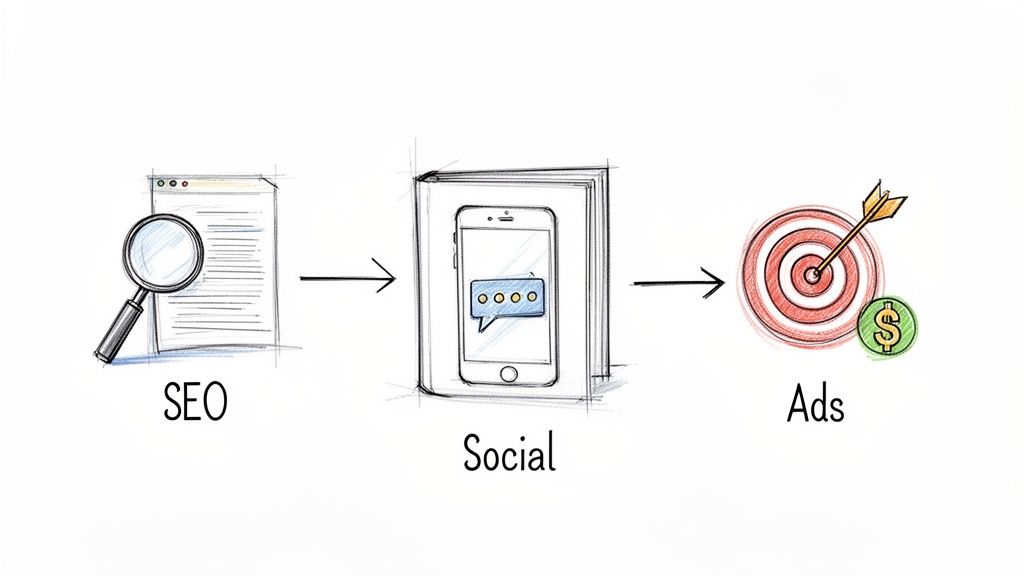
The smartest marketing approach combines both long-term, sustainable growth with quick, targeted wins. We'll start with the organic methods that build your authority over time, then dive into paid strategies that can deliver interested visitors on demand.
Harnessing Organic Traffic Through Content
Organic traffic is the bedrock of any sustainable marketing plan. It’s all about providing real value upfront, establishing yourself as the go-to expert, and letting search engines and social platforms do the heavy lifting for you. This strategy hinges on one simple idea: repurposing the core concepts of your ebook into smaller, shareable pieces of content.
Think of it this way: each piece of content you create acts as a permanent signpost on the internet, pointing people directly to your ebook’s landing page.
One of the most effective ways to do this is by turning your ebook's chapters into standalone blog posts. Each chapter likely dives deep into a specific sub-topic that people are already searching for. By creating an SEO-friendly blog post around it, you start attracting readers who need that exact information.
Let’s say your ebook is "The Ultimate Guide to Container Gardening." You could easily create blog posts like:
"Choosing the Best Soil for Your Container Garden"
"5 Common Container Gardening Mistakes (and How to Avoid Them)"
"How to Water Potted Plants for Maximum Growth"
Each post delivers a quick win for the reader and naturally ends with a call-to-action inviting them to download the full ebook for the complete, step-by-step system.
By repurposing your ebook's content, you're not creating more work; you're maximizing the value of the work you've already done. Each piece of content becomes another entry point into your sales funnel.
Engaging Audiences on Social Media
Social media is another beast entirely. It demands a different approach than long-form blog content. Here, you need to create bite-sized, engaging posts that stop the scroll and spark genuine curiosity.
Video is an absolute game-changer on platforms like Instagram Reels or TikTok. You could create short, punchy videos that share one powerful tip from your ebook. For our container gardening example, a 30-second video showing someone how to test soil moisture with their finger is infinitely more engaging than just writing about it.
But don't just broadcast—engage. Ask questions, run polls about common challenges related to your topic, and jump into relevant online communities. The goal isn't just to promote; it's to build a community around your expertise, with your ebook positioned as the ultimate resource for anyone ready to go deeper.
Demystifying Paid Advertising Campaigns
While organic traffic builds momentum over time, paid ads deliver immediate, laser-targeted reach. Platforms like Meta (Facebook and Instagram) are incredibly powerful for ebook marketing because of their sophisticated audience targeting.
You don't need a massive budget to see results. In fact, it's much smarter to start small. A daily budget of just $10 to $20 is more than enough to test your ads and figure out what resonates with your audience.
A successful ad campaign really comes down to three things:
Audience Targeting: Go beyond simple demographics. Use interest-based targeting to reach people who already follow related experts, buy complementary products, or belong to relevant groups.
Compelling Ad Creative: Your ad's image or video needs to grab attention instantly. A clean, high-quality mockup of your ebook cover or a short video of you explaining a key benefit can work wonders.
Benefit-Driven Copy: Your ad copy has to speak directly to your reader's pain points and promise a clear solution. Forget features; focus on the transformation your ebook delivers.
Imagine you're running a Meta ad for the gardening ebook. You could target users who have shown interest in pages like "Gardener's World Magazine" or brands like "Miracle-Gro."
Your ad copy might read: "Tired of your balcony plants dying? My new ebook reveals the 3 simple secrets to a thriving container garden, even if you don't have a green thumb." This copy hits on a common pain point and offers a specific, compelling solution. It’s far more effective than a generic "Buy my ebook" plea.
Start with a small test budget, run two or three different ad variations to see which one performs best, and then put your money behind the winner. This methodical approach minimizes risk and maximizes your return, ensuring every dollar you spend is working to bring qualified leads straight into your funnel.
Using Partnerships and Affiliates to Widen Your Reach
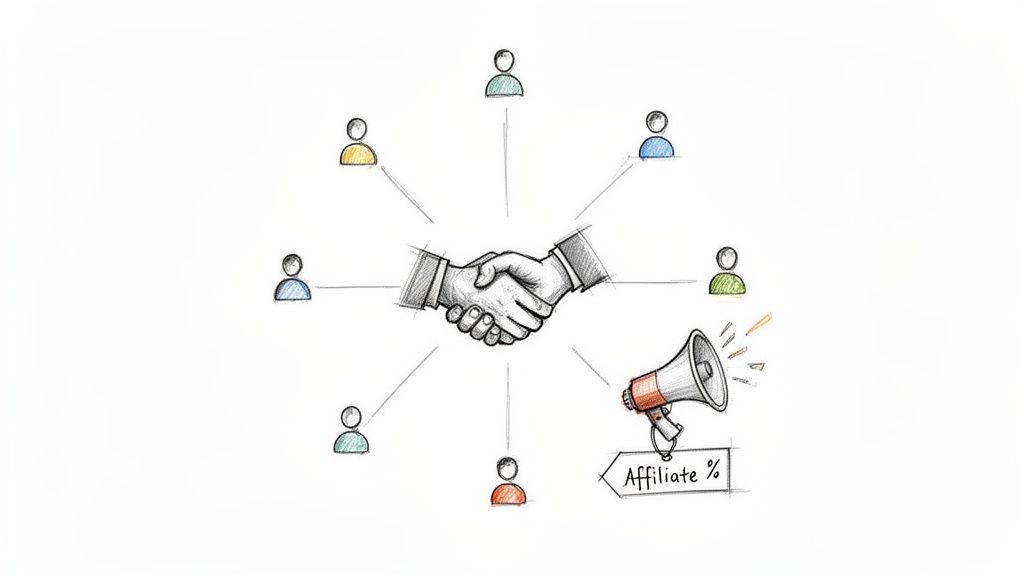
You've done the hard work. You created a fantastic ebook and even built an automated sales funnel to go with it. That’s a huge win. But even the slickest system needs a steady flow of the right kind of traffic.
Instead of trying to build an audience entirely from scratch—which can take months, if not years—you can fast-track your growth by tapping into existing communities. The secret is collaborating with people who have already earned the trust of your ideal customers.
Strategic collaborations are one of the most powerful tools in your marketing toolkit. By working with influencers, podcasters, or even brands in a related niche, you get to "borrow" their audience and credibility. This puts your ebook in front of warm, engaged leads who are way more likely to be interested in your topic than some random person you reached with a cold ad.
How to Find and Connect with the Right Partners
The single most important factor for a successful partnership is relevance. Your perfect partner serves the same audience you do but isn't a direct competitor. Their followers should be an almost perfect match for the ideal reader you imagined when writing your ebook.
Don't get hung up on follower counts. I’ve seen micro-influencers with a super-engaged, niche audience of 5,000 drive more sales than a macro-influencer with 100,000 followers who barely pay attention. Look for partners who create content that genuinely aligns with your ebook’s message.
Here are a few types of partners to look for:
Podcasters: Find hosts who talk about topics related to your ebook. Getting booked as a guest is an incredible way to share your expertise and casually mention your ebook as a resource for their listeners.
Bloggers and YouTubers: Identify creators in your niche with an active, trusting audience. They could review your ebook, feature it in a "best of" list, or interview you for their channel.
Complementary Brands: Team up with businesses that sell different products or services to your target audience. If your ebook is about meal prepping, a company selling high-quality food containers is a natural fit.
Once you have a list, it's outreach time. Forget the generic, copy-paste emails—they get deleted instantly. Your pitch needs to feel personal and, most importantly, show what’s in it for them.
A great partnership pitch isn't about what they can do for you. It's about what you can do for their audience. Frame your ebook as a valuable resource that will help their followers solve a problem, which makes the partner look good for sharing it.
Start by genuinely engaging with their content for a week or two before you pitch. When you do reach out, keep it brief, mention something specific about their work you enjoyed, and clearly explain why your ebook is a perfect fit for their community. And always, always offer them a free copy so they can see the quality for themselves.
Building Your Own Affiliate Sales Team
While one-off partnerships are great for a quick burst of attention, an affiliate program creates a sustained, commission-based sales force. This is how you turn your most passionate readers and partners into motivated promoters who earn a cut of every sale they send your way.
Setting up an affiliate program is probably easier than you think. Platforms out there handle all the technical stuff, like tracking links and paying commissions, so you can focus on building relationships. If you're new to this, it's a core skill for any digital creator. You can learn the fundamentals in our guide on affiliate marketing essentials.
The commission structure is everything. It’s what motivates people to promote your stuff. Since digital products like ebooks have zero fulfillment costs, you can afford to be generous. A commission rate between 30% and 50% is standard and highly attractive. A higher rate gives affiliates a real incentive to promote your ebook over someone else's.
To set your new sales team up for success, give them a "swipe file" of promotional materials. This kit should include:
Email Templates: Pre-written emails they can easily adapt and send to their list.
Social Media Copy: Ready-to-go posts for platforms like X (formerly Twitter), Instagram, and Facebook.
Graphics and Banners: Professionally designed images, including ebook mockups and ad-style graphics.
By making it dead simple for your affiliates to promote your ebook, you remove all the friction. This transforms your marketing from a solo grind into a powerful, community-driven campaign that can scale far beyond what you could ever achieve on your own.
Smart Pricing and Post-Launch Sales Strategies
So, you launched your ebook. The first wave of sales rolled in, and you're getting some great feedback. Fantastic. But what happens next week, or next month, when the initial buzz dies down?
This is where the real work begins. The most successful creators know that an ebook launch isn't the finish line; it's the starting pistol. Sustained revenue comes from what you do after that initial push.
Smart pricing and ongoing promotions are what turn your ebook from a one-off project into a reliable business asset. It’s all about keeping the momentum going and building a sales engine that works for you long after launch day.
How to Price Your Ebook for Maximum Value
Pricing an ebook can feel like walking a tightrope, but it’s a critical decision that signals your content's worth. The biggest mistake I see is pricing too low. A $2.99 price tag might seem like an easy way to get sales, but it attracts bargain hunters and screams "low value."
Instead, price your ebook based on the transformation it delivers.
What high-value problem are you solving? If your ebook shows a freelancer how to land their first $5,000 client, then a $49 price tag is a steal. The price should reflect the outcome, not just the page count.
Here’s a simple way to think about pricing tiers:
Entry-Level ($9 - $29): This is a great spot for ebooks that offer a solid introduction to a topic or act as a gateway to your bigger, more expensive products.
Premium ($39 - $99): Reserve this for specialized, deep-dive content that solves a major pain point. This price point attracts serious buyers who are ready to invest in a real solution, not just another download.
Don't be afraid to experiment. Run a limited-time promotion at a lower price for a week and track the results. Did your total revenue go up or down? You need to know what’s working, which means getting comfortable with your numbers. If you're not sure where to start, learn how to calculate marketing ROI to validate your efforts.
Creating Offers and Bundles People Can't Refuse
A standalone ebook is good. An ebook bundle is often a complete no-brainer for the right person. Bundling is psychologically powerful—customers see a much higher value when they get multiple items together, which can dramatically increase your average order value.
And these add-ons don’t have to be massive projects. Small, high-impact resources can make all the difference.
Here are a few bundle ideas that work wonders:
The "Action Taker" Bundle: Pair your ebook with a workbook, a set of checklists, or a ready-to-use Notion template. This helps readers put your advice into practice immediately.
The "Accelerator" Package: Add a short, pre-recorded video workshop that dives deeper into a key concept from the book.
The "Insider" Kit: Include a resource library with your favorite tools, a curated list of industry contacts, or swipe files that save your readers hours of work.
A great offer makes the decision to buy feel easy and obvious. The goal is to stack so much value into the bundle that your ideal reader thinks, "I have to get this."
This shifts the customer's mindset from "Should I buy this?" to "Look at everything I'm getting for this price!"
How to Keep Sales Coming in Long After Launch
The global eBook market is booming, projected to hit $22.76 billion by 2030, with over a billion readers. Your strategy after the launch is what determines your slice of that pie.
Here are a few proven tactics to keep your sales chart moving in the right direction:
Run Timely Promotions: Use holidays or seasons as a hook for a sale (e.g., "New Year, New Skills"). A 48-hour flash sale is also fantastic for creating urgency and driving a quick burst of revenue.
Show Off Your Social Proof: The minute you get positive feedback, ask for a testimonial. Splash those glowing reviews all over your sales page, in your emails, and on social media to build trust with potential buyers.
Use It as a Tripwire: Position your ebook as an affordable entry point to your brand. Immediately after someone buys it, offer them a special one-time deal on a more expensive course or service. It's a killer way to increase customer lifetime value right from the start.
Ebook Offer Structure Comparison
Choosing the right offer structure is just as important as setting the price. The right structure can maximize your revenue per customer and provide more value to your audience. Here's a quick comparison of the most effective models I've seen.
Offer Type | Description | Best For | Example |
|---|---|---|---|
Standalone Ebook | The ebook sold as a single digital product. | Simple, straightforward sales where the ebook is the main attraction. | Selling "The Ultimate Guide to SEO" for $39. |
Ebook + Bonus | The ebook plus a small, high-value digital add-on like a checklist or template. | Increasing perceived value and encouraging immediate purchase without complexity. | The SEO ebook plus a "Keyword Research Checklist." |
Tiered Bundle | Offering multiple versions (e.g., Basic, Pro, Premium) with more resources at each level. | Appealing to different budget levels and maximizing the average order value. | Basic: Ebook only. Pro: Ebook + templates. Premium: Ebook, templates + video workshop. |
Tripwire Offer | A low-cost, irresistible offer presented immediately after a free download (like a lead magnet). | Converting new leads into paying customers quickly and funding ad spend. | After downloading a free SEO guide, offering the full ebook for just $9 (for 15 mins only). |
Ultimately, the best structure depends on your audience and the other products you offer. Don't be afraid to test a simple standalone offer first, then introduce a bundle later to see how it impacts your sales.
Got Questions About Ebook Marketing? We’ve Got Answers.
Even the best-laid marketing plan hits a few bumps. When you're in the thick of a launch, you need clear, direct answers to the hurdles that pop up. Let's tackle some of the most common questions I hear from creators.
How Much Should I Really Spend on Marketing?
This is the classic "it depends" question, but we can definitely put some real numbers on it. You don't need a massive budget right out of the gate.
A great starting point for paid ads, especially on platforms like Meta, is $10 to $20 a day. That's enough to get your feet wet and start gathering crucial data on what messages and images are actually working—without risking a ton of cash.
From there, your budget really hinges on your goals.
Growing Your Email List? If lead generation is your main play, your budget should be tied to your target cost-per-lead.
Driving Direct Sales? If it’s all about revenue, your ad spend needs to be a percentage of your ebook's price that still leaves you with a healthy profit.
The key is to start small, test everything, and double down on what works. And don't forget that organic marketing—like repurposing content or being a guest on podcasts—costs you time, not money. It should be a core part of your strategy no matter the budget.
How Long Should My Ebook Be?
There’s a huge misconception that a longer ebook is a better ebook. That’s almost never true.
Your ebook should be exactly as long as it needs to be to solve the specific problem you promised to solve. Not a single page longer.
Here’s the thing: Value isn't measured in page count. It's measured in the transformation you give the reader. A punchy, actionable 30-page guide that delivers a real result is infinitely more valuable than a rambling 150-page book that doesn't.
Focus on delivering a complete solution. If you can nail that in 25 pages, fantastic. If it takes 75 pages to do it right, that's fine too. Just don't add fluff to hit an arbitrary page count. It just weakens your message and annoys your reader.
Fiction vs. Non-Fiction Marketing: What's the Difference?
While some marketing fundamentals overlap, selling fiction and non-fiction ebooks are two very different games. The real distinction comes down to why someone is buying in the first place.
Non-fiction readers are looking for a solution. Fiction readers are looking for an escape.
Marketing Focus | Non-Fiction | Fiction |
|---|---|---|
Primary Appeal | Solving a problem, learning a skill, and getting a tangible result. | Entertainment, emotional connection, and escaping reality. |
Key Tactics | Proving your expertise with blogs, webinars, and data. Building authority is everything. | Building a fan community, using genre-specific hashtags, and leaning on reader reviews on sites like Goodreads. |
Audience Targeting | Based on professional interests, specific pain points, and industries. | Based on favorite authors, similar genres, and reading habits. |
For a non-fiction ebook, your marketing needs to scream credibility and promise a clear outcome. For fiction, it’s all about hooking them with a compelling story, unforgettable characters, and building a loyal fanbase who can't wait for your next book. Both require you to know your audience inside and out, but the emotional triggers you pull are worlds apart.