Explained
How to Self Publish Ebook: A Practical Path to Success

Learning how to self-publish an ebook is a surprisingly straightforward process, broken down into three main phases. It all starts with a professionally edited manuscript, then moves into production (cover design and formatting), and wraps up with a smart launch and distribution plan. Taking this path puts you in the driver's seat, giving you full creative control and much higher royalties.
Your Realistic Path to Self-Publishing
Welcome to the world of indie authorship, where you’re not just the writer—you’re the CEO of your book. Self-publishing isn't some mysterious, walled-off garden. It's simply the process of taking your finished manuscript and turning it into a professional digital product ready for readers everywhere.
The ebooks that succeed are the ones that nail a few key milestones. It’s a game of quality control, and you’re the one making all the final calls.
The Author-Entrepreneur Mindset
The biggest mental shift you'll make is going from writer to author-entrepreneur. This just means you start treating your book like a business from day one. Instead of only focusing on the craft of writing, you also have to get comfortable with the commercial side of things—understanding who you're writing for, investing wisely in your book's production, and mapping out a marketing plan.
Thinking this way gives you some incredible advantages:
You Keep Creative Control: From the cover art to the very last word, every decision is yours.
You Earn Higher Royalties: Forget the tiny percentages of traditional publishing. With self-publishing, you can keep up to 70% of your book's revenue.
You Publish on Your Timeline: No more waiting for gatekeepers. You decide when your book is ready for the world.
The global eBook market is booming, expected to hit $18.02 billion by 2025. Indie authors are a huge part of that, pulling in around $1.25 billion every year. This isn't just a hobby; with a good plan, it’s a real, profitable business. You can dive deeper into these eBook market trends to get a better sense of the opportunity.
The image below breaks down the three core stages you'll be working through.
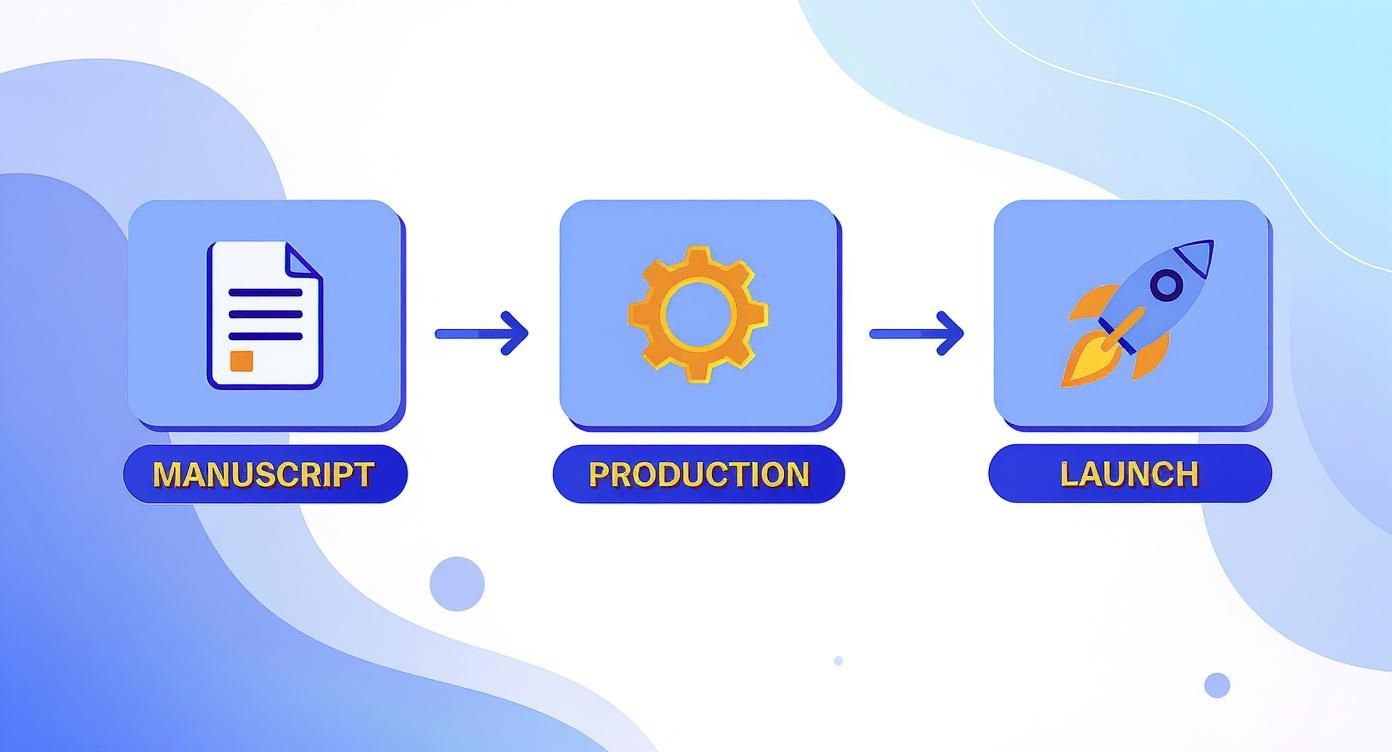
This workflow gives you a bird's-eye view of the entire journey, from polishing your manuscript to hitting "publish" on launch day.
To give you a clearer picture of what's involved, let's break down the journey into its core phases and goals.
Ebook Self-Publishing Key Stages at a Glance
Phase | Key Activities | Primary Goal |
|---|---|---|
Manuscript Preparation | Writing, professional editing (developmental, copy, proofreading), and final revisions. | To create a polished, error-free manuscript that delivers an exceptional reading experience. |
Production | Cover design, interior formatting (EPUB/MOBI), ISBN acquisition, and copyright registration. | To package the manuscript into a professional, market-ready ebook that attracts readers. |
Launch & Distribution | Choosing platforms (KDP, D2D), setting price, writing descriptions, and executing a marketing plan. | To make the ebook available to a global audience and drive initial sales and reviews. |
Each of these stages builds on the last, turning your hard work as a writer into a tangible product that people can buy, read, and enjoy.
Getting Your Manuscript Reader Ready
Before your ebook ever hits a digital shelf, it needs to be polished into a professional reading experience. This is the stage that turns a passionate draft into a product readers will happily pay for—and recommend. Skipping this part is probably the most common mistake I see, and it almost always leads to negative reviews that can kill your book's momentum before it even starts.
The journey from a finished manuscript to a reader-ready file really comes down to two big phases: comprehensive editing and precise digital formatting. Each one is designed to make sure the inside of your book is just as good as the work you put into writing it.
The Essential Layers of Professional Editing
Seasoned authors know that editing isn't just about catching typos; it's where the real magic happens. A manuscript that hasn't been professionally edited stands out for all the wrong reasons. Readers notice, and their reviews will absolutely reflect it. If you want to compete, your book needs the same level of polish as traditionally published titles.
This means you have to go beyond your own proofreading and the squiggly red lines from spell-check. Professional editing happens in layers, with each one tackling a different part of your writing.
Developmental Editing: Think of this as the big-picture edit. A developmental editor looks at the core of your story or argument—things like structure, pacing, plot consistency, and character arcs. Their job is to make sure the foundation of your book is solid.
Copy Editing: Once the structure is locked in, a copy editor zooms in on the line-by-line details. They’ll fix grammar, punctuation, and spelling, of course, but they also sharpen sentence flow, keep the tone consistent, and just generally make the whole thing easier to read.
Proofreading: This is the final quality check. A proofreader is the last line of defense, catching any tiny errors that slipped through the other stages. They make sure the final version is flawless before it gets formatted.
One of the biggest mistakes you can make is thinking you can handle all the editing yourself. After spending months or years with your manuscript, you're just too close to it to spot every issue. A fresh, professional perspective is what elevates a book from good to great.
Formatting Your Ebook for a Perfect Reading Experience
Once your text is polished, it’s time to format it for digital readers. This isn't as simple as saving a Word doc as a PDF. Ebooks use reflowable text, which means the content has to adjust to fit different screen sizes, from a tiny smartphone to a big tablet. Good formatting makes sure your book looks clean, professional, and is easy to navigate on any device.
There are two main file formats you absolutely need to know: EPUB and MOBI.
EPUB (.epub): This is the industry standard. It's compatible with almost every e-reader and platform out there, including Apple Books, Kobo, and Barnes & Noble's Nook.
MOBI (.mobi) / KF8 (.kpf): These formats are for Amazon's Kindle devices and apps. While Amazon is slowly phasing out the old MOBI format for new uploads, their Kindle Create tool produces the KPF file you'll need.
If you're looking to tackle formatting yourself, there are some great user-friendly tools. Scrivener, a popular writing app, has powerful exporting features that can generate clean EPUB and MOBI files. For Mac users, Vellum is the gold standard; it creates beautiful, professional-grade ebook interiors with just a few clicks.
While DIY formatting is totally doable, hiring a professional formatter can save you a ton of time and prevent technical headaches. This is especially true for books with complex layouts, images, or tables. To get a bit deeper on this, check out our guide on crafting your first ebook with the right tools and strategies.
It's also worth exploring how AI for content creation is changing the game. These tools can help refine your manuscript during the pre-formatting stages, assisting with everything from grammar checks to improving sentence structure. In the end, whether you use DIY tools or hire a pro, the goal is the same: a perfectly formatted file that gives readers an immersive, frustration-free experience.
Creating a Cover That Actually Sells Books
Let's be blunt: your ebook cover isn't just a pretty picture. It's your single most powerful, 24/7 marketing machine. In a sea of digital thumbnails, your cover has a fraction of a second to scream, "Hey, you! If you love [your genre], you'll love me." A great cover moves books. A bad one guarantees they'll never even get clicked.
It’s an old saying for a reason—readers absolutely judge a book by its cover. It's the first promise you make to them about the story inside. When it looks professional and fits the genre, it builds immediate trust. It tells them you cared enough to get it right.
Core Principles of High-Converting Ebook Covers
Before you start thinking about designers or DIY tools, you need to understand what makes a cover actually work. This has less to do with your personal artistic taste and everything to do with reader expectations. It's time to think like a marketer.
Three things are completely non-negotiable:
Genre Conformity: A thriller cover needs to look like a thriller, period. Think bold, high-contrast fonts and moody, atmospheric imagery. A romance cover has its own set of visual cues, whether it’s a sweet, illustrated scene or a steamy, shirtless cowboy. Your best homework? Go to the Amazon bestseller list for your specific category and just scroll. That's your market research.
Clear Typography: Your title and author name must be easy to read, even when shrunk down to a tiny thumbnail. This is the #1 place where DIY covers fall flat. The font, its size, and the color have to pop against the background and instantly signal the book's tone.
Compelling Imagery: The main image has to be high-quality and create an emotional spark. It should build intrigue without spoiling the entire plot. It doesn't matter if it's a custom illustration or a carefully chosen stock photo—the image is what sets the mood.
Your cover's only job is to stop a reader from scrolling. It has less than three seconds to communicate genre, tone, and professionalism. If it fails that test, how good your writing is becomes irrelevant, because no one will ever click to find out.
Finding the Right Designer for Your Vision
I love tools like Canva for social media posts, but for a book cover, they're often not enough. A real cover designer understands typography, composition, and all the subtle signals that sell books in specific genres. They bring an objective, expert eye that's almost impossible to replicate on your own.
When you're ready to hire a pro, platforms like Reedsy and 99designs are fantastic starting points. They're marketplaces full of designers who specialize in one thing: creating covers that sell books.
Writing a Design Brief That Gets Results
To get a cover you truly love, you have to give your designer crystal-clear instructions. A vague request like "make it look cool" is a recipe for endless, frustrating revisions. The design brief you write is the most critical document you'll hand over.
A rock-solid brief always includes:
Book Title and Author Name: The exact text, spelled out perfectly.
Genre and Sub-genre: Get specific. Not just "Fantasy," but "Grimdark Epic Fantasy."
A Short Synopsis: One tight paragraph summarizing the plot, main characters, and overall tone.
Target Audience: Who are you writing for? (e.g., "Fans of Sarah J. Maas and Jennifer L. Armentrout.")
Cover Examples: This is huge. Send links to 3-5 book covers in your genre that you love, and—this is key—explain why you like them. Is it the font? The color palette? The mood?
Ideas and Mandatories: Mention any key symbols, objects, or scenes you'd like to see, but also give the designer creative freedom to do what they do best.
Spending $300-$800 on a professional cover is hands-down one of the best investments you can make in your self-publishing career. It pays for itself over and over again through better visibility and stronger sales.
Choosing Your Ebook Distribution Strategy
Deciding where your ebook will be sold is one of the most critical business decisions you'll make. This isn't just about uploading a file; it’s a strategic choice that shapes your potential audience, how much you earn, and the marketing tools you get to use. The two main paths are pretty clear: go all-in with Amazon or distribute your book "wide" to reach readers across dozens of different stores.
The self-publishing world has come a long way since Amazon's Kindle Direct Publishing (KDP) platform first appeared back in 2007. It literally blew the doors open, giving authors a direct line to a global audience and the chance to earn royalties up to 70%—a number that was completely unheard of in traditional publishing. By 2021, ebook sales on Amazon alone soared past $1.1 billion, driven by millions of indie authors. To get a better sense of where things are headed, you can find more insights on eBook market trends and what to expect in the coming years.
The Amazon Exclusive Path: KDP Select
Going exclusive means enrolling your ebook in Amazon's KDP Select program. For a 90-day period, you agree not to sell your ebook digitally anywhere else. In return, Amazon rolls out the red carpet, giving you access to a powerful set of promotional tools and a pretty unique way to earn money.
The biggest draw of KDP Select is getting your book into Kindle Unlimited (KU). KU subscribers can read your book for "free" as part of their membership, and you get paid for every single page they read out of a massive global fund. For new authors, this can be an incredible way to get discovered and build an early readership without dropping a fortune on marketing.
Benefits of KDP Select
Kindle Unlimited Royalties: You earn money from page reads, which can add up to a substantial income, especially for popular genres like romance and fantasy.
Promotional Tools: You get to use exclusive tools like Kindle Countdown Deals (running limited-time price drops) and Free Book Promotions to spike your downloads and climb the sales charts.
Algorithmic Boost: When all your sales and reads happen on one platform, it can create a snowball effect, pushing your book higher up in Amazon's all-powerful recommendation algorithms.
The obvious downside? You're putting all your eggs in one giant, Amazon-shaped basket. Your entire business depends on their ecosystem, and you're completely missing out on readers who only shop at other stores.
The Wide Distribution Strategy: Reaching Every Reader
Going "wide" is the exact opposite approach. Instead of tying yourself to Amazon, you make your ebook available on as many platforms as you can. This includes heavy hitters like Apple Books, Barnes & Noble Nook, Kobo, and countless smaller digital bookstores all over the world.
This strategy is all about building a sustainable, long-term author business. You aren't beholden to a single retailer, which massively reduces your risk and opens up brand-new income streams. You won’t get the promotional perks of KDP Select, but you gain access to a much broader, more international audience.
Sure, you could upload your ebook to each store one by one, but that's an administrative nightmare nobody has time for. This is why most authors who go wide use an aggregator.
An aggregator is a third-party service that distributes your ebook to multiple online retailers for you. You upload your manuscript, cover, and book details just once, and they do all the heavy lifting. Popular services like Draft2Digital and Smashwords make going wide a ridiculously simple and manageable process.
Comparing Your Options Head-to-Head
The choice between exclusive and wide is a tough one, and there’s no single "right" answer. It really comes down to what your personal goals are as an author.
Feature | KDP Select (Exclusive) | Wide Distribution |
|---|---|---|
Audience Reach | Limited to Amazon's massive customer base. | Global reach across dozens of retailers, including libraries and subscription services. |
Royalty Structure | Up to 70% on sales, plus per-page-read royalties from the KU Global Fund. | Up to 70% on most platforms, but aggregators take a small cut (around 10% of retail price). |
Promotional Tools | Access to Kindle Countdown Deals and Free Book Promotions. | Relies on retailer-specific promotions (e.g., Kobo promotions) and your own marketing efforts. |
Best For... | New authors building a readership, series with high read-through, and authors in KU-heavy genres. | Authors building a long-term brand, those with an established audience, and nonfiction authors. |
Uploading Your Book and Optimizing for Sales
Once you’ve settled on a strategy, the actual upload process is pretty similar across most platforms. You'll need your final formatted ebook file (EPUB is the universal standard), your professional cover, and your book's metadata.
The two most crucial pieces of metadata you'll enter are your book description and your sales categories.
Your Book Description: This is your sales pitch. It needs a killer hook to grab the reader, a quick summary of the premise, and a clear call to action. Use basic HTML formatting like bold and italics to make key phrases pop. Think of it less like a book report and more like the copy on the back of a physical book.
Your Sales Categories: These are the digital "shelves" where your book lives. Be as specific as you possibly can. Instead of just picking "Romance," drill down to "Romance > Contemporary Romance" or "Romance > Paranormal." Choosing niche, less-crowded categories makes it much easier to hit the bestseller list for that category, which gives you a huge visibility boost.
Beyond these big platforms, some authors also sell their ebooks directly from their own websites or through marketplaces like Gumroad. This gives you way more control over your pricing and customer data. If that sounds interesting, we have a helpful guide on how to start selling digital products on Gumroad that breaks it all down.
Remember, the strategy you pick today isn't set in stone. You can always switch from exclusive to wide (or vice versa) after your 90-day KDP Select term is up.
Building Your Ebook Launch and Marketing Plan
Hitting “publish” is the starting line, not the finish. A brilliantly written ebook is completely invisible without a plan to connect it with actual readers. Your marketing is what turns a file on a server into a book that finds its audience, generates reviews, and starts earning you an income.
https://www.youtube.com/embed/MASo0A-fj7s
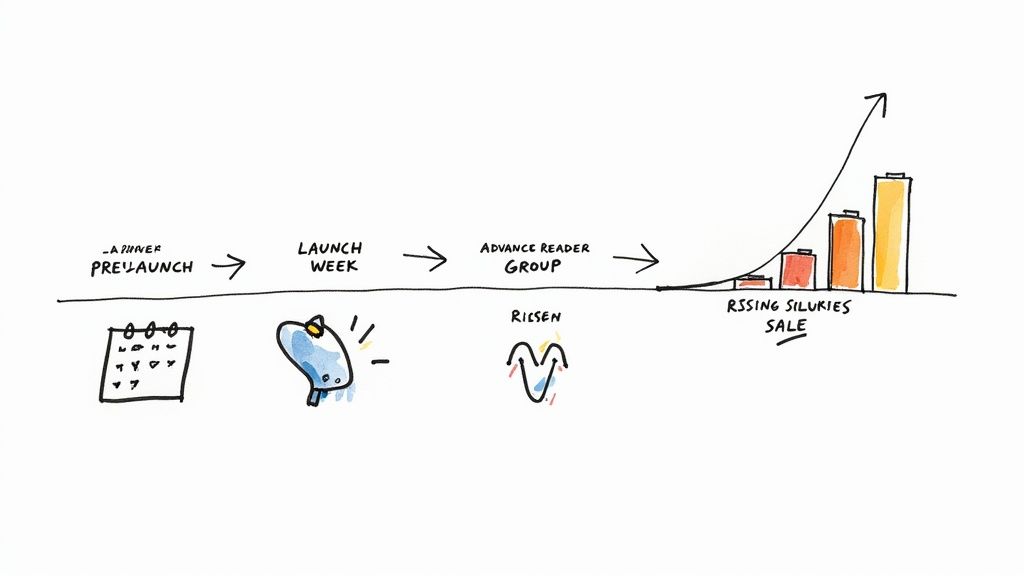
A successful launch isn’t about luck; it’s about strategically building momentum before, during, and after your book goes live. Think of it as a campaign with a beginning, middle, and end, where each stage serves a specific purpose. The real goal is to create a system that keeps bringing in new readers long after the initial excitement of launch week fades.
The Crucial Pre-Launch Phase
What you do in the weeks and months before your ebook is even for sale will have the single biggest impact on its success. This is where you prime the pump, build anticipation, and gather the social proof you need to convince total strangers to take a chance on your work.
Your two most critical assets during this phase are your email list and your advance review team.
Build Your Email List: This is the only audience you truly own. Start gathering potential readers by offering a valuable freebie—a "lead magnet"—related to your book's topic. For fiction authors, this could be a free short story; for non-fiction, a helpful checklist or template works wonders.
Assemble an Advance Review Team (ARC Team): These are your superfans. They're the eager readers who get a free, early copy of your ebook in exchange for posting an honest review on launch day. You can manage this with platforms like Booksprout or even a simple sign-up form on your website. Those early reviews are absolutely vital for triggering platform algorithms and building trust with new buyers.
Your launch begins the moment you start talking about your book, not the day it goes on sale. The pre-launch phase is your opportunity to turn passive followers into an active, engaged audience ready to buy on day one.
Crafting Your Launch Week Strategy
Launch week is all about one thing: sales velocity. This is the speed and volume of your sales in a very short window. High sales velocity signals to platforms like Amazon that your book is popular, which in turn nudges their algorithms to show it to more people.
A focused plan for that first week might include:
Announcing to Your Email List: Your subscribers should be the very first people to know the book is live, and you should reward them for their loyalty with a special launch-day price.
Coordinated Social Media Push: Plan your posts for the entire week. Use engaging graphics, share some behind-the-scenes content, and always include a clear call to action directing people to the sales page.
Leveraging Promotional Newsletters: Services like BookBub, Freebooksy, or Fussy Librarian have massive email lists packed with avid readers. Landing a promotion with one of them during launch week can drive thousands of downloads and sales.
The intense activity of launch week is designed to create a big spike in visibility, helping your book climb the charts in its categories. Once you have that foothold, you can shift into more sustainable, long-term marketing. For a deeper dive, our guide on launching your first digital product offers more detailed strategies to make your release a success.
Sustaining Momentum with Long-Term Marketing
A strong launch is fantastic, but the real goal is to build a marketing system that sells your book month after month. This means moving beyond one-off promotions and building evergreen channels that consistently attract new readers without your constant attention.
Consider weaving these long-term tactics into your plan:
Running Targeted Ads: Platforms like Amazon Ads and Facebook Ads let you put your book directly in front of readers who have shown interest in your genre or similar authors. You can start with a small daily budget to test what works before scaling up.
Content Marketing: Create content related to your book's themes. This could be blog posts, YouTube videos, or even a podcast. Over time, this builds your authority and naturally attracts your ideal audience.
Author Collaborations: This is a powerful, often overlooked strategy. Partner with other authors in your genre for newsletter swaps or social media cross-promotions to tap into an established and highly relevant audience.
The modern ebook market represents a massive opportunity. By 2025, projections show that around 13.7% of the global population—roughly 1 billion people—will be using eBooks. But the competition is staggering. Only an estimated 0.01% of books sell over 100,000 copies each year, which shows just how tough it is to stand out. You can learn more about these book sales statistics and the competitive landscape to better understand why a solid marketing plan isn't just optional—it's essential.
Common Ebook Self Publishing Questions
Jumping into the world of self-publishing always kicks up a storm of questions. From costs and timelines to the legal nuts and bolts, getting straight answers is the only way to move forward with any real confidence. Let's cut through the noise and tackle the most common questions I hear from aspiring authors, giving you practical advice for your journey.
How Much Does It Really Cost to Self Publish an Ebook?
The honest answer? Your cost can be anything from nearly zero to several thousand dollars. While your budget can be flexible, your investments need to be strategic. The two areas you absolutely cannot afford to cut corners on are professional editing and cover design—they directly impact sales and reader trust more than anything else.
Here’s a realistic look at what you might spend:
Professional Editing: This is usually the biggest line item, running anywhere from $500 to $3,000. The final price tag depends on your manuscript's length and the level of editing it needs (developmental, copy, or just a final proofread).
Cover Design: A high-quality, genre-appropriate cover can cost between $150 and $800. Think of this as your single most important marketing tool. It has to be good.
Formatting: You can use free tools like Kindle Create, but many authors pay a few hundred dollars for professional formatting to get that flawless, polished look across all devices.
It’s tempting to bootstrap the entire project, but a book that looks professional signals quality to potential readers before they've even read a word.
Do I Actually Need an ISBN for My Ebook?
This is a huge point of confusion, and the answer comes down to your distribution goals. An ISBN (International Standard Book Number) is a unique identifier for your book, but it's not always a must-have.
If you only plan to publish on Amazon KDP, you can get away with using their free ASIN (Amazon Standard Identification Number). It works perfectly within the Amazon ecosystem. No problem there.
However, if you want to distribute your ebook "wide"—meaning you'll sell it on platforms like Apple Books, Kobo, and Barnes & Noble—then you absolutely need an ISBN. Aggregators like Draft2Digital might offer a free one, but purchasing your own from an agency like Bowker makes you the official publisher of record. This gives you far more control over your book's metadata down the road.
Owning your ISBN is about long-term control. It ensures your book's identity is tied to you, the publisher, not the distributor you happen to be using at the moment.
How Do I Copyright My Self Published Ebook?
Protecting your intellectual property is a non-negotiable step. In the United States and many other countries, your work is legally copyrighted the moment you write it down and save it in a tangible form (like a Word doc).
But that automatic copyright doesn't give you full legal muscle. To truly protect yourself, you need to formally register your copyright with the U.S. Copyright Office. It's an inexpensive but critical step.
Here's why formal registration is so important:
It creates a public record that you are the owner.
It's a legal prerequisite if you ever need to sue someone for infringement.
It gives you stronger legal recourse if someone decides to steal your work.
You can handle the entire registration process online for a small fee. Just think of it as an affordable insurance policy for all the hard work you've poured into your book.
What Is a Realistic Timeline to Self Publish an Ebook?
One of the best parts of self-publishing is that you control the clock. Once your manuscript is finished, the production phase—editing, cover design, and formatting—is where the timeline varies the most. This stage can take anywhere from two to six months, mostly depending on the availability of the pros you hire.
The actual upload process to a platform like Amazon KDP is shockingly fast; your book can be live in under 72 hours. But a strategic launch is different. That often includes a pre-order period of several weeks or months to build buzz and anticipation.
The biggest mistake I see new authors make is rushing, especially the editing. A rushed book feels unprofessional and amateurish, and it's a surefire way to get hammered with bad reviews. Give each stage the time it deserves. You'll end up with a high-quality ebook you can actually be proud of.