Guide
How to Create Membership Site: A Step-by-Step Guide to Thrive

Building a membership site really breaks down into four big moves: planning out your niche and value, choosing the right platform (like WordPress with a good plugin), creating all your exclusive content, and finally, launching it to your audience.
But here’s the thing: real success is all about what you do before you ever touch the tech. It’s about building a rock-solid strategic foundation first.
Building Your Membership Site Foundation
Before you dive headfirst into comparing software features or sketching out logos, let's hit pause for a second. The membership sites that truly thrive aren't built on flashy tech. They're built on a deep, almost obsessive understanding of a specific audience and a crystal-clear promise to change their lives for the better.
Your first, most critical job is to lay this strategic groundwork. This is where you turn a fuzzy idea into an actual business plan.
Too many creators get excited and jump straight to picking a platform, only to realize they've built a beautiful, empty house. They never figured out who their ideal member is, what keeps them up at night, or what kind of solution they'd happily pull out their credit card for.
Don't be that person. The foundation is everything.
Pinpoint a Niche Where Passion Meets Demand
The sweet spot for your membership site lives at the intersection of three key things:
Your Expertise and Passion: What could you talk about for hours? What skills do you have that other people want to learn? Authenticity is your secret weapon, and you can only keep it up if you genuinely love the topic.
A Definable Audience: Who are you actually helping? "Everyone" is the fastest path to failure. Get specific. Are you helping freelance graphic designers land bigger clients? Teaching busy parents how to cook healthy 30-minute meals?
A Proven Market Need: Here’s the big one—are people already spending money to solve the problem you want to address? Look for existing courses, coaching programs, popular books, or buzzing online communities in your potential niche. Think of this as validation, not competition.
A perfect example is a yoga instructor who decides to specialize. Instead of a generic "yoga membership," they could launch a site for "Yoga for Office Workers," focused entirely on relieving the back pain and stress that comes from sitting at a desk all day. It’s specific, it targets a clear pain point, and it serves a defined audience with disposable income. Nailed it.
Get Inside the Mind of Your Ideal Member
Once you've got your niche, your next mission is to become an expert on your ideal member. You need to understand their world so well that when they read your sales page, it feels like you're reading their mind. This goes way beyond basic demographics like age and location.
You need to dig deeper into their psychographics:
What are their biggest frustrations related to your niche?
What goals are they desperately trying to achieve?
What have they already tried that just didn't work?
What specific words and phrases do they use to describe their problems?
Pro Tip: Don't just guess. Go where your audience hangs out online—Reddit, Facebook Groups, forums, or Quora. Be a fly on the wall. Pay close attention to the questions they ask and the challenges they vent about. This is a goldmine of unfiltered customer research.
The insights you uncover here will shape every single thing that comes next, from your content calendar to your pricing tiers.
Craft a Compelling Value Proposition
With a clear picture of your audience's pain points, you can finally craft your value proposition. This is a simple, powerful statement that explains the unique benefit you deliver. It has to instantly answer the question, "Why should I join this membership and not another one?"
Your value proposition isn’t a list of features like "access to 50 videos." It’s all about the outcome or the transformation you promise.
Here's the difference:
Weak Value Proposition: "Get monthly yoga videos and a community forum."
Strong Value Proposition: "Relieve chronic back pain and reclaim your energy in just 15 minutes a day, alongside a supportive community of fellow professionals."
Getting this right is absolutely vital. The subscription economy is exploding, which means it’s easier than ever to start, but also harder than ever to stand out. The subscription e-commerce market was valued at around USD 199.41 billion in 2023 and is projected to hit a staggering USD 2,227.63 billion by 2028. You're stepping into a massive arena, and a razor-sharp value proposition is how you carve out your space.
You can dig into the numbers and see this incredible growth for yourself in the market analysis on MemberPress.
Choosing Your Membership Platform and Tech Stack
Picking the right technology for your membership site is a huge decision. Honestly, it’s one of the most important ones you’ll make. Your platform will either feel like a great business partner, making your life easier, or it'll become a source of daily tech headaches. Get this right, and you can focus on your members. Get it wrong, and you'll be fighting with your tools.
The goal is to land on a system that matches your budget, your comfort level with tech, and where you see your business going in a few years. The market is crowded, but your options really boil down to two main paths.
All-in-One Platforms vs. WordPress Plugins
All-in-one platforms like Podia or Kajabi are like leasing a fully furnished, professionally managed apartment. Everything is included in one monthly package: content hosting, payment processing, email marketing, landing pages... you name it. This is usually the best route for beginners who just want to get started quickly without becoming a part-time web developer.
Using a WordPress plugin like MemberPress, on the other hand, is like owning your own house. You have total control and the freedom to customize every last detail. You pick your own hosting, your theme, and all the best-in-class tools you want to integrate. The trade-off? You're responsible for the setup and ongoing maintenance. This approach gives you way more flexibility and can be more cost-effective as you scale.
Of course, before you even get to this point, you need to be crystal clear on your niche. This flowchart can help you figure out where your passion and a real market need come together.
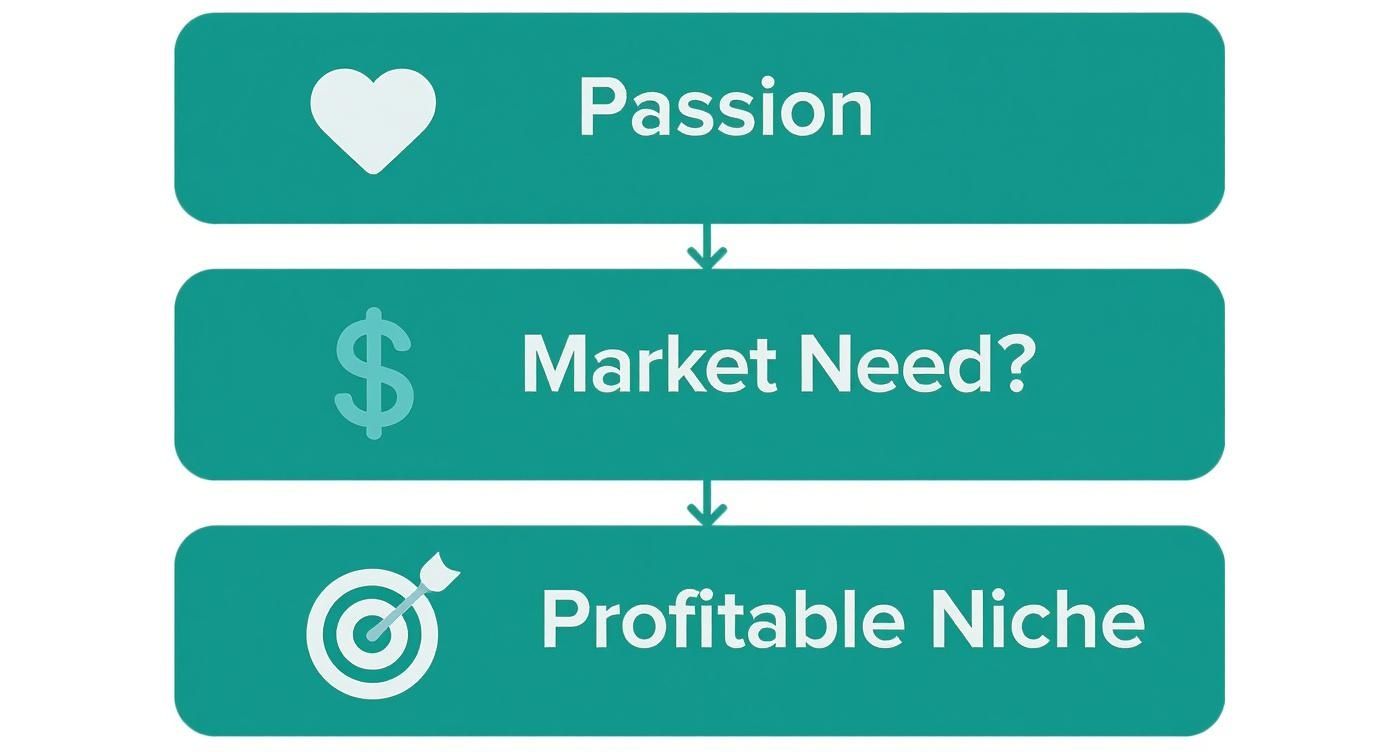
Having a solid, profitable niche is the foundation—you can't build a house, or choose the right tools, without it.
As you weigh your options, it's smart to compare website builder platforms like Wix, Squarespace, and WordPress. For anyone wanting deep customization, WordPress is often the top choice because of its massive ecosystem of powerful plugins.
Comparing Popular Membership Site Platforms
To give you a clearer picture, I've put together a quick comparison of some of the leading platforms. This should help you see how they stack up based on what matters most for a membership business.
Platform | Type | Best For | Key Features | Pricing Model |
|---|---|---|---|---|
Kajabi | All-in-One | Creators selling courses, coaching, and community in one place. | Integrated website, CRM, email, funnels, and mobile app. | Subscription |
Podia | All-in-One | Beginners and solopreneurs wanting simplicity and affordability. | Unlimited products, email marketing, affiliate tools, no transaction fees. | Subscription |
MemberPress | WordPress Plugin | Entrepreneurs who want maximum control and customization on a WordPress site. | Content dripping, powerful access rules, LMS features, coupons. | Annual License |
Mighty Networks | Community Platform | Businesses where community and engagement are the core offer. | Live events, chat, courses, and member profiles in a dedicated app. | Subscription |
Choosing the right platform is about finding the best fit for your specific vision. An all-in-one might be perfect for a quick launch, while a WordPress setup offers the freedom to grow and adapt for years to come.
Must-Have Features for Any Platform
No matter which path you take, some features are simply non-negotiable for running a successful membership site. As you review your options, make sure your chosen platform nails these core functions.
Content Dripping: This lets you release content to members over time (like a new module each week). It's a fantastic way to prevent overwhelm and keep people engaged month after month.
Tiered Access Levels: You absolutely need the ability to create different membership tiers (e.g., Bronze, Silver, Gold) and restrict content based on a member's level.
Payment Gateway Integration: The system must connect seamlessly and securely with trusted processors like Stripe and PayPal. Recurring subscription payments need to be smooth and reliable.
Email Marketing Integration: Your platform has to talk to your email service provider (like ConvertKit or Mailchimp). This automates adding new members to the right email lists and sending critical communications.
The technology is always changing, and that makes your platform choice a critical long-term investment. Many of the same principles apply if online courses are a big part of your plan. If that’s you, check out our guide on the best course platforms for selling digital products.
At the end of the day, the best tool is the one that lets you focus on creating amazing content and serving your community, not battling your tech stack.
Developing Your Content and Community Strategy
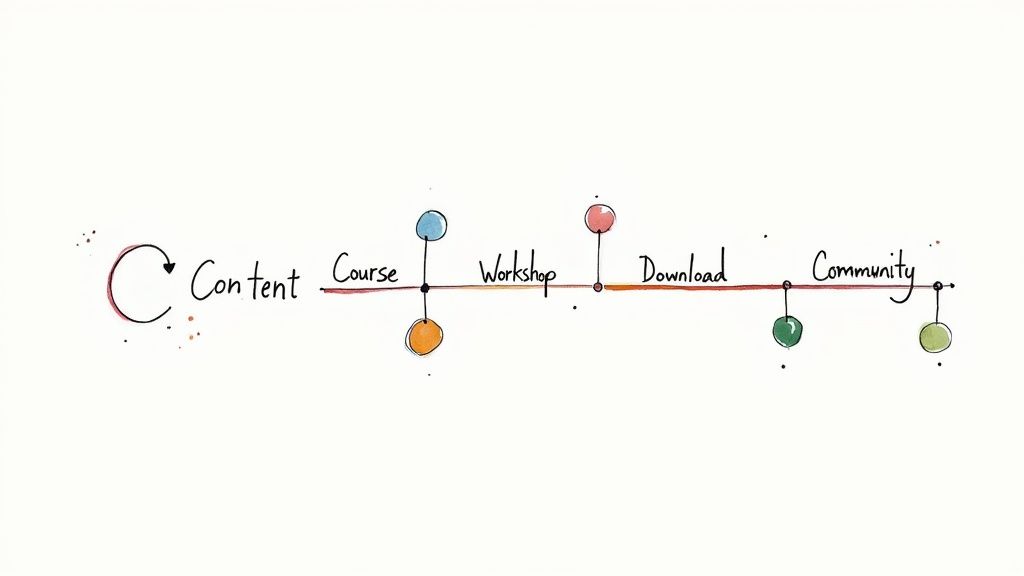
Let's be honest: your platform is just the stage. The real show—what people actually pay for—is your content and community. This is what keeps them coming back long after that initial sign-up excitement wears off. A membership that lasts isn't a one-time transaction; it's an ongoing experience.
So, let's move past the theory and build the playbook for an experience that's actually worth that recurring subscription fee. It all comes down to a smart mix of killer resources and a space where your members feel like they truly belong.
Architecting Your Content Ecosystem
Before you even think about creating something new, map out the structure. Just throwing a bunch of downloads and videos behind a paywall won't work. You need a deliberate plan that guides members toward the transformation you promised them.
Your content needs to serve different needs at different times. I've found the best way to organize this is to think in categories:
Cornerstone Content: This is your big, foundational material. It could be your signature online course, a comprehensive workshop series, or maybe an in-depth certification program that delivers a massive win for your members.
Ongoing Value Content: These are the regular drops that keep people engaged month after month. Think weekly Q&A calls, monthly expert interviews, new templates, or timely case studies that keep things fresh.
Quick-Win Resources: These are the small, easily digestible assets that solve an immediate problem. We're talking checklists, cheat sheets, scripts, and short video tutorials that offer instant gratification.
This mix is powerful for retention. It gives new members a clear path to follow with your cornerstone content, while your seasoned members always have fresh, ongoing value to look forward to.
A key tactic I've seen work wonders is to strategically drip your content. Instead of unlocking everything at once (which is totally overwhelming), release modules or resources on a set schedule, like weekly. This keeps members hooked and reduces the risk of someone downloading everything and canceling right away.
Planning Your Content Delivery Cadence
Consistency is everything. A predictable content schedule gives members something to anticipate and builds a habit of logging into your site. An erratic, "whenever I feel like it" flow of new material is a surefire way to cause disengagement and churn.
A simple content calendar can make all the difference. For instance, your schedule might look something like this:
First Week of the Month: Drop a new expert masterclass video.
Second Week: Host a live Q&A session to dig into the masterclass.
Third Week: Publish a detailed case study related to the month's theme.
Fourth Week: Release a new downloadable toolkit with templates and checklists.
This kind of structure sets clear expectations. It shows members that your membership is an active, evolving resource and that you’re continually investing in their success—a powerful reason for them to keep investing in you.
Fostering a Thriving Community Hub
Content gets them in the door, but community is the glue that makes them stay. It’s where your members connect, collaborate, and find the support they need to actually use what they're learning. That sense of belonging is something your competitors can't easily replicate.
First, you need to pick the right "venue" for your community. You could go with a built-in forum on your membership platform, a dedicated tool like Circle or Mighty Networks, or even a well-managed Discord or Slack server. The trick is to choose a platform where your audience already feels comfortable.
Of course, just creating the space isn't enough; you have to actively nurture it. If you want to go really deep on this, our guide on how to grow an online community is packed with actionable strategies.
To get started, focus on sparking those initial conversations and making every single member feel heard. Introduce daily or weekly conversation prompts, celebrate member wins publicly, and make a point to personally welcome every new person who joins. These small, consistent actions are what transform a quiet forum into a vibrant, active hub.
Setting Up Payments and Protecting Content
Alright, you've got your content strategy dialed in. Now it's time to hook up the financial engine of your membership. This part is all about two critical, connected pieces: getting paid smoothly and making sure only paying members can access your premium content.
Nailing this is what turns your expertise into a real, sustainable business.
First things first, you need a solid payment gateway. This is the service that handles the credit card transactions and puts the money into your bank account. For most of us, this decision boils down to the two heavyweights: Stripe and PayPal.
Both are great, but they shine in slightly different ways. Stripe is famous for its powerful developer tools and an on-site checkout experience that just feels seamless, which can definitely help boost conversions. We did a full breakdown on the benefits of using Stripe if you want to go deeper. PayPal, on the other hand, brings that globally recognized brand trust, which can make some customers feel more comfortable hitting "buy."
The good news is that nearly every membership platform plays nicely with both.
Structuring Your Subscription Plans
With your payment gateway connected, it's time to set up your membership tiers. This is where you translate all that value you're offering into clear, attractive price points. The simplest and most effective approach is to offer both monthly and annual options.
Monthly Plans: These are perfect for lowering the barrier to entry. It's an easier "yes" for someone new who isn't ready for a big financial commitment.
Annual Plans: This is your secret weapon for healthy cash flow and member loyalty. The classic move is to offer a discount—something like "get two months free"—for anyone who pays for the year upfront.
Another fantastic way to get people in the door is with a free trial. Offering a 7-day or 14-day trial gives potential members a risk-free peek behind the curtain. It's their chance to see the value for themselves, and that firsthand experience can do wonders for your sign-up rate. Just make sure your onboarding is on point so they feel that value right away.
Key Takeaway: Your pricing is more than just a number—it’s a signal of the transformation you provide. An annual plan with a discount isn't just about saving your member money; it's about encouraging them to commit to their own growth and to your community.
Implementing Content Gating and Access Rules
The last piece of this puzzle is content gating, or what some people call setting access rules. This is the techy part where you restrict content so that only members with the right subscription can see it. Think of it as the digital velvet rope that protects your hard work.
Your membership platform should make this pretty simple. You'll essentially create rules that tie specific pieces of content to your different membership tiers.
For instance, you could set it up like this:
Bronze Members: Get access to the community forum and the monthly newsletter.
Silver Members: Get everything in Bronze, plus your full library of on-demand video workshops.
Gold Members: Get all Silver benefits, plus exclusive live Q&A sessions and your one-on-one coaching templates.
This kind of setup ensures every member gets exactly what they signed up for—no more, no less. It automates the whole experience. When someone joins the Gold tier, the system instantly unlocks all the right content without you having to do a thing. That automation is what allows you to scale without burning out.
Creating a Welcoming Member Onboarding Experience
The moment a new member signs up, a clock starts ticking. Those first few days are your golden opportunity to turn their initial excitement into genuine loyalty. I've seen it time and time again—a poor or nonexistent onboarding process is one of the top reasons for early cancellations. Getting this part right is absolutely critical for long-term success.
Your goal is simple: make new members feel seen, smart, and successful as quickly as possible. This isn’t just about a "thank you for joining" email; it's a strategic sequence you design to guide them straight to the value they signed up for.
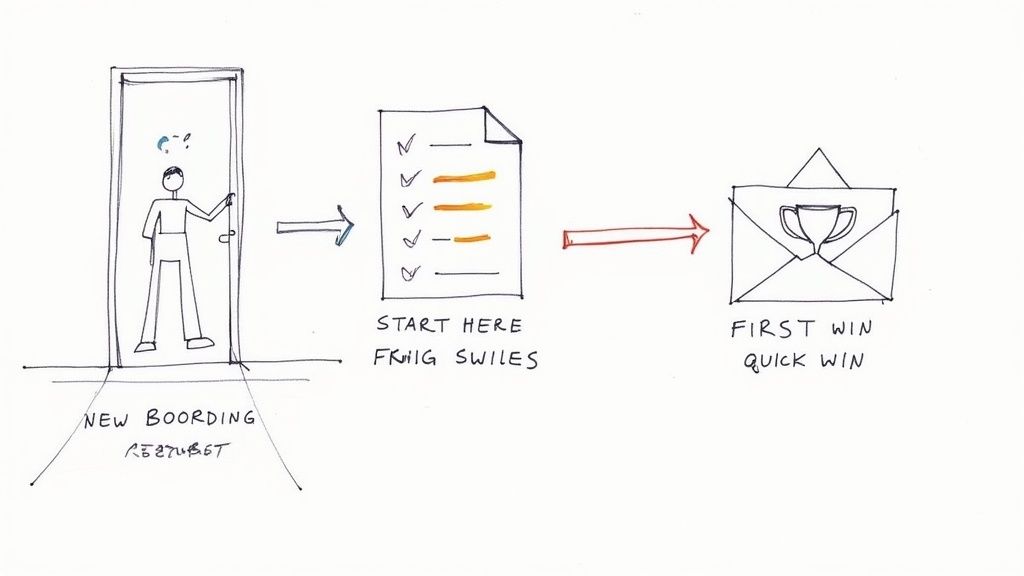
This is more important than ever. While renewal rates for membership sites are healthy—hovering around a median of 84%—new member acquisition has actually slowed down. To fight this, a killer onboarding process is your best weapon to convert fresh signups into engaged, long-term subscribers from day one. Digging into the latest membership marketing benchmarks makes it crystal clear why retention is so vital right now.
Crafting the Perfect Welcome Email Sequence
An automated welcome email sequence is your best friend here. It works for you 24/7, making sure every new member gets a consistent and helpful introduction. Your sequence shouldn't just be informative; it needs to be motivational.
Here’s a proven three-part welcome flow I've used with great results:
The Immediate Welcome (Sent within 5 minutes): This email confirms their purchase and gives them their login details. Crucially, it must also point them to one single action to take right now, like visiting the "Start Here" page. Keep it simple.
The "Quick Win" Guide (Sent on Day 2): Now, you highlight a simple resource that solves a small, immediate problem. This could be a downloadable checklist, a short tutorial video, or a popular forum thread. Give them an easy win.
The Community Nudge (Sent on Day 4): Gently encourage them to introduce themselves in the community forum. Provide a simple prompt to make it easy, like "Share the #1 thing you're hoping to achieve."
Designing a "Start Here" Guide
Don't ever make new members hunt for value. You need a dedicated "Start Here" or "Welcome" page that acts as a central hub for anyone who just joined. This page sets clear expectations and prevents that dreaded feeling of being overwhelmed.
Your "Start Here" guide should be less of a manual and more of a treasure map. Its sole purpose is to point members directly to the most valuable, high-impact areas of your site first.
Think of it as a guided tour. Your guide should clearly outline the first three things a new member should do. For example:
Watch the 2-minute welcome video: A personal message from you builds an instant connection.
Download the Success Path PDF: A visual roadmap of the journey they're about to take.
Join our private community: Provide a direct link and a warm invitation.
To give members instant answers and cut down on your support tickets, think about implementing some strategies for how to create a knowledge base that drives self-service. This can be a fantastic supplement to your onboarding, letting members find answers to common questions on their own time.
By front-loading value and showing them exactly how to succeed, you build momentum that keeps them engaged and subscribed for the long haul.
So, you’ve built your membership site. The content is ready, the tech is humming along, and you're feeling good. It’s easy to think the hard part is over, but in reality, your launch isn't the finish line—it's the starting gun.
Getting the site live is one thing. Turning it into a thriving, long-term business? That comes down to a smart, ongoing plan for marketing and retention. This is where your focus has to shift from building to growing.
A powerful launch actually begins long before you open the doors. One of the most effective things you can do is build a pre-launch waitlist. Start teasing your upcoming content, share some behind-the-scenes progress, and offer a special "founder's rate" just for those early subscribers. This not only proves people want what you're making but also ensures you have paying members from day one.
Choosing Your Launch Model
When it's time to officially go live, you have two main models to think about. The path you choose here will shape your marketing efforts for months, so it’s worth getting right.
The "Open/Close Cart" Model: This approach creates a ton of urgency by only opening enrollment for a short window, maybe just a few times a year. It's fantastic for generating a massive burst of signups and buzz because people are driven by a fear of missing out (FOMO).
The "Evergreen" Model: With an evergreen setup, your membership is always open for new signups. This provides a steady, more predictable stream of revenue and is often easier to manage long-term since it relies on consistent marketing rather than intense, high-pressure launch campaigns.
A lot of creators I've seen have great success starting with an open/close cart launch to build that initial excitement. Once they have a solid member base, they often transition to an evergreen model to keep the momentum going.
Shifting to Sustainable Growth
After that first launch rush, the real work begins. Growing your membership requires a multi-channel approach to attract a steady flow of new people while keeping your current community engaged and happy. Your strategy needs to be a blend of attracting new leads and delighting the members you already have.
The most successful memberships are built on a foundation of continuous value. Your marketing shouldn't stop once someone signs up; it should evolve into a retention strategy that makes members feel like insiders who can't imagine leaving.
Here are a few proven tactics that work for consistent growth:
Content Marketing: Get into a rhythm of publishing high-value blog posts, videos, or podcast episodes related to your niche. This is how you position yourself as an authority and attract your ideal members through search and social media.
Targeted Advertising: Don't be afraid to put some money behind your marketing. Using platforms like Facebook or Google Ads lets you reach specific audiences who are a perfect fit for what you offer.
Affiliate Partnerships: This is a huge one. Collaborate with other creators in your space who serve a similar audience. Offering them a commission for every new member they refer is a powerful, performance-based way to grow that can scale incredibly well.
Got Questions? We've Got Answers
When you're first mapping out a membership site, a ton of questions always come up. It's totally normal to wonder about the costs, how much content you really need, and what to charge before you dive in too deep.
Let's clear the air and tackle the most common questions I hear.
How Much Does It Cost to Start a Membership Site?
Honestly, your initial investment can be anything from less than $100 to several thousand dollars. It all comes down to the tech you choose.
If you're on a budget, you can get up and running with a WordPress plugin like MemberPress. Combine that with basic hosting and a domain, and you’re looking at around $200-$400 for the whole first year.
On the other end, all-in-one platforms like Kajabi or Podia are more convenient but carry a higher price tag, usually starting around $150-$400 a month. No matter which path you take, your main costs will always be the platform software, web hosting, and an email marketing service.
How Much Content Do I Need Before Launching?
You don't need a massive library to go live. Not even close. The real goal is to have enough "foundational" content to deliver immediate value and make that first month's subscription feel like a steal.
This could be as simple as a single signature course, a handful of high-impact workshops, or a resource library with 5-10 must-have downloads.
It’s far more important to have a clear content plan for the next three to six months than it is to have everything created on day one. This signals to new members that your site is a living, growing resource worth sticking around for.
What Is the Best Way to Price My Membership?
Pricing is part art, part science. It’s a mix of your niche, the transformation you promise, and what your audience can comfortably afford. A tiered pricing model is a proven strategy that works wonders.
Here’s a common breakdown:
Basic Tier ($15-30/month): Usually gets you community access and some of the core content.
Pro Tier ($40-70/month): The sweet spot. This typically unlocks the full content library and live Q&A sessions.
Premium Tier ($99+/month): This level might add personal coaching, direct access, or other high-touch perks.
Take a look at what similar memberships are charging, but ultimately, price your tiers based on the specific value and results you deliver.
How Can I Prevent Members from Canceling?
Keeping members from hitting that "cancel" button boils down to two things: continuous value and deep engagement.
First, your onboarding has to be stellar so new members know exactly how to get a quick win. Second, you need to add new, relevant content on a predictable schedule they can count on.
Third, and maybe most importantly, you have to build a strong community where members feel connected to you and each other. Actively ask for feedback with surveys and actually implement their suggestions. Offering a discount for annual plans is another killer tactic to lock members in and boost retention right from the start.