Explained
10 Powerful Content Repurposing Strategies to Scale Your Business in 2026

In the world of entrepreneurship, creating high-quality content is only half the battle. The other, often overlooked half, is making sure that content works as hard as you do. Constantly being on the content creation hamster wheel leads to burnout, but what if you could multiply the impact of a single blog post, video, or podcast into a dozen different assets? This is the core power of a smart content repurposing strategy. It's not about being lazy; it's about being strategic.
By transforming your core content into various formats tailored for different platforms, you not only save hundreds of hours but also achieve critical business goals. This approach allows you to reach new audience segments where they spend their time, reinforce your core message through repetition, and build a powerful, omnipresent brand that feels like it’s everywhere at once. It’s the ultimate leverage for small teams and solo entrepreneurs who need to maximize their output without sacrificing quality or sanity.
This comprehensive guide moves beyond theory and dives straight into execution. We will break down 10 proven content repurposing strategies, complete with step-by-step workflows and real-world examples, designed specifically for coaches, creators, and entrepreneurs ready to work smarter, not harder. To gain further insights and specific examples of how to achieve this, explore these 10 actionable content repurposing strategies that can help scale your business. Get ready to unlock the true potential of the content you've already created and turn every piece into a long-term asset for your brand.
1. Blog Post to Social Media Content
Transforming a single, in-depth blog post into a diverse array of social media assets is one of the most efficient content repurposing strategies available. This foundational tactic allows you to take your most valuable, long-form content and break it down into digestible, platform-specific formats that capture attention and drive traffic back to your website. Instead of creating new social content from scratch, you leverage the research and insights you've already compiled.
This approach works because it meets your audience where they are, tailoring the same core message for different consumption habits. What resonates as a comprehensive guide on your blog can become a visually engaging carousel on Instagram, a professional text-based thread on LinkedIn, or a quick, punchy quote graphic on Twitter.
How to Implement This Strategy
To effectively convert your blog content, focus on extracting the most compelling elements. A 2,000-word article is a goldmine of potential micro-content. Start by identifying the main takeaways, surprising statistics, actionable tips, and powerful quotes within the piece.
Here is a simple workflow:
Identify Core Assets: From one blog post, pull out 5-7 key ideas. These can be subheadings, bullet points, or core arguments.
Create Visuals: Use a tool like Canva to design graphics for each key idea. Create quote cards for impactful statements, infographics for data, and multi-slide carousels to explain a process.
Write Platform-Specific Captions: Tailor your messaging. For LinkedIn, write a professional, thought-provoking caption. For Instagram, use a more conversational tone with relevant hashtags. For Twitter, create a thread that expands on each point.
Schedule and Distribute: Use a scheduling tool to spread these posts out over several weeks. This gives one blog post an extended lifespan and ensures consistent visibility. Always include a clear Call-to-Action (CTA) prompting followers to read the full article.
This method not only saves immense amounts of time but also reinforces your authority by consistently sharing valuable insights. It’s a crucial first step in building a cohesive content ecosystem that is foundational to any successful content strategy. To further refine your approach, you can learn more about creating a content strategy on entrepedia.co.
2. Long-Form Content to Video Content
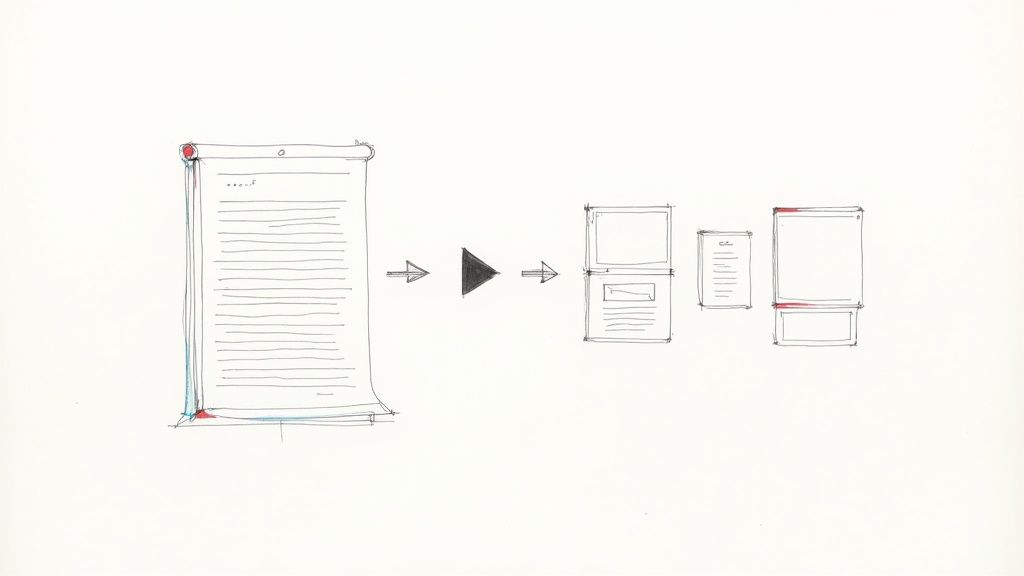
Transforming comprehensive written guides, whitepapers, or blog posts into engaging video content is a powerful way to tap into the massive and growing audience that prefers watching over reading. This strategy allows you to take your deeply researched long-form content and give it new life in a dynamic, visual medium, from in-depth YouTube tutorials to bite-sized social media clips. It's one of the most effective content repurposing strategies for reaching a broader demographic.
This approach works exceptionally well because video excels at building a personal connection and simplifying complex topics. A detailed guide on your blog can become an approachable explainer video on YouTube, a high-value webinar, or a series of engaging tips for TikTok and Instagram Reels, capturing attention in a way that text alone often cannot.
How to Implement This Strategy
To successfully convert written content into video, focus on creating a narrative structure that suits a visual format. Instead of just reading your article aloud, think about how you can show, demonstrate, and illustrate your key points. The goal is to translate information into a compelling viewing experience.
Here is a simple workflow:
Script and Storyboard: Outline your video script by pulling the main headings and key takeaways from your long-form piece. Create a simple storyboard to plan your visuals, B-roll, and on-screen text.
Choose a Video Format: Decide on the best format. A how-to guide is perfect for a YouTube tutorial, a research-heavy whitepaper can become a webinar, and a list-based article can be broken down into a series of short-form videos.
Record and Edit: Film your primary content and gather supplementary visuals like screen recordings, stock footage, or animations. Edit the video to be concise and engaging, adding captions for accessibility and improved viewer retention.
Optimize and Distribute: Upload your video to platforms like YouTube with keyword-optimized titles, descriptions, and tags. Extract short, impactful clips from the main video to share as Reels, Shorts, and TikToks to drive traffic to the full-length version.
This method maximizes the reach of your best ideas and positions you as an expert across multiple platforms. By catering to visual learners, you can significantly expand your audience and build a stronger community. To create professional-quality videos, you can explore the best video tools for marketing your digital products on entrepedia.co.
3. Podcast Episode Transcription and Distribution
Repurposing a single podcast episode into multiple content formats is a powerful strategy to maximize the return on your production efforts. This method involves taking your audio content and transforming it into written articles, video clips, and social media assets, ensuring your message reaches audiences who prefer reading or watching over listening. By transcribing and deconstructing an episode, you unlock a wealth of material without starting from scratch.
This approach works by catering to diverse content consumption habits and platform algorithms. A deep-dive interview that thrives on audio can be converted into a skimmable blog post for SEO, a compelling video clip for YouTube, or a series of insightful quote graphics for Instagram. This extends the life and reach of each episode far beyond its initial publication.

How to Implement This Strategy
To effectively repurpose your podcast, begin with a clean transcription. This document becomes the source material for all subsequent assets. Focus on identifying the most valuable, shareable, and impactful moments from the conversation to create a cohesive content distribution plan.
Here is a simple workflow:
Transcribe the Episode: Use a service or AI tool like Riverside.fm or Descript to generate a full text transcription of your audio. Clean it up for readability and accuracy.
Create a Blog Post: Structure the transcription into a comprehensive blog post. Use subheadings for key topics, embed the audio player, and include timestamps that link directly to specific moments in the episode. This is one of the most effective content repurposing strategies for boosting SEO.
Extract Micro-Content: Identify 3-5 powerful quotes, surprising statistics, or actionable tips from the transcript. Use a tool like Canva to turn these into visually appealing quote graphics for social media.
Produce Video and Audiograms: Pull short, engaging 30-60 second clips from the episode to create video snippets for YouTube Shorts, Instagram Reels, and TikTok. For audio-only content, create audiograms with moving waveforms to capture attention in social feeds.
Leverage for Email: Use the episode’s main takeaways as the core content for your next email newsletter. You can feature a key insight, link to the full blog post, and encourage subscribers to listen to the episode.
This strategy ensures that the significant time and resources invested in producing a podcast generate value across all your marketing channels, solidifying your expertise and engaging your community on their preferred platforms.
4. Webinar and Live Event Content Repurposing
Transforming a high-effort webinar or live event into a library of evergreen assets is one of the most powerful content repurposing strategies for maximizing return on investment. This approach takes a single, time-intensive broadcast and multiplies its value, turning it into on-demand courses, highlight reels, social media teasers, and downloadable resources that serve your audience for months or even years. Instead of letting your live content disappear, you leverage its authority and depth to fuel your entire marketing ecosystem.
This strategy works by capturing the energy and expertise of a live presentation and repackaging it for different contexts and consumption habits. A one-hour educational webinar can become a lead-nurturing email course, a series of short, impactful video clips for social media, or a premium mini-course for your audience. This extends the lifespan of your best content far beyond the initial broadcast date.
How to Implement This Strategy
To effectively repurpose your live content, begin with high-quality recording and a clear plan for segmentation. The goal is to identify distinct, valuable moments within the larger presentation that can stand on their own. For example, a webinar on digital marketing could yield standalone clips on SEO, social media, and email marketing.
Here is a simple workflow:
Segment the Recording: Watch the full recording and identify key chapters, modules, or powerful talking points. Create timestamps for each distinct topic.
Create Highlight Reels and Clips: Edit the best moments into a 2-3 minute highlight reel to use as a promotional asset. Create shorter, 30-60 second clips of individual tips or insights to share on platforms like Instagram Reels, TikTok, and LinkedIn.
Develop a Companion Resource: Package the key takeaways, slides, and links mentioned into a downloadable PDF. This serves as a valuable lead magnet and a useful tool for attendees.
Build an Email Nurture Sequence: Break the webinar content into a series of 5-7 educational emails. Each email can cover one key topic from the presentation and include a short video clip, nurturing new leads over time. Always include a CTA to watch the full on-demand replay.
This method establishes you as a definitive expert by continuously sharing valuable, in-depth knowledge. It’s a cornerstone for any brand, like HubSpot Academy or Teachable, that uses educational content to build trust and drive conversions.
5. Infographics and Data Visualization
Transforming dense research, data-heavy reports, or complex blog posts into compelling infographics is a powerful content repurposing strategy. This tactic translates complicated information into a visually engaging and easily digestible format, making it far more accessible and shareable for a broad audience. Instead of asking readers to sift through spreadsheets or paragraphs of statistics, you present the key takeaways in a clear, graphical narrative.
This approach works exceptionally well because humans process visual information significantly faster than text. An infographic can instantly convey trends, comparisons, and key data points that might take pages to explain. This makes them highly effective for social media platforms like Pinterest and LinkedIn, as well as for embedding within blog posts to enhance understanding and engagement.
How to Implement This Strategy
To effectively convert data into a visual story, you must first distill the information down to its most crucial insights. Not every statistic needs to be included; the goal is clarity and impact, not comprehensiveness. Focus on the narrative your data tells and design the visual to support that story.
Here is a simple workflow:
Identify Key Data Points: Review your source material (e.g., a report, case study, or data-driven article) and extract 5-7 of the most impactful statistics or findings. These will form the backbone of your infographic.
Choose a Visual Theme: Select a design template and color scheme that aligns with your brand and makes the data easy to read. Tools like Canva and Piktochart offer countless pre-made templates to simplify this process.
Design and Structure: Create a logical flow for your information. Use charts, graphs, icons, and minimal text to illustrate each point. Ensure you include your logo and brand elements for recognition.
Promote and Distribute: Share the infographic across all relevant visual platforms, especially Pinterest and LinkedIn. Embed it into the original blog post to enrich the content and encourage shares. Always include a clear citation or link back to the original source to maintain credibility.
This method not only makes your content more appealing but also positions your brand as an authority capable of simplifying complex topics. To see this in action, you can explore how Visual Capitalist uses data visualization to explain complex economic trends.
6. Email Newsletter Sequences
Transforming a single comprehensive content piece into a multi-part email series is one of the most effective content repurposing strategies for nurturing your audience. This approach takes your pillar content, such as a long-form blog post or an ultimate guide, and breaks it down into a sequence of valuable, bite-sized emails. Instead of overwhelming new subscribers with a massive article, you deliver its core lessons incrementally, keeping them engaged and building anticipation.
This method works because it leverages the trust-building nature of email to educate your audience over time. It transforms a one-time read into a mini-course, reinforcing your expertise and guiding subscribers through a learning journey. This is perfect for turning evergreen content into a powerful lead nurturing asset that runs on autopilot.
How to Implement This Strategy
To effectively convert your content into an email sequence, focus on creating a logical flow that delivers value with each email. A detailed guide or webinar can easily be deconstructed into a 5 to 7-part series. Start by outlining the main sections or steps of your original content.
Here is a simple workflow:
Deconstruct Your Content: Break down a comprehensive article or guide into 5-7 distinct themes or steps. Each theme will become a single email in your sequence. For example, a guide on "Starting a Podcast" could be broken into emails on equipment, recording, editing, and promotion.
Write Each Email: Craft an email for each theme, summarizing the key points and adding a personal touch. Ensure each email provides a standalone piece of value but also teases what's coming next to encourage opens.
Incorporate a Clear CTA: End each email with a clear Call-to-Action (CTA). This could be a prompt to reply with a question, visit a specific page on your site, or simply to look out for the next email in the series.
Set Up an Automation: Use an email marketing platform like ConvertKit or Mailchimp to build an automated sequence. Set the timing between emails, typically 2-3 days apart, to maintain momentum without overwhelming subscribers.
This strategy not only extends the life of your best content but also strengthens your relationship with your audience. It's a key tactic in any content repurposing plan designed to convert subscribers into loyal customers.
7. User-Generated Content Campaigns
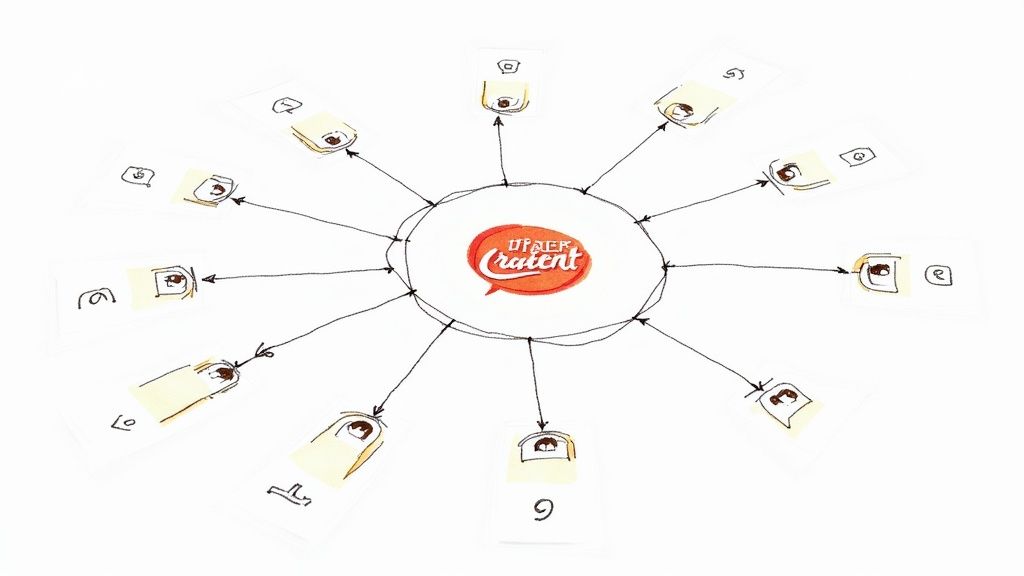
Flipping the script from brand-led to audience-led creation is one of the most powerful content repurposing strategies available. This method involves encouraging your community to create content based on your original material or brand prompts, which you then amplify and repurpose. It transforms passive consumers into active co-creators, generating a stream of authentic, high-trust content that serves as powerful social proof.
Instead of being the sole creator, you become a curator and amplifier of your audience's voice. This approach works because it fosters a deep sense of community and ownership. Content created by real users, like a customer's success story using your coaching framework or a photo of them enjoying your product, is often perceived as more genuine and relatable than brand-produced assets. Think of campaigns like GoPro's adventure videos or Airbnb's community photography initiatives.
How to Implement This Strategy
To launch a successful user-generated content (UGC) campaign, you need to provide a clear framework and compelling incentives. The goal is to make participation easy, fun, and rewarding. Start with a piece of your core content, a brand challenge, or a simple prompt that inspires creativity.
Here is a simple workflow:
Create a Clear Prompt and Hashtag: Launch a campaign with a specific call-to-action. For example, "Show us how you use our planner to organize your week!" or "Share your biggest win after taking our course." Create a unique, branded hashtag (e.g., #MyBrandWin) to track submissions.
Offer Compelling Incentives: Motivate participation by offering rewards. This could be anything from a feature on your social media channels, a discount on future products, entry into a prize giveaway, or a spotlight in your newsletter.
Establish Clear Guidelines: To ensure quality and legal compliance, provide simple submission rules. Most importantly, state that by submitting, users grant you permission to repurpose their content (with credit). Always get explicit written permission for larger-scale use.
Curate and Repurpose Submissions: Gather the best submissions and repurpose them across your channels. A user’s video testimonial can become a social media ad, a powerful photo can be used on your website's homepage, and a collection of positive reviews can be compiled into a "community highlights" blog post.
This strategy not only fills your content calendar with authentic material but also builds a loyal, engaged community that feels seen and valued. It’s a dynamic way to validate your brand and demonstrate real-world impact without having to create every single asset from scratch. To see how a major brand leverages community, you can explore the LEGO Ideas platform for user-submitted designs.
8. Interactive Content Conversion
Turning static content like blog posts or guides into interactive experiences is a powerful content repurposing strategy that boosts engagement and captures valuable audience data. Instead of passively consuming information, users actively participate through quizzes, polls, calculators, or assessments. This lean-forward approach transforms your content from a monologue into a dynamic dialogue with your audience.
This strategy excels because it provides immediate, personalized value. A blog post about financial planning becomes a tangible retirement calculator, or a guide to branding becomes an interactive brand personality quiz. This not only makes your content more memorable but also allows you to collect first-party data, segment your audience, and better understand their needs and pain points.
How to Implement This Strategy
To convert static content into an interactive tool, identify pieces that answer a common user question or solve a specific problem. A lengthy guide or a data-heavy report is often the perfect candidate for this transformation. The goal is to distill complex information into a simple, user-driven experience.
Here is a simple workflow:
Identify a High-Value Concept: Choose a piece of content that addresses a key challenge for your audience. For example, a blog post titled "10 Ways to Improve Your Instagram Engagement" could become a "What's Your Instagram Engagement Score?" quiz.
Select the Right Format: Use a tool like Interact, Typeform, or Riddle to build your interactive element. Choose the format that best suits the content: a quiz for personality assessments, a calculator for financial data, or a poll for gathering opinions.
Design for Value: Ensure the outcome delivers genuine insight. The results of a quiz or calculator should provide actionable advice or a clear takeaway that helps the user. Gate the detailed results behind an email opt-in to generate leads.
Promote and Analyze: Promote the interactive tool across all your channels. As users engage, you gather data on their choices and preferences, which can inform future content. This user-generated feedback is incredibly valuable. As you develop your user-generated content campaigns, consider innovative ways to leverage this content, such as to explore AI-driven UGC ad generation.
This method dramatically increases time-on-page and generates highly qualified leads by offering a personalized solution. It positions your brand as a helpful authority capable of solving real problems, making it a cornerstone of modern content repurposing strategies.
9. Ebook and Downloadable Resources Creation
Bundling your existing content into a high-value downloadable resource like an ebook, guide, or checklist is a powerful content repurposing strategy. This tactic consolidates related articles, research, and insights into a single, comprehensive asset that positions you as an expert while generating qualified leads. Instead of leaving valuable content scattered across your blog, you package it into a premium offering that solves a specific, significant problem for your audience.
This approach is effective because it elevates the perceived value of your content. A well-designed eBook feels more substantial and authoritative than a series of blog posts, making it an irresistible offer. By gating this resource behind an email opt-in form, you transform your best informational content into a consistent lead generation engine that fuels your sales funnel.
How to Implement This Strategy
The key to creating a successful downloadable resource is to curate your best content around a unified theme. Look for clusters of blog posts that address different facets of the same core topic. Combining these pieces allows you to create a definitive guide that saves your audience time and effort.
Here is a simple workflow:
Identify a High-Value Topic: Review your analytics to find a topic that consistently attracts high traffic and engagement. This indicates a strong audience need.
Compile and Structure Content: Gather 3-5 related blog posts. Organize them into a logical flow, creating chapters or sections. Write a new introduction and conclusion to frame the content and fill in any gaps to ensure a seamless reading experience.
Add Exclusive Value: Enhance the compiled content by adding exclusive elements like checklists, templates, or worksheets. These practical tools make the resource more actionable and desirable.
Design and Gate: Use a tool like Canva to professionally design your eBook. Create a dedicated landing page with a clear value proposition and an email capture form to gate the content. Promote this new lead magnet across your website, social media, and email newsletter.
This method not only builds your email list but also provides a tangible asset that demonstrates your expertise. It’s an essential strategy for nurturing leads and moving them deeper into your marketing ecosystem. For a step-by-step guide, you can learn more about crafting your first eBook on entrepedia.co.
10. Case Study and Success Story Development
Transforming raw customer data, testimonials, and project outcomes into compelling case studies is a powerful content repurposing strategy that builds trust and demonstrates tangible value. Instead of simply stating your product works, you are showing it in action through real-world examples. This leverages existing client relationships and results to create high-impact marketing assets that serve as powerful social proof.
This approach is effective because it shifts the focus from your brand to your customer's success. Prospects are more likely to trust the authentic voice of a peer who has overcome a similar challenge using your solution. A well-crafted case study is not just a testimonial; it's a narrative that guides a potential customer from a problem they recognize to a result they desire.
How to Implement This Strategy
To convert customer success into a structured case study, you need a repeatable process for gathering information and presenting it in a clear, persuasive format. This involves collaborating with your happiest customers to tell their stories in a way that resonates with your target audience.
Here is a simple workflow:
Identify and Vet Candidates: Pinpoint customers who have achieved significant, measurable results. Reach out to them, explain the process, and get their explicit permission to feature them. Offering an incentive like a discount or a gift card can be helpful.
Follow a Narrative Structure: Organize your case study around the classic "Challenge, Solution, Results" framework. Clearly define the problem the customer faced, detail how your product or service was implemented as the solution, and showcase the quantifiable outcomes.
Incorporate Direct Quotes and Metrics: Add authenticity by weaving in direct quotes from the customer. Crucially, back up claims with hard numbers. Vague statements like "increased efficiency" are far less impactful than "reduced project completion time by 40%."
Design and Distribute: Create a professionally designed PDF version for your website and sales team. Then, repurpose the case study into smaller assets: create quote graphics for social media, a summary for an email newsletter, and a short video testimonial.
This method turns your existing client base into your most effective marketing channel. It's a key tactic in any set of content repurposing strategies aimed at moving prospects from consideration to conversion. For inspiration, you can explore how industry leaders like Slack craft their case studies.
10-Point Content Repurposing Comparison
Method | Implementation complexity | Resource requirements | Expected outcomes | Ideal use cases | Key advantages |
|---|---|---|---|---|---|
Blog Post to Social Media Content | Medium — platform-specific formatting and multiple variants | Low–Medium — design tools, scheduling, copywriting | Increased reach, traffic, extended lifespan | Awareness campaigns, promoting evergreen posts | Multi-platform reach, minimal new content, SEO touchpoints |
Long-Form Content to Video Content | High — scripting, filming, editing workflows | Medium–High — camera, editing software, production skills | Higher engagement, stronger audience connection, discoverability | Tutorials, explainers, thought leadership, course content | Strong engagement and retention, highly shareable clips |
Podcast Episode Transcription and Distribution | Medium — transcription, editing, clip extraction | Medium — transcription tools, audio/video editors | Better discoverability, multi-format assets, accessibility | Interview shows, expert panels, SEO expansion | Turns one episode into many assets, improves accessibility |
Webinar and Live Event Content Repurposing | High — segmentation, editing, course packaging | High — multi-camera capture, editors, LMS or hosting | Evergreen assets, lead generation, improved event ROI | Product demos, training, enterprise webinars | Monetizable evergreen content, multiple assets from one event |
Infographics and Data Visualization | Medium — design plus accurate data representation | Medium — designers, data tools, illustration software | High shareability, improved comprehension, backlinks | Research summaries, report highlights, data-driven posts | Increases shareability and retention, attracts backlinks |
Email Newsletter Sequences | Low–Medium — segmentation and cadence planning | Low — email platform, copywriting, basic design | Higher opens/CTRs, sustained engagement, conversions | Nurture sequences, drip education, product launches | Direct conversion channel, low ongoing content cost |
User-Generated Content Campaigns | Medium — community management and curation | Low–Medium — moderation tools, incentives, legal review | Authentic content, higher engagement, social proof | Brand advocacy, product launches, community growth | Builds community, scalable authentic content, social proof |
Interactive Content Conversion | High — development and personalization logic | Medium–High — dev resources, interactive platforms, analytics | Very high engagement, first-party data, qualified leads | Lead qualification tools, assessments, calculators | Captures valuable data, improves lead quality, viral potential |
Ebook and Downloadable Resources Creation | Medium — compilation, design, gating setup | Medium — designer, landing page, distribution plan | Qualified lead generation, authority building, durable asset | Lead magnets, onboarding guides, gated resources | High perceived value, bundles content into lead-generating asset |
Case Study and Success Story Development | Medium — interviews, data collection, writing | Medium — time with customers, writers, design for formats | Strong social proof, higher conversion rates, sales enablement | B2B sales, high-ticket offerings, trust-building scenarios | Demonstrates tangible ROI, builds credibility and trust |
Building Your Content Engine: The Path Forward
You've just navigated a comprehensive blueprint of modern content repurposing strategies, moving far beyond the simple advice to "turn a blog post into a tweet." We've dissected ten powerful, distinct pathways, from transforming a single, in-depth blog post into a month's worth of dynamic social media content to converting a data-rich case study into a compelling visual infographic that captivates and converts. The journey from a single pillar piece of content to a sprawling ecosystem of assets is no longer a mystery; it's a strategic, repeatable process.
The core principle underpinning every strategy we've explored is leverage. Your initial content creation effort, whether it's recording a podcast, hosting a webinar, or writing an eBook, is only the first step. The real magic, the kind that drives exponential growth and solidifies your authority, happens in the deconstruction and redistribution of that core asset. It's the difference between shouting a message once and having it echo across a dozen valleys, each time in a language the local inhabitants understand perfectly.
Recapping Your Arsenal of Strategies
Let's distill the critical takeaways from our deep dive. The true power of content repurposing isn't just about saving time; it's about maximizing impact by meeting your audience where they are, in the format they prefer.
Format Fluidity is Key: You saw how a long-form blog can become a video script, a podcast episode, an email sequence, and a series of striking quote cards. The best content repurposing strategies embrace this fluidity, recognizing that the core value of your content can and should exist in multiple forms.
Audience-Centric Adaptation: Repurposing is not a simple copy-and-paste job. It’s about thoughtful adaptation. A webinar's Q&A segment becomes a series of high-engagement Instagram Reels because that format aligns with the platform's user behavior. A detailed case study becomes a visually-driven infographic for the scannable, data-hungry LinkedIn audience.
Systemization Unlocks Scalability: The most successful entrepreneurs and creators don't repurpose content haphazardly. They build systems. They create templates for social media graphics, develop checklists for podcast transcriptions, and establish a clear workflow for turning live events into evergreen lead magnets. This systemization turns a daunting task into a manageable, predictable part of their marketing engine.
Your Actionable Next Steps: From Theory to Implementation
Knowledge without action is just trivia. To prevent this guide from becoming another unread bookmark, you must take a concrete first step. The path forward is not to implement all ten strategies at once. That's a direct route to burnout. Instead, adopt a focused, methodical approach.
Choose Your Pillar: Select one high-performing piece of content you've already created. This could be your most-read blog post, your most-downloaded podcast episode, or the webinar with the highest attendance. Start with a proven winner.
Select One Strategy: Review the list and pick the one repurposing strategy that feels most achievable and aligns best with your current business goals. If your goal is to boost social media engagement, turning your pillar content into micro-videos and quote graphics is a perfect start. If lead generation is your priority, creating a downloadable eBook or checklist is the logical choice.
Document Your Workflow: As you execute the strategy for the first time, document every single step. What tools did you use? How long did each step take? What were the exact dimensions for the graphics? This documentation becomes your repeatable workflow, your standard operating procedure (SOP) for all future efforts.
Measure and Iterate: Track the performance of your repurposed assets. Did the social clips drive traffic? Did the email sequence lead to conversions? Use these metrics to refine your approach, doubling down on what works and adjusting what doesn't.
By mastering these content repurposing strategies, you are fundamentally changing your relationship with content creation. You escape the relentless pressure of the "content treadmill" and step into the role of a strategic asset manager. You build a library of valuable content that works for you 24/7, attracting new audiences, nurturing leads, and reinforcing your expertise long after the initial creative spark. This is how you build a resilient brand and a sustainable business.