How to Create Content Strategy: Content Strategy for Growth

A solid content strategy isn't just a list of blog post ideas. It's a framework that starts with defining your business goals and understanding your audience's needs. From there, you audit what you already have, find the gaps, and then build out your content pillars, editorial calendar, and a system to measure what’s actually working. This groundwork ensures every single piece of content you create has a clear purpose.
Aligning Your Content With Business Goals and Audience Needs

Before you write a single word, you have to lay the foundation. I've seen countless content efforts fall flat because they jump straight to the tactics—making videos, starting a blog—without ever defining what success even looks like. A winning strategy is always built on that powerful connection between your business objectives and your audience’s real-world problems.
This isn't just about "doing content." It’s a strategic investment. The global content marketing market was valued at an eye-watering $413.2 billion in 2022 and is expected to hit nearly $2 trillion by 2032. This kind of growth shows why a plan is non-negotiable. Without one, you’re just adding to the noise.
Defining Your North Star Goals
Your content goals need to be a direct reflection of your business goals. Forget vague ambitions like "get more traffic." You need to get specific and measurable, because clear objectives will guide every single decision you make, from the topics you cover to the formats you use.
Think about what your business actually needs to achieve. For instance:
Increase qualified leads by 15% in the next quarter.
Improve customer lifetime value by reducing churn with better onboarding content.
Boost organic search rankings for five of our core service-related keywords.
Establish brand authority by becoming the undisputed go-to resource in our niche.
The most effective strategies are built on SMART goals—Specific, Measurable, Achievable, Relevant, and Time-bound. A goal like "Increase email newsletter sign-ups from our blog by 20% in Q3" is infinitely more powerful than "grow our email list."
Moving Beyond Generic Demographics
Once your goals are locked in, it’s time to get crystal clear on who you're talking to. And I mean really clear. Generic demographics like "women, ages 25-40" are practically useless. You need to build buyer personas that feel like real people with real problems.
Dig deep. What keeps them up at night? What embarrassing questions are they typing into Google at 2 AM? What are their career goals, daily frustrations, and deepest motivations? Answering these questions is the heart of a successful https://www.entrepedia.co/blog/content-marketing-strategy-guide.
To help you connect the dots between what your business wants and what your audience needs, here's a quick reference table.
Essential Goals and Audience Questions
Business Goal | Key Metric (KPI) | Audience Question to Answer |
|---|---|---|
Increase Brand Awareness | Website Traffic, Social Mentions | What platforms do they use to discover new brands? |
Generate More Leads | Form Submissions, Demo Requests | What problem are they trying to solve right now? |
Improve Customer Retention | Churn Rate, Repeat Purchases | What challenges do they face after buying our product? |
Establish Thought Leadership | Backlinks, Media Mentions | What advanced questions do they have that no one else is answering? |
Drive Sales/Revenue | Conversion Rate, Average Order Value | What information do they need to feel confident making a purchase? |
This table forces you to map every business objective directly to a tangible audience need, ensuring your content is always relevant.
For a deeper dive into weaving this information into a cohesive plan, the principles of Content Marketing and Strategic Communications are incredibly valuable. This approach shifts your content from a monologue into a genuine dialogue. By mapping their pain points directly to your solutions, every piece of content becomes a purpose-driven asset that builds trust and drives action. That alignment is the secret to building a content strategy that actually delivers results.
Before you even think about creating new content, the smartest thing you can do is take a hard look at what you already have. Your existing blog posts, videos, and guides are sitting on a goldmine of data, telling you exactly what your audience loves and what they ignore.
A content audit isn't about criticizing past work. It's about finding hidden opportunities.
This whole process is designed to show you which pieces are pulling in traffic, keeping people engaged, and ultimately, making you money. It also flags the old, dusty articles that could use a refresh and points out the glaring gaps where your competitors are eating your lunch. By looking at what’s worked before, you can build a strategy based on solid proof, not just guesswork.
Creating Your Content Inventory
First things first, you need to know what you’re working with. That means creating a master list of all your content. I know, it sounds about as fun as watching paint dry, but this spreadsheet is the foundation for everything else.
You can build this out manually, but some tools can make it much faster. At a minimum, your spreadsheet should have columns for the URL, title, content type (like a blog post or video), and the date it was published. You'll add the performance numbers in the next step.
Having this bird's-eye view makes it so much easier to see patterns you’d otherwise miss.
Analyzing Performance to Find Your Winners
Okay, with your inventory ready, it's time to bring in the data. You’re on the hunt for your "hero" content—the top-performing pieces that are already doing the heavy lifting for you. The easiest way is to pull data from your Google Analytics and Google Search Console accounts.
Here’s what to look for:
High Traffic: Which pages get the most organic views? These are your SEO workhorses.
Strong Engagement: Check metrics like time on page and bounce rate. Low bounce rates tell you the content is grabbing and holding attention.
Conversion Rates: Which articles are actually driving newsletter sign-ups, downloads, or sales? These are your most valuable players.
Backlinks: Use a tool like Ahrefs or Semrush to see which posts have earned the most links from other sites. This is a huge signal of authority.
The content that shines in these areas is worth protecting and promoting. Often, you can give these posts a simple refresh—update some stats, add a new example, maybe embed a recent video—and republish them for a quick and powerful performance boost. It’s amazing what a little polish can do for a two-year-old article.
A content audit isn't a one-and-done chore. I recommend doing a quick check-in every quarter and a full deep-dive once a year. This keeps your strategy sharp and stops you from wasting time and money on content that just doesn't perform.
Finding Content Gaps and Spying on Competitors
An audit isn't just about what you have; it’s about what you don't have. This is where you get to play detective and see what your competitors are up to. Your mission is to find the valuable topics they rank for that you haven’t even touched.
Start by picking your top 3-5 direct competitors. Then, use an SEO tool to see which of their pages perform best. You're looking for keywords where they rank high, but your site is nowhere to be found. This is what’s known as a content gap analysis.
For instance, maybe you find out your main rival has a huge, in-depth guide on a specific software integration that’s bringing them tons of traffic—a topic you’ve completely overlooked. That’s a golden opportunity. The topic is already proven to have an interested audience, and now you have a clear shot at targeting it.
By mapping out these gaps, you create a data-backed list of content ideas. You're no longer just throwing content at the wall to see what sticks. Instead, you're strategically filling holes in the market to capture traffic that was going straight to your competition. This is how you build a content strategy that actually wins.
Nail Down Your Content Pillars and Topic Clusters

This is where we stop throwing content at the wall and hoping something sticks. A winning content strategy isn’t about chasing every shiny new trend; it’s about building a rock-solid foundation of expertise. That foundation is built with content pillars—the core topics your brand will own.
Imagine your brand is a university. What are the 3-5 majors you want to be known for? Those are your content pillars. They aren't blog post titles, but the broad, critical themes where your business goals and your audience’s biggest problems overlap.
How to Select Your Core Content Pillars
Picking the right pillars is probably the most crucial decision you'll make in this entire process. Nail this, and every piece of content you create will feel like it belongs. Get it wrong, and you’re right back to creating a disjointed mess that fails to build any real authority.
Start by digging back into your audience research and your business goals. A perfect pillar lives in that sweet spot where your unique expertise solves a massive headache for your ideal customer.
For example, a company that sells project management software isn't just selling software. Their pillars might be:
Team Productivity
Agile Methodologies
Remote Work Leadership
Project Planning
These are big enough to generate tons of ideas but specific enough to signal exactly what you’re an expert in. This structured approach ensures you’re methodically building authority where it matters most. To speed things up, you can grab frameworks and templates from comprehensive guides on content pillar creation.
Your content pillars are your promise to your audience. They declare, "This is what we know better than anyone else, and this is the value you can consistently expect from us." Choosing them carefully is how you transition from just another voice to a trusted authority.
From Pillars to Topic Clusters
Once your pillars are locked in, the next move is to build out topic clusters. This is how you turn those broad themes into a strategic web of interconnected content—a move that both supercharges your SEO and proves your expertise to real people.
A topic cluster has two parts: a central, monster-sized "pillar page" and a bunch of "cluster pages" that all link back to it. The pillar page is your definitive guide on the main topic. The cluster pages dive deep into specific, long-tail keyword sub-topics related to it.
Let's stick with our "Team Productivity" pillar:
Pillar Page: The Ultimate Guide to Boosting Team Productivity
Cluster Content (the spokes):
How to Run More Effective Team Meetings
Best Productivity Tools for Small Teams
Time Management Techniques for Creative Professionals
Avoiding Burnout in a High-Performance Culture
This model basically tells search engines that you have deep, meaningful expertise on a subject, making it much easier for that main pillar page to rank for the big, competitive keywords.
Choosing the Right Content Formats
Here’s a hard truth: not every idea deserves to be a blog post. A huge part of a smart strategy is matching the right format to the topic and where your customer is in their journey. A healthy mix of formats keeps your audience hooked and caters to how different people prefer to learn.
Think about your content plan using a matrix like this:
Buyer's Journey Stage | Audience Goal | Ideal Content Formats |
|---|---|---|
Awareness | To understand a problem or find answers to questions. | Blog Posts, Infographics, Short Videos, Social Media Posts |
Consideration | To compare different solutions and options. | Case Studies, Webinars, In-depth Guides, Comparison Articles |
Decision | To validate a choice and feel confident in a purchase. | Free Trials, Demos, Customer Testimonials, Pricing Pages |
For instance, a cluster topic like "Best Productivity Tools" is perfect for a detailed comparison article (that’s for someone in the Consideration stage). But a topic like "Avoiding Burnout" could be an incredibly powerful and empathetic short video for social media (perfect for the Awareness stage).
This multi-format approach ensures you have the right asset ready to meet your audience's needs at every single step. It’s how you build a complete content ecosystem that actually works.
Incredible content is worthless if nobody sees it. This is where a smart, intentional distribution plan comes in, turning that file on your computer into an asset that actually works for you. It’s the bridge between creation and results.
Forget the idea that you need to be everywhere at once. That's a surefire recipe for burnout and mediocre results across the board. The real goal is to pick the channels where your ideal customers are already spending their time and then show up there consistently and effectively.
Choosing Your Core Distribution Channels
The foundation of your distribution plan is identifying the right platforms. This isn’t about chasing trends; it’s about making smart decisions based on where your specific audience is most active and receptive. A good distribution strategy is a focused one.
Think about it like this: if your audience is made up of C-suite executives, spending your entire budget on TikTok dances is probably not the best use of your resources. They’re far more likely to be on LinkedIn or subscribed to high-value industry newsletters.
Your primary channels will likely fall into three main buckets:
Owned Channels: These are the platforms you control completely. Think of your website blog, email newsletter, and any community forums you manage.
Earned Channels: This is the publicity you don’t pay for, like organic search traffic, social media shares, press mentions, and guest posts on other sites.
Paid Channels: This involves paying to get your content in front of a targeted audience, such as with social media ads, search engine marketing (SEM), or sponsored content.
A healthy distribution plan uses a mix of all three, creating a system where each channel supports the others.
Prioritizing for Maximum Impact
For maximum reach, your distribution plan should always have a strong SEO component. This is non-negotiable. Organic search is often the number one traffic source for marketers, and it’s no wonder when you see that search engines drive 93% of all website traffic. When you're building your plan, SEO can't be an afterthought—it needs to be woven in from the very beginning. You can learn more about these crucial SEO tips to improve Google search rankings.
Video content also plays a massive role here. A staggering 86% of businesses now use it as a marketing tool, with 92% of marketers saying it’s an essential part of their strategy. The data is clear: prioritizing channels with proven success, like organic search and video, is a cornerstone of an effective content strategy.
Your distribution strategy shouldn't feel like a separate, final step. Think of it during the creation phase. Ask yourself, "How will I promote this piece?" before you even finish writing it. This mindset ensures you create content with built-in shareability.
Tailoring Content for Each Platform
One of the biggest mistakes I see is the "spray and pray" approach—blasting the exact same message and link across every single social media platform. It just doesn't work. Each channel has its own culture, format, and audience expectations.
A successful plan involves tailoring your core content pillar to fit the native language of each platform.
Here’s what that looks like in the real world:
Core Content: You publish a 2,500-word ultimate guide on "How to Start a Podcast."
LinkedIn: You write a thoughtful post summarizing the 3 biggest mistakes new podcasters make, linking back to the full guide for those who want all the details.
Twitter/X: You create a compelling 10-part thread that breaks down the guide's key steps into bite-sized, actionable tips, with a link to the full article in the final tweet.
Instagram: You make an engaging Reel showcasing a quick "before and after" of audio quality, using tips pulled directly from the guide.
Email Newsletter: You send a dedicated email to your subscribers, explaining why this guide is so valuable and sharing a personal story about your own podcasting journey to drive them to the blog.
Now let's look at how to map this out so you can match the right content with the right channel for the best results.
Content Format and Channel Matching Matrix
This matrix helps you decide the best channels to distribute different types of content for maximum reach and engagement.
Content Format | Primary Channel | Secondary Channel | Key Goal |
|---|---|---|---|
Long-Form Blog Post | Your Website/Blog | Email Newsletter | SEO & Authority |
Video Tutorial | YouTube | Instagram Reels/Stories | Engagement & Education |
Case Study/White Paper | Website, LinkedIn | Targeted Email | Lead Generation |
Infographic | Twitter/X | Virality & Shares | |
Quick Tips/Checklist | Instagram Stories | Twitter/X Thread | Quick Engagement |
Podcast Episode | Spotify/Apple | LinkedIn Post | Audience Building |
This multi-channel approach gets your content in front of more people in a way that feels natural to each platform. Planning this out ahead of time using a dedicated tool can make all the difference. Check out our ready-to-use content calendar templates to map out your distribution workflow.
This approach turns a single piece of content into a mini-campaign, dramatically extending its life and impact.
Turning Your Strategy Into an Actionable Workflow
A brilliant strategy is just a document until you put it into practice. This is where we move from planning to doing—turning all those great ideas into a consistent, reliable stream of high-quality content.
It’s all about building a system that ends the last-minute scramble.
The heart of this system is your editorial calendar. This isn't just a spreadsheet with dates; it's your command center. A truly functional calendar maps out everything: topics, target keywords, content formats, who’s responsible, and when everything is due.
Building Your Editorial Calendar
Your calendar gives you that bird's-eye view of your entire content plan, making sure you maintain a balanced mix of formats and cover all your content pillars evenly. It’s the single source of truth that keeps your team—even if it's a team of one—aligned and on track.
You don’t need anything fancy. Simple tools like Trello, Asana, or even a detailed Google Sheet can work wonders.
The key is to include enough detail to actually make it useful. For each piece of content, your calendar should track things like:
Topic Title: The working headline for the piece.
Content Pillar: Which core theme does this content support?
Format: Is it a blog post, video, case study, or infographic?
Status: What stage is it in (e.g., Ideation, Writing, Editing, Published)?
Owner: Who is responsible for getting this piece across the finish line?
Publish Date: When is it scheduled to go live?
A well-managed editorial calendar is the difference between proactive, strategic content creation and reactive, chaotic scrambling. It turns your strategy from a wish list into a concrete plan.
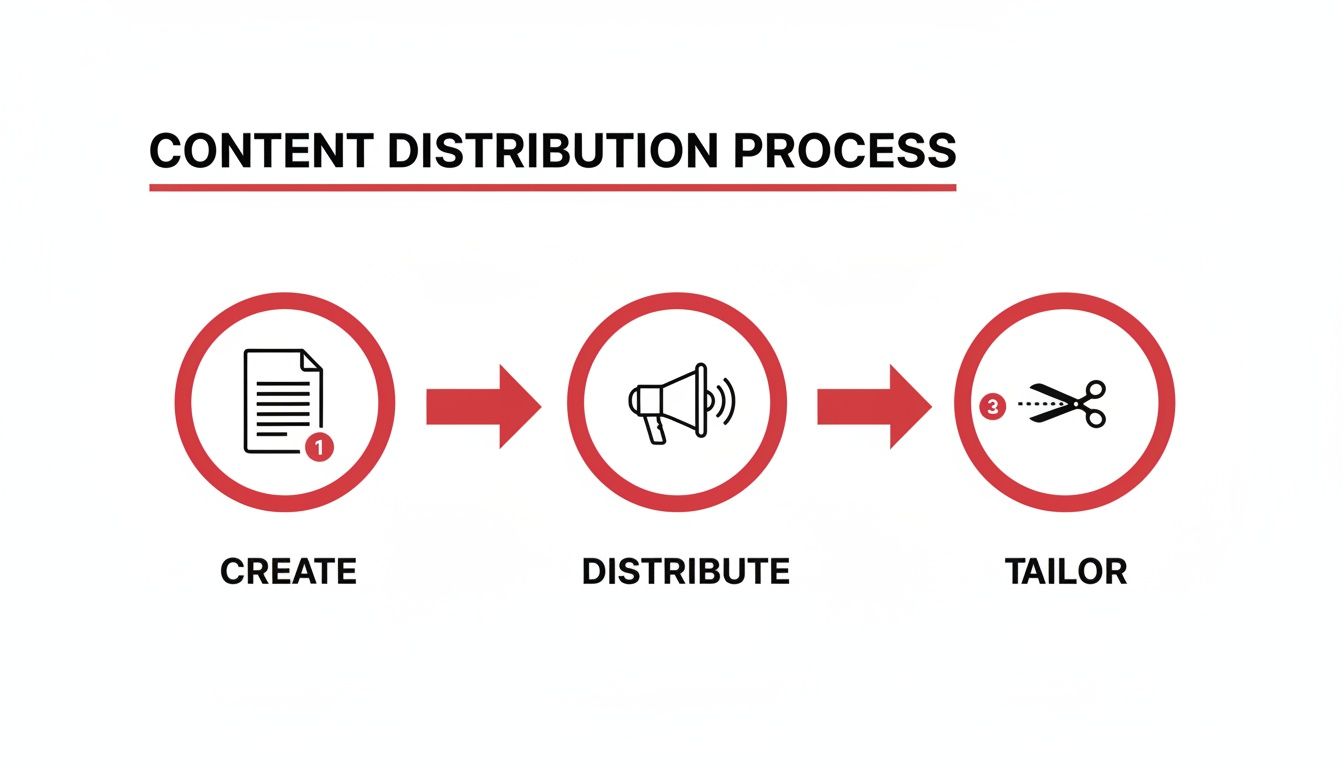
This process visualizes a crucial point: creation is just step one. The real magic happens when you intentionally distribute and adapt that content for every channel you're on.
Designing a Realistic Production Workflow
With your calendar in place, you need a repeatable process for moving content from an idea to a published asset. A structured workflow prevents bottlenecks and ensures every single piece meets your quality standards before it reaches your audience. Don't overcomplicate it; just focus on clear, logical stages.
For a typical blog post, a workflow might look like this:
Ideation & Briefing: The idea gets the green light, and a detailed creative brief is developed. This should cover the target audience, primary keyword, key talking points, and the desired call-to-action.
Drafting: The writer takes the brief and creates the first draft.
Editing & Review: An editor (or just a fresh pair of eyes) reviews the draft for clarity, tone, grammar, and SEO alignment.
Design & Formatting: Any visuals, like custom graphics or screenshots, are created and added. The post gets formatted in your CMS for the best reading experience.
Final Approval & Scheduling: A final check is done, and the content is officially scheduled in the editorial calendar.
This kind of structured approach removes any guesswork. Everyone involved knows exactly what’s expected at each step. It’s the operational backbone of any successful content strategy, creating a sustainable engine that fuels your growth without causing burnout.
Measuring Your Content's Performance and ROI
So, how do you prove your content strategy is actually doing anything? This is the part where measurement circles everything back to your original business goals. It's what turns your content from a creative line item into a measurable asset.
Without data, you're flying blind.
The trick is to zero in on the right key performance indicators (KPIs)—the ones that actually reflect the goals you set way back at the beginning. It's time to stop chasing vanity metrics and start tracking numbers that have a real impact on your bottom line.
Selecting the Right KPIs for Your Goals
Your KPIs need to connect directly to your objectives. Don't just obsess over website traffic if your real goal is to get more leads. You have to align your measurement with your intent to see what's truly working.
Here’s how you can link common goals to the right metrics:
Goal: Brand Awareness - Track things like organic traffic growth, social media mentions, and any keyword ranking improvements.
Goal: Lead Generation - Keep an eye on conversion rates from your landing pages, the cost per lead, and—critically—the lead quality reported back from your sales team.
Goal: Customer Engagement - Look at metrics like time on page, comments on blog posts, and your email open/click-through rates.
This kind of focus is non-negotiable. The global content marketing scene is ballooning, with revenue expected to climb to $107.5 billion by 2026. And yet, 34% of marketers admit that proving a clear ROI is their biggest headache. This just shows how critical it is to connect your content efforts to real business results. You can dive deeper into the latest content marketing industry trends to see the bigger picture.
Proving ROI isn't just about justifying your budget; it's about making smarter decisions. Your data tells you exactly what your audience wants more of, what isn't landing, and where your biggest opportunities for growth are hiding in plain sight.
Building Simple Dashboards for Clarity
You don't need some ridiculously complex, expensive analytics suite to get started. Honestly, a simple dashboard in Google Analytics 4 (GA4) can give you a powerful, at-a-glance view of how your content is doing. Just set up a custom report that pulls in your most important KPIs.
A good dashboard should give you answers, not just a pile of data. For instance, create a view that shows your top-performing blog posts by conversions. That immediately tells you which topics are driving the most valuable actions and helps you decide what to create next.
Interpreting Data to Optimize Your Strategy
The final piece of the puzzle is turning your data into action. This is the continuous improvement loop that separates the good content strategies from the great ones. Look at your reports regularly and start asking the tough questions.
What should we double down on? Pinpoint the content formats and topics that consistently knock it out of the park and create more of them.
What needs to be refreshed or pruned? Find those underperforming articles that have high potential and give them an update. If a piece consistently fails to perform, it might be time to let it go.
Where are the new opportunities? Analyze your top content to find related sub-topics you can explore to build out your topic clusters and claim more authority.
By constantly measuring, interpreting, and tweaking, you create a self-improving content engine. This data-driven approach ensures your content strategy evolves, adapts, and continues to deliver a powerful return on your investment.
Still Have Questions About Content Strategy?
Even with the best-laid plans, a few questions always seem to pop up. Let's tackle some of the common hurdles I see people run into when they're building out their content strategy for the first time.
How Often Should I Publish New Content?
This is probably the most common question I get, and the answer is always the same: consistency is way more important than frequency.
Seriously, publishing one amazing, well-promoted blog post every week will do more for you than dropping three mediocre ones. Start with a pace you know you can stick with without your quality dropping off a cliff. Once you get into a groove, you can think about ramping things up.
For most B2B brands, once a week is a solid target. If you're in B2C, where social media is a bigger piece of the puzzle, you might aim for 2-3 shorter, more visual posts each week.
How Long Until I Actually See Results?
I'll be honest with you—content marketing is a marathon, not a sprint. It’s about building a long-term asset for your business.
You should start seeing some early signs of life, like little bumps in traffic, within three to six months. But the real, meaningful results—the kind that bring in consistent organic leads and establish you as an authority—that usually takes a good six to twelve months of dedicated, consistent effort.
Don't get discouraged if you're not an overnight success. The goal is steady, compounding growth that builds on itself. Patience is probably the most underrated skill in this game.
What’s More Important: SEO or Audience Engagement?
Ah, the classic chicken-or-the-egg dilemma. The truth is, you can't have one without the other. SEO gets them in the door, but great engagement is what convinces them to stay.
Here's how I think about it:
SEO (Search Engine Optimization): This is all about getting discovered by new people. Without it, the best content in the world is invisible.
Engagement (Comments, Shares, Time on Page): This is what signals to search engines that your content is actually valuable. That, in turn, gives your SEO a nice boost.
Your focus should always be on creating amazing content for people first. Once you've done that, you can go back and optimize it for search engines. Great content naturally picks up the engagement signals that improve your rankings over time.
Ready to stop guessing and start building?
Entrepedia provides over 1,000+ market-tested PLR assets—from ebooks and courses to templates and videos—that you can rebrand and launch in minutes. Skip the months of creation and build your content engine today.