Explained
What Is Content Automation and How Can It Scale Your Business

Content automation sounds like a buzzword, but let's cut through the noise. Think of it as your business's dedicated operations manager for content—a system that takes your core ideas and handles all the repetitive, time-consuming tasks for you.
What Is Content Automation Really?
At its heart, content automation is about building a system that works for you in the background. It takes your raw content, data, and templates, then manages the grunt work of scheduling, publishing, and distributing it across all your channels.
This isn’t about replacing your creativity with robots; it's about amplifying it. By letting technology handle the logistics—like posting to social media or sending out your weekly newsletter—you get your time back. You're free to focus on the things that actually move the needle: big-picture strategy, connecting with your audience, and creating that next piece of high-impact content.
From Manual Grind to Automated Engine
The difference between a manual workflow and an automated one is night and day. One relies on your constant effort for every single task, while the other builds an engine that runs on its own.
A manual approach means you are the engine. You’re the one writing and posting every social media update, formatting and sending every email, and tracking every single piece of content by hand. This isn't just slow; it's impossible to scale. As your business grows, the content demands pile up, and you head straight for burnout and inconsistency.
Content automation, on the other hand, builds the engine. You set the rules and provide the content, and the system takes over from there.
The goal of automation is not just efficiency; it's scalability. It allows a single creator or a small team to achieve the reach and consistency of a much larger organization, ensuring your message reaches the right audience at the right time, every time.
For a comprehensive deep dive into the definition and foundational understanding, refer to this guide on What is Content Automation? Your Church's Ministry Multiplier.
This shift isn't just a trend; it's becoming essential. The marketing automation market is already valued at $6.65 billion and is projected to hit $15.58 billion by 2030, which shows just how central this has become for modern business. You can find more insights about this growing market on emarsys.com.
To really bring this transformation to life, let’s look at how the two approaches stack up side-by-side.
Manual vs Automated Content Workflows
This table breaks down the core differences between grinding it out manually and building a smart, automated system. It highlights the shift in focus from tedious execution to high-level strategy.
Aspect | Manual Content Creation | Content Automation |
|---|---|---|
Process | Repetitive, task-by-task execution by a person. | Pre-defined workflows triggered by rules or schedules. |
Speed & Scale | Slow and limited by individual capacity and hours. | Fast, scalable, and operates 24/7 without manual effort. |
Consistency | Prone to human error, missed posts, and brand voice drift. | Ensures consistent brand messaging and reliable delivery. |
Resources | High time investment for creators and team members. | Low ongoing time investment after initial setup. |
Focus | On logistical tasks like posting, scheduling, and sending. | On strategic planning, content quality, and analysis. |
As you can see, automation isn't just about doing things faster. It fundamentally changes what you work on, freeing you from low-value tasks so you can concentrate on strategic growth.
The Three Pillars of Your Automation Engine
Building a content automation system might sound complicated, but it really just comes down to three core parts working together. Think of it like a modern assembly line for your marketing. Each part, or pillar, handles a specific job to turn your raw ideas into published content that consistently reaches your audience.
This diagram shows the big picture—the shift from a slow, manual grind to a smooth, automated engine.
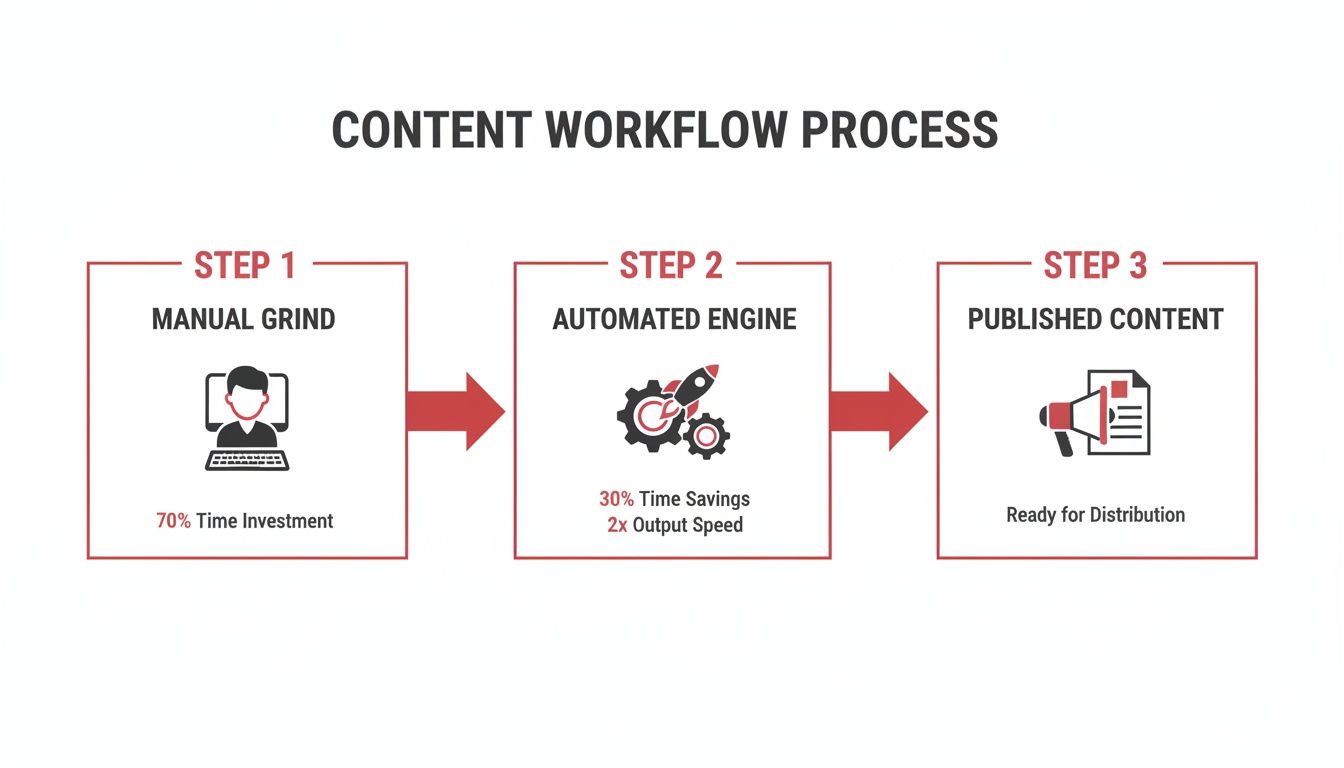
You can see how automation takes the repetitive, hands-on work off your plate, creating a system that just runs. Now, let’s pull back the curtain and look at the individual pieces that make this engine hum.
Pillar 1: Content Generation
This is the "parts department" of your system. It's where all the raw materials for your content—the text, images, and ideas—are created and stored. This pillar is all about producing the assets that your automation will later chop up, repackage, and distribute.
Good content generation isn't just about speed; it's about building a library of high-quality, reusable assets to fuel your marketing for months to come.
AI Writing Assistants: These are great for knocking out first drafts of blog posts, social media captions, or email newsletters based on your prompts.
Templates and Frameworks: Having pre-designed templates for graphics, videos, and documents keeps everything on-brand and saves a ton of time.
Your Knowledge Base: This includes your own expertise, past articles, or even high-quality PLR content that can be repurposed into new formats.
Pillar 2: Workflow Management
This is the "conveyor belt" and the central nervous system of your entire operation. It connects the other two pillars by creating a set of rules that tell your content where to go and what to do next. This is where the real "automation" happens.
A clear workflow is what lets you scale without losing your mind. If you need a starting point, our guide on preparing SOPs for automation can help you map out your own processes.
Workflow management is where you define the triggers and actions. For example: "When a new blog post is published (the trigger), automatically create five social media posts from its key points and schedule them for next week (the action)."
This ensures every piece of content follows a predictable, repeatable path without you having to manually push it along every step of the way.
Pillar 3: Content Distribution
Finally, we have the "shipping department." Once your content has been created and run through the workflow, this pillar makes sure it gets delivered to the right audience, on the right platform, at the right time.
Distribution tools handle the final, crucial step of getting your content out into the world.
Social Media Schedulers: These are platforms that automatically publish your content to channels like LinkedIn, Instagram, and X.
Email Marketing Platforms: These systems send out newsletters, drip campaigns, and welcome emails to your subscribers on autopilot.
CMS Integration: These are tools that can push content directly to your blog or website, handling all the formatting and publishing for you.
Together, these three pillars create a complete system that manages your content from start to finish, letting you scale your output and impact with far less manual effort.
How Automation Delivers Tangible Business Growth
Let's cut through the buzzwords and talk about what automation actually does for your business. It's not about saving a few minutes here and there; it's about building a system that delivers measurable growth by connecting your automated workflows directly to your bottom line.
When you automate, you create consistency. Your audience gets your newsletter at the same time every week. They see your brand on social media every single day. That kind of reliability builds trust and turns passive followers into a real community.
This consistency is what fuels your growth engine. You can scale your content output without having to scale your workload, creating more touchpoints to attract and nurture leads. An automated system can push out ten times the content in the same time it takes you to handle one piece manually, massively expanding your reach.
Boosting Productivity and Reducing Costs
The financial side of a smart automation strategy is where things get really interesting. By taking over all those repetitive tasks, automation cuts down your marketing overhead and improves your overall return on investment. Think of it not as an expense, but as a strategic investment that pays for itself in time, efficiency, and revenue.
The numbers back this up. Businesses that bring in automation see a 14.5% boost in marketing productivity while also reducing their marketing overhead by 12.2%. These aren't small figures; they show that creators who adopt automation are gaining a serious edge in both efficiency and cost savings. You can dig into more of these marketing automation statistics and see the impact for yourself.
This shift frees up both your money and your time, letting you focus on the high-value activities that actually move your business forward.
Calculating Your Return on Investment
Every hour you save is money you've earned back. Content automation directly impacts your profit by letting you reallocate your most valuable resource—your time—away from tedious execution and toward big-picture strategy and innovation.
A smart content automation system doesn't just do more work; it creates more value. It transforms your content from a manual, time-consuming task into a predictable, scalable asset that generates leads and revenue around the clock.
To see how these savings could apply to your own business, a great first step is to run the numbers. When you understand the true cost of your manual efforts, it becomes much easier to justify investing in an automated system.
You can use our Small Business AI ROI Calculator to get a clear picture of what you could be saving. This simple tool empowers you to make data-driven decisions on where and how to implement automation for the biggest possible impact.
Real-World Content Automation in Action
Theory is one thing, but seeing how content automation actually works in the wild is where the lightbulb really goes on. It's not just a game for giant corporations; solo entrepreneurs and small teams are building incredibly powerful, efficient systems that fuel their growth every single day.
Let’s look at a few practical examples you can borrow for your own business. These aren't crazy, enterprise-level setups—just smart, focused automations that solve common headaches for creators.
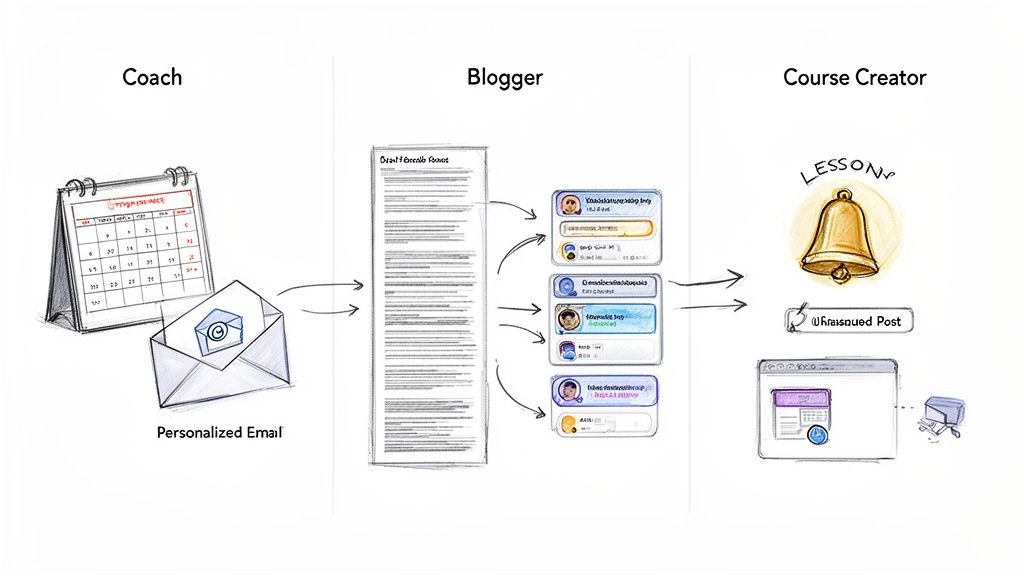
Each of these scenarios turns a repetitive, soul-crushing manual process into a hands-off workflow. This frees up the creator to focus on what they actually do best.
The Coach Automating Client Onboarding
Imagine a business coach who wants every new client to feel like a VIP the second they sign up. Instead of frantically sending a bunch of welcome emails by hand, she builds an automated sequence.
Trigger: A new client signs up through her payment gateway.
Workflow: An automation tool like Zapier connects her payment platform to her email marketing service.
Actions:
The client is instantly added to a "New Clients" email list.
A personalized welcome email fires off immediately with login details and a link to book their first call.
Follow-up emails are scheduled over the next week, dripping out helpful resources, success stories, and reminders.
This simple system ensures every client gets a consistent, professional experience, building trust and excitement right from the start. The best part? The coach doesn't have to lift a finger after the initial setup.
The Blogger Repurposing Core Content
A blogger pours 20 hours into writing an epic, 3,000-word guide. Instead of just hitting "publish" and hoping for the best, they use automation to spin that single asset into an entire month's worth of content.
The smartest creators understand that the value of content isn't just in its creation, but in its distribution. Automation is the engine that multiplies the reach and lifespan of every single piece you create.
Here’s how they pull it off:
The Pillar Piece: The long-form blog post is the source of truth.
The Repurposing Workflow: Using AI-powered tools, they extract key ideas, quotes, and data from the main article. To see how this works in detail, you can explore Entrepedia’s Content Extraction System.
The Automated Output:
Social Media: Automatically generate 15-20 social media posts with juicy quotes, stats, and key takeaways.
Newsletter: Create a quick summary for the weekly newsletter with a link back to the full article.
Graphics: Feed key quotes into a template tool like Canva to churn out branded graphics for Instagram and LinkedIn.
This workflow transforms one massive piece of content into dozens of micro-assets, all scheduled and distributed automatically. It keeps their channels buzzing with activity and drives a constant stream of traffic back to their most valuable content, squeezing every last drop of value out of it.
Your First Steps into Content Automation
Jumping into content automation doesn't have to feel like a massive technical project. The secret is to start small, solve a real, nagging problem, and then build on that success. This simple, five-step roadmap is designed to guide you through launching your first automation, turning a manual headache into a hands-off system.
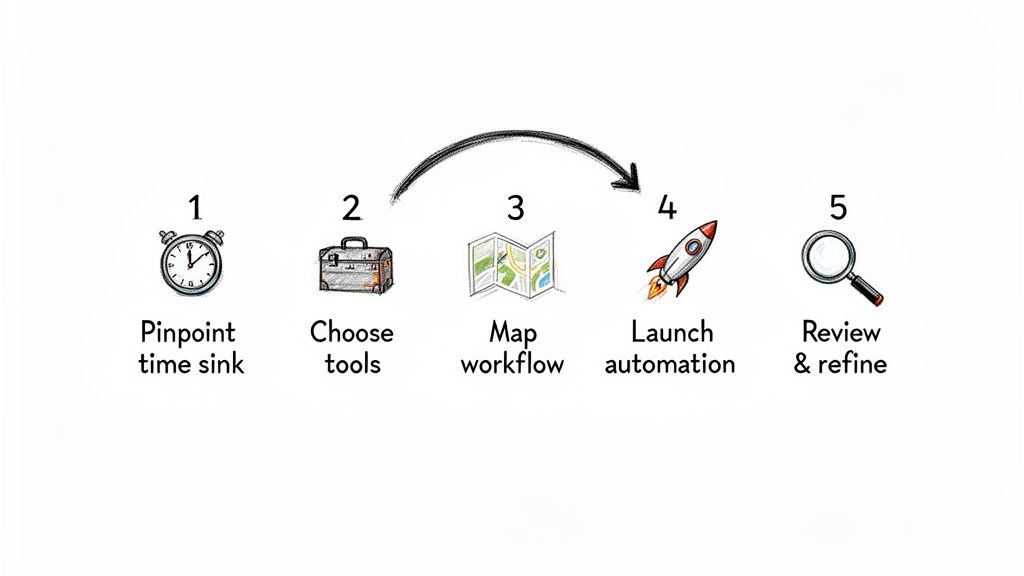
This whole process is about getting a quick win. It proves the value of automation without asking you to sink a ton of time or money into it.
Let's break down each step.
Start with a Simple Action Plan
Instead of trying to automate your entire business overnight, just pick one pain point. Build a repeatable process around it. This is how you build momentum and see a clear return on your effort.
Pinpoint Your Biggest Time Sink: What's the one content task you do over and over that just drains your energy? Is it manually posting to every social media platform? Sending the same welcome emails? Find that single, repetitive task.
Select Your Starter Tool: Don't get lost in a sea of options. Pick one user-friendly tool that does one thing really well. If social media is your time sink, a scheduler like Buffer or Later is perfect. For emails, something like MailerLite is a great starting point.
Map a Simple Workflow: Get the process out of your head and onto paper (or a doc). What’s the trigger? What are the exact steps that happen next? For example: "When a new blog is published (trigger), create one LinkedIn post and one tweet (actions)."
Launch Your First Automation: Now, build that simple workflow in the tool you chose. Set up your social media queue or your three-part welcome email sequence. The goal is just to get something live and running.
Review and Refine: Give it a week or two, then check the results. Are people actually clicking the links in your automated emails? Are your scheduled posts getting any engagement? Use this feedback to make small tweaks and improve how it performs.
Fuel Your Engine with Ready-Made Content
One of the biggest roadblocks to effective automation is having enough high-quality content to feed the system. If your content library is empty, your automation engine has no fuel. This is where Private Label Rights (PLR) content can be a game-changer for entrepreneurs.
Think of high-quality PLR as a strategic asset. It gives you a ready-made library of expertly crafted articles, guides, and lead magnets that you can immediately plug into your new automated workflows, saving you hundreds of hours of creation time.
For example, you could take a single comprehensive PLR ebook and instantly break it down into a dozen blog posts, a 10-part email course, and a full month's worth of social media updates.
By starting with a solid foundation of premium content, you can launch a powerful automation system from day one. You won't have to spend months creating all those assets from scratch. This approach lets you focus your energy on building the system itself, knowing the content is already handled.
Common Questions About Content Automation
Jumping into content automation can feel like a huge leap, and it's totally normal to have a few questions rattling around. Most entrepreneurs I talk to worry about the same things: losing their brand's voice, the cost, and whether the quality will suffer.
Let's tackle those concerns head-on. My goal is to give you straight answers so you can decide if building an automation engine is the right move for your business right now.
Will Automation Make My Brand Sound Robotic?
This is probably the biggest fear, and it's a valid one. But here's the thing: effective automation does the exact opposite of what you'd expect. It automates the delivery, not the soul of your brand.
Think of your automation system as the world's most reliable mail carrier, not the person writing the letters. You're still the one crafting the message with your unique voice and personality. The magic is in using high-quality templates and personalization, which ensures that even though the sending is automated, the content itself feels human and relevant to the person on the other end.
By handing off the logistical grunt work, automation actually frees you up to spend more time personally engaging with your audience in comments and DMs—which is where the real connection happens anyway.
Is Content Automation Too Expensive for a Small Business?
While some of the big, enterprise-level systems come with eye-watering price tags, the market today is filled with powerful, affordable tools built specifically for entrepreneurs. In fact, many of the best platforms for email marketing or social media scheduling offer generous free plans that are more than enough to get you started.
The most important thing to look at is the return on investment (ROI). If a tool that costs $20 per month saves you 10 hours of manual work, it’s already paid for itself many times over. The smartest approach is to start small. Pinpoint your single biggest bottleneck and find one low-cost tool that solves it. You can always scale up as your business—and your revenue—grows.
The real cost isn't the software subscription; it's the value of your time. Every hour you spend on a repetitive, low-value task is an hour you can't spend on strategy, sales, or product development.
What’s the Difference Between Automation and AI Generation?
This is a fantastic question because the two work hand-in-hand but are fundamentally different things. Nailing this distinction is the key to building a truly smart system.
AI Content Generation creates the what. It’s the tool that helps you draft a blog post, design an image, or write social media copy based on your prompts. Think of AI as the creator.
Content Automation manages the how, when, and where. It takes that content—whether it was made by a human or an AI—and handles the entire workflow of scheduling, publishing, and distributing it. Think of automation as the project manager.
In a perfect world, you use AI to help you create content at scale, and then you use automation to get that content in front of the right people at the right time, without lifting a finger.
How Do I Maintain Quality with Automated Content?
Quality control is everything in an automated system. The guiding principle here is simple: quality in, quality out. Your automation engine is only as good as the content you feed it, so you have to start with a strong foundation.
Begin with a library of expertly written content, whether that's your own best-performing work or professionally created PLR. Your role then shifts from being a manual publisher to a strategic editor and curator. The most critical step? Build a human review point into your workflow before anything goes live. This final check ensures every automated post, email, or article meets your brand’s standards.
This blend of automated efficiency and human oversight is the secret to scaling up without watering down your quality.