Explained
Your Essential Product Launch Checklist Template

A solid product launch checklist isn't just an asset; it's the single most important tool for turning launch-day jitters into predictable success. This isn't just about staying organized. It’s a strategic framework that gets your teams aligned, heads off potential disasters, and makes sure no detail falls through the cracks.
Why a Checklist Is Your Secret Weapon for Launch Success
Ever feel like a product launch is a high-wire act without a net? You’ve poured everything into creating a fantastic product, but the path from your workshop to your customer’s hands is littered with potential missteps.
One missed email, one broken link, or one marketing message that’s slightly off-key can derail months of hard work. This is exactly where a structured checklist stops being a "nice-to-have" and becomes absolutely essential.
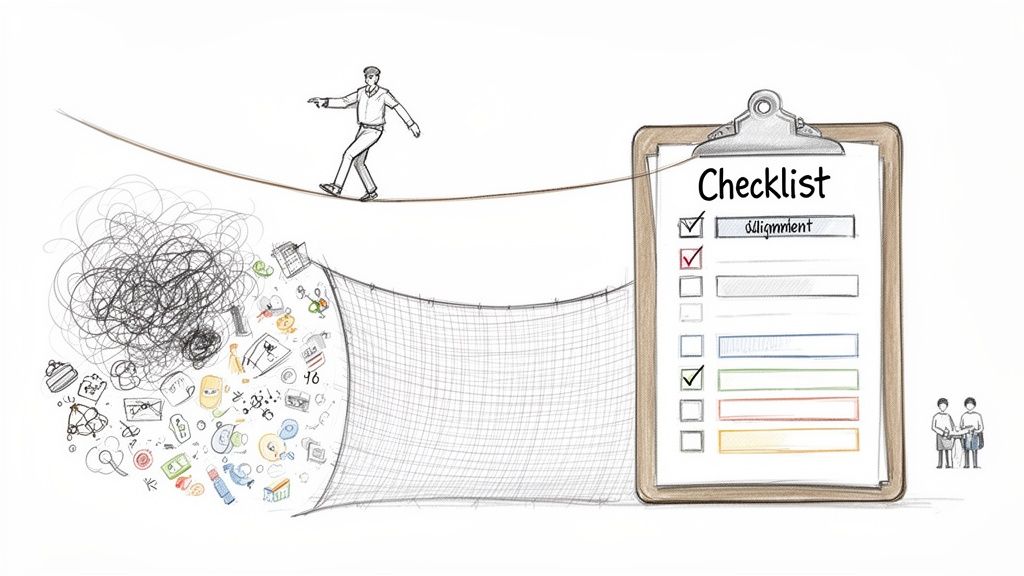
Think of it as the central nervous system for your entire launch, connecting every moving part of the operation. Without this common ground, teams drift into silos, leading to duplicated work and, even worse, critical gaps that nobody catches until it's too late.
From Chaos to Cohesion
Just imagine your marketing team running a huge campaign built around a feature that the product team quietly decided to delay. Or picture your customer support staff getting blindsided by questions they were never trained to answer. These nightmares happen all the time, and they are entirely preventable.
A good product launch checklist template brings everyone together by:
Creating a Single Source of Truth: Everyone from your developers to your sales reps is working from the same playbook. No more confusion.
Assigning Clear Ownership: Every single task has a name next to it. Accountability is baked right into the process from day one.
Sequencing Tasks Logically: It guarantees that foundational steps, like nailing down your market research, are actually finished before dependent tasks, like writing ad copy, even begin.
Mitigating Risk with a Repeatable System
The real magic of a checklist isn't just in managing one launch—it's in building a repeatable, scalable system you can rely on. Industry data shows that launches without a structured plan flop 60% more often. I've personally seen teams use integrated templates to slash their planning time by up to 30%, ensuring every milestone gets hit on schedule.
A checklist doesn't stifle creativity; it creates the structure where creativity can actually thrive. It frees up your mental energy from worrying about "what's next" so you can focus on making your launch truly exceptional.
By systemizing your process, you stop reinventing the wheel and start refining a winning formula. With your core operations running smoothly, you can even start layering in powerful psychological hacks to turn product launches into sellouts. This turns chaotic, stressful events into predictable, profitable outcomes, giving you the confidence to execute flawlessly from day one.
Get Your Free Product Launch Checklist Template
Alright, this is what you’ve been looking for. We’ve poured years of launch experience into a comprehensive, battle-tested product launch checklist template that’s ready for you to download and make your own. Forget starting from a blank page; this is your launch-day insurance policy.
This isn’t just another generic to-do list. We built it to be a flexible strategic framework, no matter what you're launching. Whether you’re an entrepreneur releasing a new digital course, a SaaS founder shipping a new feature, or a creator selling a physical product, this template will bend to your needs.
What Is Inside Your Template
Let's take a quick look inside. The template is broken down into three core components, each designed to bring clarity to the chaos of a launch. This structure helps you see the big picture without losing track of all the tiny, critical details that can make or break your release.
Here’s a breakdown of what you’ll find:
The Launch Runway: This is your master timeline, split into manageable phases—90, 60, 30, 7, and 1 day before launch. It tells you exactly what to focus on and when, so you can ditch the last-minute panic.
Team Playbooks: We’ve organized every task by function (Marketing, Product, Tech, Ops). This creates clear ownership and helps every team member know their exact responsibilities—even if you’re a solopreneur wearing all the hats.
The Post-Launch Dashboard: The work doesn't stop when you hit "publish." This section is all about tracking key metrics, gathering feedback, and planning your next moves based on real data, not guesswork.
This framework is built to save you dozens of hours and put you on the fast track to a smooth, successful launch.
This template is more than a checklist; it's a repeatable system. It's the same structure successful brands use to turn chaotic product releases into predictable, profitable events, time and time again.
Download in Your Preferred Format
We know that tools should work the way you do. That’s why we’re offering this essential product launch checklist template in multiple formats, making sure it fits right into your existing workflow. Just pick the one that works best for you and your team.
Google Sheets: Perfect for collaborative teams who need to track progress in real-time.
Notion: Ideal for those who love building out dynamic, interconnected project hubs.
PDF: A simple, printable version you can use for quick reference or offline planning.
You can download your favorite version instantly and start customizing it for your next big launch. While you're there, check out our other free resources for entrepreneurs to help you scale even faster. Stop guessing and start executing with confidence. Your most successful launch is just a click away.
Mastering Your Launch Timeline From 90 Days to Day Zero
A powerful launch isn't a single event; it's a meticulously built campaign that gains momentum over several months. I’ve seen it time and again: trying to cram everything into the final few weeks is a recipe for burnout and missed opportunities. The key is to break the process down into manageable phases, each with its own clear objective.
This chronological approach, built directly into our product launch checklist template, helps you manage your energy, build anticipation methodically, and avoid the last-minute chaos that sinks so many otherwise great products.
This visual timeline breaks down the core phases from initial planning to launch day, mapping out the journey.
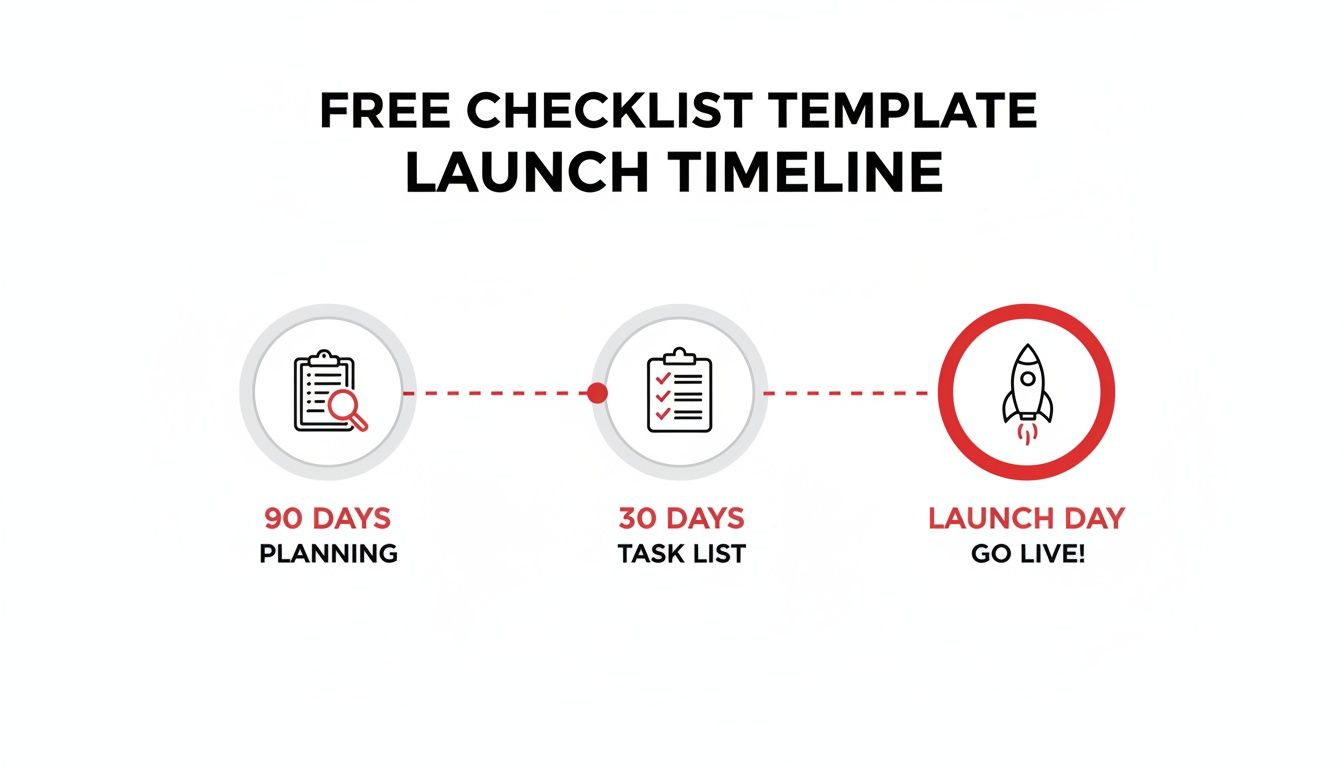
The graphic underscores a critical truth: the work done months in advance is what makes a successful launch day possible, moving from high-level strategy to detailed execution.
The 90-Day Horizon: Strategy and Research
Three months out from your launch date feels like a lifetime away, but this is your most important strategic window. This is where you lay the foundation for everything that follows. Rushing this phase is like building a house on sand; the cracks won't show immediately, but the structure is doomed to fail.
Your primary focus here is validation and planning. You’re not writing ad copy or designing landing pages yet. Instead, you're answering the big, fundamental questions that will guide every future decision.
Here's what you should be doing:
Deep Market Research: Go beyond basic competitor analysis. What are customers really saying in reviews and forums? What pain points are being ignored?
Ideal Customer Profile (ICP) Refinement: Create a crystal-clear picture of who you're selling to. What are their goals, challenges, and watering holes online?
Core Messaging and Positioning: Draft your value proposition. How is your product uniquely positioned to solve your ICP's problem?
High-Level Goal Setting: Define what success looks like. Is it revenue, user acquisition, or market penetration? Set specific, measurable targets.
This period is all about listening, not broadcasting. For a detailed roadmap on structuring this crucial period, check out this complete 90-day merchandise launch plan to ensure your groundwork is solid.
The 60-Day Countdown: Content and Infrastructure
With two months to go, you shift from high-level strategy to tangible asset creation. You know who you're talking to and what you want to say; now it's time to build the tools and content to deliver that message. This phase is about constructing the infrastructure of your launch campaign.
The goal is to have all major marketing and product assets well underway, if not complete, by the end of this period. This prevents a frantic scramble later on when you need to be focused on promotion and engagement.
For example, this is the perfect time to create a foundational piece of content, like a detailed ebook or guide that addresses your audience's core problem. You can then repurpose this single asset into dozens of smaller ones—blog posts, social media carousels, email snippets, and video scripts—to fuel your entire campaign.
At the 60-day mark, your focus shifts from "what if" to "what is." You are building the tangible pieces of your launch, turning strategic concepts into real-world assets your audience can interact with.
The 30-Day Sprint: Finalization and Buzz Building
One month out, the intensity picks up. This is the final sprint where all the pieces you've been carefully crafting come together into a cohesive campaign. The focus shifts from creation to finalization, testing, and starting to build genuine pre-launch buzz.
This is when you run your beta tests with a small, select group of users. Their feedback is invaluable for catching bugs, refining onboarding, and ensuring your messaging truly connects. Don't skip this step; it's your last chance to fix major issues before they impact paying customers.
Your primary objectives now are:
Finalize All Creative: All ad copy, email sequences, social media posts, and landing page designs should be approved and ready for scheduling.
Conduct Beta Testing: Gather user feedback, identify bugs, and make final tweaks to the product.
Warm Up Your Audience: Begin teasing the launch through your email list and social channels. Share behind-the-scenes content, hint at the problem you’re solving, and get people excited.
Onboard Partners and Affiliates: If you're running an affiliate program, now is the time to provide them with all the assets and information they need for a successful promotion.
The Final Week: The Last Mile Check
The last seven days are not for creating new things. This week is exclusively for testing, confirming, and executing. Your job is to double-check every technical detail to ensure a smooth experience on launch day. Any new initiatives at this stage only introduce unnecessary risk.
Walk through the entire customer journey yourself. Sign up for your own waitlist, click every link in your launch emails, and complete a test purchase with your payment processor. As you meticulously plan this final week, you should also consider specific strategies for achieving record-breaking launch day sales, even without a massive ad budget.
Here’s your final pre-flight checklist:
Tech Audit: Test your website under load, confirm payment gateways are working, and ensure all automated emails are firing correctly.
Team Huddle: Hold a final alignment meeting with your team to review the launch day schedule and assign specific roles and responsibilities.
Schedule Everything: All social media posts and emails for launch day should be scheduled and ready to go.
Prepare Customer Support: Ensure your support team (even if it's just you) is ready with canned responses for common questions and knows how to handle any potential issues.
By following this phased approach, you transform a daunting, monolithic event into a series of calm, controlled steps. You build momentum deliberately, reduce risk systematically, and set the stage for a launch that feels effortless to your audience—because you did the hard work months in advance.
Getting Your Team Aligned for Launch Day
A product launch is never a one-person show. Even if you're a solopreneur, you know the feeling of constantly switching hats—you're the marketer one minute and the tech support guru the next. For a launch to really stick the landing, every single role has to be crystal clear, whether it's handled by a different person or just you in a different frame of mind.
This is exactly why breaking down your product launch checklist template by department or function is a game-changer. Instead of staring at one monster to-do list that makes you want to crawl back into bed, you get focused playbooks for each critical area. It’s how you make sure specialized tasks don't just get remembered—they get assigned, owned, and done on time.
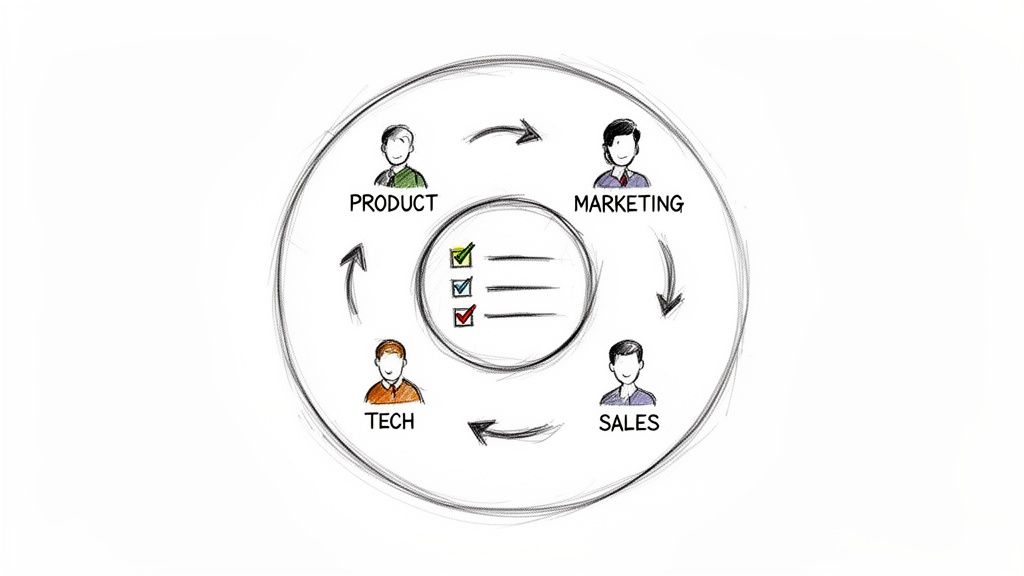
This isn’t just about neat project management, either. It directly impacts your bottom line. When your go-to-market teams sync up their checklists across product, marketing, and sales, the results are huge. Research from Highspot shows this kind of coordination can pump up your qualified pipeline volume by as much as 35% and speed up deals by 22%.
Product and Content Responsibilities
The product and content team is the heart of the whole operation. Their job is to make sure the product itself is polished, stable, and ready for its close-up. But just as important, they need to build the library of resources that helps new users feel like pros from day one.
Ever launched a slick new software feature without a single help article to explain it? The result is always the same: a tidal wave of support tickets from confused customers and a lot of frustrated early adopters. This team is the firewall against that chaos.
Their key tasks usually fall into a few buckets:
Finalizing Features: Locking in the final feature set, running brutal QA tests, and squashing every last bug they can find.
Creating Help Documentation: Writing knowledge base articles that are actually helpful, shooting quick tutorial videos, and prepping FAQs for the most obvious questions.
Onboarding Materials: Designing a welcoming and intuitive onboarding flow, whether that's through in-app tours or a carefully crafted welcome email series.
This division of labor keeps your engineers from writing marketing copy and your marketers from guessing about technical specs. Everyone sticks to what they do best.
Marketing and Communications Tasks
While the product team is building the what, the marketing team is busy crafting the why. Their entire mission is to build buzz, get people excited, and drive demand. They’re the storytellers, turning a list of features into a narrative about customer benefits.
Their work starts long before launch day, as they warm up the audience and build a runway of anticipation. A course creator, for example, might have their VA schedule a three-week email sequence to build hype and segment the most interested leads. That’s marketing 101.
This team's checklist is all about creative and strategic execution:
Crafting Campaigns: Nailing down the core messaging, writing all the copy for emails and ads, and designing landing pages that convert.
Content Creation: Churning out blog posts, social media updates, videos, and lead magnets that pull in and educate the right people.
Public Relations and Outreach: Writing press releases, pitching journalists and bloggers, and coordinating with influencers to get the word out.
The marketing team's ultimate goal is to ensure that on launch day, there's an eager, waiting audience ready to buy, not an empty room.
Tech and Operations Oversight
The tech and ops team makes sure the entire launch machine is stable, secure, and ready to handle a flood of new customers. Think of them as the guardians of the customer experience, tightening all the digital nuts and bolts behind the scenes.
Nothing kills launch momentum faster than a website crash or a broken payment link. For instance, a founder might need to work with a freelance developer to get a marketing pixel installed on the sales page. It's a small but absolutely critical ops task that makes ad tracking and retargeting possible.
Their responsibilities are highly technical and non-negotiable:
Website Stability: Running load tests on the site and servers so a traffic spike doesn't bring everything down.
Payment Gateway Setup: Configuring and battle-testing payment processors like Stripe or PayPal to make sure money can change hands without a hitch.
Analytics and Tracking: Setting up tools like Google Analytics and making sure every tracking code and pixel is firing correctly.
Security Checks: Performing security audits to protect customer data and ensure you’re compliant with privacy rules.
Without this team's obsessive preparation, even the world's best product and marketing campaign can trip at the finish line.
Sales and Partnership Enablement
Finally, you have the sales and partnerships team, whose job is to light up the direct and indirect sales channels. For a B2B launch, this is all about equipping the sales reps to go out and close deals. For many creators and entrepreneurs, this is about mobilizing an army of affiliates and partners.
This team is responsible for turning marketing buzz into actual revenue. They’re the bridge connecting excitement to signed contracts and paid invoices.
Their checklist is focused on empowerment and coordination:
Sales Collateral: Creating battle cards, demo scripts, and one-pagers that arm the sales team with everything they need to explain the product's value.
Affiliate Onboarding: Recruiting the right affiliates, giving them their unique tracking links, and arming them with promotional materials (like swipe copy and graphics).
Partner Coordination: Syncing up with strategic partners for co-marketing pushes, like a joint webinar or a bundled offer.
When you organize your product launch checklist template into these functional playbooks, you create a system built on clarity and shared ownership. Everyone knows their part, every task has a home, and the entire launch moves forward like a single, coordinated force.
Tracking What Matters After You Launch
Hitting that “launch” button feels like the finish line, but honestly, it’s just the start of the most important race. The initial chaos is over, and now the real learning begins. This is where you pivot from executing your plan to gathering real-world data that will dictate your product’s future.
So many founders get hooked on vanity metrics like social media likes or a quick spike in website traffic. While it’s exciting to see those numbers jump, they don’t tell you if your business is actually healthy. Your focus has to immediately shift to the key performance indicators (KPIs) that reveal the true story of your launch.
This is exactly why the post-launch section of your product launch checklist template is so critical. It’s designed to keep you locked on the metrics that genuinely drive growth and profitability, not just feel-good numbers.
Focusing on Core Growth Metrics
To figure out if your launch is truly working, you have to look past the surface. The real goal is to track metrics that map out the entire customer journey, from the first click to their long-term value. This data-driven approach is what separates a one-hit wonder from a scalable business.
Here are the absolute essentials to monitor from day one:
Customer Acquisition Cost (CAC): This is your total marketing and sales spend divided by the number of new customers you brought in. Knowing your CAC is non-negotiable for figuring out if your marketing is sustainable.
Customer Lifetime Value (LTV): LTV is a prediction of the total revenue you can expect from a single customer over their entire relationship with you. A healthy business needs an LTV that's significantly higher than its CAC—a ratio of at least 3:1 is the classic benchmark.
Conversion Rates by Channel: Don’t just glance at your overall conversion rate. You need to break it down by the source—organic search, paid ads, email marketing, social media. This shows you exactly which channels are your heavy hitters so you can double down on what’s working.
Churn Rate: This one is especially crucial for subscription products. Churn measures the percentage of customers who cancel during a specific period. Keeping this number as low as possible is the key to long-term survival.
The smartest product managers I know use their checklist not just to launch, but to learn. By tracking the right metrics, they can spot problems early, jump on opportunities, and consistently iterate their way to a much more successful product.
Analyzing Early Customer Feedback
Quantitative data like CAC and LTV tells you what is happening, but it’s the qualitative feedback from your first customers that tells you why. This early feedback is pure gold. It gives you raw, unfiltered insights into what’s clicking, what’s confusing, and what’s missing entirely.
You need a simple way to start collecting these insights immediately. You don’t need a complicated system, just start with:
Welcome Email Surveys: Pop a single, open-ended question into your welcome email, like, "What was the #1 reason you signed up today?"
Direct Outreach: Personally email your first 20-50 customers. Thank them, and ask if they’d be open to a quick chat about their experience.
On-Site Polls: Use simple tools to ask visitors on key pages if they found what they were looking for.
Essential Post-Launch KPIs to Monitor
Once you're live, the dashboard becomes your best friend. The table below breaks down the key performance indicators you need to track to accurately measure success and plan your next move. These aren't just numbers; they're the vital signs of your new product.
Metric (KPI) | What It Tells You | Typical Industry Goal |
|---|---|---|
Customer Acquisition Cost (CAC) | The cost to acquire one new paying customer. | Varies by industry, but should be < 1/3 of LTV. |
Customer Lifetime Value (LTV) | The total revenue you can expect from a single customer. | Aim for at least 3x your CAC. |
Monthly Recurring Revenue (MRR) | Predictable revenue generated by subscriptions each month. | Strive for consistent month-over-month growth. |
Churn Rate | The percentage of customers who cancel their subscription. | For SaaS, aim for below 5% monthly. |
Conversion Rate (by channel) | The percentage of visitors who complete a desired action. | Varies, but track which channels perform best. |
User Activation Rate | The percentage of new users who perform a key action. | Defines "aha" moment; aim for >25% initially. |
Net Promoter Score (NPS) | A measure of customer loyalty and satisfaction. | A score above 50 is considered excellent. |
This blend of hard data and customer stories gives you the complete picture you need to make smart decisions. For example, research from Product School highlights that product marketing managers who used checklists to track post-launch metrics saw a 40% reduction in launch failures. They stayed laser-focused on hitting key targets like a 25% monthly growth in active users while keeping churn below that critical 5% mark.
By tracking what truly matters, you turn your launch from a one-time event into a powerful engine for sustainable growth. If you want to dive deeper into data-backed strategies, you can find a great product launch guide on highspot.com.
Got Questions About Your Launch? We've Got Answers
Even with a killer product launch checklist, you're going to have questions. It’s just the nature of the beast. Juggling all the moving parts of a launch means you’ll inevitably hit a snag or two, wondering what the heck to do next.
Let's cut through the noise and tackle the most common questions I hear all the time. These aren't textbook theories; they're straight answers pulled from years of real-world launch experience.
How Far Out Should I Actually Start Planning This Thing?
This is the million-dollar question, and while there’s no single magic number, we can get pretty close. For most digital products—think online courses, ebooks, or even slick Notion templates—a 90-day runway is your sweet spot.
Why 90 days? Because it gives you enough breathing room to do the important stuff right. You can build genuine anticipation, warm up your audience, and get all your tech sorted without feeling like you're sprinting a marathon. A surprise launch often lands in a dead-silent room, but a 90-day plan lets you build a slow burn that turns into a wildfire on launch day.
Of course, the more complex your product, the longer you'll need.
Complex SaaS Products: If you're building software with a bunch of features and a longer sales process, you should be thinking 6-12 months ahead.
Physical Goods: Dealing with manufacturing, supply chains, and logistics? Your timeline gets much, much longer. Plan on 9-18 months from concept to a customer's doorstep.
The easiest way to figure this out is to work backward. Grab our checklist, plug in your ideal launch date, and start plotting your major milestones. You’ll see pretty quickly whether your timeline is realistic or pure fantasy.
What Are the Biggest, Most Common Launch Mistakes?
I've been in the trenches for hundreds of launches, and I see the same handful of mistakes sink amazing products over and over again. The frustrating part? They are almost always preventable.
The undisputed champion of launch-killers is building a product nobody asked for. It’s what happens when you skip the audience validation step. You get swept up in a brilliant idea, build it in a silo, and then are shocked when you hear crickets instead of cha-chings.
Another classic blunder is a total mismatch between your marketing message and what the product actually delivers. Your sales page promises a spaceship, but the product is a really solid minivan. Both are useful, but the whiplash from that mismatched expectation will kill your credibility and send refund rates through the roof.
"The most common mistake is a mismatch between your marketing message and the actual product, which leads to confusion and high refund rates. Our checklist is designed specifically to help you sidestep these common traps."
And finally, never underestimate the power of a technical glitch to ruin your day. A crashed website or a broken payment link on launch day can vaporize all the momentum you’ve spent months building. Test everything. Then test it again.
How Can I Adapt This Checklist for My Specific Product?
Our product launch checklist template was built from the ground up to be flexible. The core strategy—building buzz, aligning your team, and testing everything—is universal. It’s the nitty-gritty tasks that will change based on what you’re selling.
If you’re launching a digital product (like a course on Kajabi), you'll be focusing heavily on tasks like:
Content Creation: Filming video lessons, writing workbooks, designing slide decks.
Platform Setup: Configuring your course platform, setting up a community space, and hooking up your email service provider.
Automations: Building out all those crucial email sequences for onboarding, engagement, and cart abandonment.
Affiliate Management: Getting partners on board and arming them with everything they need to promote you.
On the other hand, if you're launching a physical product, your to-do list will look totally different on the operational side. You'll need to add sections for:
Manufacturing & Sourcing: Vetting suppliers, managing production runs, and handling quality control.
Inventory Management: Setting up a system that actually tracks what you have in stock.
Packaging & Shipping: Designing the unboxing experience, choosing carriers, and figuring out logistics.
Returns & Exchanges: Creating a clear, fair policy and a process to handle it without losing your mind.
Just swap out the task lists inside the template to fit your world. The marketing framework will feel right at home no matter what you sell.
What's the Single Most Important Part of the Whole Launch?
If I had to put all my money on one phase, it would be the pre-launch. Hands down.
What you do in the 30-60 days before you open the cart has the single biggest impact on your results. This is your golden opportunity to build your email list, create real buzz, and get your audience genuinely excited to buy.
A launch that comes out of nowhere feels abrupt and salesy. It’s almost guaranteed to fall flat. But a launch where your audience feels like they've been part of the journey? That’s where the magic happens. They've been warmed up, they're engaged, and they’ve been waiting for you to finally let them buy.
Pour your energy into building that audience and delivering massive value before you ever ask for a dollar. Share behind-the-scenes content, create a lead magnet that solves a related problem, and actually talk to people. By the time you open the cart, they should already be sold.