Explained
10 Community Engagement Best Practices for Lasting Growth in 2026

In a crowded market, likes and follows are fleeting metrics. True, sustainable growth comes from building an engaged, loyal community that actively participates in your brand's journey and feels a genuine sense of belonging. But how do you transform passive followers into passionate advocates? The answer lies in mastering the art and science of authentic connection, which requires a deliberate and strategic approach.
This guide moves beyond generic advice to provide a blueprint of 10 actionable community engagement best practices. Each point is packed with checklists, templates, and real-world examples designed for entrepreneurs, creators, and community managers to implement immediately. These strategies are just as relevant for building strong local ties as they are for online groups. For further insights into fostering stronger connections and trust, explore these 8 K-12 Community Engagement Best Practices.
Whether you are launching a new community or revitalizing an existing one, these proven techniques will help you create a space where your audience feels heard, valued, and motivated to contribute. By focusing on these core principles, you can turn engagement into your most powerful engine for long-term success. Let's dive into the strategies that build communities that last.
1. Two-Way Dialogue and Active Listening
The foundation of authentic community engagement best practices is moving beyond one-way broadcasts to foster genuine, two-way dialogue. This approach prioritizes actively listening to your community's concerns, ideas, and feedback, and then thoughtfully responding and integrating that input into your decision-making. It transforms your audience from passive consumers into active co-creators, building profound trust and ensuring their voices genuinely shape your organization’s direction.

This method shifts communication from a megaphone to a conversation, making members feel heard and valued. For example, a software company could host regular "developer office hours" where users can directly ask questions and suggest features, leading to a more user-centric product roadmap. Similarly, a local nonprofit can form a community advisory board to guide its strategic planning, ensuring its services remain relevant and impactful.
How to Implement Active Listening
To embed this practice, focus on creating accessible feedback loops and demonstrating that you value the input received.
Create Multiple Input Channels: Offer diverse ways for people to share their thoughts, such as online surveys, dedicated email inboxes, social media polls, and in-person or virtual town halls.
Close the Feedback Loop: Always report back to the community. Share a summary of the feedback received and explicitly state, "You said X, so we are doing Y." This shows their contribution had a tangible impact.
Train Your Team: Equip your community-facing staff with active listening skills, teaching them to listen without judgment, ask clarifying questions, and validate community members' perspectives. This ensures every interaction reinforces a culture of respect and collaboration.
2. Community Asset Mapping and Strengths-Based Approach
Effective community engagement best practices shift the focus from what's lacking to what's already there. A strengths-based approach involves systematically identifying and mobilizing existing community assets, such as individual skills, local businesses, institutions, and social networks. This method empowers residents by framing them as co-creators with inherent resources, rather than just recipients of aid, fostering greater ownership and sustainable change.
Instead of asking "What's the problem?", this strategy asks "What are our strengths and how can we use them to build a better future?". For example, a neighborhood revitalization project might start by mapping local artists, skilled tradespeople, and active volunteer groups to lead beautification efforts. This Asset-Based Community Development (ABCD) model, pioneered by John Kretzmann and John McKnight, leverages internal resources first, building community pride and resilience.
How to Implement a Strengths-Based Approach
To apply this practice, you must collaboratively discover and visualize the resources hidden within your community.
Conduct an Asset Inventory: Work with community members to create a comprehensive map of assets. Use surveys, focus groups, and one-on-one interviews to identify individual talents (e.g., graphic design, event planning), local institutions (libraries, schools), and physical resources (community gardens, public spaces).
Identify and Empower Connectors: Pinpoint the natural leaders and "connectors" who are already hubs of social activity. Engage these individuals to help mobilize their networks and champion community-led initiatives, amplifying your reach and impact.
Build Bridges Between Assets: Once mapped, the goal is to connect these resources. For instance, link a local business that wants to volunteer with a nonprofit that needs skilled support, or connect an experienced mentor with a young entrepreneur. This creates a powerful, self-sustaining ecosystem.
3. Culturally Responsive and Inclusive Engagement
Truly effective community engagement best practices must be built on a foundation of cultural responsiveness and inclusivity. This approach acknowledges that communities are not monolithic; they are diverse mosaics of different cultures, languages, abilities, and experiences. Strategies are intentionally designed to be accessible and respectful of these differences, actively dismantling barriers to participation and ensuring every voice, especially from marginalized groups, is genuinely heard and valued.

This practice moves beyond simple representation to create an environment of true belonging. For example, a city’s public health commission might conduct multilingual outreach campaigns and hold workshops in trusted neighborhood centers to connect with immigrant communities. Similarly, a tech company can form employee resource groups (ERGs) and consult them on product design and marketing to ensure their offerings are inclusive and avoid cultural missteps. This method fosters deeper trust and ensures your initiatives are relevant and respectful.
How to Implement Inclusive Engagement
To embed this practice, focus on intentionally designing your processes with an equity lens from the very beginning.
Partner with Community Leaders: Collaborate with cultural organizations, trusted local leaders, and community ambassadors who can act as a bridge to specific populations, ensuring your message is authentic and well-received.
Prioritize Accessibility: Provide translation and interpretation services for key communications and events. Hold meetings in physically accessible locations that are familiar and trusted by the community you wish to engage.
Train Your Team: Invest in ongoing cultural competency and implicit bias training for all staff. This equips them with the awareness and skills needed to interact respectfully and effectively with diverse community members, fostering a genuinely welcoming environment.
4. Strategic Partnerships and Collaboration
Effective community engagement best practices often extend beyond your own organization. Strategic partnerships involve intentionally building relationships with other groups, businesses, or institutions to amplify your reach and impact. By collaborating, partners can pool resources, share expertise, and cross-promote to create more comprehensive and efficient initiatives that benefit everyone involved. This approach transforms community building from a solo effort into a collective movement.
This strategy is about finding allies who share your vision and can help you achieve common goals more effectively. For example, a local food bank could partner with schools and churches to distribute food to families in need, leveraging established community networks. Similarly, a tech startup might collaborate with a university's entrepreneurship center to co-host workshops, gaining access to emerging talent while providing valuable real-world experience.
How to Implement Strategic Partnerships
To build successful collaborations, focus on mutual value, clear communication, and shared objectives from the start.
Identify Aligned Partners: Seek out organizations with shared values and complementary strengths. A strong partnership is built on a foundation of mutual goals, not just transactional benefits.
Establish Clear Agreements: Develop a written partnership agreement that outlines roles, responsibilities, resources, and shared metrics for success. To strengthen your community building efforts, exploring diverse approaches to strategic alliances can provide valuable insights into effective collaborations.
Invest in the Relationship: Go beyond formal meetings. Invest time in building genuine trust and rapport between the teams. Regular, open communication is crucial for navigating challenges and celebrating wins together.
5. Digital and Hybrid Engagement Platforms
In today's interconnected world, one of the most effective community engagement best practices is leveraging digital and hybrid platforms. This approach uses technology-driven tools to reach, communicate with, and mobilize community members wherever they are. By combining digital methods like social media groups and dedicated apps with traditional in-person events, you create a flexible and accessible engagement strategy that caters to diverse preferences and circumstances.
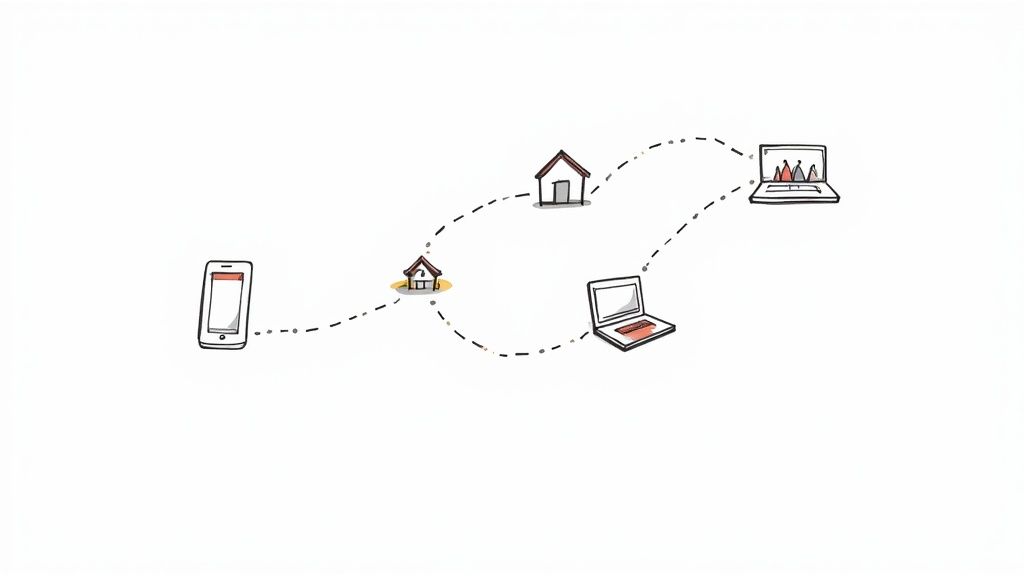
This method extends your reach beyond physical boundaries, making participation more convenient and continuous. For instance, a local business can use a Facebook community group to share updates and gather feedback, while a city can launch a mobile app like Boston's 311 for residents to report issues directly. These platforms foster ongoing conversations and empower members to engage on their own terms, strengthening community ties and streamlining communication. For more on this, discover how to grow your online community on entrepedia.co.
How to Implement Digital and Hybrid Engagement
To successfully adopt this practice, focus on choosing the right tools for your audience and integrating them seamlessly with offline activities.
Select Appropriate Platforms: Choose platforms where your community is already active. This could be anything from a dedicated Slack channel for a course creator to a Nextdoor group for a neighborhood initiative.
Ensure Accessibility: Prioritize mobile-friendly and user-friendly platforms. Address the digital divide by offering tech training or alternative non-digital options to ensure no one is left behind.
Merge Online and Offline: Use digital tools to promote and supplement in-person events. For example, livestream a town hall meeting on YouTube for those who cannot attend and use an online poll to gather questions beforehand.
6. Community Education and Capacity Building
Truly effective community engagement best practices go beyond simple participation by actively investing in your members' growth. This approach focuses on building the skills, knowledge, and confidence of your community through education. By providing training, workshops, and learning opportunities, you empower members to solve problems, lead initiatives, and contribute more meaningfully, transforming them from participants into capable leaders.
This method creates a powerful, self-sustaining ecosystem where expertise is cultivated from within. For instance, a nonprofit running a digital literacy program for seniors not only teaches valuable skills but also empowers them to engage more fully in a digital world. Similarly, a creator can offer workshops on content creation to their audience, building a pipeline of skilled advocates who can help grow the community organically. This builds capacity and deepens loyalty simultaneously.
How to Implement Community Education
To build capacity effectively, focus on accessible, relevant learning that connects directly to real-world community action and goals.
Assess Learning Needs: Before launching any program, survey your community to understand their interests and identify skill gaps. Ask what they want to learn to better contribute to the community's mission.
Remove Barriers to Participation: Make training as accessible as possible. Offer it for free or at a low cost, and consider providing support like childcare, flexible scheduling, or transportation stipends for in-person events.
Connect Learning to Action: Ensure every educational opportunity has a clear purpose. Tie workshops to specific community projects or leadership roles, giving members a direct path to apply their new skills and see their impact. For more strategies on this, explore these resources for building thriving communities.
7. Participatory Decision-Making and Governance
This advanced community engagement practice elevates members from advisors to active partners by directly involving them in key decision-making processes. It’s about genuinely sharing power, ensuring the people most affected by decisions have a direct hand in shaping them. This deepens commitment and accountability, leading to more equitable, sustainable, and widely supported outcomes that truly reflect the community's priorities.
This model moves beyond simple feedback collection to structured co-creation. For instance, cities like Chicago use participatory budgeting to allow residents to decide how to spend millions in public funds, directly improving their neighborhoods. Similarly, a tech cooperative might implement a governance model where user-members vote on new feature developments and pricing structures, ensuring the platform evolves in the interest of its community.
How to Implement Participatory Governance
To effectively share power, you must create clear, fair, and accessible structures for collective decision-making.
Establish a Clear Mandate: Define the scope of decisions the community will influence. Start with a specific, manageable project, like a community event budget or a new feature policy, to build trust and momentum.
Ensure Diverse Representation: Actively recruit participants from all segments of your community to form representative bodies like citizen juries or advisory boards. This prevents a vocal minority from dominating the conversation.
Share Authority, Not Just Input: This is the most critical step. Grant the decision-making body real authority. For example, explicitly state, "The community board's vote on this matter will be the final decision." This transforms the process from consultation into true collaboration.
8. Community-Based Participatory Research (CBPR)
A truly advanced community engagement best practice involves shifting from studying a community to collaborating with it. Community-Based Participatory Research (CBPR) is a partnership approach where community members are treated as equal experts throughout the entire research process, from identifying key questions to analyzing data and sharing the results. This method ensures that the insights gathered are not just academically interesting but are directly relevant, actionable, and address genuine community concerns.
This collaborative model turns research into a tool for empowerment and social action. For example, an environmental justice organization could use CBPR to work with residents to measure local pollution levels, producing data that residents can then use to advocate for policy changes. Likewise, a tech company could partner with a specific user group to co-design and test a new accessibility feature, ensuring it meets their lived needs from the start.
How to Implement CBPR
To adopt this practice, focus on building equitable partnerships and sharing power throughout your project.
Establish a Community Advisory Board: Form a board of community members to guide every phase of the research, from creating the initial questions to interpreting the final data. Compensate them fairly for their time and expertise.
Co-Create Research Tools: Develop surveys, interview questions, and data collection methods with your community partners, not for them. Use accessible language and formats that are culturally appropriate and easy to understand.
Plan for Action and Dissemination: From the beginning, collaborate on a plan for how the findings will be used. This includes co-authoring reports, creating visual summaries, and presenting the results at community meetings to spur tangible action.
9. Grassroots Community Organizing and Mobilization
This bottom-up approach to community engagement best practices empowers members to identify issues they care about, build collective power, and take action for meaningful change. Instead of imposing an external agenda, this method focuses on facilitating relationship building, developing leaders from within the community, and executing strategic actions rooted in self-determination and shared ownership. It transforms members from participants into powerful advocates.
This practice is powerful because it builds authentic, lasting investment by focusing on what truly matters to the community itself. For instance, a local business facing disruptive zoning changes could mobilize its customer base to advocate at city council meetings. Similarly, an online creator community might organize a digital campaign to raise awareness for a social cause important to its members, demonstrating collective impact beyond the platform.
How to Implement Grassroots Organizing
To successfully mobilize your community, focus on empowerment, relationship building, and strategic action.
Start By Listening: Begin with one-on-one conversations to understand what members are passionate about or concerned with. Build genuine relationships before you ever ask for action.
Develop Internal Leaders: Identify and nurture potential leaders within your community. Provide them with the skills, resources, and confidence to take on more responsibility and rally their peers.
Celebrate Small Wins: Mobilization is a long-term strategy. Acknowledge and celebrate every milestone, no matter how small, to maintain momentum and keep morale high. This reinforces that collective action creates tangible results.
10. Continuous Feedback Loops and Adaptive Management
Effective community engagement best practices require moving beyond one-off surveys and treating feedback as an ongoing, iterative process. This approach involves establishing continuous feedback loops to collect insights, evaluate what's working, and adapt strategies in real time. Rather than viewing engagement as a static campaign, you treat it as a cycle of learning and improvement, ensuring your organization remains agile and responsive to your community’s evolving needs.
This method transforms community management into a dynamic system of continuous improvement, much like agile development. For instance, a course creator could use post-module "micro-surveys" to gather immediate feedback, allowing them to tweak future content based on learner input. Similarly, a nonprofit can use a lean startup approach, rapidly prototyping new programs on a small scale and using community feedback to refine them before a major rollout.
How to Implement Continuous Feedback
To build this practice into your operations, focus on integrating feedback collection into your daily routines and creating a culture that embraces adaptation.
Integrate Feedback into Operations: Don't wait for annual surveys. Build feedback collection directly into your processes, such as adding a simple rating system at the end of every support ticket or hosting monthly "ask me anything" sessions.
Systematize Analysis and Action: Regularly review the collected data and create a transparent process for turning insights into action. Share your findings and planned changes with the community to demonstrate their input is valued and acted upon.
Test, Learn, and Iterate: Instead of launching large-scale, untested initiatives, use community feedback to develop small "tests of change." Pilot new ideas with a small group, learn from the results, and refine your approach before a wider implementation. For more information, explore how to set up a customer feedback collection system.
10-Point Community Engagement Best Practices Comparison
Practice | Implementation complexity | Resource requirements | Expected outcomes | Ideal use cases | Key advantages |
|---|---|---|---|---|---|
Two-Way Dialogue and Active Listening | Moderate — ongoing facilitation and coordination | Low–Moderate — staff time, multiple channels | Greater trust, improved programs, increased buy-in | Policy development, service design, community consultation | Builds trust; enables co-creation and responsive decision-making |
Community Asset Mapping and Strengths-Based Approach | Moderate–High — systematic research and mapping | Moderate — surveys, mapping tools, community time | Identifies local assets; sustainable, strength-based programs | Neighborhood revitalization, resource allocation, volunteer mobilization | Leverages existing resources; empowers residents |
Culturally Responsive and Inclusive Engagement | High — requires adaptation and training | Moderate–High — interpreters, accessibility, training | More inclusive participation; reduced equity gaps | Diverse or multilingual communities; health and social services | Reaches marginalized groups; improves relevance and trust |
Strategic Partnerships and Collaboration | Moderate — coordination, agreements, shared governance | Moderate — joint resources, coordination infrastructure | Expanded reach; improved efficiency and sustainability | Cross-sector initiatives, large-scale service delivery | Leverages complementary expertise; reduces duplication |
Digital and Hybrid Engagement Platforms | Low–Moderate — platform setup and moderation | Moderate — tech platforms, analytics, maintenance | Broader reach; data for decisions; asynchronous participation | Large or dispersed communities; hybrid events and surveys | Scales engagement; enables real-time feedback and analytics |
Community Education and Capacity Building | High — curriculum design and long-term programs | High — trainers, materials, support services | Stronger local leadership; sustainable community capacity | Leadership development, workforce readiness, long-term change | Builds leadership and skills; creates multiplier effects |
Participatory Decision-Making and Governance | High — power-sharing structures and facilitation | High — time, facilitation, training, transparency systems | Decisions reflecting community values; higher legitimacy | Participatory budgeting, governance reforms, major projects | Shares power; increases accountability and equitable outcomes |
Community-Based Participatory Research (CBPR) | High — collaborative research design and ethics | High — funding, training, long-term partnerships | Actionable, community-relevant findings; capacity building | Community health, environmental justice, local evaluations | Produces relevant evidence; builds trust and research capacity |
Grassroots Community Organizing and Mobilization | High — intensive relationship building and tactics | Low–Moderate (but sustained) — organizers, time, networks | Collective power, policy wins, strong local leadership | Advocacy campaigns, tenant organizing, social movements | Creates authentic power and sustained civic engagement |
Continuous Feedback Loops and Adaptive Management | Moderate–High — systems for data, evaluation, iteration | Moderate — feedback tools, analytics, staff capacity | Ongoing improvement; increased program effectiveness | Service delivery, pilot programs, quality improvement | Enables rapid learning and responsive adaptation |
From Blueprint to Action: Your Next Steps in Community Building
Navigating the landscape of community engagement can feel complex, but the journey from a passive audience to an active, thriving community is built on a series of intentional, consistent actions. We've explored ten powerful community engagement best practices, moving beyond surface-level tactics to the core principles that create genuine connection and sustainable growth. From the foundational necessity of Two-Way Dialogue to the strategic power of Continuous Feedback Loops, each practice serves as a vital component in your community-building blueprint.
The common thread weaving through these strategies is a fundamental shift in perspective. It’s about moving from a top-down, brand-centric model to a collaborative, member-centric ecosystem. It’s recognizing that your community members are not just consumers; they are co-creators, advocates, and partners in your mission. Embracing principles like Participatory Decision-Making and a Strengths-Based Approach isn't just good practice, it's a strategic advantage that fosters deep-seated loyalty and organic growth.
Turning Insight into Impact
The true value of this guide lies not in just understanding these concepts, but in applying them. The most successful community builders don't implement everything at once. They start small, test, and iterate. Your immediate next step isn't to master all ten practices overnight. It's to choose one or two that address your most pressing need or biggest opportunity.
Is your community quiet? Focus on Two-Way Dialogue and Active Listening. Start by posing one thoughtful, open-ended question this week and actively engaging with every single response.
Are you struggling to create relevant content? Implement a Continuous Feedback Loop. Deploy a simple two-question survey asking members what they want to learn next.
Feeling isolated or resource-strapped? Explore Strategic Partnerships. Identify one complementary brand or creator you could collaborate with on a joint event or piece of content.
By transforming these community engagement best practices from a checklist into a set of ingrained habits, you cultivate an environment where members feel seen, heard, and valued. This is the fertile ground where loyalty flourishes, turning your community into your most powerful asset. The effort you invest in building these authentic connections will pay dividends in brand advocacy, member retention, and long-term success. Your blueprint is now complete; it's time to start building.