Explained
White Label Services For Agencies That Scale Your Business

Picture this: you’re offering clients a full suite of expert services—from killer SEO campaigns to slick web development—all under your agency's name, without hiring a single new person. That’s the magic of white label services for agencies. It's a business model where one company creates a service, and another company puts its own brand on it and sells it directly to their clients.
What Are White Label Services And Why Do They Matter

Think of it like the store brand at your local supermarket. The supermarket doesn't own the factory that makes the cereal, but they put their name on the box. In this scenario, you're the supermarket, and the white label provider is the factory, working behind the scenes to create top-notch services you can sell.
This partnership lets you instantly broaden what you can offer. Let's say your agency is amazing at web design, but a client suddenly needs a complex PPC campaign. Instead of turning them away or scrambling to find a specialist, you bring in a white label PPC partner who runs the entire campaign in the background.
Your client gets expert campaign management under your trusted brand, and you open up a brand-new revenue stream. It’s a model that tackles some of the biggest headaches agencies run into.
For a quick summary, here’s how white label services break down at a high level.
White Label Services At A Glance
Aspect | Description |
|---|---|
Core Concept | A service produced by one company that other companies rebrand and sell as their own. |
Primary Benefits | Instant scalability, expanded service offerings, and reduced overhead without new hires. |
Ideal Use Cases | Agencies looking to add specialized services (e.g., SEO, PPC, content) to meet client demand. |
This table shows just how straightforward and powerful the model can be when applied correctly.
Solving Key Agency Growth Problems
White label partnerships are a direct answer to the classic agency roadblocks: scaling up, hitting resource limits, and feeling the pressure to offer everything to stay competitive. The benefits are felt almost immediately:
Instant Scalability: Take on more clients and bigger projects without the overhead and headaches of hiring.
Expanded Expertise: Overnight, you gain access to a team of specialists in areas like technical SEO, content creation, or social media management.
Reduced Overhead: You get to skip the costs tied to salaries, benefits, training, and pricey software subscriptions.
The core idea is simple but powerful: focus on what you do best—building client relationships and strategy—while a trusted partner handles the specialized execution. This is a strategic lever for growth, not just an operational shortcut.
It helps to see how this fits into the bigger picture. You can get a better sense of the operational side by comparing staff augmentation vs. outsourcing models, which share some of the same core principles.
And this concept isn't just for services. It works for digital products, too. To see how, you can dig into what PLR products are and discover how they can be rebranded. This whole approach paves the way for a smarter, more flexible way to build your agency.
Exploring The Most Profitable White Label Services
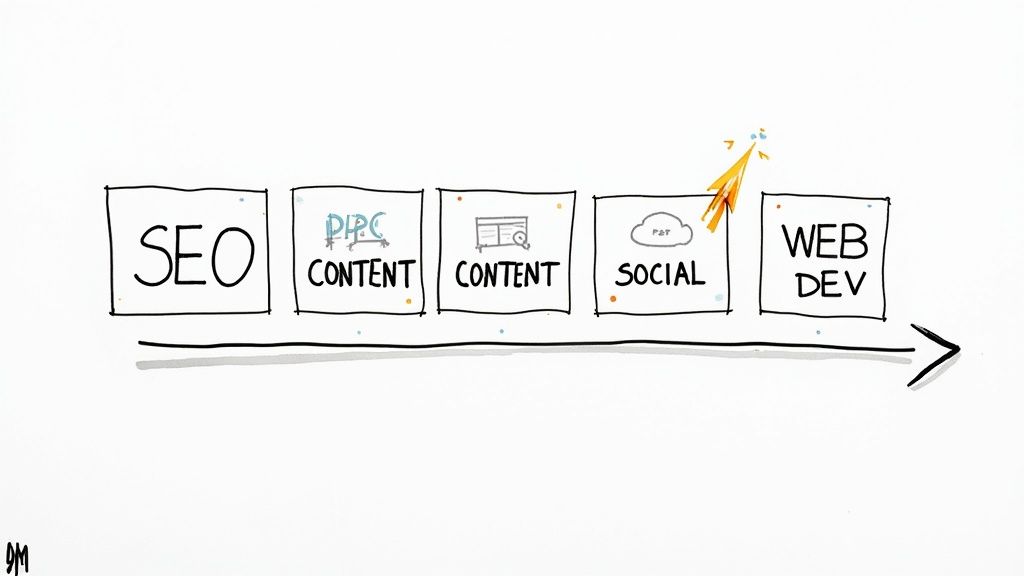
While you can white-label just about anything, a few key service areas consistently bring in the highest demand and profits for agencies. These are the specialized, high-impact services that clients desperately need but are far too complex and resource-heavy for them (or you) to build from scratch.
Think of these services as pre-built, high-performance engines you can drop right into your agency’s chassis. You don't need to engineer them from the ground up; you just connect them to your brand and start delivering incredible results for your clients.
Let's dive into the most lucrative options out there.
Technical SEO And Link Building
Search Engine Optimization is the foundation of almost every successful digital strategy, which makes it one of the most sought-after white label services for agencies. In fact, with the global SEO market projected to hit a staggering $122.11 billion by 2028, it’s clear why 85% of digital marketing agencies now rely on white-label SEO partners to stay competitive.
A top-tier white-label SEO provider does much more than just sprinkle in a few keywords. They bring a comprehensive, technical-first approach to the table.
Comprehensive Audits: A great partner always starts with a deep dive into a client's website, hunting down technical gremlins like crawl errors, slow page speeds, and missing schema markup.
Strategic Link Building: They don't just build links; they execute targeted outreach campaigns to earn high-authority backlinks that actually move the needle on search rankings.
Performance Reporting: You get detailed, beautifully branded reports that clearly show keyword movement, traffic growth, and the direct impact of their work.
This is where the real value lies—it’s a powerful blend of deep-dive analysis (audits) and active growth tactics (link building), all wrapped up in transparent, client-ready reporting.
PPC Management And Ad Campaigns
Running effective pay-per-click (PPC) ads on platforms like Google Ads and Meta is a full-time job that requires constant vigilance and optimization. A skilled white-label PPC partner manages every single piece of the puzzle, from the initial campaign setup to ongoing bid adjustments and A/B testing ad creative.
This lets you offer sophisticated ad management that drives real leads and sales, all without needing a certified ads specialist on your payroll.
A strong PPC partner acts as your agency's in-house quantitative analyst and ad strategist, all rolled into one. They wrestle with the complex data and platform quirks so you can focus on your client's big-picture marketing strategy.
Content Creation And Strategy
High-quality content is the fuel for every other marketing channel, from SEO and email to social media. White-label content services deliver professionally written blog posts, articles, white papers, and website copy that is thoroughly researched, optimized, and ready to publish under your brand.
This solves a massive bottleneck for agencies that are constantly struggling to produce consistent, high-caliber content at scale.
Some partners even provide strategic assets to help you build out entire content funnels in a fraction of the time. For instance, you could tap into Entrepedia’s white label master library to get ready-to-rebrand ebooks, courses, and lead magnets.
Social Media Marketing
Great social media management goes way beyond just scheduling a few posts. A reliable white-label social media partner will handle the heavy lifting for you, including:
Content Calendars: Strategically planning and scheduling posts across multiple platforms to align with your client's business goals.
Community Engagement: Actively monitoring comments, messages, and mentions to build a genuinely engaged and loyal audience.
Analytics and Reporting: Tracking key metrics like reach, engagement rates, and follower growth to prove the ROI of your social efforts.
Web Design And Development
Offering web design and development can be incredibly profitable, but it absolutely requires a highly specialized team. White-label development firms essentially become your production house, building everything from simple brochure sites to complex e-commerce platforms.
You get to manage the client relationship and project strategy, while they handle all the coding, testing, and deployment. This model allows you to confidently take on lucrative web projects you'd otherwise have to turn away.
The Strategic Benefits Of A White Label Partnership
So, we’ve covered what white-label services are. Now, let's get into the good stuff: how they can completely change the game for your agency. A smart partnership isn't just about handing off tasks; it's a massive growth lever built on three pillars: explosive scalability, instant expertise, and serious financial efficiency.
Picture this: a dream client walks in with a huge, multi-channel project that’s just a bit beyond what your current team can handle. In the past, you might have had to turn them down. With a white-label partner in your corner, you can confidently say "yes" to just about anything, knowing you have a skilled production team ready to go.
That ability to scale on demand is what separates the agencies that stay small from the ones that dominate.
Achieve Explosive Scalability
The old way of growing an agency is slow and linear. You land a client, you hire someone, your overhead goes up, and you do it all over again. It's expensive, takes forever, and is packed with risk.
White-label services completely demolish that model. Instead of taking the stairs one slow step at a time, you get an elevator straight to the top. This approach lets you take on new business without the usual growing pains.
Handle Fluctuating Workloads: Easily manage the busy season or that one massive project that comes out of nowhere without burning out your core team.
Enter New Markets: Want to test the waters with a new service or target a different industry? Now you can do it with minimal upfront cash.
Increase Client Retention: When you can offer a wider range of services, you become the indispensable, go-to partner for your clients. Churn drops.
This kind of flexibility turns your business from a rigid, fragile structure into an agile operation that can pivot on a dime.
Gain Instant Access To Expertise
Building an in-house team of genuine specialists—a technical SEO wizard, a PPC data genius, a brilliant content strategist—can take years and cost a small fortune. A white-label partnership plugs you into that collective brainpower overnight.
Your agency immediately has the capabilities of a much larger, more established firm. You can confidently pitch sophisticated campaigns and advanced strategies, knowing you have the talent to back it up. That instant credibility is how you start competing for (and winning) higher-value clients.
A white-label partner acts as an invisible extension of your team. They bring deep, specialized knowledge to the table, allowing your agency to deliver world-class results under your own trusted brand.
White-label partnerships are changing the entire financial equation for agencies, with some reporting 500% organic traffic growth and 300% increases in online leads. Agencies using this model sidestep the rising costs of hiring top talent, pouring those resources back into sales while the experts handle fulfillment. The impact on revenue is real, with 35-50% growth within the first 12 months becoming a common benchmark.
Enhance Your Financial Freedom
Maybe the most powerful benefit is the impact on your bottom line. A partnership radically cuts your operational overhead, freeing up cash you can pump back into growth activities like marketing and sales.
Think about the costs you completely wipe off your books:
Recruitment and Hiring: Forget about expensive recruiter fees and months-long hiring sagas.
Salaries and Benefits: You dodge the high fixed costs of full-time staff, including health insurance and retirement plans.
Software and Tools: Your partner foots the bill for all the expensive industry software, from SEO audit tools to analytics platforms.
Training and Development: You get a team that's already trained and on top of the latest industry shifts.
This financial efficiency juices your profit margins on every single project. For agencies exploring this model, understanding how low-code solutions can boost agency profits and delivery speed offers another layer of insight into getting work done faster and more profitably.
By letting your core team focus on client strategy and relationships—the high-value work—you build a much more resilient and profitable agency.
How To Choose The Right White Label Partner
Picking a white label partner is one of the most important calls you'll make for your agency. A great one acts like a secret weapon, letting you scale up and punch above your weight. A bad one, however, can quickly turn into a nightmare, putting client relationships and your hard-earned reputation on the line.
This isn't just about farming out tasks you don't have time for. It's about handing a piece of your brand over to someone else. That means the vetting process needs to be serious, strategic, and focused on finding a true partner—not just another vendor.
First, Scrutinize Their Track Record And Expertise
Before you even glance at a price sheet, you need to see proof of performance. Any white label provider worth their salt will have a portfolio of work and case studies ready to go. Don’t just skim them—dig in.
You're looking for real-world evidence that they get your clients' industries. A partner who crushed it for a B2B SaaS company might be completely lost when it comes to a local e-commerce brand. Their expertise has to line up with the specific challenges your clients are actually facing.
Ask for Relevant Case Studies: Request examples of work that mirror what you need. If you're hunting for SEO help, you want to see ranking improvements and traffic growth charts for their past clients.
Check for Testimonials and Reviews: Look for feedback from other agencies, not just the end clients. This gives you a peek into what it's actually like to work with them day-to-day.
Verify Their Team's Credentials: Who is doing the work? Get the details on the experience and qualifications of the specialists who will be handling your accounts.
This initial deep dive helps you weed out the providers who talk a big game but don't have the results to back it up.
Next, Evaluate Their Communication And Reporting
In a white label relationship, communication is everything. They are an invisible extension of your team, so you need absolute clarity and transparency on how projects are moving along. A partner that goes dark or sends you vague, fluffy updates is a massive red flag.
The right partner will have a clear, structured way of keeping you in the loop. This usually means a dedicated account manager you can always reach, regular check-in calls, and access to a shared project management tool like Asana or ClickUp.
The quality of a white label provider's reporting is a direct reflection of their accountability. A professional partner provides clear, data-driven reports that are fully brandable, making it easy for you to demonstrate value to your clients.
Go one step further and ask for a sample report or a live demo of their client dashboard. Is it easy to understand? Does it clearly track the key performance indicators (KPIs) that your clients care about? If their reporting is a confusing mess, it just creates more work for you, which defeats the whole purpose of bringing them on.
Finally, Analyze The Pricing And Contract Terms
Once you've confirmed they have the chops and communication is solid, it's time to talk money. But don't just fixate on the price tag. You need to analyze the entire pricing structure for hidden costs and annoying inflexibility.
A transparent partner will have a straightforward pricing model without surprise fees for things like setup or account management. Be wary of anyone offering rock-bottom prices—it often signals rushed work, junior staff, or non-existent support. The goal is value, not just the lowest cost.
To help you systematically vet potential partners, we've put together a checklist. Think of this as your guide to asking the right questions and spotting potential issues before they become your problem.
White Label Partner Evaluation Checklist
Evaluation Criteria | Key Questions to Ask | Red Flags to Watch For |
|---|---|---|
Expertise & Track Record | Can you show me 3-5 case studies from my clients' industries? Who is on your team, and what are their qualifications? | Vague results without data. No experience in your niche. High staff turnover. |
Communication & Reporting | Who is my main point of contact? Can I see a demo of your reporting dashboard? What is your standard response time? | No dedicated account manager. Confusing or non-brandable reports. Slow or inconsistent communication. |
Onboarding & Integration | What are the exact steps to get started? How long does it take to launch the first client project? | A complicated or lengthy onboarding process. Lack of a clear plan or timeline. |
Quality & Scalability | How do you ensure consistent quality across all client accounts? What is your process for handling a sudden increase in workload? | No documented QA process. Hesitation when asked about handling more work. |
Pricing & Contract Terms | Is your pricing all-inclusive, or are there hidden fees? What is the contract length and what are the terms for cancellation? | Unusually low prices. Vague contract terms or long-term lock-ins with no exit clause. |
Using a structured checklist like this ensures you don't miss anything critical. It forces a disciplined evaluation, helping you compare different providers on an even playing field.
Choosing the right white label partner is a foundational move for scaling your agency. By following this framework, you can go beyond a simple vendor relationship and build a true strategic partnership—one that drives growth, boosts your bottom line, and protects the brand you've worked so hard to build.
Integrating White Label Services Into Your Agency Workflow
Finding the right partner is a massive win, but the real magic happens when they become an invisible extension of your team. A great partnership lives or dies by how well you merge their operations into your own. Get this wrong, and you’re in for a world of friction, missed deadlines, and confused clients.
The goal is to make the whole process so slick that it just works from day one. This isn't about just handing off tasks; it's about thoughtfully integrating a new, specialized department into your company.
When done right, every step—from the initial sales pitch to the final client report—feels fluid, efficient, and completely on-brand.
Establishing A Foundation For Success
First things first: you need a rock-solid communication plan. Messy email chains and missed Slack messages are the fastest way to kill a partnership before it even gets started. You have to create one central place where your team and their team can work together without skipping a beat.
Shared Communication Channels: Set up a dedicated Slack or Microsoft Teams channel. This gives everyone a direct line for quick questions, fast updates, and hashing out problems in real time.
Unified Project Management: Give your partner a seat at the table in your project management tool, whether it's Asana, ClickUp, or Trello. A shared board means total transparency—everyone can see who’s doing what and when it’s due.
Clearly Defined Roles: Write down who is responsible for what. Who’s your main point of contact? Who talks to the client? Who handles the technical side? A simple roles and responsibilities chart can prevent a mountain of headaches down the road.
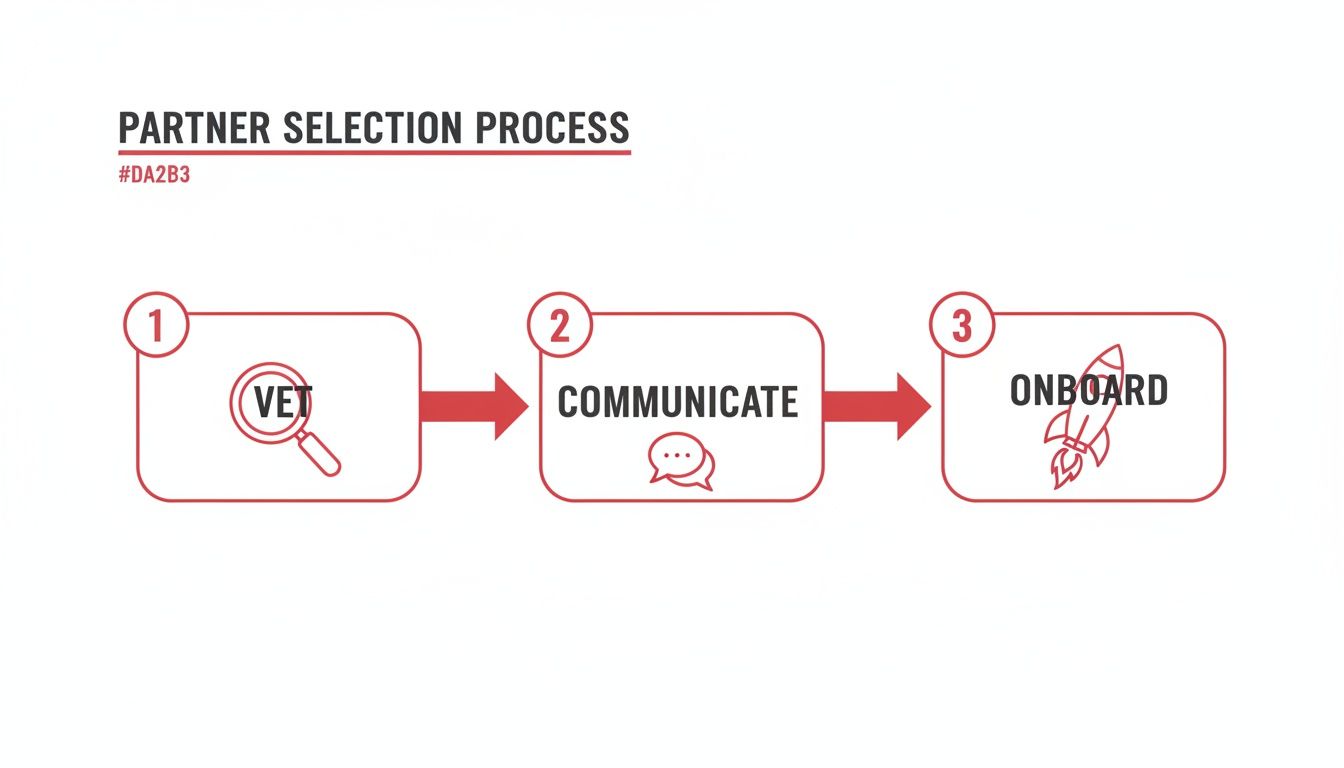
This process shows that vetting, communicating, and onboarding aren't just one-off tasks. They’re part of a continuous flow that leads to a truly seamless partnership.
Creating A Fluid Workflow
Once your communication is locked in, it's time to map out the entire project journey from start to finish. This is all about creating a repeatable process that guarantees quality and consistency for every single client. A clear workflow eliminates the guesswork and gives your team the confidence to sell and manage these new services.
The real goal here is to completely erase the line between your agency and your partner. To the client, it should all look and feel like it's coming from you—one unified, trusted brand.
Start by breaking down the key stages of any client project.
Sales Enablement: Your partner should arm you with unbranded sales decks, case studies, and proposal templates. This is the ammo your sales team needs to pitch the new services effectively.
Project Kick-Off: Create a standard onboarding checklist for every new client. This should include a detailed brief or a kick-off call that brings your account manager and the partner’s key contact together.
Fulfillment and Execution: This is where the partner shines. But your project management system should give you a live view of their progress so you’re never in the dark.
Reporting and Review: Set a firm schedule for receiving branded performance reports. Your team must review these internally first, adding your own strategic insights before ever sending them to the client.
When you treat the integration with this level of detail, you’re not just hiring a vendor; you’re building a scalable system for growth. This same mindset applies to more than just services. Many agencies learn how to outsource digital product creation to add even more revenue streams.
Ultimately, a thoughtful integration turns a simple service provider into a true strategic partner that helps fuel your agency’s future.
Pricing Your Services For Maximum Profitability
So, you've got these new capabilities ready to go. That's the fun part. But turning that excitement into a real revenue stream? That all comes down to smart pricing. The financial strategy behind using white label services for agencies is what separates a small add-on from a major profit center. This isn't just about covering your costs; it's about capturing the full value of the solution you’re now able to offer.
Think of it this way: your white label partner is giving you the raw ingredients at wholesale. Your job is to be the chef—to package them, add your strategic flavor, and present a premium, finished dish to your clients. A simple markup is your profit, but the real art is setting a price that reflects the comprehensive, problem-solving meal you're serving.
Establishing Your Pricing Model
First things first, you need a pricing model that builds in healthy margins without making clients run for the hills. You're looking for a method that’s both profitable for you and easy for your customers to justify. Luckily, there are a few tried-and-true approaches that agencies lean on.
Cost-Plus Markup: This is the most straightforward route. You take the wholesale price from your white label partner and tack on a fixed percentage. A typical markup can be anywhere from 50% to 200%, depending on how complex the service is and how much of your own time is involved.
Value-Based Pricing: Here, you stop thinking about your cost and start thinking about the client's ROI. You price the service based on the value and results it delivers for them. This model can lead to much higher margins, especially for heavy-hitters like SEO or PPC management.
Tiered Packages: Don't just sell one-off services. Bundle your new white-labeled offerings with your existing services into different tiers (think Basic, Pro, and Premium). This makes the buying decision much simpler for clients and can dramatically increase your average contract value.
The demand for this model is exploding. The white-label marketing sector is on track to hit USD 99 billion by 2026 as more agencies look for scalable ways to stay competitive. And the results speak for themselves—top white-label PPC providers have helped clients see a 700% return on ad spend, a 4x jump in lead volume, and a 30% increase in qualified leads. Knowing what's possible is your secret weapon for setting confident, value-based prices. You can dig into more stats and see some of the top white-label marketing agencies on xceedbd.com.
Communicating Value To Clients
How you talk about your new services is every bit as important as how you price them. Clients aren’t just buying a task off a to-do list; they're buying a solution, expertise, and, most importantly, results. Your communication has to hammer this home every single time.
When the conversation turns to price, shift the focus from cost to investment. Don't frame it as an expense. Frame it as a strategic tool that will get them closer to their goals, whether that’s more leads, higher sales, or a stronger brand.
Never just email over a price list and hope for the best. Walk them through a proper proposal that spells out the deliverables, your process, and the outcomes they can expect. Use the branded reports your partner provides to show tangible progress and prove a clear return on their investment. When you back up your price with hard data, it starts to feel less like a cost and more like a bargain.
Common Questions About White Label Services
Thinking about bringing on a white-label partner? It’s smart to have questions. Getting clarity on a few key points is the best way to make sure a partnership is the right move for your agency.
Let's cut through the noise and tackle the most common concerns agency owners have.
Will My Clients Know I Am Using A Provider?
Absolutely not. The entire white-label model is built on one simple idea: the partner works for you, not your client. They are a completely invisible extension of your team.
Every single deliverable, from the monthly performance report to the weekly check-in email, is branded with your agency’s logo and voice. Your client relationships stay yours, and your brand authority is never compromised. It’s seamless.
How Do I Maintain Quality Control?
This is a big one, and it’s a shared responsibility that begins long before you sign a contract. Your first line of defense is a thorough vetting process. Look for partners with transparent workflows and a portfolio filled with case studies you can verify.
Once you’re working together, the best way to stay in control is by setting clear KPIs and having regular check-ins. Reputable providers will give you access to a white-labeled dashboard where you can see campaign progress in real time. This keeps you in the driver's seat, able to monitor performance without getting stuck in the weeds of daily execution. You always have the final say.
A great white-label partner understands they are representing your brand. Their success is directly tied to yours, creating a powerful incentive to deliver consistent, high-quality work that makes you look good.
Is It More Expensive Than Hiring In-House?
Not even close. In almost every single scenario, a white-label partnership is significantly more cost-effective. You get to sidestep all the massive, and often unpredictable, costs that come with building out a team yourself.
Think about the expenses you completely avoid:
Recruitment: No more headhunter fees or sifting through hundreds of applications.
Salaries & Benefits: Competitive pay, health insurance, and retirement plans are off your plate.
Software & Tools: You don't have to pay for those expensive, specialized platform subscriptions.
Training: No need to budget for ongoing professional development to keep skills sharp.
You get instant access to a full team of specialists for a predictable monthly fee—often for less than the total cost of a single senior in-house employee.