Guide
A Guide to White Label Digital Products and How to Profit

White label digital products are essentially ready-made items, like software or online courses, that you can legally stick your own brand on and sell. Think of it as putting your logo on a professionally built product, letting you get new offers to market without the massive upfront investment in development. It's a massive shortcut.
What Are White Label Digital Products Anyway?
Imagine you’re a fantastic baker known for your incredible cake decorating skills. Instead of spending months perfecting a new cake recipe from scratch, you find a premium, unbranded cake mix that’s absolutely delicious. You bake it, add your signature frosting and decorations, and then package it in a beautiful box with your bakery’s logo.
That’s exactly how white label digital products work. They are pre-built digital assets—software, courses, templates, or reports—created by one company (the provider) and sold to another (you) to customize and sell as if you made it from the ground up.
This approach lets entrepreneurs and agencies offer sophisticated products without the crippling cost, time, and technical skill usually required. Instead of getting bogged down in coding or spending months creating content, you can focus on what actually grows your business: marketing, sales, and taking care of your customers.
The Core Concept Explained
At its heart, white labeling is all about efficiency and speed. The original creator does all the heavy lifting—the development, the bug fixes, the updates. You, the reseller, just handle the branding and customer-facing side of things.
It’s a win-win. The developer gets wider distribution without having to manage thousands of individual customers, and you get a high-quality product to sell almost overnight.
The real value of white labeling is simple: It dramatically shrinks your time-to-market. A custom software solution might take 12-18 months to build, but you can often launch a white label version in under 90 days.
This kind of speed is a huge competitive advantage. To really get it, it helps to compare custom software versus off-the-shelf solutions, where white label products offer a powerful middle ground.
To help you get a quick handle on the defining features, here’s a simple breakdown of what makes a digital product "white label."
Core Characteristics of White Label Digital Products
This table summarizes the defining attributes of white label digital products, helping you quickly grasp the key features.
Characteristic | Description |
|---|---|
Rebrandable | You can add your own logo, brand colors, and company name to make the product look and feel like yours. |
Ready-Made | The product is fully developed and functional, saving you from the time and cost of building it from scratch. |
Developer Support | The original creator typically handles technical maintenance, updates, and bug fixes in the background. |
Non-Exclusive | Other businesses can also purchase and rebrand the same core product, though your branding makes it unique. |
Scalable | You can easily sell to a large number of customers without worrying about the underlying infrastructure. |
Ultimately, these characteristics combine to create a low-risk, high-reward opportunity for businesses looking to expand their offerings without the traditional barriers to entry.
Why This Model Is Gaining Traction
The appeal of white label digital products has fueled some serious growth. The broader white-labeling market was valued at around USD 28.3 billion in 2025 and is expected to grow at a compound annual rate of about 22.0%, hitting roughly USD 75.0 billion by 2033.
Why the boom? Businesses are realizing they can outsource the entire development process and launch fully branded digital products without hiring a single engineer. You can dig into more of the numbers in the full industry analysis.
For an entrepreneur, this is a game-changer. It means you can go toe-to-toe with bigger, more established companies without needing their deep pockets. You can quickly bolt on new revenue streams or make your existing services more valuable. The key benefits are pretty clear:
Faster Market Entry: Launch a new product line in weeks, not years.
Reduced Development Costs: Skip the six-figure investment that software or a comprehensive course usually demands.
Brand Enhancement: Offer high-value products under your brand, which instantly boosts your authority and credibility.
Focus on Core Strengths: Pour your energy into marketing and customer service instead of getting lost in development logistics.
Ultimately, using white label digital products is a strategic move. You’re building on the proven work of others, allowing you to stand on the shoulders of giants and get where you want to go much, much faster.
Understanding White Label vs PLR vs Resell Rights
Dipping your toes into the world of ready-made digital products can feel a bit confusing. You’ll hear terms like White Label, Private Label Rights (PLR), and Resell Rights thrown around, but they aren't interchangeable. They represent entirely different business models with their own unique rules.
Picking the wrong license is like trying to open your front door with your car key. It looks similar, but it just won’t work for what you’re trying to accomplish.
Let's clear this up with a simple coffee shop analogy.
Imagine you want to launch your own café. You’ve got three main paths you can take:
White Label: A company offers you a fully built, operational coffee shop that's completely unbranded. The espresso machine is installed, the tables are set, but the sign out front is a blank slate. You get to put your name on it, design your own cups, and start serving. It's your shop, built on a proven, ready-to-go foundation.
Private Label Rights (PLR): A master roaster gives you their secret recipe for an award-winning coffee blend. You can take that recipe, tweak it with a dash of cinnamon, call it "Morning Fire," and sell it in bags with your own branding. The core formula wasn't yours, but you have the right to modify it and claim the final creation as your own.
Resell Rights: You strike a deal to become an authorized seller for a famous coffee brand. You can sell their pre-packaged beans in your shop, but you can’t change the branding, alter the roast, or say you made it. You are simply a licensed retailer for someone else’s finished product.
That fundamental difference—the level of control you have over branding and modification—is what separates these three powerful models.
What Can You Actually Do With Each License?
The license you choose directly impacts your creative freedom and control. A white label deal offers the smoothest integration, making the product look like it was built by your team from day one. PLR gives you incredible flexibility for content, while Resell Rights offer a simple way to add products to your lineup with zero creative effort.
This diagram shows the straightforward hierarchy for white label digital products, where you take a finished product and put all your energy into branding, marketing, and selling it.
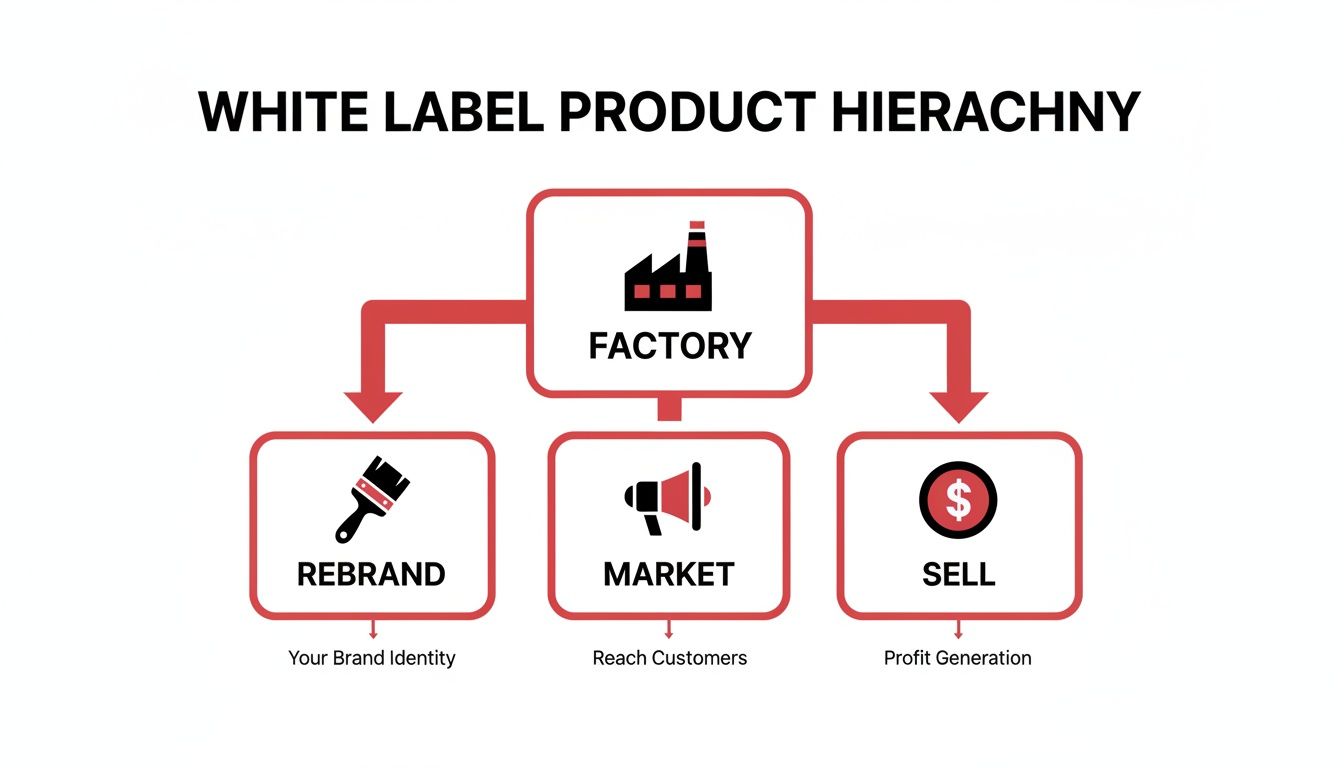
As you can see, the white label model lets you completely bypass the development phase. This frees you up to pour all your resources into what actually generates revenue: branding and sales.
To go deeper into the specifics of content-based assets, you can check out our guide on what PLR products are and how they really work.
A Head-to-Head Comparison
To help you figure out which model is the right fit for your business, I've broken down the key differences in a simple table. This comparison highlights the practical permissions and limitations that come with each license, from branding control to profit potential.
Comparing White Label vs PLR vs Resell Rights
Feature | White Label | PLR (Private Label Rights) | Resell Rights |
|---|---|---|---|
Branding Control | Total Control. You apply your own brand, logo, and colors. The end customer never knows the original creator. | Full Control. You can claim authorship and rebrand the content completely as your own. | No Control. You must sell the product under the original creator's brand name. |
Modification Rights | Minimal to None. You typically cannot alter the core functionality of the software or product. | Extensive Rights. You can edit, rewrite, combine, and change the product significantly. | No Rights. You cannot alter the product in any way. You sell it "as is." |
Exclusivity | Low. The same core product is often sold to multiple resellers. Your branding is the key differentiator. | Very Low. PLR content is sold to many buyers, so originality requires significant modification. | Low. The same product is sold by many distributors, often creating price competition. |
Common Use Case | Offering a SaaS tool, app, or marketing dashboard to clients under your agency's brand. | Creating unique e-books, courses, or blog posts by modifying and combining existing content. | Quickly adding a complementary product to your store without any creative work. |
Primary Goal | To sell a finished, high-value product or service without any development costs. | To use foundational content as a flexible starting point for creating original assets. | To act as a third-party retailer for an established product, earning a commission or margin. |
Ultimately, the right choice comes down to your business strategy. If your goal is to sell a polished, ready-to-use software platform, white label is the perfect match. If you need a flexible content engine to power your marketing, PLR is your best friend. And if you just want to add a simple, no-fuss product to your catalog, Resell Rights offer the fastest path to market.
Profitable Business Models Using White Label Products
Knowing what white label digital products are is one thing, but seeing how they actually make money is where things get interesting. These products aren’t just abstract assets; they are the engines powering several proven, profitable business models. When you plug a ready-made product into the right framework, you can create new income streams with surprising speed.
The whole idea is to skip the expensive and time-consuming development grind and jump straight to making money. Think of it like leasing a fully-built factory instead of laying every brick yourself. This frees up your energy and cash to focus on what really moves the needle: finding and delighting customers.
Let's walk through four distinct models that entrepreneurs, agencies, and creators are using right now to turn white label products into steady, scalable income. Each one serves a different purpose and offers its own strategic edge for your business.
Agency Service Expansion
For marketing agencies, consultants, and freelancers, the key to growth is increasing client lifetime value. Instead of just offering strategy or ad management, you can use white label SaaS (Software as a Service) platforms to provide powerful tools under your own brand. This simple move can transform a one-time project into a recurring revenue relationship.
Imagine a social media marketing agency. Beyond just posting content, they could offer clients a branded social media scheduler, a custom analytics dashboard, or even a reputation management tool.
Target Customer: Existing clients who already trust the agency’s expertise.
Revenue Model: Monthly recurring subscription fees for software access.
Strategic Advantage: This makes your agency "stickier." By embedding your tools into a client's daily workflow, it becomes much harder for them to even think about leaving.
Standalone Digital Product Sales
This is the most direct route: get the rights to a white label digital product, rebrand it, and sell it as your own signature offer. It’s an incredibly popular model for online courses, e-books, and digital toolkits. You can build an entire brand around a single, high-quality white label product without ever writing a word or recording a video yourself.
For instance, a business coach could buy a white label course on sales funnels, add their own insights and branding, and sell it as their flagship program. They get full control over the pricing, marketing, and the entire customer journey.
A white label product gives you a professionally-built foundation. Your unique branding, marketing angle, and customer support are the value-add layers that make it a premium, one-of-a-kind offer in the market.
This approach mirrors the explosive growth we've seen in the physical goods space. Just look at the white-label cosmetics market, which is projected to hit USD 1.57 billion by 2030. Small brands use pre-made formulas to launch fast, focusing their energy on building an online presence and influencer marketing. The same principle applies here, and you can learn more about this trend in the full market analysis.
High-Value Lead Magnets
Not every white label product needs a price tag. Many savvy consultants and service providers use smaller white label assets as powerful lead magnets. Instead of a basic PDF checklist, they offer a branded template, a mini-course, or a specialized digital planner in exchange for an email address.
This strategy is effective because it delivers immediate, real value. Giving away a genuinely useful tool builds a ton of trust and instantly positions you as an expert. That high-quality first impression makes it so much easier to convert that lead into a paying client down the road. A financial advisor, for example, could offer a white label budgeting spreadsheet rebranded as their "Wealth Kickstarter Template."
Membership Site Content
Running a successful membership community means delivering a constant stream of fresh, valuable content to justify that recurring fee. But creating all that content can quickly become a full-time job, leading to serious burnout. White label products offer a brilliant way out of this trap.
A community manager can license a whole library of white label resources—e-books, video workshops, templates, and guides—and drip them out to members each month. This provides a steady flow of high-value material without the grind of constant creation. The variety and quality of the resources become a core selling point for the membership itself, helping you attract new members and keep the current ones happy.
How to Find and Rebrand Your First White Label Product
Jumping into the world of white label digital products is a fantastic move for growing your business fast. The process itself is pretty simple, but your success really boils down to two things: picking the right product and making it truly yours. This is about so much more than just sticking your logo on something pre-made. It’s about turning a generic asset into a premium product that feels like it was born in your business.
The whole journey breaks down into three clear phases: finding a high-quality product, rebranding it to match your company's vibe, and then getting it ready for a successful launch. Each step is essential if you want to turn a ready-made item into a real money-maker that your customers will be excited about.
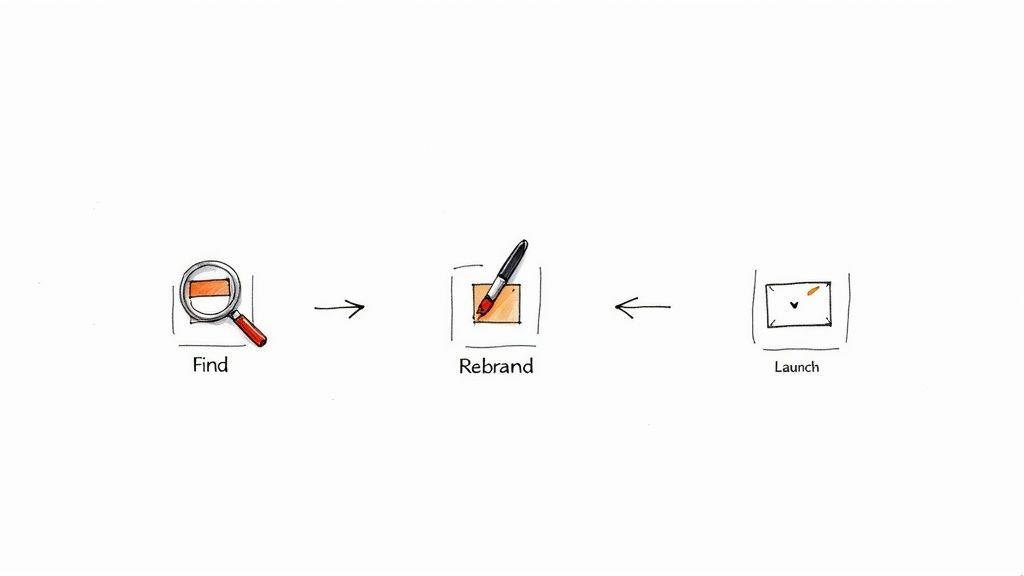
This little roadmap lays it all out. Now, let's get into the nitty-gritty of how you can find and customize your first white label product.
Sourcing High-Quality White Label Products
First things first, you need to play detective. The quality of your final product is 100% dependent on the foundation you choose. Start by zeroing in on a profitable niche where you either have some expertise or a strong connection with the audience. A product that solves a real, specific problem is always going to sell better than something generic.
Once you know your niche, it’s time to hunt for a supplier. Specialized marketplaces are usually the best place to start because they do a lot of the heavy lifting for you, curating products and vetting the providers. Think of them as a bridge between the original creators and resellers like you.
Here are a few great places to start your search:
SaaS Reseller Marketplaces: Platforms like Vendasta offer massive catalogs of rebrandable software perfect for agencies, covering everything from social media schedulers to SEO reporting tools.
PLR and Content Libraries: For info products like e-books, templates, and courses, a well-curated library is your best bet. You can explore our own White Label Master Library for market-tested digital products that are ready to go.
Direct from Developers: Some software companies run their own private reseller or white label programs. If there's a tool you already use and love, poke around their website for a "Partners" or "Reseller" link—you might get lucky.
Marketplaces make it easy by organizing products based on business needs, which helps you quickly find a solution that speaks directly to your customers' biggest headaches.
The Art of a Professional Rebrand
Okay, finding the product is just the first step. The real magic happens during the rebrand, where you inject your unique brand personality into the generic product. This goes way deeper than just swapping out a logo. A proper rebrand makes the product feel like a natural part of your entire business ecosystem.
Think of it like renovating a house. You start with a solid structure, but you’re the one picking the paint colors, the furniture, and all the little details that make it feel like your home.
Crucial Takeaway: The goal of rebranding is to completely erase any hint of the original creator. When a customer interacts with your product, their entire experience—from the login screen to the support emails—should feel like it's 100% from your brand.
To pull off a professional and polished rebrand, your checklist should cover these key steps:
1. Customize the Visuals This is the most obvious part. You'll need to implement your brand's logo, color palette, and fonts across the entire product. For software, this means tweaking the dashboard, buttons, and menus. For an e-book, it means a full redesign of the cover and interior layout to match your style.
2. Rewrite the Copy Don't skip this. The product's default text was written to be generic. Your job is to rewrite all the copy that a user sees—from welcome messages and button text to error notifications—so it matches your brand's voice. Are you playful and witty? Serious and professional? Make sure the words reflect that personality.
3. Create Supporting Marketing Assets Your new white label product can't sell itself. You need to build a whole suite of marketing materials to promote it effectively. This means creating a dedicated landing page, writing a sequence of sales emails, designing social media graphics, and even preparing onboarding guides for new customers. These assets are what will actually drive sales and create a smooth, welcoming experience from day one.
Smart Pricing and Sales Funnels for Digital Products
Having a great white label product is a fantastic start, but it's only half the battle. To turn that product into a dependable stream of income, you need a smart way to price it and a clear path to guide customers to the checkout. Without these, even the best product will just sit on a digital shelf collecting dust.
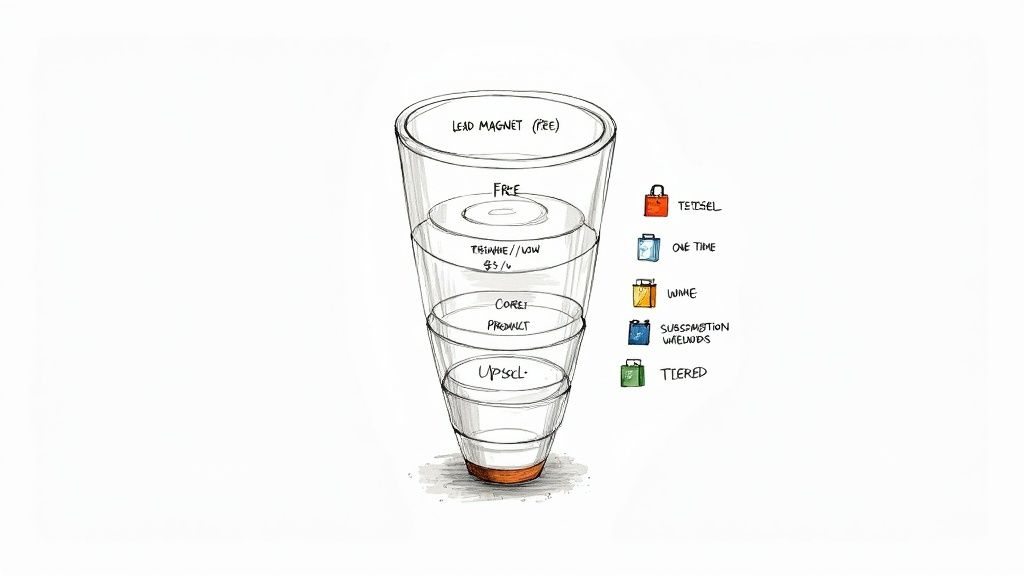
This is where pricing models and sales funnels make all the difference. A well-chosen price communicates your product's value and lines up with what your customers expect to pay. Meanwhile, a structured funnel creates an automated system that turns curious visitors into loyal buyers, time and time again.
Choosing Your Pricing Model
How you price your white label digital product sends a direct message about its value and shapes your long-term income. There’s no single "right" price; the best model really depends on what you're selling and who you're selling it to.
Here are the three most common approaches:
One-Time Payment: This is the simplest model out there. A customer pays once for lifetime access. Think of an e-book or a pack of templates. It’s a perfect fit for standalone products where people don't expect ongoing updates.
Recurring Subscription: If you're offering white label software (SaaS) or running a membership site, this is your go-to. Customers pay a recurring monthly or annual fee, giving you predictable revenue. It works because you're providing continuous value, like software updates or fresh content each month.
Tiered Pricing: This strategy offers a few packages at different price points, like a Basic, Pro, and Premium plan. Each tier unlocks more features, extra usage, or better support, letting you serve different types of customers without leaving money on the table.
To really get the most out of your product, it's crucial to use smart pricing strategies for digital products, balancing what the market will bear with the value people feel they're getting.
Building a High-Converting Sales Funnel
A sales funnel is simply the journey you create to lead someone from just hearing about you to actually buying something. For white label digital products, a classic "value ladder" funnel works wonders because it builds trust one small step at a time before asking for a bigger commitment.
And the market for these products is massive. The digital goods space, which includes all kinds of software and white label offers, was pegged at USD 124.3 billion for 2025. Some are even forecasting it to hit USD 416.2 billion by 2030. A well-built funnel is how you can carve out your piece of that pie.
Here’s a breakdown of a proven four-step funnel that you can put into action:
1. The Lead Magnet (Top of Funnel)
This is where it all starts. You offer a small but highly valuable piece of a white label product for free in exchange for an email address. This could be one rebranded template, the first chapter of your e-book, or a free trial of your software. The goal isn't to sell—it's to attract your ideal customer and get their permission to stay in touch.
2. The Tripwire Offer (Low-Cost Entry)
Right after someone grabs your free lead magnet, you hit them with an irresistible, low-cost offer, usually in the $7-$27 range. This could be a small bundle of templates or a mini-course. The point isn't to get rich off this sale; it's to turn a free subscriber into a paying customer. That small transaction builds huge trust and momentum.
A person who has paid you even a small amount of money is exponentially more likely to buy from you again. The tripwire offer bridges the gap between "freebie seeker" and "loyal customer."
3. The Core Product (Main Offer)
Now it's time for the main event. This is your primary white label digital product—the full course, the complete software subscription, or the entire collection of e-books. You'll market this to the people who bought your tripwire, since they're already warmed up and have seen the quality you deliver.
4. The Upsell (Maximizing Value)
Once a customer buys your core product, you can immediately offer them an upgrade. This could be a lifetime deal on your software, a personal coaching package, or a "done-for-you" service that perfectly complements what they just bought. This final step is key to increasing the average value of each customer. For more ideas, you might be interested in our guide on pricing strategies for online businesses.
Navigating Legal and Licensing Agreements
Before you even think about selling, you need to understand the rules of the game. Every white label digital product comes with a licensing agreement, which is just a fancy term for the legal contract between you and the original creator.
Skipping this step is like building a house without checking the property lines—you could be setting yourself up for a world of hurt down the road. This document is your guide to what you can and can't do with the product. It’s not just legal jargon; it's the instruction manual for your new asset. Ignoring it can lead to getting your accounts suspended, facing legal action, or losing the right to sell the very product you’ve invested time and money into.
Crucial Takeaway: A license isn't a suggestion; it's a binding contract. You absolutely must read and understand every part of it before you spend a single dollar on rebranding or marketing. While this isn't legal advice, it's fundamental business sense.
Key Clauses to Scrutinize
Think of the licensing agreement as a checklist for your rights. A quick scan won’t do the job here; you need to get into the specifics of what you're actually buying. To protect your business and make sure you’re playing by the rules, pay close attention to these four critical areas.
Here are the main points to look for:
Usage Rights: The license will spell out exactly how you can use the product. Can you sell it on its own? Can you bundle it with other products or use it as a bonus? Some licenses might even restrict you to using the product only as a lead magnet to build your email list.
Modification Limits: This part defines how much you can actually change the product. While "white label" implies rebranding, there might be limits on altering core content or features. You need to make sure the license allows for the level of customization you have in mind.
Distribution Rules: Where are you allowed to sell? Some agreements might stop you from selling on big third-party marketplaces like Amazon or Etsy, limiting sales to your own website.
Resale Terms: This section gets down to the money. Does the original creator require a royalty on every sale you make, or do you just pay a one-time fee? Getting this straight is absolutely essential for calculating your potential profit margins accurately.
Got Questions About White Label Digital Products? Let's Clear Them Up
Diving into the world of white label products is exciting, but it’s totally normal to have a few questions buzzing around your head before you commit. Getting these last few details sorted is the key to building a strategy you feel great about.
Here are the straight-up answers to the questions I hear most often from entrepreneurs.
Is Selling White Label Digital Products Actually Profitable?
Absolutely. Done right, this model can be a goldmine. The biggest win is that you get to skip the time and money pit of creating a product from scratch. All that capital you would have spent on development can now go directly into marketing and sales—the things that actually bring in cash.
Of course, your final profit depends on your pricing, how much you spend on ads, and any fees from the white label provider. But because your starting costs are so low, you have a massive potential for a high return on investment (ROI). This is especially true if you’re selling something with recurring revenue, like a SaaS tool.
What Are the Best Products to Sell?
Honestly, the "best" product is always one that fixes a real, nagging problem for the audience you know inside and out. That said, some categories are just consistent winners and make for a great starting point.
Here are a few of the top contenders:
SaaS Platforms: Think tools for social media scheduling, SEO audits, or email marketing. These are perfect for B2B audiences and agencies.
Online Courses and E-books: People are always looking to learn. Selling educational content is a fantastic way to position yourself as an authority.
Digital Planners and Templates: These are a slam dunk for coaches, creators, and consultants. You can sell them as standalone products or use them as killer lead magnets.
Marketing Reports: Agencies can rebrand analytics dashboards to deliver more professional, data-backed value to their clients.
The secret sauce is matching a proven product type to an audience whose problems you genuinely understand.
Key Insight: The most profitable digital products tend to either teach something valuable or solve a recurring business headache. To give you an idea, educational products like workout guides and online courses are top sellers, generating over $100 million for creators on some platforms.
How Much Does It Cost to Get Started?
The startup cost can swing wildly depending on what you’re selling. For simpler white label digital products like an e-book or a set of templates, you might just pay a one-time license fee that’s under $100.
For more complex software platforms, you’re usually looking at a monthly or annual subscription. This could be anywhere from $50 to several hundred dollars a month, and it often scales up as you bring on more of your own customers. But in every single case, this cost is a tiny fraction of what you’d pay for custom development, which can easily soar into the tens of thousands of dollars.