Explained
Scaling with White Label Content Creation

Ever heard the term "white label content" and wondered what it's all about? It’s a pretty simple concept, really. A specialized provider creates content—think blog posts, articles, or social media updates—and another company, often a marketing agency, buys it and puts their own brand on it.
Essentially, it’s a way to deliver expert-level content to your clients without the massive overhead of hiring an in-house writing team.
Unpacking White Label Content Creation

Here's an easy way to think about it: imagine a fantastic local bakery that supplies incredible, unmarked pastries to all the best coffee shops in town. Each coffee shop then packages those treats in their own branded boxes, selling them as if they baked them in-house.
That’s the essence of white label content creation. Your agency is the coffee shop, and the white label provider is the expert baker working tirelessly behind the scenes.
This model lets you instantly expand your services and handle a ton of different client needs, all without adding a single writer to your payroll. You get to look like a full-service powerhouse while a dedicated partner handles the creative heavy lifting. It's a game-changer for scaling your agency efficiently.
The Core Components of the Model
The process itself is wonderfully straightforward. You drive the strategy by giving the provider a clear brief that outlines your client’s voice, goals, and target audience. The white label provider then gets to work, tapping into their network of professional writers to create the content.
Once it's done, the finished piece comes back to you, ready for a final review and your agency's branding before it ever reaches the client. Simple, right?
This system unlocks some serious advantages:
Scalability: Suddenly, you can take on a huge volume of content requests without ever burning out your team.
Expertise: You get immediate access to specialized writers who know their way around all sorts of niches and industries.
Cost-Effectiveness: Forget about the high costs of hiring, training, and retaining full-time employees.
Efficiency: Your agency can finally focus on big-picture strategy and building client relationships instead of getting bogged down in day-to-day production.
This setup truly gives you the best of both worlds: a steady stream of high-quality content without the operational headache of managing an in-house writing department. It’s a direct path to better profit margins and a bigger service capacity.
How It Differs from Other Content Models
It’s really important not to mix up white label content with other common ways of outsourcing. One of the biggest points of confusion is with Private Label Rights (PLR) content.
PLR content is created once and sold to multiple buyers, meaning lots of people could be using the exact same article. White label content, on the other hand, is created specifically for you and stays 100% exclusive to your agency. That exclusivity is absolutely critical for SEO and for building a unique brand identity for each of your clients. If you want to dive deeper into the differences, it helps to understand what PLR products are and how they function.
At the end of the day, white label content creation isn't just a service—it's a strategic partnership. It empowers agencies to deliver consistently great work, expand what they can offer, and grow their business in a way that’s truly sustainable.
Choosing Your Content Sourcing Model
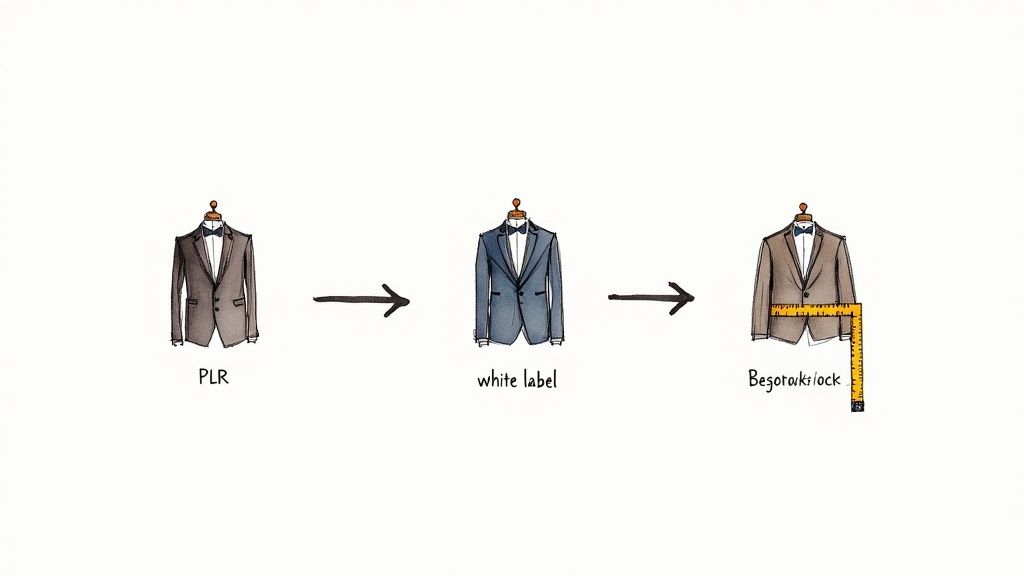
When you decide to bring in outside help for content, you’re standing at a crossroads with a few different paths. But not all content sourcing models are created equal. Picking the wrong one can quietly sabotage your agency’s goals before you even get started.
You've basically got three main options: Private Label Rights (PLR), building a custom in-house team, and the star of our guide, white label content creation. Getting the fundamental differences between them is the key to making a smart move that actually supports your agency's needs for quality, growth, and brand integrity.
The Off-The-Rack Option: PLR Content
Private Label Rights, or PLR content, is the quickest and cheapest way to get your hands on content. Think of it like buying a generic, off-the-rack suit. It’s affordable and ready to go right away, but it comes with a massive catch: it’s sold to absolutely everyone.
That same article you just bought? It can be purchased and published by dozens, maybe even hundreds, of other businesses. This complete lack of exclusivity is a death sentence for SEO, since search engines penalize duplicate content. While PLR can be a decent starting point for brainstorming, it needs a ton of editing to be unique and almost never hits the quality bar required for real client work.
The Bespoke Option: Custom In-House Content
At the complete opposite end of the spectrum is creating fully custom content with your own in-house team. This is your bespoke, tailored suit—it’s a flawless fit, made exactly to your client’s specs, and 100% exclusive.
But this approach brings some serious costs and headaches. You’re on the hook for hiring, training, and managing writers, which means salaries, benefits, and a whole lot of overhead. You get total control over the quality, sure, but the process is slow and incredibly difficult to scale, especially when client needs swing up and down. A sudden request for 20 blog posts can grind a smaller in-house team to a screeching halt.
The Strategic Sweet Spot: White Label Content
This brings us to white label content creation, the strategic middle ground that really does offer the best of both worlds. It’s like getting a high-quality, made-to-measure suit from an expert tailor who works exclusively for your shop. The content is created just for you and is 100% unique to your agency—just like in-house work, but without the baggage.
With a white label partner, you get the exclusivity and quality of custom content without the high overhead and scalability issues of an in-house team. It’s a model built for agency growth.
This model lets you keep full brand control and deliver premium, original content under your own banner. Your partner handles all the production chaos behind the scenes, freeing you up to focus on client strategy and actually growing your business. It's a bit like choosing between staff augmentation vs. managed services, where you're picking an operational model that best fits your growth plans.
To make it even clearer, let's put these three models head-to-head.
Comparing White Label vs PLR vs Custom Content
Here’s a simple breakdown of how the three primary content sourcing models stack up against the business factors that matter most to agencies.
Attribute | White Label Content | PLR Content | Custom Content |
|---|---|---|---|
Exclusivity | 100% Exclusive to your agency. | Non-Exclusive, sold to many buyers. | 100% Exclusive and proprietary. |
SEO Value | High, as content is original. | Low, due to duplicate content issues. | High, as content is original. |
Cost | Moderate, pay-per-project or retainer. | Very Low, one-time purchase. | Very High, salaries and overhead. |
Scalability | High, easily handles volume changes. | Instant, but not unique. | Low, limited by team size. |
Effort Required | Low, provide brief and review. | High, requires significant rewriting. | High, manage entire creation process. |
Ultimately, your choice boils down to your agency’s priorities. But for those looking for a scalable, cost-effective way to deliver top-tier, original content that builds both client trust and SEO authority, white label content creation is the clear winner. It offers the operational agility you need to grow your agency without compromise.
The True Business Impact of White Labeling
Thinking about white label content as just another way to outsource tasks is missing the bigger picture. It’s actually a powerful lever for business growth. This approach fundamentally changes how your agency operates, letting you move faster, deliver better results, and fatten your bottom line without the usual growing pains.
It’s really about making a strategic shift. You stop being just a service provider and start becoming a scalable growth partner for your clients.
The real impact hits you when you can suddenly expand what you offer. Imagine a client loves your social media work, but they also desperately need high-quality blog posts for their SEO. Instead of saying "no" or scrambling to find a writer, you can immediately say "yes." That kind of agility lets you capture revenue that would have walked right over to a competitor.
This model completely transforms your operational capacity. You can confidently take on more complex or high-volume projects without burning out your core team. A sudden request for 20 blog posts and a dozen case studies in one month is no longer a crisis—it's just another manageable workflow.
Unlock New Revenue and Expertise
When you partner with a white label provider, you get instant access to a deep bench of specialized talent. Need an expert in FinTech, healthcare compliance, or B2B SaaS? A good partner has writers with that specific domain knowledge ready to go.
This on-demand expertise empowers you to chase larger, more lucrative contracts. You're no longer limited by the skills of your immediate team, which directly boosts your agency's authority and earning potential.
White label content creation isn't just a production tool; it's a strategic asset. It allows an agency to punch above its weight, competing for and winning clients that would normally be out of reach.
The Financial Advantage of Outsourcing
The numbers behind this strategic shift are pretty compelling. The white label marketing industry is exploding, with the global market projected to hit $99.19 billion by 2026. Data shows that 73% of marketing agencies now use white label services to expand their offerings.
Even more telling, agencies that outsource 40-60% of their operations through these partnerships see 2.3 times faster growth and achieve 20% higher profit margins than their peers. You can dig into the full findings on these white label marketing statistics at amraandelma.com.
This isn't just about saving a few bucks on salaries; it’s about reallocating your resources intelligently. The money you would have spent on hiring, benefits, and training can be plowed back into sales, marketing, and client relationships—the things that actually fuel growth. This leaner operational model creates a more resilient and profitable business.
Ultimately, white label content creation lets you focus on what you do best. By offloading the time-consuming production work, your team is free to concentrate on high-value strategic planning, client communication, and business development. This shift not only improves efficiency but also boosts team morale, because your key players get to do the work they excel at instead of getting bogged down. The result? A more agile, profitable agency that keeps clients longer and consistently outmaneuvers the competition.
Working with a white label provider is more than just hiring a vendor—it’s about building a system. A solid workflow turns that external service into a natural extension of your team, making sure every single piece of content comes out polished, on-brand, and ready for your client.
Without a process, you’re just inviting chaos. You'll get tangled in miscommunication, endless revisions, and subpar work that makes your agency look bad. The real goal is to create a repeatable blueprint that makes content production feel like it’s happening right down the hall.
This means setting up crystal-clear communication, writing ironclad briefs, and locking in a structured review cycle. When you get this right, you eliminate all the guesswork and guarantee consistency, no matter how big the project gets.
Stage 1: Crafting the Perfect Content Brief
The quality of the content you get back is a direct reflection of the brief you send out. A lazy, one-sentence request like, "Write a blog post about SEO," is a one-way ticket to a generic article that completely misses the mark.
A great brief is a detailed instruction manual. It leaves nothing up to interpretation and serves as the single source of truth for the entire project. This isn't a "nice-to-have"; it's non-negotiable.
Client Background: Give a quick rundown of your client’s business. What’s their brand voice—professional, witty, academic? What’s their mission?
Target Audience: Who are you trying to reach? Define their pain points, their goals, and how much they already know about the topic.
Primary Goals: What is this content supposed to do? Drive traffic? Generate leads? Build up topical authority? Be specific.
SEO Requirements: List the primary keyword, any secondary keywords, the target word count, and specific instructions for internal or external links.
Key Talking Points: Spell out the core arguments, essential data points, or specific concepts that absolutely must be included.
By investing a little extra time in a bulletproof brief, you front-load the effort and save yourself from a world of back-and-forth revisions later. This simple document is the single most important tool you have for getting exactly what you and your client envision.
Stage 2: Streamlining the Review and Revision Cycle
Once that first draft lands in your inbox, the real work begins. A messy review process with feedback scattered across a dozen emails is a recipe for confusion and frustration. Instead, you need a structured revision cycle.
Use a central hub for feedback—a shared Google Doc, a card in Trello, or a task in Asana. This keeps everything in one place.
First, your team does an internal review. Check the draft against the original brief. Did they hit all the requirements? Is the tone right? Is it factually accurate? Does it flow well? This internal QA step is your chance to catch issues before the client ever sees them, maintaining your agency's standard of quality.
Only after it passes your internal check should you send the polished draft to the client. Collect all of their notes, consolidate them into one document, and send it back to your white label partner. This gives them clear, actionable feedback, which means you get a better second draft, faster. For more ideas on refining your internal processes, check out our guide on the 5-step content extraction workflow.
Stage 3: Finalizing and Deploying Content
This is the final polish. After the revisions are done, do one last quality check for any lingering grammar, spelling, or formatting errors. This is also where you add your agency's signature touch. Maybe it's a set of custom graphics, a specific call-to-action, or formatting tweaks to match the client’s website perfectly.
This final step ensures the content is completely indistinguishable from something your in-house team would produce. The demand for this kind of scalable, high-quality content is exploding. The creator economy is projected to hit a staggering $528 billion by 2030, but it’s a tough world out there for creators.
With over 207 million creators globally, a mere 4% earn over $100,000 a year. This massive gap highlights just how critical efficient and affordable white label content creation has become. You can dive deeper into these numbers and the booming creator economy on inbeat.agency.
This infographic breaks down how a solid white label workflow fuels business growth, helping you expand your services, boost revenue, and ultimately become a leader in your market.
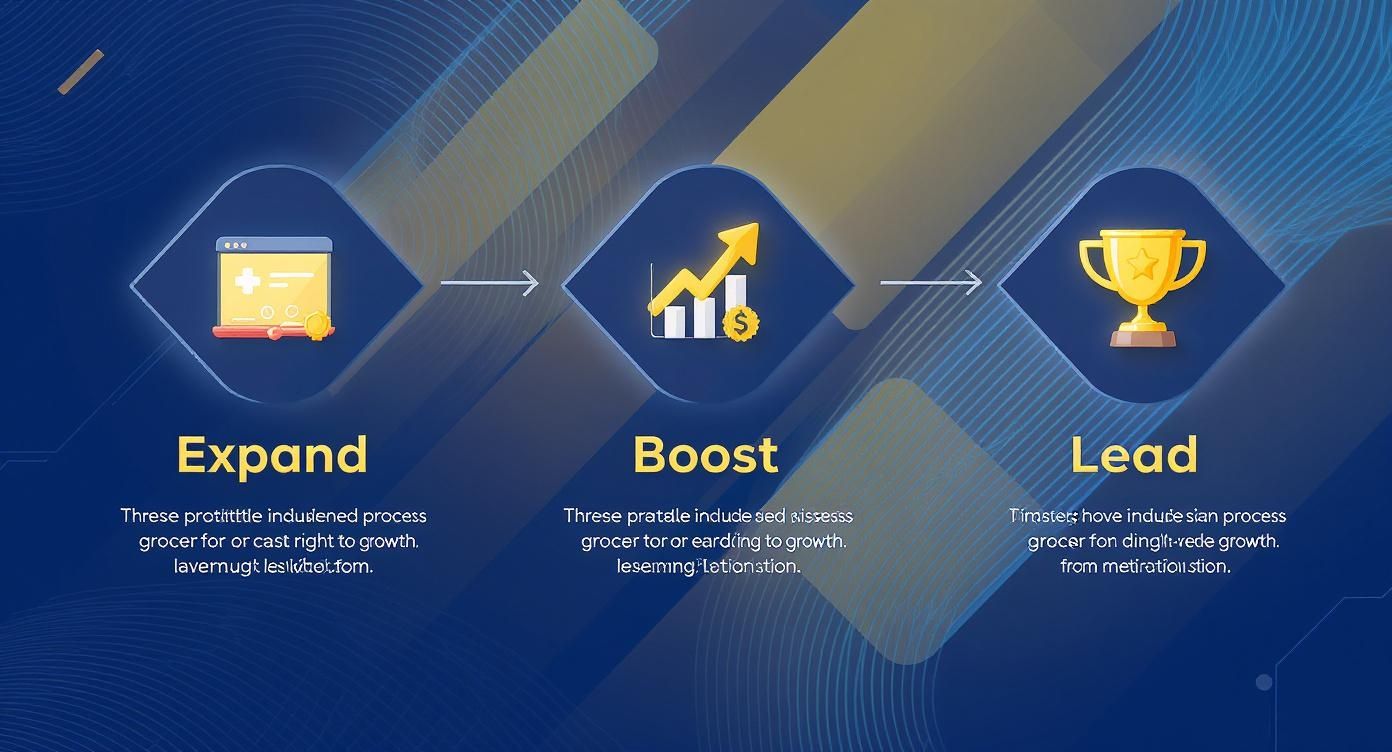
It’s a perfect visual reminder of how a structured process isn't just about managing tasks—it's the engine that turns a simple partnership into a powerful tool for growth.
How to Vet and Select the Right Partner
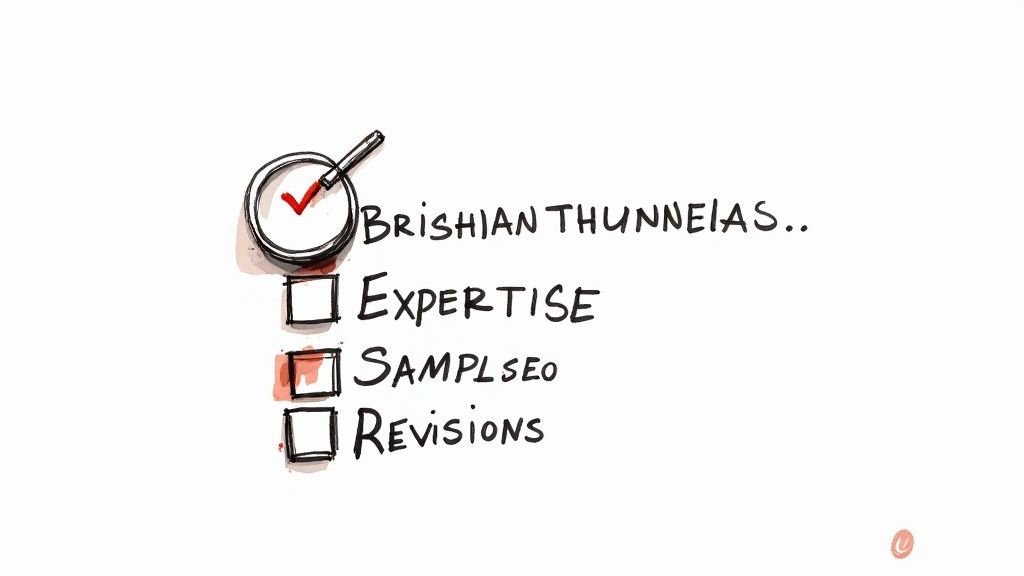
Choosing a white label content provider is one of the most critical decisions you'll make for your agency. A great partner can supercharge your growth and make you look like a hero to your clients. A bad one? They can torpedo your reputation with sloppy work and blown deadlines.
This isn’t just about hiring writers. It's about finding a reliable production engine that feels like a true extension of your team. To pull that off, you need a methodical vetting process that looks past a flashy website and gets to the core of what they can actually do.
Verify Their Industry-Specific Expertise
The first filter is always expertise. A provider claiming to be a jack-of-all-trades is often a master of none. Your clients operate in specific niches—from B2B SaaS to specialized healthcare—and they expect content that speaks their language with genuine authority.
Don't just take their word for it. Ask for specific examples of content they’ve created for clients in industries similar to yours. A solid partner will have a portfolio loaded with relevant case studies and work samples that show deep domain knowledge, not just a surface-level grasp of the topic.
Scrutinize Their Portfolio and Samples
A portfolio is more than a gallery of pretty links; it's hard evidence of their quality, consistency, and ability to get results. As you review their work, keep an eye out for a few key things:
Writing Quality: Is the writing clear, engaging, and error-free? Does it flow naturally, or does it feel robotic and stuffed with jargon?
Strategic Depth: Does the content just list facts, or does it deliver real insight and answer the reader's most pressing questions?
Brand Voice Adaptability: Can they write in different tones? Look for examples that prove they can pivot from a formal, corporate voice to a casual, conversational one.
Pay close attention to how they handle complex topics. The best partners can take dense, technical information and make it accessible and interesting to a target audience without dumbing it down. This skill is a clear sign of high-caliber talent.
Test Their Communication and Process
A brilliant writer is completely useless if their communication is terrible. Before you sign anything, test their responsiveness and professionalism. Send over a detailed inquiry or a mock project brief. How quickly and thoroughly do they reply?
A transparent, well-defined process is a huge green flag. Ask them to walk you through their entire workflow, from the initial brief and drafting to revisions and final delivery. A partner who can clearly map out their system is likely organized, dependable, and ready to handle your agency's volume.
Assess Their SEO Knowledge and Revision Policy
Finally, it’s time to get into the technical details. Any modern white label content creation partner must have a strong command of SEO. Ask them about their approach to keyword research, on-page optimization, and creating content that nails search intent. Their answers should show a strategic mindset, not just a plan to stuff keywords everywhere.
Just as important is their revision policy. Miscommunications happen, and you need a partner who handles feedback constructively instead of defensively. Get clarity on how many rounds of revisions are included and what that process actually looks like. A fair and flexible revision policy shows they're committed to your success, not just closing a ticket and moving on.
The Future of AI in White Label Content
It’s no longer a question of if technology and content will merge; that’s already the reality we work in every day. Artificial intelligence isn't some futuristic novelty anymore. It's become a core part of the white label content creation world, completely changing the game for speed, accuracy, and performance.
The smartest white label providers have stopped treating AI as just a tool and now see it as a partner in the entire content process. It all starts with smarter topic generation. AI can sift through mountains of search data and competitor content to pinpoint exactly where the biggest opportunities are, making sure your content strategy is built on solid evidence, not just a hunch.
From that starting point, sophisticated AI helps fine-tune content to match what people are actually searching for, making sure every blog post or landing page hits the mark.
AI as the New Baseline for Service
Let’s be clear: in today's market, having AI isn't a bonus feature—it's the bare minimum. Clients have come to expect AI-powered capabilities as a standard part of any competitive agency's toolkit. This shift is fueling the massive growth in the digital content creation market, which was valued at USD 36,841.5 million globally back in 2025.
We're seeing AI personalization engines deliver incredible results, often boosting a campaign's return on investment by 2-3 times. That kind of performance makes AI an essential weapon for agencies fighting to get their clients the best results.
AI integration isn't just about working faster. It's about gaining a serious competitive edge. White label providers using AI can offer quicker turnarounds, smarter insights, and highly personalized content that delivers real, measurable ROI.
Personalization and Optimization at Scale
One of the biggest game-changers AI brings to the table is its ability to deliver hyper-personalization on a scale that was once impossible. AI can analyze user data and behavior to craft content that speaks directly to specific audience segments, which sends engagement and conversion rates through the roof.
This isn't just about tweaking a headline. It's about turning generic content into a powerful engine for building real customer relationships. This tech has spawned a whole new category of powerful platforms. To get a feel for what’s out there, you can explore various AI tools for content creation that are reshaping how we work.
Of course, just having the tools isn’t enough; you need to know how to use them well. Our guide on smart digital creation with AI can show you how to apply these technologies effectively.
Ultimately, the future of white label content belongs to those who can masterfully blend human creativity with AI-powered precision. It’s about offering agencies a smart, scalable solution that meets the demands of today’s clients head-on.
Common Questions About White Label Content
Stepping into a white label partnership is a big move, and it’s smart to have questions before you commit. We hear them all the time from agencies testing the waters. How does billing actually work? Will the content really sound like it came from my client? And what about SEO?
Getting clear, straight answers to these questions is the only way to feel confident you're making a good investment. Most of the uncertainty boils down to three things: the money, the brand voice, and search engine performance. Let’s tackle them one by one.
How Does Billing and Pricing Work?
One of the best parts of working with a white label partner is flexibility, especially when it comes to pricing. You aren’t stuck with a single, rigid model. Most providers offer a few different options to fit how your agency operates and manages cash flow.
You’ll typically see a few common pricing models:
Per-Project Fees: This is the simplest, pay-as-you-go route. You get a fixed price for one deliverable, like a blog post or a white paper. It's perfect for one-off needs or for trying out a service without a long-term commitment.
Monthly Retainers: If you have steady, ongoing content needs for your clients, a retainer is your best friend. You pay a set fee each month for an agreed-upon amount of work. This usually comes with a nice discount and makes your own budgeting incredibly predictable.
Content Packages: Many services bundle their work into packages. Think a monthly blog package that includes four articles, all the SEO work, and a few social media blurbs to go with them. This is often the best value and makes ordering a breeze.
The whole point of these different models is to give you financial predictability and a clear path to scale. You can dip your toes in with a single project and grow into a full retainer as your agency expands, making sure your costs always line up with your revenue.
Will the Content Match My Client's Brand Voice?
This is probably the most important question on the list, and a good provider has a solid answer. The magic is all in the onboarding and briefing process. A reputable white label content creation service doesn’t just get an order and start typing; they dig deep to understand each of your clients first.
A great onboarding process involves building out detailed style guides. These capture everything—from a brand’s tone (is it witty, academic, or buttoned-up?) to the specific jargon they use and how they like things formatted. You’ll hand over brand guidelines, audience personas, and maybe a few existing content examples.
That document becomes the writer’s North Star, making sure every single piece they create feels like it came straight from your client’s team. A tight review and feedback process helps dial this in even further over time.
Is White Label Content Good for SEO?
Yes, absolutely—as long as it’s done right. There’s a common myth that any outsourced content is automatically weaker in the eyes of search engines. That’s only true for cheap, non-exclusive stuff like PLR. High-quality, original white label content is treated exactly the same as content written in-house by Google.
Because the work is created from scratch just for your client, it is 100% original, so you never have to worry about duplicate content penalties.
Even better, a skilled white label partner is an SEO expert, too. They know how to build content around the right keywords, satisfy search intent, and structure articles for readability and ranking. This lets you confidently walk back to your client with results you can actually measure.