Explained
What Is Value Proposition and How to Create One That Wins Customers

A value proposition is the simple, clear promise you make to your customers. It’s the dead-simple answer to the one question that matters most: “Why should I buy from you and not your competitor?” This single statement is the bedrock of all your marketing and sales.
What Is a Value Proposition, Really?
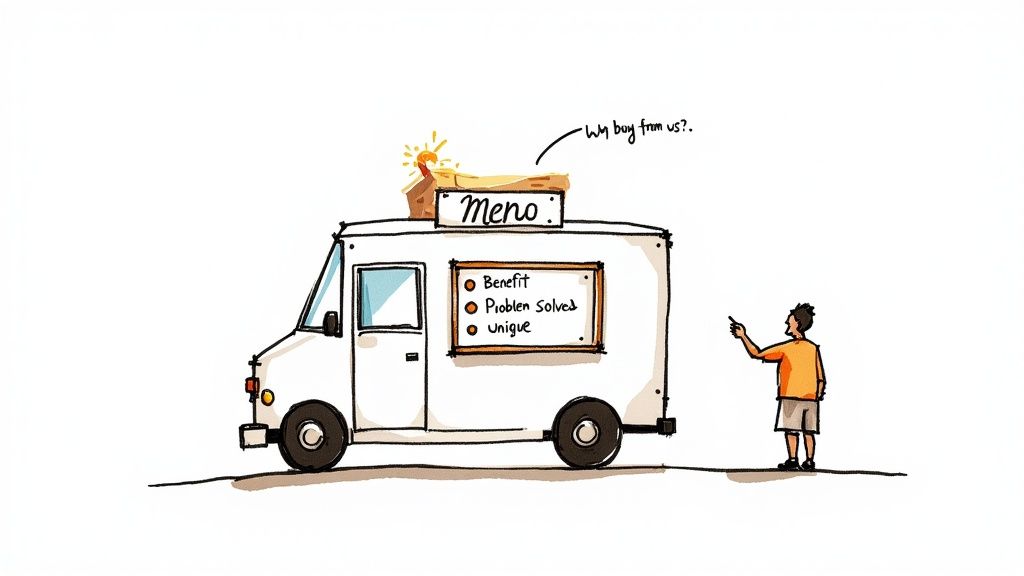
Let's cut through the business school jargon. Imagine you're standing in front of two food trucks. The first has a sign that just says, "Good Food." Okay, not very helpful. The second truck’s sign reads: "Authentic Neapolitan Pizza in 90 Seconds—The Fastest, Freshest Lunch You'll Find."
Which one are you lining up for?
The second truck nailed its value proposition. It doesn't just sell food; it sells a specific solution (a fast, fresh, authentic lunch) to a specific problem (you're busy and starving). It instantly carves out its own space and makes the other truck irrelevant. That's exactly what a value proposition does for your business. It’s not a fluffy mission statement or a catchy tagline you’d put on a t-shirt.
A value proposition is a concise explanation of the tangible results a customer gets from using your products or services. It’s the strategic core of your brand's promise.
This is the promise that gets a potential customer to even consider engaging with your brand. Think of it as the bridge connecting what you sell with what your ideal customer desperately needs.
The Essential Components of Your Promise
To be effective, your promise can't be vague. It needs a few key ingredients to really hit home. You've got to clearly explain the specific benefits, nail the problem you’re solving, and show why you're the absolute best choice. If you miss any of these, your message gets lost in the noise of a crowded market.
Every great value proposition is built on three foundational ideas:
It solves a real problem. It speaks directly to a pain point or fulfills a deep desire for your target audience.
It delivers specific benefits. It clearly communicates the concrete value and outcomes the customer will actually experience.
It explains why you're different. It shows what makes your solution better or more unique than any other alternative out there.
Thinking in these terms gives you a blueprint for crafting a message that truly connects. The best ones bundle these elements into a punchy statement that someone can understand in just a few seconds.
The table below breaks down exactly what each component of your value proposition needs to answer and why it's so critical for success.
Core Components of a Powerful Value Proposition
A strong value proposition is your secret weapon, grabbing attention and making it clear why you're the best choice. Here's a look at the three core elements that make it work.
Component | What It Answers | Why It's Important |
|---|---|---|
Relevance | How does your product solve my specific problem? | It grabs the attention of your ideal customer by showing you understand their needs right away. |
Value | What specific, tangible benefits will I receive? | It provides a concrete, often measurable, reason to choose you over anyone else. |
Uniqueness | Why should I buy from you and not your competitors? | It sets you apart from the competition and establishes your unique position in the market. |
When you weave these three elements—Relevance, Value, and Uniqueness—into a single, compelling statement, you create a promise that not only attracts customers but convinces them to stay.
The Three Pillars of an Unbeatable Promise
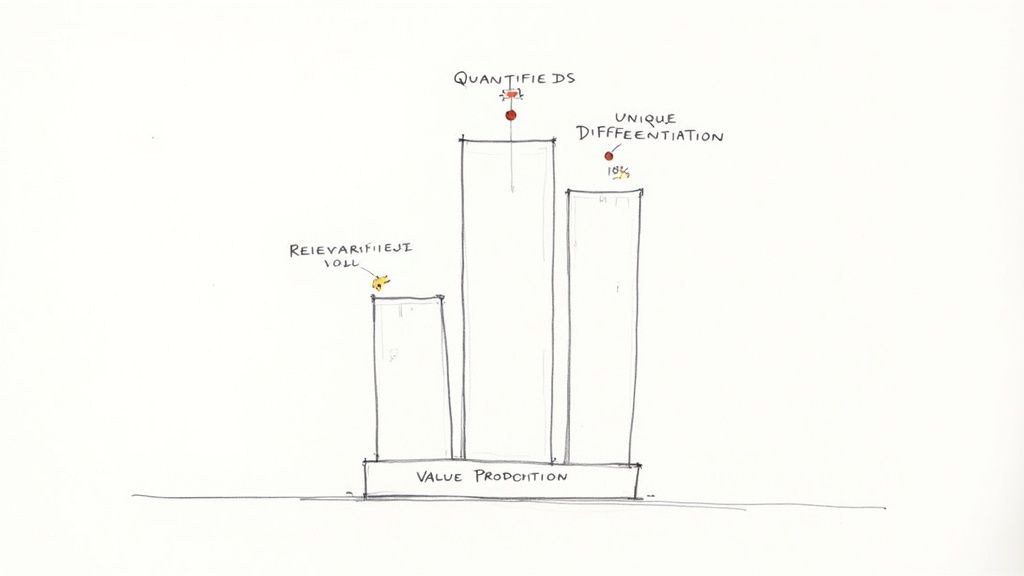
A powerful value proposition isn’t just a clever marketing slogan you dreamed up. It stands firmly on three core pillars. When you get these right, a simple product description transforms into a compelling promise that a customer can’t ignore.
Think of them like the legs of a stool—if one is missing, the entire message wobbles and falls flat. To craft an unbeatable promise, you need to master each one. They work together to answer your customer’s unspoken questions and build a rock-solid case for your business.
Pillar 1: Relevancy
The first and most important pillar is relevancy. Your offer has to directly solve a specific problem or fulfill a significant need for your target audience. It must feel like it was made just for them.
This means you need to get inside your customer's head. What keeps them up at night? What are their biggest frustrations or aspirations? A value proposition that isn't relevant is just noise.
A generic claim like "we sell high-quality software" is totally irrelevant. But a specific promise like "our software helps freelance designers manage client invoices in under five minutes" is immediately relevant to a specific person with a specific pain point.
Pillar 2: Quantified Value
Next, your promise needs quantified value. This is what takes your claim from a vague benefit to a concrete, measurable outcome. Numbers are powerful because they paint a clear picture in the customer's mind.
Instead of saying, "our service saves you money," a quantified value proposition says, "our software reduces operational costs by an average of 18%." The first is a nice idea; the second is a tangible result that justifies a purchase.
A strong value proposition doesn't just promise improvement; it defines the scale of that improvement. It gives customers a specific benchmark for the success they can expect to achieve.
Quantified value can show up in a few different ways:
Time Saved: "Launch your website in one day, not weeks."
Money Earned or Saved: "Increase your sales conversions by 25%."
Efficiency Gained: "Process 50% more orders with the same staff."
This is where you really see the power of your value proposition—it's all about spelling out specific, desirable results.
Pillar 3: Unique Differentiation
Finally, your promise has to have unique differentiation. Your customer needs to understand why you are their only logical choice. What do you offer that nobody else can touch?
This is your Unique Selling Proposition (USP) brought to life. It might be a proprietary feature, an incredible service model, or an unmatched guarantee. It’s the secret ingredient that makes your offer stand out in a crowded market. You can learn more by exploring our detailed guide on how to find your Ultimate USP.
This pillar is critical for long-term survival. Without clear differentiation, you’re stuck competing on price alone, which is a race to the bottom.
Building an unbeatable promise is the very core of your brand. For more insights on this, you can learn how to create a brand your customers will love. By weaving relevancy, quantified value, and unique differentiation together, you build a promise that doesn't just attract customers—it earns their loyalty.
Learning From Iconic Value Proposition Examples
Theory is one thing, but the concept really clicks when you see how iconic brands communicate their promise in the real world. The best way to understand what a value proposition is, and what it isn't, is to deconstruct how successful companies have mastered their own.
We’re going to break down the powerful promises made by a few industry giants. These aren't just clever slogans; they are carefully built messages designed to connect with a specific audience, solve a real problem, and stand out from the noise. By looking at their headlines and core messaging, we can see the three pillars of a great value proposition in action.
The image below represents three distinct companies—Slack, Shopify, and Uber—that have built empires by clearly communicating their unique value.
Each one has carved out its niche by simplifying team communication, revolutionizing commerce, or completely changing how we get around town. Let's dig in.
Slack: Made for People
Slack’s value proposition is a masterclass in putting the human side of productivity first. Its promise isn't just about sending messages; it's about making your work life simpler, more pleasant, and more productive.
The headline, "Made for people. Built for productivity," immediately sets the tone. It speaks directly to the end-user's experience, positioning the tool as something genuinely helpful, not just another piece of corporate software. The sub-headline reinforces this by promising to bring the right people, information, and tools together in one place.
Pillar Emphasis: Slack leans heavily on Relevancy. They zeroed in on the universal pain point of disorganized, siloed communication that frustrates teams every single day.
Key Differentiator: Their unique advantage was creating a single, user-friendly hub that replaced the chaos of endless email chains and clunky, separate apps. The promise isn't just efficiency; it's a fundamentally better way to work together.
By focusing on the user experience, Slack became the go-to choice for teams fed up with outdated communication tools. A reported 77% of Fortune 500 companies use Slack, which is a massive testament to how well their promise connects.
Shopify: The Platform Commerce is Built On
Shopify’s value proposition is all about empowerment. It promises to give anyone—from a solo creator in their bedroom to a massive enterprise—the tools they need to build and scale an online business.
Their headline, "The platform commerce is built on," is bold and oozes confidence. It positions Shopify not just as another tool, but as the foundational infrastructure for selling online. This is backed up by messaging that highlights its all-in-one nature, offering everything you need to start, run, and grow.
Shopify’s core message is one of accessibility and power. It tells aspiring entrepreneurs that they don’t need to be a developer or a marketing wizard to succeed online; the platform gives them everything.
This promise is delivered through a list of clear benefits:
Build an online storefront
Process payments securely
Manage inventory and shipping
Market your business effectively
The primary pillar here is Value. Shopify backs up its promise by offering a comprehensive suite of powerful tools under one roof, effectively democratizing e-commerce for millions of people.
Uber: Tap a Button, Get a Ride
Uber’s original value proposition blew up an entire industry by focusing on absolute simplicity and convenience. It targeted the deep-seated frustrations of traditional taxi services—the unpredictable waits, the uncertain fares, and the hassle of paying.
The promise, "Tap a button, get a ride," is one of the most powerful value propositions of the modern era. It’s incredibly simple, laser-focused on the outcome, and highlights the core differentiator: on-demand service with zero friction.
Pillar Emphasis: Uber’s strength is its Differentiation. Before Uber, the idea of summoning a private car from your phone in minutes was science fiction.
Quantified Value: The value was instantly understood—no more trying to hail a cab in the rain or calling a dispatch line with no clue when a car might show up.
Relevancy: It was hyper-relevant to anyone in a city who needed reliable transportation without the headache of owning a car.
This crystal-clear message of convenience and control is what allowed Uber to completely disrupt the global transportation market. It solved a universal problem with a solution that felt like magic, making the old way of doing things feel obsolete overnight.
Value Proposition Breakdown of Top Brands
To see these principles in a broader context, let's compare how a few other household names craft their value propositions. Notice how each one emphasizes a different pillar to connect with its ideal customer.
Brand | Core Promise (Value) | Target Audience (Relevancy) | Key Differentiator |
|---|---|---|---|
Apple (iPhone) | A seamless, premium device that simplifies your digital life. | Consumers who value design, ease-of-use, and a secure ecosystem. | The integration of hardware, software, and services into one elegant experience. |
Netflix | Unlimited entertainment, anytime, anywhere. | People looking for on-demand movies and shows without ads or schedules. | A vast, exclusive library of original content accessible on any device. |
Canva | Design anything. Publish anywhere. | Non-designers (entrepreneurs, marketers, students) who need to create professional visuals easily. | A radically simple, drag-and-drop interface with thousands of templates. |
Amazon Prime | Get everything you need, fast and free. | Frequent online shoppers who prioritize convenience and speed above all else. | Unbeatable two-day (or faster) shipping combined with a suite of other benefits. |
As you can see, each of these brands has a crystal-clear answer to the question, "Why should I choose you?" They don't just list features; they connect those features to a fundamental customer need, making their offer irresistible.
How to Build Your Value Proposition Step by Step
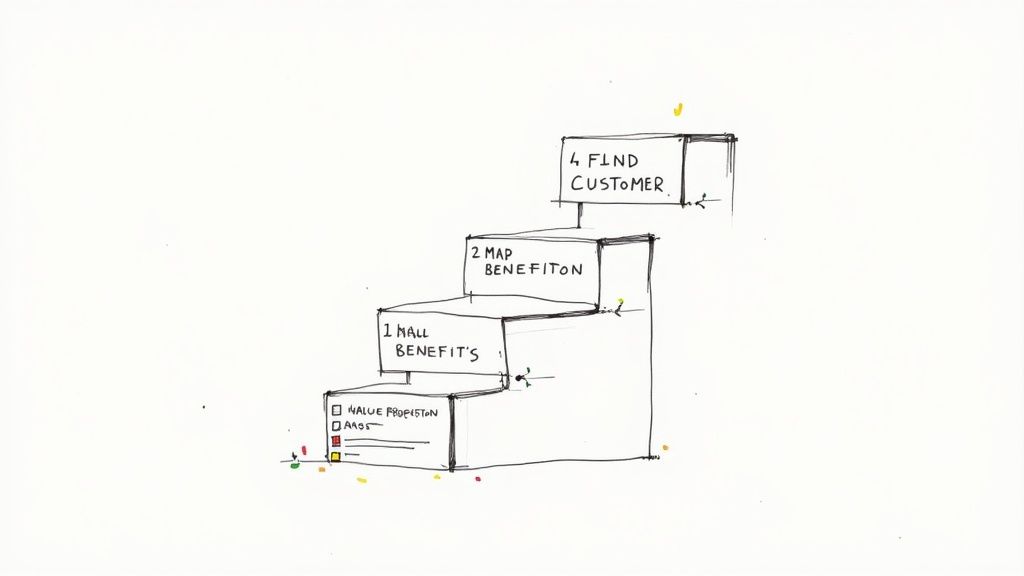
Knowing what a value proposition is and actually building one from scratch are two totally different things. So, let’s get our hands dirty and turn those abstract ideas into a concrete, powerful statement that gets people to listen.
This isn’t about waiting for a single stroke of genius. It’s a methodical, step-by-step process that starts with your customer, not your product. When you truly get their world—their frustrations, goals, and secret wishes—you can craft a promise that actually connects.
Let's walk through the four essential steps to build a value proposition that truly works.
Step 1: Identify Your Ideal Customer
Before you can say anything meaningful, you have to know exactly who you're talking to. A message for "everyone" ends up resonating with no one. You need to get laser-focused on your ideal customer avatar.
And I don't just mean basic demographics like their age or where they live. You need to dig way deeper into their psychographics—what makes them tick.
What are their biggest professional or personal headaches? Get specific about the problems that keep them up at night.
What does success look like in their world? Understand their goals and what they’re trying to achieve.
What words do they use to describe their problems? Ditch the industry jargon and use their language. This builds an instant connection.
This kind of deep empathy is the bedrock of a relevant promise. The best way to get this information is to just talk to them. A well-structured customer research interview protocol can be a huge help in making sure you’re asking the right questions to uncover these golden nuggets.
Step 2: Pinpoint Their Core Pain Points
Once you have a clear picture of your audience, it’s time to zero in on the specific pain points your product is built to solve. Think of your solution as the "gain" that directly cancels out their "pain."
Make a list of every single problem, frustration, and obstacle your customer faces that your offer can fix. Then, take it a step further and spell out the consequences of that pain. For example, a freelancer's pain isn't just "invoicing takes too long." The real pain is the cash flow problems, the wasted hours they can't bill for, and the mounting professional stress.
A truly effective value proposition doesn't just address a surface-level inconvenience. It speaks to the deeper, more emotional consequences of the problem, making your solution feel not just helpful but essential.
This is what turns your offer from a "nice-to-have" into a "must-have."
Step 3: Connect Your Benefits to Their Pains
Now for the fun part: connecting what your product does to the problems you just identified. So many businesses get this wrong. They list a bunch of features, but customers don't buy features—they buy outcomes.
A customer doesn’t care about "cloud-based synchronization." They care about "accessing their files from anywhere, on any device, so they never miss a deadline again."
Try this simple exercise. Create a two-column chart:
Column A: List a key feature of your product. (e.g., "AI-powered scheduling tool")
Column B: Write the direct benefit or outcome for the customer. (e.g., "Saves you 10+ hours a week by automatically booking meetings for you.")
This little trick forces you to see everything from your customer's perspective. It shifts the entire conversation from what your product is to what your product does for them.
Step 4: Define Your Unique Differentiator
You've got your customer, their pains, and your benefits. The final piece of the puzzle is figuring out what makes you the only choice. Your competitors are out there trying to solve these same problems. Why should someone pick you?
Your unique differentiator is that one thing you do better than anyone else. It could be anything:
A groundbreaking feature: You have a proprietary technology that no one else can touch.
Superior design: Your product is just plain easier and more enjoyable to use.
An unmatched service model: You offer 24/7 expert support while everyone else uses chatbots.
A specific niche: You're the only solution built from the ground up for a very specific type of customer.
This is the element that makes your offer hard to copy and justifies your spot in the market. In some industries, like healthcare, this clarity is absolutely critical. For example, a global value proposition for a new medical device needs a cohesive story of both clinical and economic benefits to gain approval in different countries. That requires deep research and teamwork, as experts on developing global value propositions for market access will tell you.
By following these four steps, you’ll have all the raw materials you need to build a compelling value proposition that grabs attention and gets people to act.
Testing and Refining Your Message for a Perfect Fit
Crafting your value proposition is a massive step forward, but let’s be honest: your first draft is just a starting point. It's really just your best-educated guess about what will truly connect with your audience.
To turn that guess into something that actually drives sales, you have to get it out into the real world and see how it performs.
The whole point is to move past your own assumptions and get some hard evidence. Does your message actually land with people? Can they grasp it in five seconds? And most importantly, does it convince them to take that next step? Flying blind is a surefire way to waste time and money on a message that completely misses the mark.
Think of it like a chef creating a new dish. They don’t just scribble down a recipe and slap it on the menu. They test it, taste it, get feedback, and tweak the ingredients over and over until it’s just right. Refining your value proposition is the exact same iterative process.
Low-Cost Methods for Validating Your Promise
You don’t need a huge budget or a fancy market research firm to figure out if your message works. There are plenty of practical, low-cost ways to get the insights you need. The key is simply getting your message in front of real potential customers and watching how they react.
Here are a few powerful techniques to get you started:
Simple A/B Testing: This is one of the fastest ways to get solid data. Just test two different headlines on your landing page or in an ad. Maybe one version highlights how much time your product saves, while the other focuses on cutting costs. Whichever one gets more clicks or sign-ups is your clear winner.
Customer Interviews: Seriously, just talk to your ideal customers. This kind of feedback is absolute gold. Ask them to read your value proposition and then explain it back to you in their own words. If they struggle, your message isn't clear enough. Find out what parts excite them, what feels confusing, and what would make it a no-brainer for them.
Surveys and Polls: Use simple tools like Google Forms or polls on social media for quick feedback. You can ask your audience to choose which of two or three value propositions they find most appealing. It’s a fast way to see which message has the broadest appeal.
Using Data to Drive Your Decisions
The feedback you gather is what will sharpen your message from a rough idea into a powerful tool. Market research is the foundation for this, and having strong data to back you up directly correlates with commercial success.
In fact, studies show that product launches backed by comprehensive market research see up to 85% greater success rates than those that skip this step. That’s because a data-driven understanding of what people actually need ensures your value proposition solves a real problem. You can dig deeper into how market research refines your value proposition to see the full impact.
The purpose of testing isn't to prove you were right; it's to find out what's truly right for your customer. Be prepared to be wrong—it’s the fastest path to getting your message right.
Ultimately, testing isn’t a one-and-done task. It’s an ongoing process. Markets shift, customers evolve, and your value proposition will eventually need a refresh. By building a habit of listening, testing, and refining, you ensure your core message stays sharp, relevant, and powerful enough to keep your business growing.
Where to Place Your Value Proposition for Maximum Impact
Nailing your value proposition is a huge win, but it’s only half the battle. A powerful message does you no good if it's buried where no one can see it. For your promise to truly connect, it has to be front and center everywhere your audience interacts with your brand.
Think of your value proposition as your brand’s heartbeat. It needs to be strong and steady across every single touchpoint, from your homepage to your social media bio. This consistency builds trust and makes it impossible for potential customers to miss the core benefit you offer. The goal is simple: no matter how someone finds you, they should instantly get what you do and why it matters to them.
Key Placements for Your Core Message
Your website's homepage is your most valuable real estate. Your value proposition should be placed prominently "above the fold"—that’s the part of the page everyone sees without having to scroll down. You often only have a few seconds to grab a visitor's attention, and this is your best shot.
Beyond the homepage, you need to weave your promise into these key areas:
Social Media Profiles: Your bio on platforms like Instagram, X (formerly Twitter), and LinkedIn should feature a short, punchy version of your value proposition.
Ad Copy: Every single ad you run, whether on Google or social media, should be built around your core promise to attract the right people.
Email Campaigns: Use your value proposition in email subject lines, your welcome series, and promotional messages to constantly remind subscribers why they should stick around.
Sales Presentations: Your pitch decks and sales scripts should always lead with the value you deliver, framing the entire conversation around solving the customer's problem.
Once you have a compelling message, knowing how to present it visually is the next step. You can dig deeper into this with resources on landing page optimization best practices. And if you're looking for actionable templates to apply these ideas directly, our guide on high-converting landing page frameworks is a great place to start.
Common Questions About Value Propositions
Once you get the hang of what a value proposition is, a bunch of practical questions usually pop up. It's one thing to understand the concept, but it's another to actually make it work for your business in the real world. Let's dig into a few of the most common hurdles entrepreneurs and creators run into.
These questions usually go beyond the basic definition and get into the nitty-gritty of using your core message. Nailing these down will help you put your value proposition to work more effectively, especially when you have different products or customer groups.
Can My Business Have More Than One Value Proposition?
Short answer: Yes, you absolutely can. While your company probably has one big, overarching brand promise, it’s not only common but often necessary to have different value propositions for different products or types of customers.
Think about a company like Apple. Its core brand promise is all about creating simple, elegant, and powerful technology that just works. But the specific value proposition for an iPhone (a seamless, premium device that simplifies your digital life) is totally different from the one for an Apple Watch (your ultimate partner for a healthy life).
This strategy lets you speak directly to what different audiences care about without watering down your main message. You get to tailor your promise to be hyper-relevant for each group you’re trying to reach.
It's best to think of your main value proposition as the trunk of a tree. The specific value propositions for your products or services are the branches—they all grow from the same strong core but reach out to different areas.
What's the Difference Between a Slogan and a Value Proposition?
This is a huge point of confusion, but the difference is critical. A slogan is a short, catchy marketing tagline designed to be memorable. A value proposition is a clear, straightforward statement of the tangible benefits you deliver.
Slogan: This is a marketing tool built for brand recall. Think of Nike’s “Just Do It” or McDonald’s “I’m Lovin’ It.” They’re inspirational and easy to remember, but they don't explain the what or the why.
Value Proposition: This is a strategic statement that explains the value you provide. For example, Uber's old tagline, "Tap a button, get a ride," is a perfect value proposition because it clearly communicates the benefit and the outcome.
In a nutshell, a slogan is about feeling and identity; a value proposition is about concrete results and solving a problem. Your slogan supports your brand, but your value proposition is what actually drives sales.
How Often Should I Revisit My Value Proposition?
Your value proposition isn't something you carve in stone and forget about. It's a living document that needs to evolve right along with your business and the market. You should plan to take a fresh look at it whenever something significant changes.
Consider giving it a review under these circumstances:
When you launch a major new product or feature.
When you decide to enter a new market or target a new customer segment.
When a serious new competitor shows up on the scene.
When you notice a shift in what your customers need or how they behave.
A good rule of thumb is to formally review your value proposition at least once a year. This keeps your core message sharp, relevant, and perfectly aligned with where your business is headed. It ensures your promise stays just as powerful as the day you first wrote it.