Explained
What Is PLR Content and How Can It Accelerate Your Business Growth
Let’s cut to the chase. PLR stands for Private Label Rights. Think of it as a license that lets you buy ready-made content, slap your brand on it, and sell it for a profit. It’s a smart shortcut that hands you expertly crafted ebooks, courses, or templates as a starting point, saving you a massive amount of time and effort.
The Strategic Value of Done-For-You Content
Imagine you're a talented baker ready to launch a new line of gourmet cakes. Instead of spending weeks milling your own flour from scratch, you start with a high-quality, professional-grade cake mix. You didn't invent the base, but you're the one adding the signature frosting, unique decorations, and expert flair. Then, you package it beautifully under your own bakery’s brand.
That's the best way to think about what PLR content is. It’s not about mindlessly copying and pasting; it’s about getting a powerful head start. You get a well-researched, structured product—like an ebook or a video course—and your job is to infuse it with your unique brand identity, insights, and voice.
Private Label Rights shift your focus from creation to curation and customization. Instead of staring at a blank page, you start with an asset that's already 90% finished. This lets you launch products faster, fill your marketing funnels, and build authority in your niche without the burnout.
A Smart Shortcut for Modern Entrepreneurs
The real value of PLR is pure efficiency. For solopreneurs, coaches, and small business owners, time is your most precious asset. Building a high-quality digital product from the ground up can easily eat up hundreds of hours in research, writing, designing, and editing. PLR content slashes that workload, turning a project that could take months into something you can finish over a weekend.
This model is becoming incredibly popular, mirroring the massive growth in the physical private label market, which is on track to hit $1.62 trillion by 2034. For digital creators, this is an opportunity to use premium PLR to launch info products and capture the much higher profit margins that private label assets offer over big national brands.
Understanding Your Role in the PLR Process
To really make PLR work for you, you have to understand the division of labor. The PLR provider does the heavy lifting, while you're the one who brings the final product to life with your unique touch.
Here’s a quick summary to make it crystal clear.
PLR Content At A Glance
What You Receive | What You Do |
|---|---|
A professionally created digital product (ebook, course, etc.) | Customize it with your branding, colors, and logo. |
A license granting you the right to modify and rebrand it. | Rewrite sections in your voice and add personal stories. |
A solid foundation of well-researched content. | Redesign the visuals to match your business aesthetic. |
A massive head start on product creation. | Market and sell the final product as your own. |
Once you get this relationship, you can use all sorts of PLR products to build a thriving digital business without having to create every single thing from scratch.
Navigating The Different Types of Content Rights
When you jump into the world of "done-for-you" content, you'll quickly find that it's all about the license. Not all rights are created equal, and mistaking one for another can lead to frustrating dead ends or even legal headaches. Knowing exactly what you can and can't do with the content you buy is absolutely critical.
To make this simple, let's think of it like being in the pizza business. The license you have determines everything—from how you make the pizza to how you sell it. This little analogy makes it much easier to see the big differences between the most common types of content rights.
Private Label Rights (PLR) The Secret Recipe
First up is Private Label Rights (PLR), which is by far the most flexible and powerful license you can get. It gives you the power to take the original content, change it completely, slap your own brand on it, and sell it as your very own. You can even claim you wrote it. It’s like you made it from scratch.
In our pizza shop, PLR is like owning the secret recipe. You can add new toppings, switch up the crust, tweak the sauce—whatever you want. Then you sell that brand-new pizza under your restaurant's name. You get total creative control to make the product completely yours before it ever reaches a customer.
This is exactly what makes PLR such a game-changer for entrepreneurs. You're not just reselling something; you're creating a product with a massive head start.
Master Resell Rights (MRR) The Franchise Model
Next, we have Master Resell Rights (MRR). This license lets you sell the content to others, but here’s the key difference: it also lets you pass on the resale rights to your customers. So, the people who buy from you can turn around and sell the very same product to their own audience.
The big deal with MRR is that you're transferring the right to sell. But here’s the catch: you typically cannot edit or rebrand the content. You have to sell it as-is.
Back to our pizza analogy, MRR is like being a franchise owner. You can sell the company’s famous pizza, and you can also sell someone else the right to open their own franchise and do the same thing. You make money from your own sales and by empowering others to sell, too. This model has become super popular, especially for digital products where the business opportunity is the main attraction.
The flowchart below shows just how straightforward the decision process is when you're thinking about using PLR.
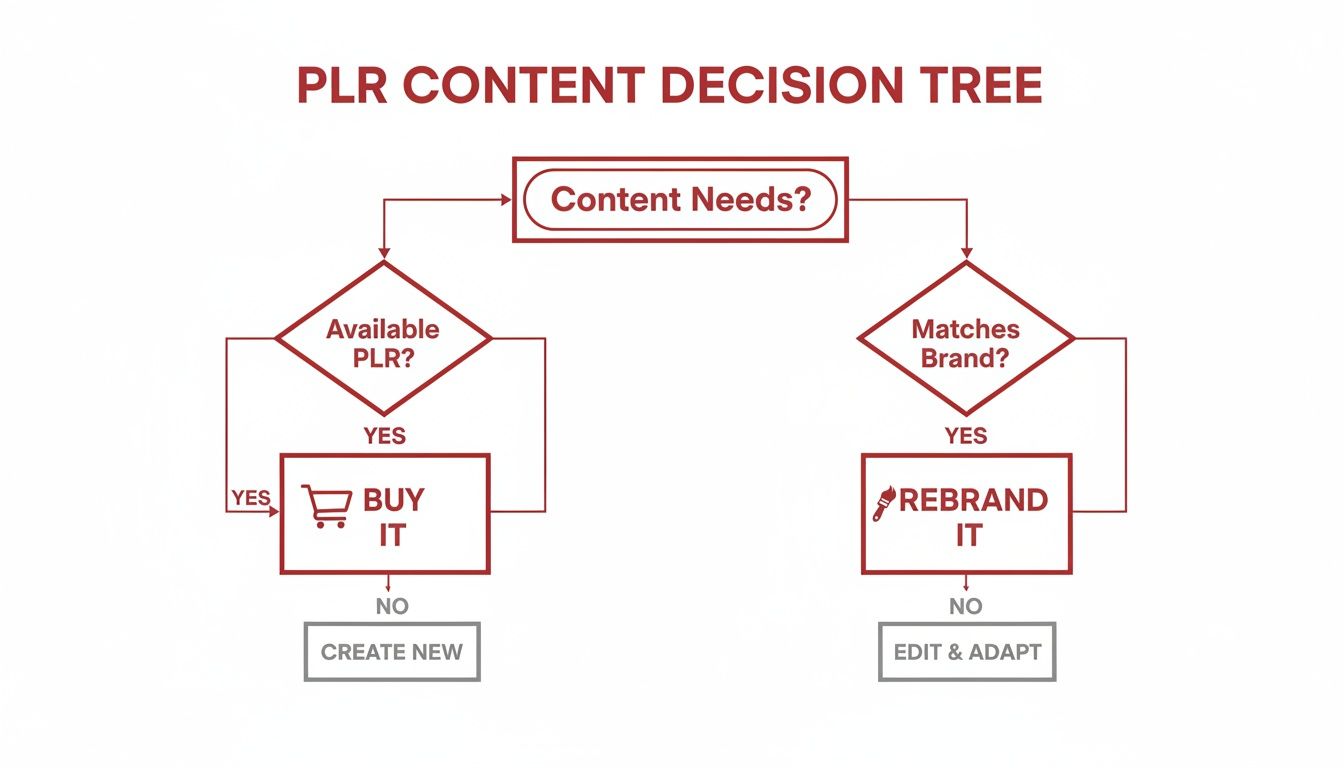
This visual really drives home the core benefit of PLR. It’s not just about getting content; it's about getting the freedom to transform it into a totally unique asset for your business.
Resell Rights (RR) The Street Vendor
Resell Rights (RR) are a step down from MRR in terms of flexibility. With RR, you can sell the content directly to customers for their own personal use. The critical difference is that you cannot pass on the resale rights to them. Once they buy it from you, the selling stops there.
Just like MRR, you usually can't edit or change the content in any way. You're basically a distributor for a finished product.
In our analogy, this is like being a street vendor who buys pizzas wholesale and sells them by the slice. You can sell the pizza, but your customer can't turn around and start their own pizza stand with it. It's a simple, no-fuss way to add more products to your lineup.
Personal Use Rights The Customer
Finally, there’s Personal Use Rights, which you'll often see labeled as "For Personal Use Only." This is the most restrictive license of all, and it’s pretty self-explanatory. You can use the content for your own learning and growth, but you have zero rights to sell, share, or give it away.
This is like buying a pizza just to eat it yourself. You can enjoy every last bite, but you can’t resell it, share the recipe, or open a shop with it. This license is standard for things like e-books or online courses meant for just one person to use.
PLR Vs Other Content Licenses A Clear Comparison
Trying to keep all these rights straight can feel a bit overwhelming, but it's crucial for making smart decisions for your business. To cut through the confusion, this table breaks down exactly what you can—and can't—do with each license type.
License Type | Can You Edit Or Rebrand It? | Can You Sell It? | Can You Sell Resale Rights To Others? | Best Use Case |
|---|---|---|---|---|
Private Label Rights (PLR) | Yes, almost always | Yes | Yes, sometimes | Creating unique branded products to sell or use as lead magnets. |
Master Resell Rights (MRR) | No, almost never | Yes | Yes | Selling a "business-in-a-box" where the product is the opportunity. |
Resell Rights (RR) | No, almost never | Yes | No | Adding ready-made products to your store for direct-to-consumer sales. |
Personal Use Rights | No | No | No | Learning and personal development; consuming the content yourself. |
Think of this table as your cheat sheet. When you're looking at a piece of content, a quick glance here will tell you if it fits your plan, whether that's creating a flagship course or just adding a simple digital download to your shop. Getting this right from the start saves a ton of headaches later on.
Putting PLR Content to Work for Your Business
Okay, we've covered the "what." Now for the fun part: the "how." Knowing the definition of PLR is one thing, but seeing it generate real-world results is where the lightbulb really goes on.
This is where we move from theory to action. For entrepreneurs, coaches, and creators, PLR isn’t just a product—it's a strategic asset. Think of it as a box of high-quality building blocks, ready for you to assemble into something much bigger. The key is to see PLR not as the finished article, but as a powerful head start.
From PLR Ebook to Signature Coaching Program
Let's say you're a business coach who helps people crush procrastination. You find a great PLR ebook called "The Ultimate Productivity System." Instead of just flipping it for a few bucks, you can use it as the skeleton for a signature 6-week group coaching program.
Here's how that transformation plays out:
Break It Down: The ebook's chapters become your weekly modules. Just like that, your entire program curriculum is outlined.
Create Your Arsenal: You pull concepts from the ebook to design practical tools. Think checklists, worksheets, and action plans that help your clients get wins every single week.
Add Your Magic: Each week, you host a live call. You expand on the module's topic, share personal stories, answer questions, and build a real connection. The PLR provided the structure; your expertise provides the transformation.
Build a Community: You spin up a private group for everyone in the program. This turns a simple digital product into a living, breathing experience where people support each other.
In this scenario, a PLR ebook that might sell for $27 becomes the foundation for a premium coaching offer you could price at $497 or more. The PLR didn’t replace your expertise; it just gave you a framework to deliver it faster and more effectively.
Using PLR to Build a High-Value Sales Funnel
Now, picture a course creator with a high-ticket program on digital marketing. Building an entire sales funnel from scratch—the lead magnet, the entry-level offer, the core product—can take months. With PLR, you can map out this entire customer journey in a fraction of the time.
You could start with a PLR report on a niche topic like "Mastering Social Media Engagement." This becomes your freebie, designed to attract your ideal audience and grow your email list. The moment they sign up, you hit them with a low-cost "tripwire" offer—maybe a compelling mini-course you built from some PLR video scripts and workbooks.
This mini-course, priced at just $17, does one crucial job. It delivers a quick win and, more importantly, turns a freebie-seeker into a paying customer, making them far more likely to invest in your main offer down the line.
From there, it's a straight shot to your flagship digital marketing course. You’ve used PLR to create a seamless, automated system that warms up leads and guides them right to your premium offering.
More Practical PLR Strategies for Growth
The applications don't stop there. The real beauty of what PLR content offers is how easily it adapts to almost any business model.
For Marketing Agencies: A detailed PLR report on "Local SEO Trends" can be rebranded as an exclusive industry white paper. Use it as a powerful lead magnet to attract the high-value agency clients you're looking for.
For Membership Site Owners: A library of PLR ebooks, templates, and workshops can become a treasure trove of resources for your members. This constantly growing library boosts the value of your membership, keeping people subscribed and attracting new ones.
For Bloggers and Content Creators: PLR articles or video scripts can be the cure for content burnout. Rewrite them in your unique voice, sprinkle in some fresh examples, and you've got a way to keep your publishing schedule consistent without starting from a blank page every time.
Once you get the hang of using PLR, the next step is to make sure it fits into your bigger picture. To learn more about building a plan where every piece of content has a purpose, check out this guide on how to create a robust content strategy. This kind of planning ensures every asset, PLR or not, is working to move your business forward.
Transforming PLR Content Into a Unique Asset
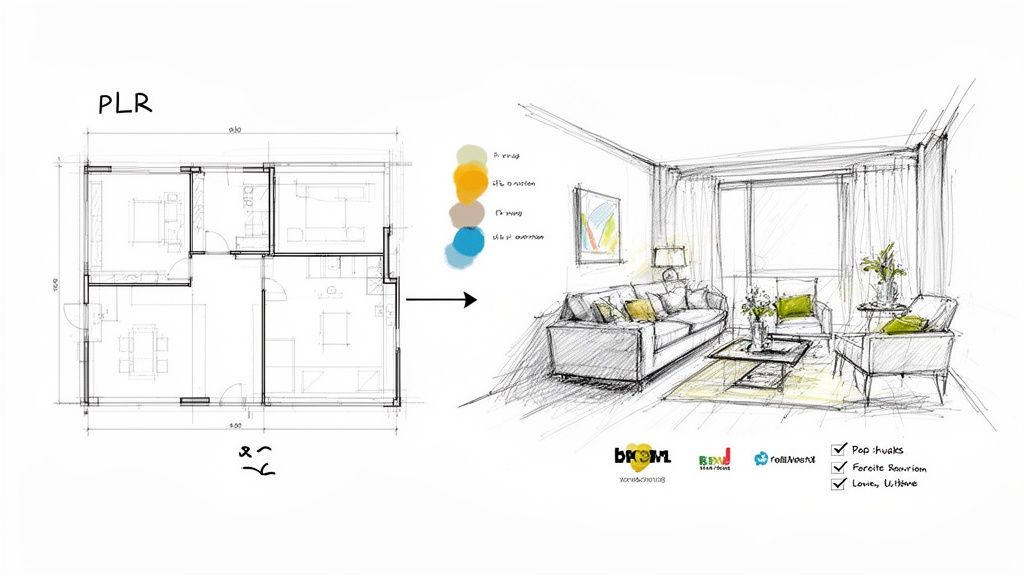
One of the biggest myths about Private Label Rights is that you’re stuck with generic, cookie-cutter material. The truth? The real value isn't in using PLR content as-is, but in making it completely your own. This is where you infuse your unique brand, voice, and expertise to create something that nobody else has.
Think of PLR as the blueprint for a house. The structure is sound and the foundation is solid, but it's not a home yet. You're the interior designer who comes in to pick the paint colors, the furniture, and the art. Your personal touch is what turns a generic structure into a home that reflects your style.
That last 20% of personalization is what elevates a standard PLR product into a premium, standout offer your audience will love. It's the critical step that separates savvy entrepreneurs from those who just copy and paste.
Your Action Plan for Customization
So, how do you add that crucial layer of personality and value? It’s not some creative mystery; it's a systematic process. By focusing on a few key areas, you can methodically transform any piece of high-quality PLR into an asset that feels like it was custom-built for your brand.
Here’s a practical checklist to guide your transformation:
Rewrite the Bookends: Your introduction and conclusion are prime real estate for your brand's voice. Rewrite them from scratch. Share a personal story, a client success, or a bold opinion that immediately hooks your reader and sets the tone.
Refresh the Data: PLR content is a snapshot in time. Go through and update any statistics, dates, or industry trends with the latest available information. Citing fresh data instantly boosts your credibility and shows you’re on top of your game.
Localize and Specialize Examples: Swap out generic examples for niche-specific case studies. If the PLR mentions "a small business," change it to "a local coffee shop in Austin" or "an online keto bakery." This makes the content far more relatable and impactful for your audience.
The old stigma around private label goods has largely faded away, with consumer acceptance growing right alongside the digital space. Big retailers are now pushing 'premiumization' to drive innovation, a strategy that digital creators can easily mirror by elevating their PLR into high-value, unique offerings.
This shift in consumer perception is huge. The global acceptance of private label products has surged, with one report highlighting that U.S. store brand sales led in eight of nine major departments. This trend is exactly why high-quality, customized PLR is seen as a valuable asset, not a shortcut. You can learn more about the rise of private label sales in this detailed report from CSN News.
Elevating the Visual and Structural Identity
Customization goes way beyond just the words on the page. The visual presentation and the way you structure the information play a massive role in how your audience perceives its value. A professional, cohesive look builds trust and makes the content feel more premium.
To truly make a PLR product your own, you need to give it a complete visual and structural makeover.
Complete Brand Integration
This is non-negotiable. You must systematically remove all traces of the original PLR branding and replace them with your own.
Redesign the Cover: Create a new e-cover that aligns perfectly with your brand's aesthetic, using your fonts, colors, and logo.
Update the Interior: Reformat the internal pages. Adjust headers, footers, and body text to match your brand guidelines.
Infuse Your Brand: Add your business name, website, and social media handles throughout the document. This reinforces your ownership and encourages readers to connect with you.
By focusing on these deep customization tactics, you ensure your final product is a true reflection of your brand's quality and expertise. For more ideas on taking your products to the next level, check out our guide on 7 ways to instantly boost the perceived value of your PLR digital products.
How to Source High-Quality PLR Content
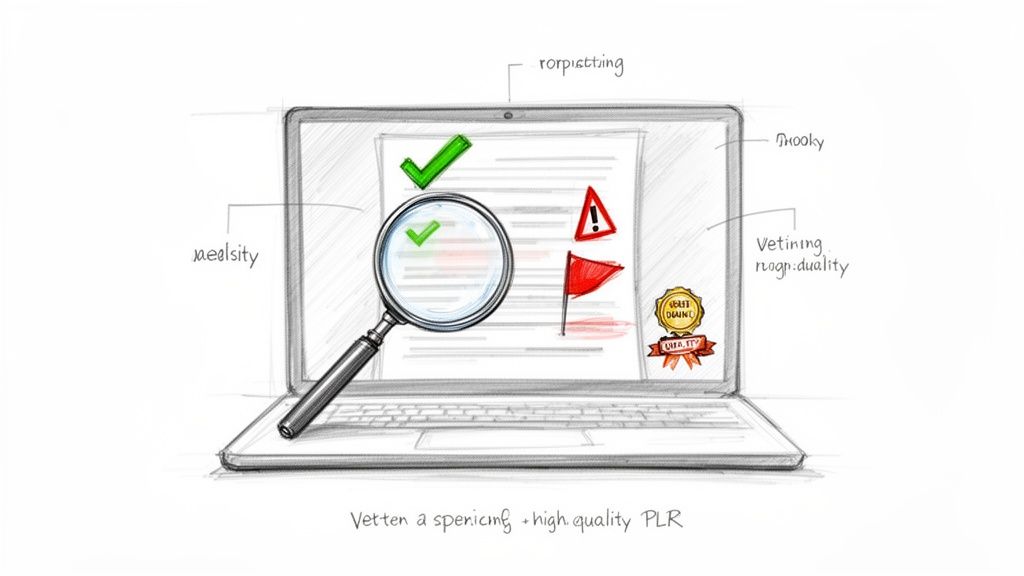
Now that you see the potential of what PLR content can do for your business, the next big question is obvious: where do you find the good stuff? The internet is absolutely flooded with PLR, but a massive chunk of it is outdated, badly written, or has been sold to thousands of other people.
Finding premium PLR is the single most important part of this whole equation. Your success hinges on it.
Think of it like cooking a signature dish. If you start with fresh, high-quality ingredients, you’re already halfway to an amazing meal. But if you’re using wilted produce and cheap spices, no amount of culinary skill can save the final product. Your brand’s reputation depends entirely on the quality of the "ingredients" you choose.
Vetting Potential PLR Providers
Let's be clear: not all PLR websites are created equal. To protect your investment and, more importantly, your brand, you need to develop a sharp eye for quality and have a clear set of standards. Before you ever hit that "buy" button, put potential providers through a quick but thorough vetting process.
A few minutes of due diligence now can save you hours of headaches and frustration down the road. You're looking for providers who operate like a real business, not some hobbyist clearing out old files from their hard drive. Their website should look professional, their content samples should be impressive, and their licensing terms must be crystal clear.
Here are the core criteria to look for:
Content Quality and Expertise: Is the content well-researched, accurate, and written by someone who actually sounds like they know the topic? Always check the samples for grammar mistakes, typos, and how readable it is.
Design and Formatting: The best PLR often comes with professional design templates, like files for Canva or InDesign. This makes customizing it a thousand times easier and ensures you end up with a polished product.
Originality and Exclusivity: Does the seller limit how many licenses they sell for each product? The less saturated the market is with that PLR, the more unique your final, customized version will be.
The goal isn't just to find a content store; it's to find a PLR partner. A reputable provider consistently delivers value, stays on top of industry trends, and gives you resources that genuinely help you succeed. That’s how your PLR investment pays off.
Red Flags to Watch Out For
Just as important as knowing what to look for is knowing what to run away from. Low-quality PLR sites often share common traits that are pretty easy to spot once you know them. These red flags are your signal to click away and keep searching.
Saving a few bucks on cheap PLR is never worth the damage it can do to your brand’s credibility. Be wary of sites that feel like digital ghost towns—no new content in months, broken links, or a design that looks like it’s from 2010. These are signs of a neglected business where the content is probably just as stale.
To help you out, we've put together a list of the best PLR websites in 2025, focusing only on providers who meet these high standards.
Here are the biggest warning signs to keep an eye out for:
Outdated Information: The content talks about old statistics, software that no longer exists, or strategies that are completely obsolete.
Restrictive or Vague Licenses: The terms of use are confusing, way too restrictive, or just plain missing.
Poor Grammar and Typos: If their own sales page has errors, just imagine what the product you're buying looks like.
No Customer Support: There’s no easy or obvious way to contact someone if you have questions or run into a problem.
Got Questions About Using PLR? Let's Clear Things Up.
As you start digging into the world of done-for-you content, a few questions always pop up. It's totally normal. Getting a handle on what PLR content really is means looking at the legal side, how it plays with your marketing, and where its practical limits are. Let's tackle the most common questions head-on so you can move forward with confidence.
Is Using PLR Content Legal and Ethical?
Yes, using PLR content is 100% legal as long as you follow the license agreement from the provider. Think of it like buying stock photos or music—you're purchasing a license that grants you specific rights to use someone else's work. It's a well-established and legitimate business model.
The ethics, however, come down to how you use it. The best and most ethical approach is to significantly modify the content. This is where you add your own voice, your expertise, and your unique value.
Using PLR as a starting point—not a copy-paste final product—is the smartest way to go. It’s not just more ethical; it's a far better business strategy. This ensures you’re giving your audience something genuinely valuable, not just flipping generic material. Always double-check the specific terms from your PLR provider to know exactly what you can and can't do.
Will PLR Content Hurt My SEO?
This is a big one, but the answer is simple: it won't, provided you do it right. Search engines like Google are smart, and they penalize duplicate content. So, grabbing a PLR article and slapping it onto your website without any changes? That's a terrible idea that will almost certainly sink your SEO rankings.
But high-quality PLR isn't meant to be used that way. It's a launchpad. Your job is to take that foundation and build something new and original from it.
By following a few simple steps, you can create a piece of content that search engines will see as completely fresh:
Rewrite the Important Parts: Always rewrite the introduction and conclusion in your own words. Go through the body of the content and rephrase several paragraphs to reflect your unique voice.
Add Your Own Stories: Swap out generic examples for specific stories, case studies, or personal experiences that connect with your audience.
Update the Facts: Find newer statistics and add fresh data. This makes the content more current and instantly more valuable.
Shake Up the Structure: Change the order of sections, combine a few points, or turn a long paragraph into an easy-to-scan bulleted list.
It's also worth remembering that many PLR assets—like ebooks, email courses, or design templates—are used as lead magnets or paid products. These are rarely indexed by search engines anyway, so they have no direct impact on your website's SEO. Instead, they work behind the scenes as powerful tools for building your email list and making sales.
Can I Build a Whole Product, Like a Course, From PLR?
Absolutely. In fact, this is one of the most powerful and efficient ways to use premium PLR. You can act like a producer, curating and bundling multiple PLR assets to create a comprehensive, high-value product that would’ve taken you months to build from the ground up.
Let's say you want to create a signature course on project management. Here’s how you could piece it together with PLR:
The Core Curriculum: Start with a detailed PLR ebook on project management. The chapters instantly become the outline for your course modules.
Video Lessons: Use a pack of PLR video scripts on related topics. Record the videos yourself, adding your own teaching style and branding.
Student Handouts: Include PLR templates—like project plans, checklists, and progress trackers—as downloadable workbooks for your students.
Bonus Material: Toss in a PLR mini-course on a related skill, like "Effective Team Communication," as a bonus to make your main offer irresistible.
By adding your own custom intro, conclusion, and a few personal stories throughout the course, you can launch a professional, in-depth program in a fraction of the usual time. The PLR gives you the structure and the bulk of the content; you provide the final layer of polish and expertise that makes it truly yours.
What's the Real Difference Between Premium and Cheap PLR?
The gap between premium PLR and the cheap (or free) stuff is massive, and it directly affects your brand's credibility. While the low price of cheap PLR is tempting, it often comes with hidden costs like poor quality, outdated info, and the fact that everyone else is using the exact same thing.
Think of it like this: cheap PLR is the fast fashion of the content world. It's inexpensive and everywhere, but it's often poorly made, falls apart fast, and looks just like what everyone else is wearing. Premium PLR, on the other hand, is like investing in a classic, well-tailored suit. It costs more upfront, but the quality, craftsmanship, and exclusivity make you look far more professional.
Here’s a quick breakdown of what you're paying for:
Feature | Premium PLR | Cheap or Free PLR |
|---|---|---|
Content Quality | Created by subject-matter experts; well-researched and fact-checked. | Often poorly written, full of errors, and lacking real depth. |
Design Standards | Professionally designed with source files (e.g., Canva) for easy customization. | Generic, outdated designs with limited or no customization options. |
Exclusivity | Often sold with limited licenses to reduce market saturation. | Sold to thousands of buyers, making it generic and overused. |
Updates | Sourced from providers who regularly add new, relevant content. | Typically static, one-off products that quickly become outdated. |
Investing in premium PLR from a reputable source means you're getting a high-quality asset that saves you time and actually enhances your brand—not one that damages it with shoddy content.