Explained
What Is Content Repurposing and How to Master It

Content repurposing is simply taking one piece of content you've already created and strategically adapting it into multiple new formats to connect with different people on different platforms. It's the ultimate "work smarter, not harder" strategy, letting you multiply your impact without constantly starting from a blank page.
The Secret to Working Smarter, Not Harder
Ever feel like you’re stuck on a content treadmill, churning out new material just to keep up? It’s a feeling most entrepreneurs and marketers know all too well. You pour hours—sometimes days—into a killer blog post, video, or webinar. It gets a brief moment in the spotlight, and then poof... you’re already under pressure to create the next big thing. It's exhausting, and frankly, it's inefficient.
But what if you could completely change that equation?
Think of a master chef who creates one incredible, versatile sauce. They don't just serve it one way and call it a day. No, they use it as the foundation for a dozen different dishes—drizzled over pasta, used as a marinade for grilled chicken, or swirled into a savory soup. Each dish appeals to a different taste, but they all come from that same core creation. That, in a nutshell, is content repurposing.

To make sure we're on the same page, let's clear up a few common myths right away.
Content Repurposing At a Glance
This table breaks down the smart strategy from the common misconceptions.
What It Is (Smart Strategy) | What It Isn't (Common Myth) |
|---|---|
Deconstructing a core idea to fit new platforms. | Copying and pasting the same text everywhere. |
Thoughtfully tailoring a message for a new audience. | Lazily recycling old, outdated content. |
Creating multiple unique assets from one effort. | Simply changing the title of an old blog post. |
Building a web of related content for better SEO. | Spamming channels with the exact same content. |
Getting this distinction right is the first step toward building a truly efficient content engine.
Beyond Simple Recycling
Content repurposing isn't about being lazy or just reposting the same text across all your social channels. It’s a deliberate strategy. You deconstruct a core idea, then rebuild it in a way that feels native to each new platform and the audience that lives there.
When you get this right, the benefits are huge:
Wider Audience Reach: That in-depth blog post is perfect for the readers on your site, but what about the people who prefer to watch or listen? Turning its key points into a short, punchy video can capture a whole new audience on YouTube or Instagram that you were missing before.
Message Reinforcement: When people see your core message in different formats, it starts to stick. This repetition builds familiarity and authority, making your brand more memorable and trustworthy in the long run.
Improved SEO Performance: Creating a web of interconnected content around a central topic sends powerful signals to search engines like Google. More assets mean more chances to rank for keywords, earn valuable backlinks, and drive consistent organic traffic back to your site.
By transforming a single piece of work into multiple assets, you stop being a content creator and start becoming a content strategist. You get a bigger return on every minute invested, building a powerful and efficient marketing engine that fuels sustainable growth.
If you think content repurposing is just a neat little time-saving trick, you're missing the forest for the trees. It’s like looking at a championship-winning team and only seeing a bunch of athletes. You’re ignoring the playbook, the synergy, and the massive strategic advantage they have.
The real magic of repurposing is how it multiplies your impact. It turns one solid piece of work into a full-blown campaign that actually moves the needle in your business.
This isn’t just a "nice to have" strategy anymore. The global content marketing world was worth over $413.2 billion in 2022 and is rocketing towards $2 trillion by 2032. In a space that crowded, just making more stuff is a losing game. You have to squeeze every drop of value out of what you already have.
Break Out of Audience Silos
Here's a hard truth: your audience isn't one big, happy family that consumes content the same way. Some people love to settle in with a long article, others are scrolling through short videos on their lunch break, and a whole other group is listening to podcasts on their commute.
If you only create content in one format, you’re basically telling huge chunks of your market, "Sorry, you're not for me."
Content repurposing is the bridge that connects these different groups. It's about meeting people where they are, in the format they already love.
The Reader: Gets an in-depth blog post or guide.
The Viewer: Gets a dynamic YouTube video or a string of Instagram Reels.
The Listener: Gets an engaging podcast episode or a quick audiogram.
By tailoring your core message to fit these different habits, you make sure your expertise reaches everyone. You stop hoping they’ll change their behavior just to hear what you have to say.
Become an SEO Powerhouse
From an SEO perspective, repurposing is a total game-changer. Every new piece of content you create is another asset that can rank on Google. It’s another shot at a new keyword and another doorway for organic traffic to find you.
This creates a dense web of interconnected content that screams "authority" to search engines.
Think about it: Your main blog post might rank for a primary keyword, but the infographic you made from it could show up in image search. The YouTube video could pop up in video results, and the LinkedIn article could grab an entirely different professional crowd.
This multi-pronged attack compounds your SEO efforts, building momentum way faster than just publishing one-off pieces ever could. For this to work, it has to be part of a plan. The best way to do this is to build a content strategy that has repurposing baked in from the start.
Reinforce Trust and Brand Recall
Ever hear a concept once and it just goes in one ear and out the other? But then you hear it explained a second or third time, maybe in a slightly different way, and it finally clicks. That's the "Rule of Seven" in marketing—the idea that someone needs to hear your message at least seven times before they're ready to act.
Repurposing makes this happen without you sounding like a broken record.
When a potential customer reads your blog post, then later sees a key quote from it on social media, and then hears you talking about it on a podcast... your message starts to stick. This constant, gentle reinforcement builds incredible brand recall and cements you as the go-to expert in your space.
To see exactly how to put this into practice, take a look at our guide on The 1-to-10 Case Study Repurposing System.
Your Guide to the Content Repurposing Flywheel
Turning your content strategy into real-world results means you need a system. A repeatable process that doesn't just work once but actually builds momentum over time. This is exactly where the content repurposing flywheel comes in.
Instead of getting stuck on the content treadmill, churning out random, disconnected pieces, you start with one central, powerhouse asset. Then, you systematically spin it off into dozens of smaller, targeted pieces for every channel you're on.
What is Pillar Content?
At the heart of this entire model is your pillar content. Think of it as the sun in your content solar system—everything else revolves around it. A pillar is a substantial, high-value piece of work that dives deep into a topic. It could be a comprehensive guide, an original research report, a detailed webinar, or a long-form video tutorial.
By starting with a pillar, you ensure your marketing efforts are cohesive and efficient. Every piece you create reinforces your core message, building your authority across the board.
Finding Your Pillar Content
Before you can start breaking content down, you need to find the right foundation to build on. The best pillar content often comes from assets that have already proven their worth with your audience.
Start by looking for:
Your Most Popular Blog Posts: Dive into your analytics. Which articles get the most traffic, keep people on the page the longest, or bring in the most leads? These are already validated winners.
Evergreen Topics: Pinpoint the content that stays relevant and valuable, month after month. These topics give you a long-lasting foundation for your flywheel.
Comprehensive Resources: Have you already created a killer webinar, an in-depth ebook, or an ultimate guide? These are often packed with enough material to fuel months of repurposed content.
Once you’ve picked your pillar, the next step is to strategically break it down into smaller, platform-specific assets. This is often called "atomizing" your content.
The goal of atomization isn't just to chop up the original piece. It's about thoughtfully adapting your core message to fit the unique context—and audience expectations—of each new platform.
From One to Many: A Practical Workflow
Let's walk through a real-world scenario. Imagine your pillar content is a 4,000-word "Ultimate Guide to Starting a Coaching Business." Here’s how you could atomize it into a powerful, multi-channel campaign.
This process creates a cycle of benefits. It starts by boosting your SEO, which helps you reach a bigger audience, and that, in turn, builds incredible trust with your followers.
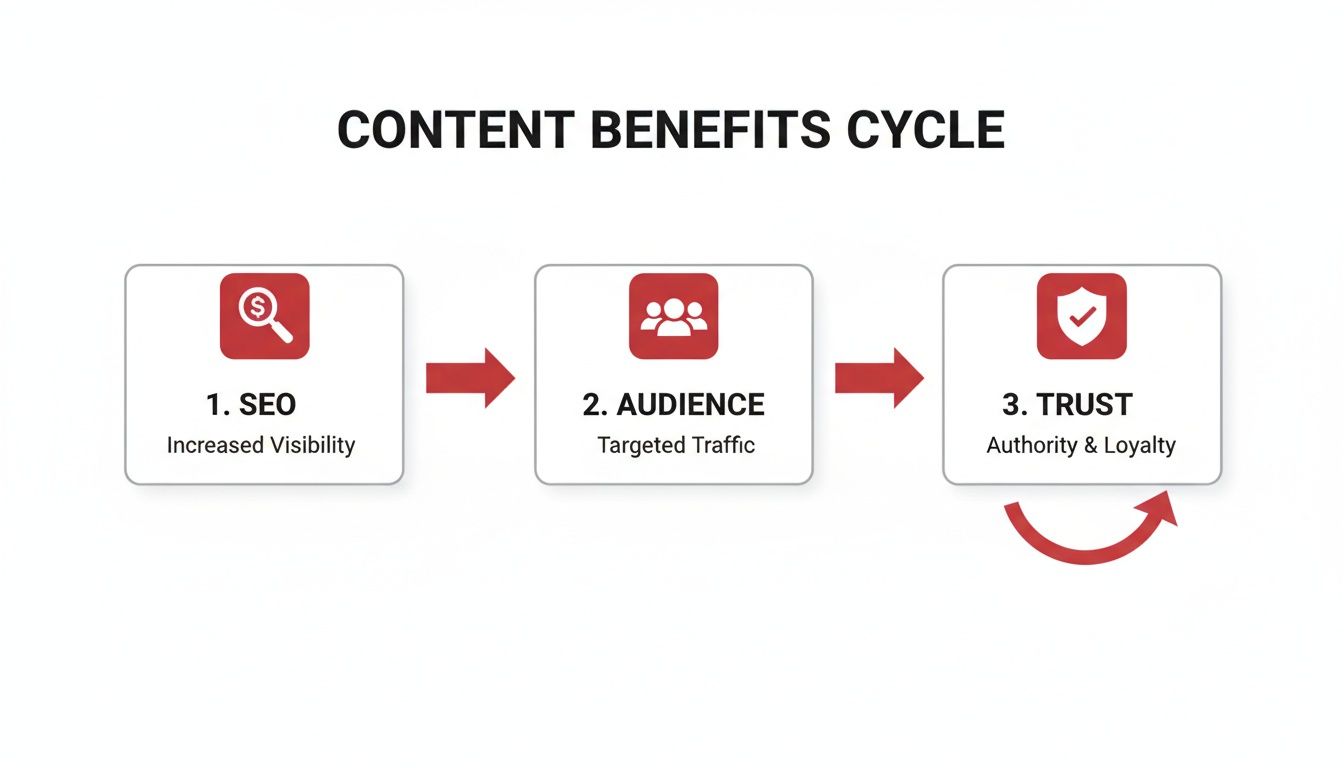
As you can see, each new asset you create contributes to a self-reinforcing loop that strengthens your entire marketing presence.
Step 1: Deconstruct the Pillar into Themes
First, break the guide down into its core sub-topics. Your guide likely has distinct sections that can easily stand on their own.
Theme 1: Finding Your Niche
Theme 2: Creating Your Coaching Packages
Theme 3: Marketing Your Services
Theme 4: Onboarding Your First Client
These four themes become the mini-campaigns that will fuel all your repurposed assets.
Step 2: Repurpose for Different Platforms
Now for the fun part. It's time to transform each theme into formats tailored for specific channels. This is where you get creative and meet your audience right where they are.
Email Newsletter Series: Turn the four themes into a 4-part email mini-course. Each week, subscribers get an actionable lesson sent straight to their inbox, driving engagement and growing your email list.
Social Media Graphics: Pull the most powerful quotes, stats, or key takeaways from each theme. Create visually appealing quote cards for Instagram and LinkedIn to share bite-sized wisdom.
Short-Form Video Scripts: Use the "Marketing Your Services" section to write scripts for 3-5 short TikToks or Instagram Reels. Each video can cover a single marketing tip, like "3 Ways to Get Your First Coaching Client."
LinkedIn Carousel: Convert the "Onboarding Your First Client" section into a step-by-step carousel post. This visual format is perfect for breaking down a process into digestible slides for a professional audience.
Infographic: Summarize the entire guide's key statistics and processes into a single, shareable infographic for Pinterest and your blog. This visual asset is great for attracting backlinks and driving traffic.
Step 3: Create a Distribution Schedule
Finally, map everything out on a content calendar. This ensures a steady, consistent flow of valuable information, preventing you from dumping all your content at once and keeping your audience engaged over time.
Just like that, you’ve turned one pillar piece into more than a dozen unique assets.
This flywheel model is incredibly versatile. For more real-world examples of working smarter, you can learn specific methods like how to repurpose a single podcast episode into multiple content pieces. The principles are the same whether you're starting with a podcast, a video, or a written guide.
To really dive deep and make this a core part of your business, check out our guide on The Evergreen Content Flywheel.
How to Measure and Optimize Your Repurposing Efforts
Putting together a powerful content repurposing flywheel is only half the job. A strategy is only as good as its results, and you need a clear way to see what’s working and what’s falling flat. Without data, you’re just guessing.
It’s easy to get lost in vanity metrics like simple view counts. Instead, you need to focus on the numbers that tie directly back to your business goals. When you measure effectively, you can double down on the formats that bring in leads and stop wasting time on assets that go nowhere.
Identifying Key Performance Indicators
To really get a grip on your ROI, you have to track specific, meaningful metrics for each piece of repurposed content. This creates a data-driven feedback loop that helps you make smarter decisions and continuously improve your strategy.
Here are the essential KPIs to keep an eye on:
Engagement Rate: Keep track of likes, shares, comments, and saves across all your platforms. If an Instagram carousel you made from a blog post gets high engagement, that’s a clear signal the visual format is a hit with that audience.
Click-Through Rate (CTR): This one’s simple: how many people click the link in your repurposed content to go back to the original pillar piece? This tells you how effective each new asset is at driving traffic where you want it to go.
Conversion Rate: This is the ultimate test. Compare the conversion rate of a lead magnet you created from a webinar against the webinar’s original registration page. This tells you which format is better at turning viewers into actual leads.
Cost Per Lead: Calculate this by dividing the total cost of creating and distributing the repurposed asset by the number of leads it brought in. This helps you pinpoint your most cost-effective repurposing tactics.
Optimizing Your Workflow with Data
Once you start gathering this data, patterns will emerge. You might discover that short video clips you pull from a podcast generate twice as many leads as the text-based quote graphics you were also making. That insight is gold.
Use this knowledge to sharpen your content calendar and distribution plan. Pour your energy into the formats and channels that deliver the best results, making sure every piece of repurposed content works as hard as possible for your business.
Measuring your efforts turns repurposing from a creative exercise into a predictable growth engine. It empowers you to systematically improve your ROI by investing only in what is proven to work.
This strategic approach is what separates the pros from the amateurs. While 37% of B2B marketers find content repurposing challenging, those who master it see huge wins. Globally, 65% of successful teams repurpose their content into four or more formats, dramatically amplifying their reach.
This matters in a market where 83% of consumers say they want more video content. Understanding your metrics is what separates you from the pack in a digital marketing space expected to grow from $667 billion in 2024 to $786 billion by 2026. You can read more about these powerful content marketing statistics to see the full picture.
Supercharge Your Strategy with Ready-Made Content
Imagine starting the whole content repurposing process with your main pillar content already finished. While the flywheel model is incredibly powerful, creating that initial asset—the deep-dive guide, the comprehensive webinar, the flagship ebook—is usually the single biggest roadblock for busy entrepreneurs.
This is where done-for-you assets completely change the game.
Let’s talk about Private Label Rights (PLR) content. Think of it as the ultimate accelerator. PLR gives you pre-written, high-quality ebooks, guides, and courses that you can legally rebrand, modify, and sell as your very own. Instead of pouring weeks into research, writing, and design, you get to start at the finish line.
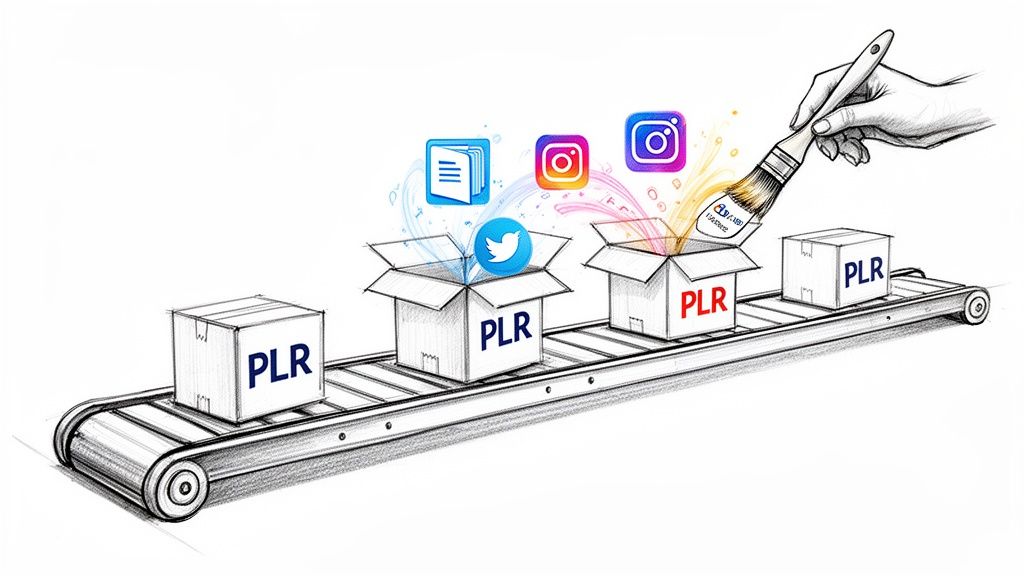
This approach lets you jump straight to the most valuable part of the work: strategically repurposing and distributing your content.
The PLR Advantage From Day One
Using PLR isn’t about cutting corners. It's about strategically reallocating your most precious resource—your time—from the grind of creation to the high-impact work of amplification. The moment you grab a PLR asset, you can begin breaking it down.
Here’s what that looks like in the real world:
Acquire a Pillar Asset: You start with a professionally written ebook on a topic your audience desperately needs.
Rebrand and Customize: You put your own spin on it—adding your branding, your unique insights, and maybe a few of your own case studies to make it truly yours.
Launch the Flywheel: Immediately, you can pull chapters to become blog posts, grab key stats for social media graphics, and outline video scripts based on its core concepts.
This completely flips the old content equation on its head. Your focus shifts from the slow, draining act of creation to the exciting, high-impact work of marketing. You can check out a wide range of PLR digital products to find the perfect foundation for your next big campaign.
By using ready-made content, you compress the content creation timeline from months into mere minutes. This frees you up to launch campaigns, test new ideas, and scale your marketing faster than you ever thought possible.
Overcoming Modern Content Challenges
This strategy hits the biggest struggles marketers are facing right now. While 56% of teams are seeing good results from AI workflows, a solid 37% still struggle with the insane volume of content needed to make repurposing truly effective.
Done-for-you assets solve this by handing you a ready-made content library. It eliminates costly outsourcing and lets you turn an idea into a Kindle-ready book in days, not months.
In a content marketing world projected to hit $2 trillion by 2032, just creating more isn't the answer. That's especially true when a staggering 94% of blog posts never attract a single backlink without a rock-solid distribution plan. Repurposing ready-made content helps you build that cohesive brand journey needed to stand out, all while slashing creation time and boosting your ROI. You can discover more insights on how a strategic approach can overcome these common content marketing hurdles.
Common Questions About Content Repurposing
Even with the best strategy laid out, jumping into content repurposing can feel a little fuzzy at first. It's totally normal to have questions pop up. Let's walk through the most common ones so you can move forward with total confidence.
Does Content Repurposing Hurt SEO with Duplicate Content?
This is probably the biggest myth out there, and the answer is a hard no—as long as you do it right. Real repurposing isn’t about just copying and pasting the same text everywhere. It's about translating your core idea into brand-new formats for different platforms.
Search engines are more than smart enough to see the difference between a long-form blog post, a punchy infographic, and a scripted video. Each one is a distinct, valuable asset. And for those rare times when you do want to publish an article somewhere else word-for-word, a simple canonical tag tells Google which one is the original, wiping out any duplicate content worries.
The reality is, this strategy actually boosts your SEO. You're creating more unique assets that can rank on their own, earn backlinks from different sources, and pull in traffic from all corners of the internet.
How Do I Choose Which Content to Repurpose First?
It's simple: start with your greatest hits. Dive straight into your analytics and find the pieces that are already bringing in the most traffic, getting the most shares, or generating the most leads. These are your proven, evergreen winners.
There's no need to guess. When you repurpose content that you already know your audience loves, you're taking a low-risk, high-reward bet. The data has already done the hard work of validating the topic for you.
By focusing your first efforts on top-performing content, you guarantee your time is invested where it will make the biggest and most immediate impact. This data-driven approach is all about setting yourself up for an early win.
How Much Should I Change Content When Repurposing It?
The amount of change depends entirely on where the new content is going to live. A lazy copy-paste job is a recipe for getting ignored. The real goal is to completely transform the piece so it feels native to its new home.
Blog Post to Instagram Carousel: This is a total visual makeover. You're not just copying text; you're boiling down your key points into short, snappy phrases that fit on beautifully designed slides.
Guide to Podcast Segment: Here, you're rewriting everything into a script that sounds natural when spoken. It needs a conversational tone, a clear narrative, and a flow that's easy for listeners to follow.
The core message stays the same, but the delivery, tone, and structure have to be thoughtfully redesigned for each platform. That's how you get people to actually stop scrolling and pay attention.