Guide
Your Guide to Video Sales Letter Success

A Video Sales Letter, or VSL, is really just your best salesperson, cloned. Imagine taking your most persuasive pitch, scripting it perfectly, and having it delivered with the exact right tone and emotion, 24/7, to anyone who will listen. That’s a VSL. It’s a powerful blend of video’s emotional punch and the time-tested formulas of direct-response copywriting.
Why VSLs Dominate Modern Marketing
Let's be honest: the battle for attention online is brutal. Those traditional, long-form sales pages that scroll on forever? They’re fighting a losing battle against our shrinking attention spans. People just don't have the patience to read thousands of words anymore.
This is where the Video Sales Letter doesn't just step in as an alternative—it completely changes the game. A VSL takes a flat, text-based argument and turns it into a living, breathing, multisensory experience. You're not just reading words; you're hearing a voice, seeing visuals, and feeling the story unfold. It builds a connection with the viewer much faster and deeper than a wall of text ever could.
The Psychological Edge of Video
The real magic of a VSL is how it taps directly into our psychology. Instead of just reading about a problem, your audience sees it and hears the frustration in a voice they can relate to. This one-two punch of audio and visual information makes the message stick.
A VSL is designed to trigger key psychological drivers:
Building Trust: There's something inherently more trustworthy about hearing a human voice. It feels personal and authentic in a way that plain text just can't replicate.
Creating Urgency: A skilled narrator can use their tone and pacing to build excitement and a sense of urgency far more effectively than some bold text or a ticking clock emoji.
Simplifying Complexity: Got a complicated idea? Break it down with simple animations or on-screen visuals. This makes your solution feel easy to understand and instantly accessible.
A great video sales letter doesn’t just present information; it orchestrates an emotional journey. It guides the viewer from a state of skepticism and uncertainty to one of clarity and desire, making the decision to buy feel like the most natural next step.
Outperforming Traditional Sales Copy
This isn't just theory—the numbers back it up. In an online world where attention is the most valuable currency, video is simply the most efficient way to get it and keep it.
The results are pretty staggering. Video sales letters have become a dominant force, with performance metrics showing they can outsell traditional long-form sales letters by as much as 300%. We've seen it time and again; a well-crafted 3-6 minute video consistently crushes 20-50 pages of written sales copy. You can explore more VSL script insights to see the data for yourself.
This isn't a fluke. It reflects a massive shift in how we prefer to consume information. People want solutions presented clearly, concisely, and in an engaging way. A VSL nails this perfectly, delivering a high-impact pitch that respects the viewer's time while maximizing its persuasive power.
It's the ultimate sales pitch, perfected once and delivered flawlessly, every single time.
To really see the difference, let’s break down how VSLs stack up against the old-school written sales letter.
VSL vs. Traditional Sales Letter Key Differences
The table below gives you a quick snapshot of why video often wins in today's market. It’s not that written copy is dead, but video has a distinct advantage in grabbing and holding the attention of a modern audience.
Attribute | Video Sales Letter (VSL) | Traditional Sales Letter |
|---|---|---|
Engagement | High; uses both audio and visual channels to create a dynamic experience. | Lower; relies solely on text and static images, demanding more reader focus. |
Emotional Connection | Strong; vocal tone, music, and visuals build rapport and trust quickly. | Weaker; harder to convey genuine emotion and personality through text alone. |
Information Consumption | Passive and easy; viewers can lean back and absorb the message with minimal effort. | Active and demanding; requires sustained focus to read through long blocks of text. |
Complexity Explained | Excellent; simplifies complex ideas using animations, charts, and demonstrations. | Challenging; explaining complex topics can lead to dense, overwhelming paragraphs. |
Pacing Control | Controlled by the creator; guides the viewer through the pitch at a deliberate pace. | Controlled by the reader; can skim, skip sections, and lose the narrative thread. |
Conversion Rates | Often significantly higher due to increased engagement and emotional impact. | Generally lower in head-to-head tests, especially with colder audiences. |
As you can see, a VSL is built for the way people consume content now. It’s a powerful, direct, and emotionally resonant tool that can make a huge difference in your marketing efforts.
The Anatomy of a High-Converting VSL
A great video sales letter isn't just a random assortment of sales pitches. It's a carefully crafted psychological journey. Every single component is a building block, deliberately placed to walk a viewer from initial skepticism all the way to a confident "yes." Think of it as a blueprint for persuasion where every piece has a specific job.
This structure isn't some new-age marketing fad. The core of modern VSLs is built on a time-tested direct-response formula that has been printing money for decades. The framework is simple but powerful: identify a problem, agitate the pain that problem causes, present your product as the only solution, and then prove it with real results. You can learn more about this foundational marketing formula to see how its deep roots in classic sales letters give it such lasting power.
This visual shows exactly how that formula turns a simple script into a sales machine.
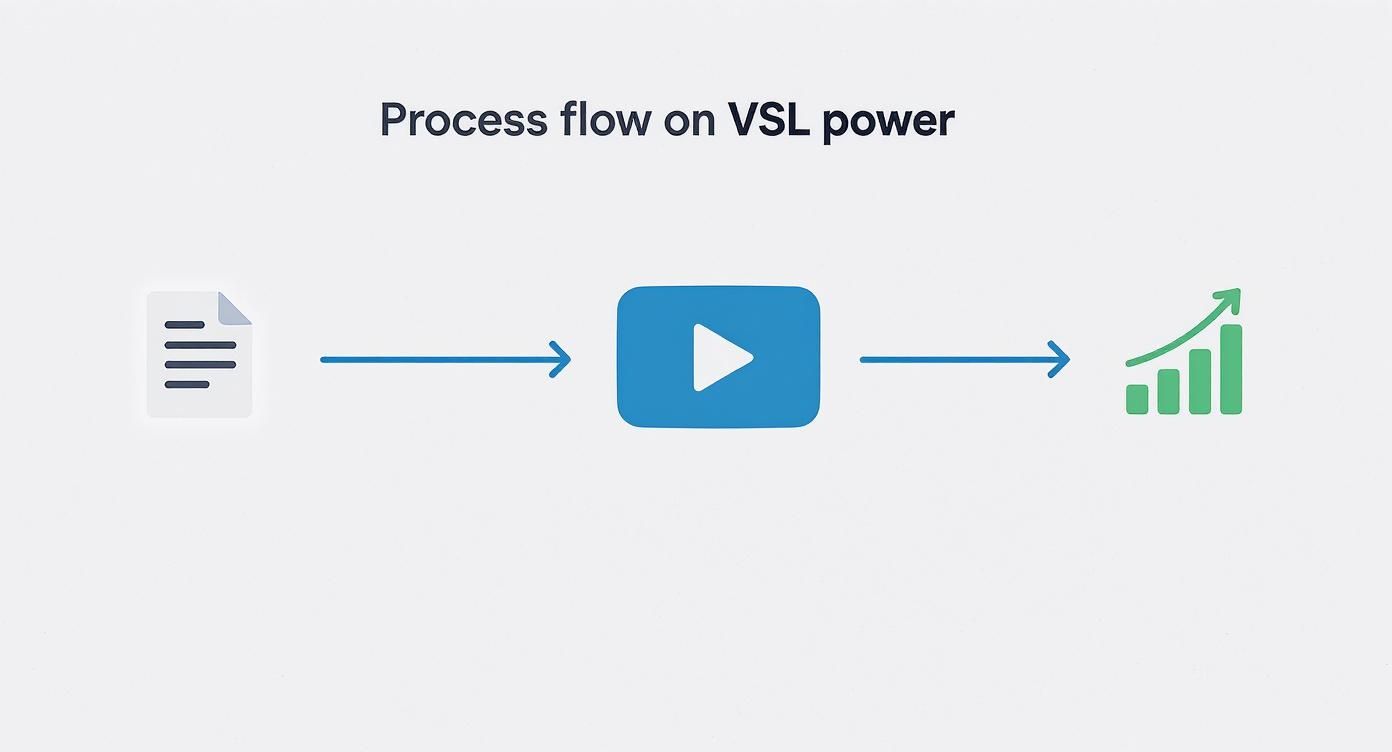
The flow is straightforward but incredibly effective. It's the engine that transforms a structured script into an engaging video that directly drives growth.
Let's break this winning formula down, piece by piece.
The Irresistible Hook
You have just a few seconds to grab your viewer's attention before they click away. Seriously, that's it. The hook is the most critical part of your VSL; if it falls flat, the rest of your brilliant message goes unheard.
A strong hook does two things instantly: it stops the scroll and it promises a solution to a problem they actually care about.
Here are a few proven ways to nail it:
Ask a provocative question: "Are you sick of pouring hours into content that nobody ever sees?"
Make a bold, intriguing statement: "This one tiny shift in your morning routine could literally double your productivity."
Start with a relatable story: "I remember staring at my screen, totally overwhelmed, with no clue how I'd ever get it all done..."
The goal is to spark enough curiosity to make the viewer think, "Okay, this person gets me. I need to hear this."
The Problem and Agitation
Once you've got their attention, you need to make them feel understood. This is where you describe their core problem in vivid, painful detail. Don't just state the problem—paint a picture of the frustration, the annoyance, and the daily grind it causes.
This is the agitation phase. You’re not just saying, "Losing files is bad." You're saying, "Remember that heart-stopping panic when you realize the presentation you slaved over all week is just... gone?"
By clearly articulating their pain and then twisting the knife a little, you create a psychological vacuum. The viewer becomes acutely aware of their need, making them incredibly receptive to your solution.
People buy solutions to their pain. Before you can sell them anything, you have to make that pain feel real and urgent.
The Perfect Solution
Now that the problem is front and center, it’s time to introduce your product or service as the hero of the story. This is where you connect the dots, showing exactly how your offer eliminates the pain you just spent time agitating.
Here's the key: don't just list features. Frame everything as a benefit. A feature is what your product does; a benefit is how it makes their life better.
Feature: Our software has cloud-based storage.
Benefit: You'll never get that gut-wrenching feeling of losing your work again. Everything is saved securely, accessible from anywhere, anytime.
Your solution should feel like the perfect, custom-made answer to the exact problem you’ve laid out.
The Trust-Building Proof
At this point, your viewer is interested but probably still skeptical. They're thinking, "This sounds good, but does it really work?" This is where you dissolve that doubt with social proof.
Proof is your secret weapon for building trust. It can take many forms:
Customer Testimonials: Short video clips or powerful quotes from happy clients.
Case Studies: A quick story of how a customer went from struggling to succeeding with your solution.
Data and Statistics: Hard numbers like "93% of our customers report saving over 10 hours per week."
Endorsements: Mentions from respected figures or publications in your industry.
Authentic proof is what turns a skeptical viewer into a believer ready to pull out their credit card.
The Irresistible Offer
It's time to present the deal. A great offer is way more than just a price tag; it's a value-packed bundle that feels like an absolute no-brainer. You need to clearly state what they get, what it costs, and why it's a massive bargain.
This is where you stack the value. Add bonuses, include a money-back guarantee, and create a little urgency with a limited-time incentive. The goal is to make the perceived value so much higher than the price that they'd feel foolish for walking away.
The Clear Call to Action
You’ve done all the hard work. Now, you have to tell them exactly what to do next. A weak or confusing Call to Action (CTA) can absolutely tank your conversion rate right at the finish line. Be direct, be clear, and be urgent.
Use action-oriented language: "Click the button below to get started," "Claim your spot now," or "Get instant access." Remove any and all friction. Your VSL has done the heavy lifting of persuasion; the CTA is the final, simple instruction to close the deal.
Crafting Your VSL Script with Proven Formulas
Staring at a blank page and trying to write a sales script is enough to give anyone writer's block. But here’s the good news: you don’t need to be a world-class copywriter to create a VSL that actually works. The best VSLs aren’t built on guesswork; they’re built on battle-tested psychological formulas that gently guide a viewer toward a decision.
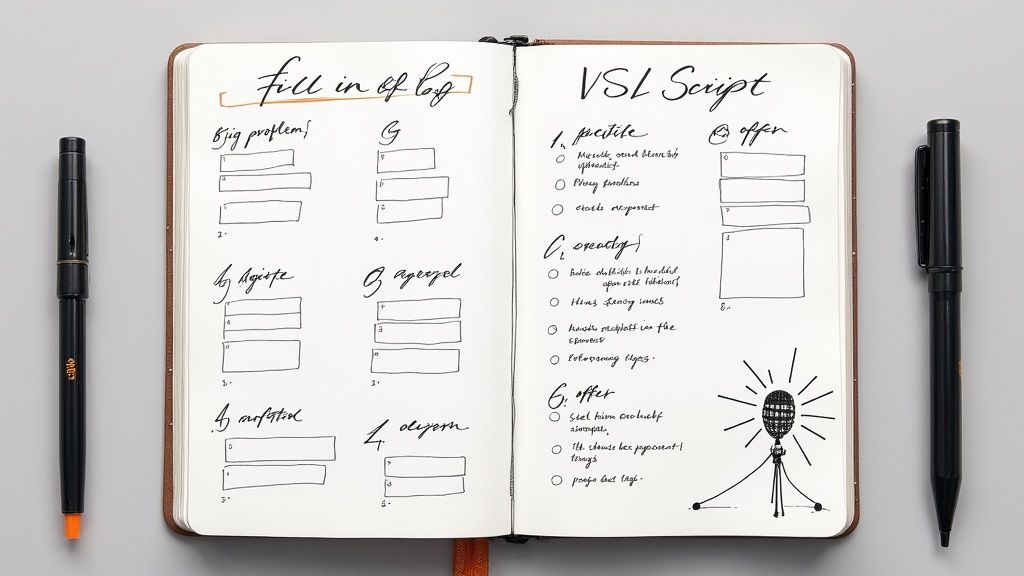
Think of these formulas as your framework. All you have to do is fill in the blanks with your story, your product, and your unique personality. By using a proven structure, you're tapping into decades of direct-response marketing wisdom. You’re not just selling something—you’re telling a story in a way that’s neurologically wired to persuade.
The Problem-Agitate-Solve (PAS) Formula
The Problem-Agitate-Solve (PAS) formula is a direct-response classic for one simple reason: it’s brutally effective. It taps into a core human driver—our deep-seated desire to move away from pain and run toward relief. It’s a simple, three-act play that gets straight to the point.
Here’s how you break it down for your VSL script:
Problem: You have to start by clearly identifying the one big thing that keeps your audience up at night. Use their language. Show them you’ve walked a mile in their shoes and understand their struggle on a personal level. For example: "Are you sick of spending every weekend chained to your laptop, trying to pump out content when you should be enjoying your life?"
Agitate: Don’t just state the problem—twist the knife a little. Pour some salt in the wound. Describe the mounting frustration, the wasted hours, and the emotional toll it’s taking. You want to make that pain feel real, tangible, and urgent. For example: "Think about all the missed family dinners and the constant, nagging feeling that you’re falling further behind because content creation is eating you alive."
Solve: Once the pain is undeniable, you ride in on your white horse. Introduce your product as the clear, obvious, and immediate solution they’ve been searching for. Show exactly how it erases the pain you just agitated and delivers the freedom they crave. For example: "Now, what if you could launch a new digital product every single week in just a few hours? That's precisely what our template library is designed to do for you."
The Hero’s Journey Formula
If you want to create a deeper, more emotional connection, the Hero's Journey is your go-to formula. This is classic storytelling 101. It brilliantly positions your customer as the hero of their own story, with your product acting as the wise mentor or magical sword that helps them slay their dragon.
This approach is perfect for personal brands, coaching programs, or any offer where a personal transformation is the real product. It builds a bond that facts and figures never could.
The Hero's Journey works because we are all hardwired for stories. When you frame your sales message as a compelling narrative, you bypass your viewer’s logical defenses and connect with them on a gut level. Your offer stops feeling like a pitch and starts feeling like their destiny.
Here’s a simplified structure for your VSL:
The Ordinary World: Describe the hero's (your customer's) current, frustrating reality.
The Call to Adventure: Introduce their desire for something more, or the big, scary problem they must finally face.
Meeting the Mentor: This is you. You (or your product) show up as the guide with the plan.
Crossing the Threshold: Show them taking that first brave step using your solution.
The Ultimate Transformation: Paint a vivid, irresistible picture of what their life looks like after they’ve won.
If you’re looking for a structured way to build out this powerful narrative, you can get started with the Hero-Promise Formula Builder, which provides a complete framework for this exact scripting process.
A Swipe File of VSL Building Blocks
No matter which formula you lean on, your script is ultimately built from smaller components. Keeping a "swipe file" of proven hooks, benefit statements, and calls to action on hand will cut your writing time in half.
Compelling Hooks to Steal:
"What if everything you've been told about [Topic] is flat-out wrong?"
"This is a little embarrassing to admit, but I used to be terrible at [Problem]..."
"In the next 3 minutes, I'm going to show you exactly how to [Achieve Desired Outcome] without having to [Do The Annoying Thing]."
Benefit-Driven Bullet Points:
Never list features. Always translate them into tangible benefits.
Instead of: "Our course includes 10 video modules."
Try: "You get our complete, step-by-step video system, so you can stop guessing and finally see real results in just 30 days."
Urgency-Driven Calls to Action:
"Click the button below right now to lock in your special launch discount before the price jumps up tomorrow."
"This offer is strictly limited to the first 100 people who join, so claim your spot before they're all gone."
"Get instant access and start transforming your business today."
Your VSL Production Workflow from Start to Finish
Turning a killer script into a video that actually sells doesn't mean you need a Hollywood budget or a film crew on standby. With a smart, step-by-step workflow, you can create a high-impact VSL that looks polished and gets people to click "buy." Let's break down the technical side into simple, manageable stages.
The journey from script to screen really begins with a plan. Just hitting "record" without mapping out your vision is a surefire way to waste time and end up with a choppy, confusing video. A clear system makes sure every piece—from your voice to the visuals—works together to tell one cohesive story.
Step 1: Storyboard Your Vision
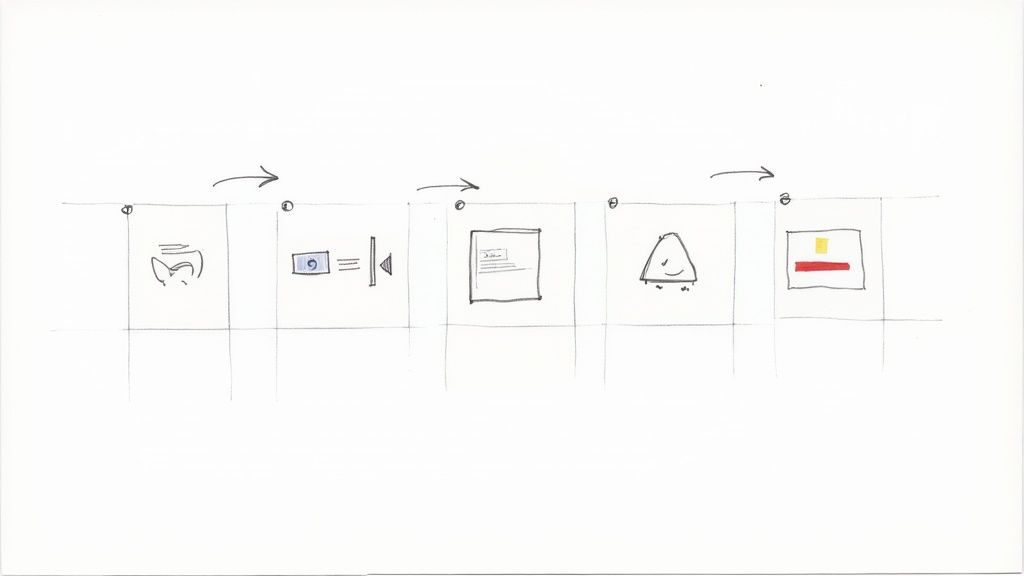
Before you even think about your microphone, you need a storyboard. Think of it as the comic book version of your VSL. It’s a simple visual outline that matches key phrases from your script with a quick sketch or note about what should be on screen at that moment.
This doesn't have to be a work of art—stick figures and scribbled notes are perfect. The goal is to map out the visual flow of your video, making sure what people see reinforces what they hear. A storyboard helps you figure out what assets you need, plan your shots, and keep a consistent pace from start to finish.
Step 2: Choose Your VSL Format
With your storyboard done, it’s time to decide on the look and feel of your video. The format you pick should match your brand, your message, and your budget. There’s no single "best" option here, only what's right for your specific project.
Here are the most common formats people use:
Kinetic Text (or "Doodle" VSL): This style brings your script to life with animated text and simple graphics. It’s incredibly engaging and forces viewers to focus on your message—which makes sense when you learn that 96% of people have watched an explainer video to learn more about a product.
Talking Head: This is just you, speaking directly to the camera. It’s fantastic for building a personal connection and establishing yourself as an authority, making it a favorite for coaches, consultants, and experts.
Screen Recording: If you're selling software or a digital tool, this is your go-to. It shows your product in action, providing undeniable proof of how your solution works. For anything technical, seeing is believing.
Slide Presentation: This is a classic for a reason. It's a simple but powerful format where you record your voiceover on top of a well-designed slide deck (think PowerPoint or Google Slides).
The key is to pick a format you can execute well. A clean, simple slide presentation with crisp audio will always outperform a poorly lit, amateur-looking talking head video. Focus on quality within your means.
Step 3: Record Crystal-Clear Audio
Your audio quality is completely non-negotiable. Viewers will forgive grainy visuals, but they will absolutely not tolerate bad audio. If your sound is muffled, echoey, or crackling, your message gets lost and you instantly look unprofessional.
You don't need a pro recording studio. Investing in a decent USB microphone is one of the smartest and most affordable upgrades you can make. Find a quiet room with soft surfaces (like carpets, curtains, or even a closet full of clothes) to absorb echo. Speak clearly, at a steady pace, and create a voiceover that sounds both confident and easy to follow.
Step 4: Source Visuals and Edit Everything Together
This is where your VSL finally comes to life. Using your storyboard as a roadmap, you’ll gather all your visual assets—stock footage, images, screen recordings—and sync them up with your audio track in a video editor. For a complete rundown of software options, check out our guide on the best video tools for selling digital products.
The editing process breaks down into a few simple steps:
Lay the Foundation: Start by dropping your main audio track (the voiceover) onto the timeline. This is the backbone of your video.
Add Visuals: Now, sync up your video clips, images, and on-screen text with the corresponding parts of your voiceover.
Enhance with Music: Add a subtle background music track to build mood and energy. Just make sure it’s quiet enough that it doesn’t compete with your voice.
Polish and Export: Add some smooth transitions between scenes, double-check your audio levels one last time, and export the final video file.
This workflow turns the intimidating task of video production into a straightforward assembly line, giving anyone the power to create a compelling video sales letter from scratch.
Placing Your VSL in a High-Performance Sales Funnel
Nailing your video sales letter is a huge win, but it’s only half the battle. Think of your VSL as a high-performance engine. It’s got all the power, but it needs a well-built car around it to actually go anywhere.
That car is your sales funnel.
Your VSL is where the real persuasion happens, but it almost never works in isolation. It’s the main event, supported by everything from the initial ad that gets the click to the final order form. When every piece works together, you create a smooth journey that warms up your audience and makes your video’s message hit that much harder.
Common VSL Funnel Structures
Most successful funnels follow a proven path, even with small variations. The goal is always to guide a potential customer from mild curiosity to a confident purchase without any awkward bumps in the road. Knowing how to create a sales funnel is a non-negotiable skill for making this happen.
Two of the most popular and effective models are the dedicated landing page and the webinar-style funnel.
The Dedicated VSL Landing Page: This is the most direct route. You run an ad on social media or search, and it drives traffic straight to a clean, simple page where your VSL is the undeniable star. There are zero distractions—just a compelling headline, your video, and a big, clear call-to-action button right below it. This setup is perfect for lower-priced offers and things people are more likely to buy on impulse.
The Webinar-Style Funnel: Got a higher-ticket product or service? Your VSL can pull double duty as an automated, on-demand webinar. A prospect signs up for a "free training session," which is actually your VSL. This builds more authority and gives you the space for a longer, more detailed pitch, positioning the sale as the logical next step after all the value they just received.
The whole point of the funnel is to build a "persuasion pipeline." Each step—the ad, the landing page, the VSL, and the checkout—should feel like a seamless progression, making the decision to buy feel both easy and inevitable.
The table below breaks down where a VSL fits best within different funnel stages and what you can expect from each placement.
VSL Funnel Placement and Expected Outcomes
Funnel Stage | VSL Placement | Primary Conversion Goal |
|---|---|---|
Top of Funnel (ToFu) | On a dedicated landing page, driven by paid ads | Capture leads, sell a low-ticket "tripwire" offer, or drive impulse buys. |
Middle of Funnel (MoFu) | As an automated "on-demand" webinar after an opt-in | Nurture leads, build authority, and sell a mid-tier product or service. |
Bottom of Funnel (BoFu) | On a product page or as a follow-up to an abandoned cart | Overcome final objections, demonstrate value, and close the sale on a core offer. |
Each placement serves a specific purpose, so aligning your VSL's message with its position in the funnel is key to getting the results you want.
Building the Supporting Elements
Your VSL can't carry the entire load on its own. The assets surrounding it—the ads, headlines, and order forms—need to be perfectly aligned with your video's tone and message. This is how you create a smooth, trustworthy journey that keeps conversions high.
Here are the key components you need to get right:
The Ad: Your ad copy and creative exist to "pre-frame" the VSL. It needs to hook the viewer by introducing the core problem or teasing the big promise that your video will deliver on. This ensures the people clicking are genuinely interested.
The Landing Page Headline: Think of your headline as the bridge between the ad and the video. It must instantly confirm the visitor is in the right place by echoing the promise from the ad.
The Order Form: Even your checkout page is a selling tool. Keep it simple and secure, but also use it to reaffirm the value of their purchase. A few benefit-driven bullet points or a small testimonial can make a huge difference here.
When you strategically position your video sales letter inside a thoughtfully designed funnel, you’re not just making a video—you’re building a powerful, automated system that brings in leads and sales day in and day out.
How to Squeeze More Conversions Out of Your VSL
Here’s a hard truth: launching your video sales letter isn't the finish line. It’s the starting line. A VSL that actually prints money is a living, breathing asset that you constantly tune up based on real-world data. This is how you turn a simple video pitch into a sales machine that gets smarter over time.
Your first move is to track the right numbers. Don't just stare at the final sales figures; you need to see exactly how people are behaving while they watch. Key metrics paint a clear picture of what’s hitting the mark and what’s falling flat.
View-Through Rate (VTR): This is simple: what percentage of people actually finish your video? A low VTR is a massive red flag. It means your message is losing steam somewhere, and you need to find out where.
Click-Through Rate (CTR): Of the people who watch, how many click your call-to-action? This metric tells you point-blank how compelling your offer and CTA truly are.
Video Heatmaps: These are your secret weapon. Heatmaps give you a visual map of viewer engagement, showing precisely where people get bored and drop off. If 70% of your audience bails at the 45-second mark, you’ve just pinpointed a critical weakness in your script.
Using A/B Testing to Let Your Audience Pick the Winner
Once you’ve got your baseline data, it's time to start experimenting. A/B testing, also known as split testing, is where the real magic happens. You create two versions of your VSL with one tiny difference and see which one performs better. This completely removes guesswork from the equation and lets your audience’s actions guide your strategy.
For the clearest results, stick to testing one high-impact element at a time:
The Hook: Pit two different opening lines against each other. Does starting with a provocative question work better than a bold, shocking statement?
The Offer: Try framing your offer in a new way. Maybe you test a different set of bonuses or a slightly adjusted price point.
The Call to Action: Test button copy like "Get Instant Access" against something more benefit-driven, like "Start My Transformation."
This methodical approach is non-negotiable. We already know how powerful video is—market research shows a staggering 88% of people were convinced to buy a product after watching a brand's video. This proves that even tiny tweaks can lead to huge wins.
Optimization isn't about hitting a home run on your first try. It's about creating a feedback loop: you test, you learn from the data, and you iterate. Every small improvement you make compounds, steadily pushing your conversion rates higher and higher.
And don’t forget the bigger picture. Beyond your VSL itself, adopting broader Conversion Rate Optimization best practices will lift the performance of your entire funnel. By constantly analyzing data and refining your approach, you turn your video sales letter into a reliable, high-performance engine for your business.
Frequently Asked Questions About VSLs
Even after laying out the whole process, a few questions always pop up when you're gearing up to create your first VSL. Let's tackle the most common ones head-on so you can move forward with total clarity.
How Long Should a VSL Be
There’s no magic number, but here’s the golden rule I live by: as long as it needs to be, and not a second longer. For most products, especially if you're targeting new customers (cold traffic), the sweet spot is usually between 3 to 15 minutes. That’s enough time to make your case without your viewer’s attention wandering off.
Now, if you’re selling a high-ticket course or a complex service, you’ll probably need more runway. A VSL of 20 minutes or more might be necessary to fully unpack the value and handle every objection. The only way to know for sure is to test what resonates with your specific audience.
Can I Create a VSL on a Small Budget
Absolutely. You don’t need a Hollywood production to make a video that converts. In fact, some of the most profitable VSLs I've ever seen were just simple slide decks with a compelling voiceover or slick text animations.
The two things you can't skimp on are a quality microphone for crisp, clear audio and a rock-solid script. A professional message and clean sound will always beat flashy visuals paired with a weak, poorly delivered pitch.
How Do I Know if My VSL Is Working
You let the data do the talking. Forget guesswork—focus on these critical numbers:
View-Through Rate (VTR): What percentage of people actually finish the video? This tells you if your story and script are keeping them hooked.
Click-Through Rate (CTR): Of those who watch, how many click your call-to-action button? This is a direct measure of how powerful your offer is.
Conversion Rate: The big one. What percentage of viewers end up buying? This is the ultimate proof that your VSL is doing its job.
As you fine-tune your VSL, it also helps to look at the bigger picture. Applying proven strategies to increase overall website conversion rates will ensure every part of your funnel is working together smoothly.