Guide
Your Winning Sponsorship Packet Template and Guide

Think of a sponsorship packet template as more than just a document—it's your frontline sales pitch, the thing that does the heavy lifting to secure funding. A polished, strategic packet tells your story, proves your value, and makes it incredibly simple for a potential sponsor to see the ROI and say 'yes.'
Why Your Sponsorship Packet Is Your Most Important Sales Tool
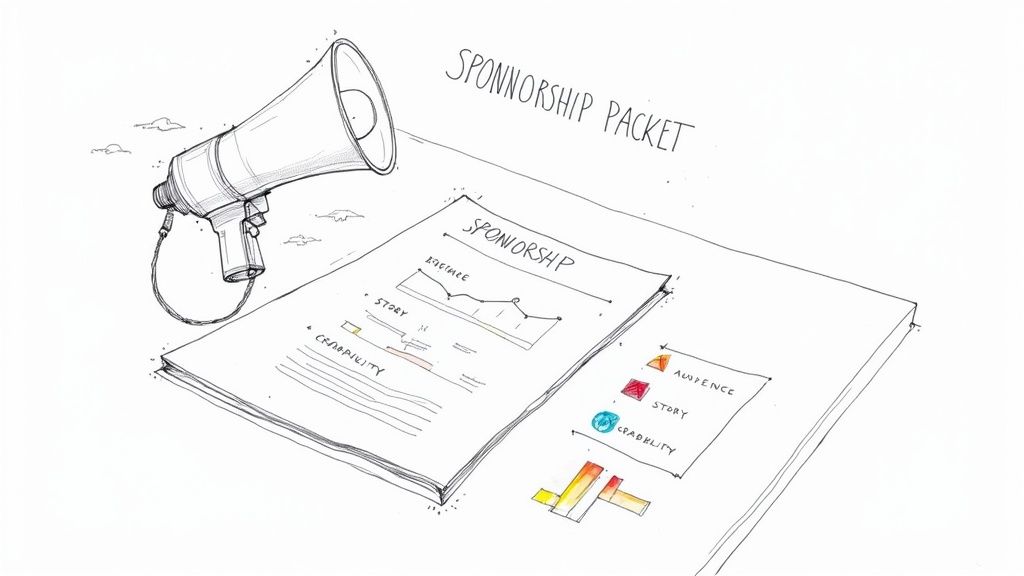
Let's get one thing straight: a sponsorship packet is so much more than a simple proposal. It's a comprehensive sales tool that acts as your organization's ambassador, working to lock in crucial funding long before you ever step into a meeting room.
In a world where brands are desperately seeking authentic ways to connect with audiences, your packet is the bridge that connects their goals with your mission.
Think of it as the ultimate first impression. A well-crafted sponsorship packet template gives you control of the narrative. It preemptively answers a potential sponsor's biggest questions: "Who are you?", "Who is your audience?", and most importantly, "What's in it for me?"
The Strategic Value of a Polished Packet
Without a professional packet, your outreach can feel disjointed and amateurish. You risk leaving potential partners confused about the value you're actually offering. A structured, well-designed document, on the other hand, immediately shows that you're organized, professional, and serious about building a mutually beneficial partnership.
This document is a workhorse, doing several critical jobs at once:
It tells your story: It communicates your mission, vision, and the impact you make in a way that’s both compelling and concise.
It validates your reach: It uses hard data and audience demographics to prove you can connect sponsors with their ideal target market.
It simplifies the decision: It clearly lays out sponsorship tiers, benefits, and costs, making it easy for a busy decision-maker to see where they fit.
The global sponsorship market has seen explosive growth, making these packets essential for getting a piece of a massive pie. In 2022, worldwide sponsorship spending hit a staggering $97.4 billion, with projections showing it could soar to $189.5 billion by 2030. Your packet is your ticket to accessing that funding.
A great sponsorship packet doesn’t just ask for money; it presents an undeniable business opportunity. It shifts the conversation from a donation request to a strategic marketing investment for the sponsor.
More Than a Document—It’s a Relationship Starter
Ultimately, your packet is the foundation of your entire sponsorship strategy. A generic, one-size-fits-all approach is doomed to fail because it doesn't speak to the unique goals of each brand you approach. A powerful sponsorship packet template, however, is a flexible blueprint you can quickly customize to resonate with different industries and companies.
Understanding the broader strategy is key to making your packet work. Taking the time to learn how to get event sponsors provides the context you need to frame your offers in the most persuasive way possible. It’s what turns your document from a simple request into a signed partnership agreement.
Anatomy of a High-Converting Sponsorship Packet
Let’s be honest: most sponsorship packets are boring. They’re generic, filled with vague promises, and end up in the trash folder faster than you can say "partnership opportunity."
A packet that actually gets a "yes" isn't just a collection of pages; it's a strategic narrative. Each section has to build on the last, guiding a potential sponsor from mild curiosity to genuine commitment. It needs to tell your story in a way that makes them feel like an essential partner, not just a walking checkbook.
The Compelling Cover Letter
This is your first impression. Don't blow it.
A generic, "To Whom It May Concern" opening is a guaranteed trip to the bin. Your cover letter needs to be personal, punchy, and immediately connect your mission to the sponsor's brand. Forget starting with your needs; start with what you know about them.
For example, if you're approaching a local bank known for its community involvement, try this: "Your commitment to supporting local youth initiatives is precisely why we believe a partnership with our annual Tech Fair for Teens would be a perfect fit."
See what that does? It instantly shows:
You’ve done your homework.
You see this as a strategic alignment, not a handout.
You’re positioning them as the hero from the very first sentence.
Keep this section to a single page. Briefly introduce your organization, explain why you're reaching out, and point them to the key sections inside.
The "About Us" and Audience Deep Dive
Once you have their attention, it’s time to build credibility. The "About Us" section isn’t just a history lesson—it's where you prove you're a trustworthy and impactful organization. Use this space to highlight your mission, major achievements, and the passionate team making it all happen.
For a nonprofit, this is where you show your impact with hard numbers. Don’t just say you help the community; quantify it. "Last year, we provided 5,000 hot meals and secured temporary housing for 250 families."
For an event, like an esports tournament, the focus shifts to reach: "Our last tournament attracted 1.2 million unique viewers with an average watch time of 45 minutes."
Right after that, you need to deliver a detailed breakdown of your audience demographics. Sponsors aren't just buying exposure; they're buying access to a specific group of people. Get as granular as you can:
Age, gender, and location percentages
Average income or purchasing power
Key interests and behaviors
Social media engagement rates
This data is the absolute cornerstone of your value proposition. It’s what allows a sponsor to start calculating their potential return on investment.
Presenting Your Sponsorship Tiers and Benefits
This is the heart of your proposal—the "what's in it for me?" section. Please, avoid vague benefits like "brand exposure." Instead, list tangible, measurable outcomes for each sponsorship level. Think in terms of assets and activations.
To make sure you cover all the bases, here’s a quick rundown of the essential components every high-impact packet needs.
Essential Components of a High-Impact Sponsorship Packet
This table breaks down the critical sections, their purpose, and a pro tip to make each one shine.
Section Name | Purpose | Pro Tip |
|---|---|---|
Cover Letter | To make a personalized first impression and hook the reader. | Mention the sponsor's recent work or values to show you've done your homework. |
About Us/Mission | To build credibility and explain your "why." | Use storytelling and impact metrics to create an emotional connection. |
Audience Data | To prove you can connect the sponsor with their target market. | Include psychographics (interests, values) in addition to basic demographics. |
Sponsorship Tiers | To present clear, value-packed options at different price points. | Give tiers creative names that align with your brand, not just Gold/Silver/Bronze. |
Call to Action | To make it incredibly easy for the sponsor to take the next step. | Provide multiple contact options and suggest a specific action, like a 15-min call. |
Getting these sections right is non-negotiable. Nonprofit sponsorship packets have become essential funding tools, with templates offering a blueprint for over 1.5 million U.S. organizations aiming to secure partnerships.
With global sponsorship spending projected to rocket from $97.4 billion in 2022 to $189.5 billion by 2030, a well-structured packet is your ticket to the game. Successful packets showcase their mission and key stats, like "25 years serving 50,000 clients yearly with 30% outcome improvements," to perfectly align with sponsor goals. You can find more great insights on nonprofit sponsorship strategy over at Qgiv.com.
Leveraging Social Proof and Your Call to Action
Sprinkling in testimonials or logos of past sponsors is a seriously powerful way to build confidence. This social proof acts as a third-party endorsement, signaling to new prospects that partnering with you is a smart move. If you want to go deeper on this, check out our guide on how to boost your conversions with social proof.
Finally, your packet must end with a clear, unambiguous call to action (CTA). Don't leave the sponsor guessing. Tell them exactly what you want them to do next.
Pro Tip: Your CTA shouldn't be a passive "we look forward to hearing from you." Be active and make it easy: "To secure the Platinum Naming Rights, please contact Jane Doe at [email] or book a 15-minute introductory call directly on her calendar here: [link]."
This confident, direct approach removes friction and makes it simple for an interested sponsor to say yes. By meticulously crafting each of these sections, your sponsorship packet transforms from a simple document into a powerful closing tool.
Designing Sponsorship Tiers That Actually Sell
Let's be honest: the days of just slapping "Gold, Silver, Bronze" on a page and hoping for the best are long gone. Sponsors are savvier than ever, their budgets are under a microscope, and they need to see a clear, undeniable return on their investment. Your sponsorship tiers are the heart of your proposal—they need to read less like a donation request and more like a compelling business opportunity.
This is where you stop talking about yourself and start translating your audience, reach, and influence into tangible value for a partner. Each tier should tell a story of escalating impact, making it incredibly easy for a marketing manager to find the perfect fit for their budget and goals. It’s all about making them feel like a strategic partner, not just another logo on a banner.
A truly effective sponsorship packet is built on a foundation of well-structured tiers that make perfect business sense. This visual breaks down the core sections that build up to your sponsorship levels, setting the stage for the final ask.
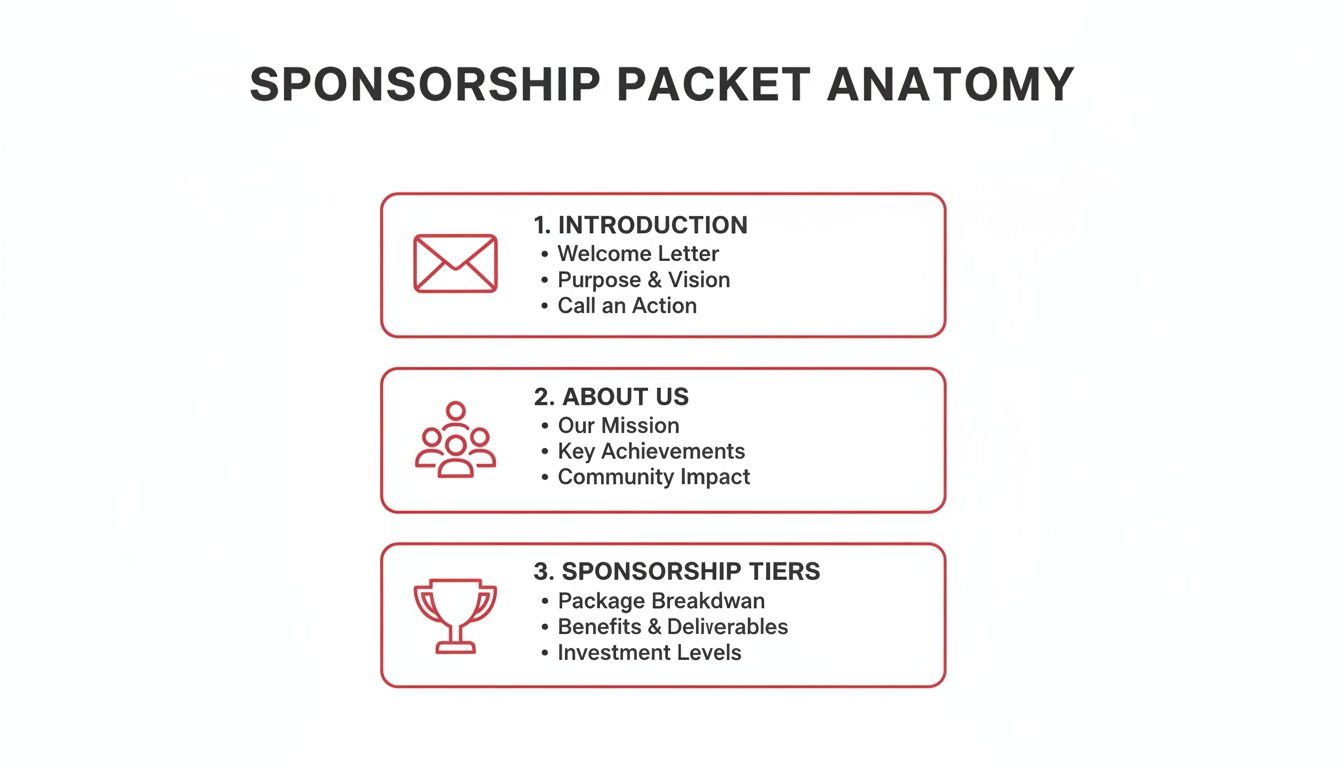
As you can see, by the time a potential sponsor gets to your packages, they should already be sold on who you are and what you represent. This makes their decision much, much easier.
Moving Beyond Generic Tier Names
While the classic naming conventions are familiar, they often lack personality and punch. Infusing your tier names with your brand’s mission can forge a much stronger emotional connection and make your entire packet more memorable.
Here are a few ideas to get you started:
For a community arts festival: Instead of Gold, try "Patron of the Arts," "Visionary Partner," or "Spotlight Sponsor."
For a tech conference: Think about names like "Innovator Tier," "Launchpad Partner," or "Headline Exhibitor."
For a nonprofit gala: Use mission-driven names like "Hope Builder," "Community Champion," or "Legacy Circle."
These names do more than just label a price point. They assign a role and a sense of purpose to the sponsor’s contribution, which is a powerful psychological hook.
Structuring Benefits for Tangible ROI
The benefits list is where the real selling happens. Ditch vague promises like "brand exposure." Instead, list specific, quantifiable assets that a marketing manager can actually understand and justify to their boss. The key is creating a clear and logical escalation of value from one tier to the next.
A common mistake I see is cramming lower tiers with too many low-value benefits. Focus on quality, not quantity. One high-impact benefit, like a dedicated email blast to your list, is worth more than ten small logo placements they can barely see.
Put yourself in the sponsor's shoes. They're looking for leads, positive brand association, and direct engagement with your audience. Structure your benefits to deliver exactly that.
Low Tier (e.g., $1,000 - $2,500): This is all about brand awareness. Think logo placement on the event website, a shout-out on social media, and inclusion in a general "thank you" email to attendees.
Mid Tier (e.g., $5,000 - $10,000): Now we're adding engagement opportunities. This could include a booth at the event, a block of tickets for their team, and a featured spot in the event program or app.
Top Tier (e.g., $15,000+): Time for exclusive integration. This is where you bring out the big guns: naming rights for a stage or lounge, a keynote speaking opportunity, or co-branding on a major event feature like the Wi-Fi network.
Sample Sponsorship Tier Comparison
To give you a clearer picture, here’s a sample framework showing how the benefits can scale across different investment levels. This structure makes it easy for a sponsor to see exactly what they get for their money and why a higher tier might be a better investment.
Benefit | Bronze Tier ($1,000) | Silver Tier ($5,000) | Platinum Tier ($15,000) |
|---|---|---|---|
Website Logo Placement | Small logo on sponsor page | Medium logo on sponsor page | Large logo on homepage & sponsor page |
Social Media Mentions | 1 "Thank You" post (group) | 1 dedicated "Thank You" post | 3 dedicated posts + story feature |
Event Tickets | 2 General Admission tickets | 4 General Admission tickets | 6 VIP tickets |
On-Site Branding | Logo on shared sponsor banner | Logo on individual banner | Stage/Lounge Naming Rights |
Exhibitor Booth | Not included | 10x10 standard booth | 10x20 premium location booth |
Email Marketing | Logo in 1 pre-event email | Mention in 2 pre-event emails | Dedicated email blast to attendees |
Speaking Opportunity | Not included | Not included | 15-minute keynote/session |
This kind of side-by-side comparison empowers the sponsor to make an informed decision, justifying their spend by clearly seeing the added value at each level.
Pricing Your Tiers with Confidence
Pricing can feel like pure guesswork, but it should be a data-informed process. If you underprice, you devalue your brand. If you overprice, you scare away great partners.
Start by making a list of every single marketable asset you have—from an email mention to physical signage space—and assign a realistic value to each one. Base these values on market rates, your audience size, and past engagement levels.
The psychology behind your pricing structure is also a massive factor. For a deeper dive into setting prices that actually convert, I highly recommend checking out our guide on price psychology optimization. Understanding concepts like price anchoring and perceived value will help you frame your tiers in a way that makes the higher-level packages seem more attractive and perfectly justifiable.
Ultimately, designing effective sponsorship tiers comes down to empathy. You have to understand what a sponsor truly values and then build packages that deliver that value in a clear, compelling, and irresistible way.
How to Customize Your Packet for Any Industry
I’ve seen it happen a thousand times: a creator sends the exact same sponsorship packet to a fintech startup and a local community bank, then wonders why they get ghosted by both. A generic proposal is a dead proposal.
Think of your template as your foundation, not the finished building. The real magic happens when you tailor it to speak the specific language of the industry you're pitching. A potential sponsor needs to see their own goals and metrics staring back at them from your offer—it should feel like a no-brainer "yes."
This means you’ve got to do a little homework before you hit send. What does a “win” look like for that company? Are they chasing brand awareness, desperate for qualified leads, or focused on building goodwill in the community? Your packet needs to answer their needs, not just list your assets.
Tailoring Your Pitch to Tech Companies
Tech companies are obsessed with data. They live and die by metrics like customer acquisition cost (CAC), lead generation, and conversion rates. If your proposal is full of fluffy promises about "brand exposure," it's going straight to the trash folder. They want to see a clear line connecting their investment to measurable results.
When you’re customizing your packet for a tech sponsor, frame everything in terms of quantifiable outcomes:
Lead Generation: Don't just offer a booth; call it a "Lead Generation Station." Go further by promising access to attendee lists (with their consent, of course) or offering to host a sponsored workshop where they can collect direct sign-ups.
B2B Networking: Highlight exclusive opportunities for their sales team to connect with high-value prospects. Think sponsored VIP lounges, curated networking dinners, or one-on-one meeting setups.
Digital Metrics: If your event is virtual or hybrid, you're sitting on a goldmine. Showcase metrics like session viewership, click-through rates on sponsored links, and engagement stats from a dedicated sponsor channel. For an esports tournament, this is everything. Data like 1.5 million unique viewers and 85% audience engagement is infinitely more compelling than a logo on a t-shirt.
Adapting Your Packet for Sports Sponsorships
The sports world plays a different game. Sponsorship here is all about massive audience reach and tapping into passionate fan loyalty. It’s a huge market, with global spending hitting a staggering $97.35 billion in 2022.
With average team deals in major cities climbing to $935,000 annually, your packet has to justify that kind of investment. You need to focus on the things that matter to brand managers in this space:
Media Impressions: Lay out the hard numbers. What's the expected TV viewership? How many radio mentions will they get? What does your online media coverage look like?
Fan Demographics: Go deep. Give them a detailed breakdown of your fanbase—age, location, income levels, and even brand affinities. This helps them see if your audience is their audience.
On-Site Activation: Get creative with how they can engage fans directly. Offer them the chance to sponsor a halftime show, a fan photo booth, a text-to-win contest, or a branded tailgate zone. Make it interactive and memorable.
Winning Over Nonprofit and Community Partners
When you approach a nonprofit or a community-focused business, the conversation shifts entirely from ROI to impact. These organizations are driven by their mission. They want to align with partners who reflect their values and boost their reputation as a positive force in the community.
Your proposal for a nonprofit sponsor should focus less on leads and more on legacy. It's about shared values, community impact, and telling a powerful story together.
Your customization strategy here needs to pivot toward storytelling and creating an emotional connection.
Community Impact: Don't be vague. Quantify the good you're doing. "Your sponsorship will provide 500 local children with school supplies" hits a lot harder than "your logo will be seen by 1,000 attendees."
Brand Alignment: Connect the dots for them. Explicitly state how their brand values mirror your mission. This shows you've done your research and genuinely believe in what they stand for.
Employee Engagement: This is a huge, often overlooked, benefit. Offer volunteer opportunities for their staff, giving their team a tangible way to get involved and feel connected to the cause.
To make your nonprofit pitch even stronger, show them you understand their world. Getting familiar with proven nonprofit fundraiser event ideas helps you structure offers that fit their goals perfectly. It proves you're not just asking for a check; you're offering a genuine partnership in making a difference.
Turning Your Packet Into a Signed Partnership
Let's be real—crafting a brilliant sponsorship packet is only half the battle. A flawless proposal is useless if it just sits unseen in an inbox or on the wrong person's desk.
The critical next step is strategic outreach. This is the art of getting your packet into the right hands and turning that first contact into a signed partnership. It's about way more than just blasting out a mass email. It requires smart research, genuine personalization, and a follow-up game that’s persistent without being annoying.
Ultimately, success hinges on making a real connection and showing you understand the sponsor's business goals just as well as your own.
Identifying and Researching Potential Sponsors
Before you even think about hitting "send," you need to build a highly targeted list of potential partners. The "spray and pray" method is a massive waste of time. Instead, you want to find companies whose brand values, target audience, and recent marketing campaigns already align with your work.
Start by looking at your own audience. Who are they? What brands do they already love and trust? Those companies are your low-hanging fruit. From there, you can use tools like LinkedIn Sales Navigator and other industry directories to spot businesses that are already active in event sponsorships.
Once you have a prospect, it's time to do some digging:
Check their website: Pay close attention to their "About Us" and "Corporate Social Responsibility" pages.
Scan their social media: What campaigns are they running? What's their tone of voice?
Look at the news: Have they recently launched a new product or announced a big initiative?
This research isn't just for you. It’s the fuel for your personalized pitch. Mentioning a specific campaign or a shared value in your opening line instantly shows you’ve done your homework and aren’t just sending another generic request.
Crafting the Perfect Outreach Email
Your first email is your digital handshake. The goal isn't to close the deal right away; it's to spark enough interest to get a reply and start a conversation.
The subject line is your first big hurdle. Ditch generic titles like "Sponsorship Opportunity" and go for something more compelling and personal.
Subject Line Example: Partnership Idea: [Sponsor's Company Name] x [Your Event/Org Name]
Keep the body of the email brief and focused on value. Introduce yourself, mention the connection you found during your research, and attach your beautifully designed sponsorship packet.
The most important part? A crystal-clear call to action. Don't leave them guessing. Propose a specific next step, like a quick 15-minute call to discuss how a partnership could directly support their current marketing goals.
The Art of the Follow-Up
Don't panic if you hear crickets after your first email. That’s completely normal. Decision-makers are busy, and their inboxes are a battlefield. A polite and professional follow-up strategy is non-negotiable. I find a good cadence is to wait 3-5 business days before sending your first follow-up.
This is not the time to be pushy. Instead, try to offer more value. You could share a link to a recent press mention of your organization or a short video from a past event. The goal is to stay top-of-mind and show you have ongoing momentum. If you still haven’t heard back after two or three follow-ups over a couple of weeks, it’s usually best to move on.
Turning a well-crafted packet into actual revenue requires a confident and structured approach to the entire sales cycle. For those looking to master this final, crucial step, our guide on how to close deals with confidence offers scripts, frameworks, and strategies to turn conversations into contracts. This is where all your hard work on the perfect sponsorship packet template truly pays off.
Answering Your Top Sponsorship Packet Questions
Once you have a draft of your sponsorship packet ready, the practical questions start popping up. It's one thing to have all the sections in place, but it's another to feel 100% confident that it’s polished, professional, and ready to send out.
Let’s tackle the most common questions that come up during this final stage. Think of this as the last-minute check-in before you start your outreach. Getting these details right can make a huge difference.
How Long Should My Sponsorship Packet Be?
This is the classic question, and the answer is simpler than you think: as long as it needs to be, but as short as possible. A potential sponsor is busy. Your packet has to respect their time while giving them everything they need to make a decision.
The sweet spot is usually between 8 to 12 pages. This gives you enough room to cover the essentials without overwhelming them with information.
Here’s how that might break down:
Cover Page: 1 page
Cover Letter: 1 page
About Us & Mission: 1 page
Audience Demographics: 1-2 pages
Sponsorship Tiers & Benefits: 2-3 pages
Past Sponsors/Testimonials: 1 page
Call to Action & Contact Info: 1 page
The goal is clarity, not density. A well-designed 10-page packet with compelling visuals and clear data is far more effective than a 20-page document filled with dense text. If you can say it in fewer words, do.
What File Format Is Best for Sending?
Always, always send your packet as a PDF. This is non-negotiable.
A PDF preserves all your formatting, fonts, and design elements, no matter what device the sponsor uses to open it. It guarantees they see the packet exactly as you intended. It just looks more professional and prevents anyone from accidentally editing your work.
Never send an editable file like a Word document or a PowerPoint unless someone specifically asks for it. It can signal that the document is just a draft and looks unprofessional. Also, keep the file size manageable—ideally under 10MB—to avoid getting blocked by email servers or firewalls.
What If a Sponsor Asks for a Custom Package?
First off, celebrate! A request for a custom package is a huge win. It means the sponsor is genuinely interested but doesn't see a perfect fit in your existing tiers. This is your chance to collaborate and build a partnership that hits their specific marketing goals.
When this happens, your first move should be to get them on a call. Don't try to build a custom package over email. You need a real conversation to understand what they’re trying to achieve:
Are they laser-focused on lead generation?
Is brand awareness their main priority?
Do they want direct engagement with your audience?
Once you know their primary goals, you can pull different benefits from your existing tiers and create a unique "à la carte" package just for them. This flexibility is often the key to closing high-value deals that might have otherwise slipped away.
Should I Put Prices Directly in the Packet?
Yes, absolutely. Be transparent with your pricing. Hiding it creates an unnecessary barrier and can make a potential sponsor hesitant to even start a conversation. They might assume that if you're not listing prices, they probably can't afford you.
Including clear pricing for each tier lets the decision-maker immediately see if your opportunities align with their budget. It qualifies them for you. If a sponsor sees your prices and still wants to talk, you know they're a serious prospect. Be confident in the value you’re offering and price it accordingly.