Guide
8 Smart Product Bundle Pricing Examples to Boost Your Sales in 2026

Imagine increasing your average order value by 30% without finding a single new customer. That's the power of smart product bundling. It’s not just about slapping a discount on a few items; it's a sophisticated pricing strategy that leverages psychology to guide customer choices, enhance perceived value, and ultimately, drive more revenue from the same traffic.
While the concept seems simple, the execution is where most entrepreneurs stumble. Getting it wrong can devalue your brand and cannibalize sales of your core products. But getting it right? That’s how you create irresistible offers that customers are eager to buy, boosting both your sales and customer satisfaction. For a deeper dive into optimizing sales, explore various strategies to increase average order value, including bundling, which can significantly boost your revenue.
This guide moves beyond theory to provide a deep dive into proven product bundle pricing examples, breaking down the exact strategy behind each one. We’ll analyze real-world applications, from digital product platforms to SaaS giants, giving you the blueprints to implement these models in your own business today. You'll learn how to structure offers that not only sell more but also make perfect sense to your ideal customer.
Get ready to explore these powerful bundling models:
Tiered Bundle Pricing (Good/Better/Best)
The Decoy Pricing Strategy (Anchoring Bundle)
The Value Stacking Method (Bundling Premium)
The Subscription Bundle Model
Progressive Bundling (Expansion Offers)
Seasonal & Holiday Bundles
Role-Based/Persona Bundles
The Hybrid Freemium Bundle (Free + Premium)
1. Tiered Bundle Pricing (Good/Better/Best)
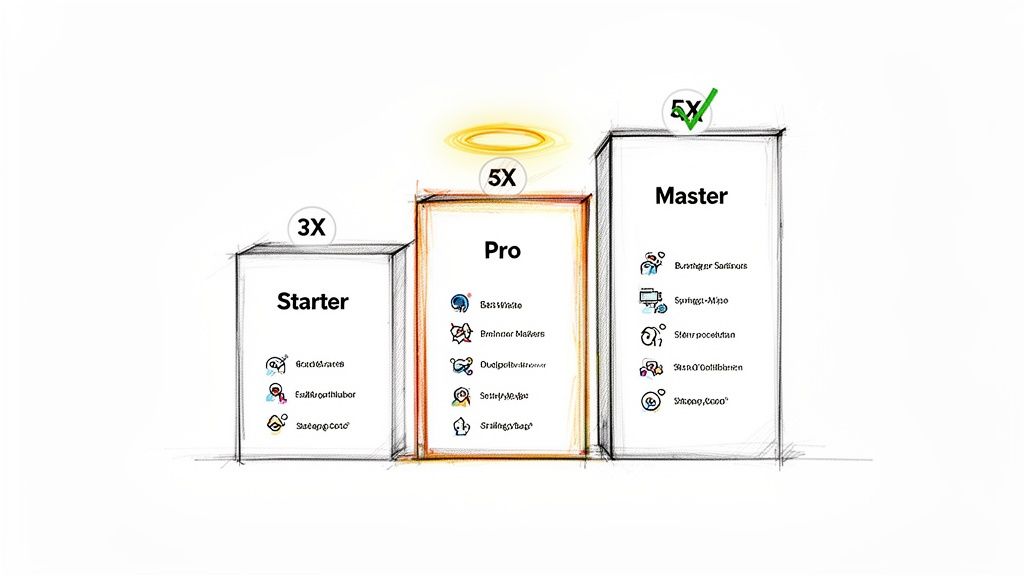
The Tiered Bundle, often called the "Good/Better/Best" model, is one of the most effective and widely used product bundle pricing examples. This strategy involves creating three distinct packages or tiers, each offering progressively more value, features, or volume. It's a powerful psychological tool that frames your offerings to guide customers toward a specific choice, usually the middle "Better" tier, by making it appear as the best value.
This model works by catering to different customer segments simultaneously. You capture budget-conscious buyers with the "Good" option, serve your core audience with the high-value "Better" option, and attract power users or those needing premium solutions with the "Best" tier. By segmenting the market this way, you maximize your potential revenue without alienating any single group.
Strategic Breakdown
Anchor Pricing: The highest tier ("Best") acts as a price anchor. Its premium price makes the middle tier look significantly more affordable and reasonable by comparison, a phenomenon known as the decoy effect.
Value Differentiation: Each tier must have a clear and compelling difference in value. This isn't about simply adding more of the same; it's about solving a progressively bigger problem for a specific customer persona.
The "Paradox of Choice" Solution: Instead of overwhelming customers with dozens of options, this model simplifies the decision to just three choices. This structure reduces analysis paralysis and increases conversion rates.
How to Implement Tiered Bundle Pricing
Define Customer Personas: Identify three core customer segments: the beginner who needs a low-cost entry point, the professional who needs a robust solution, and the enterprise or power user who needs everything.
Build the "Best" Tier First: Start by packaging your most comprehensive solution for your ideal, highest-value customer. Include every feature, all the content, and premium support.
Subtract, Don't Add: Create the "Better" and "Good" tiers by removing features or content from your premium "Best" package. This ensures your core product remains valuable and avoids the perception of your lower tiers being cheap or incomplete. For a deeper dive into this and other related strategies, explore these pricing strategies for online businesses.
Name Your Tiers Wisely: Use descriptive names that resonate with your target personas (e.g., Starter, Pro, Master; or Individual, Team, Enterprise). The name should clearly communicate who the tier is for.
2. The Decoy Pricing Strategy (Anchoring Bundle)
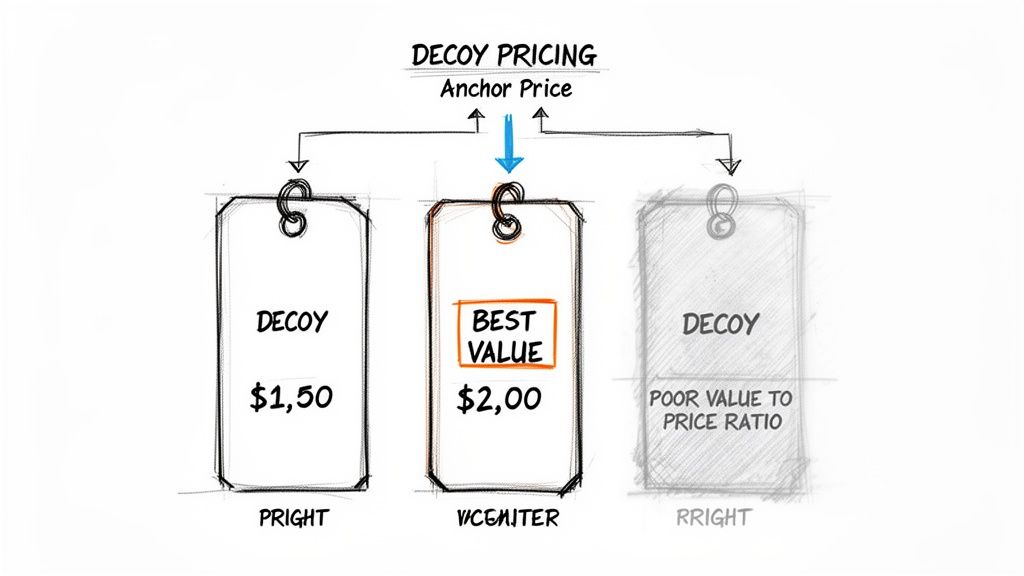
The Decoy Pricing Strategy, also known as an Anchoring Bundle, is a powerful psychological tactic where you introduce a third, deliberately less attractive option to make one of your other bundles look like a fantastic deal. This decoy isn't designed to be sold; its sole purpose is to frame the other options and steer customers toward the one you want them to choose. Popularized by behavioral economist Dan Ariely, it’s one of the most compelling product bundle pricing examples because it works by subtly influencing a customer's perception of value.
This strategy plays on the human tendency to make comparisons. When faced with a difficult choice between two options, introducing a third, slightly inferior "decoy" option makes the target option seem overwhelmingly superior. For example, The Economist famously offered "Web only" for $59, "Print only" for $125, and a "Web+Print" bundle for $125. The "Print only" option served as a decoy, making the "Web+Print" bundle feel like an incredible, can't-miss bargain.
Strategic Breakdown
Asymmetric Dominance: The decoy option is "asymmetrically dominated" by your target option. This means your target bundle is clearly better than the decoy in every way, while being only slightly different from your other main offering, making the choice simple.
Choice Simplification: The decoy removes ambiguity. Instead of a customer weighing the pros and cons of Option A vs. Option B, the decoy makes it a simple choice between a "great deal" (your target) and a "bad deal" (the decoy).
Value Anchoring: The decoy's price and features establish an anchor that enhances the perceived value of your target bundle. The classic movie theater popcorn example (Small: $6, Medium: $7.50, Large: $8) makes the Large seem like the obvious choice over the poorly-priced Medium decoy.
How to Implement Decoy Pricing
Identify Your Target Bundle: First, decide which product bundle you want to sell the most. This is typically your mid-tier or highest-margin offering that provides excellent value to the customer and high profitability for you.
Create a Slightly Inferior Decoy: Design a third option that is clearly worse than your target bundle but priced very similarly. You can achieve this by removing a key feature while keeping the price almost the same, or by offering significantly less value for a marginally lower price.
Position the Options Strategically: Place your target bundle next to the decoy. Visually, this encourages direct comparison. The decoy makes your target offering look like a logical, high-value decision, effectively guiding the customer's choice.
Test and Refine: The effectiveness of a decoy can vary. Test different price points and feature combinations for your decoy option to see which configuration results in the highest conversion rate for your target bundle. Transparency is key; clearly state what's included in each tier to maintain trust.
3. The Bundling Premium Strategy (Value Stacking)
The Bundling Premium, also known as "Value Stacking," is a classic yet highly effective product bundle pricing example. This strategy involves packaging multiple complementary products or services together and offering them as a single purchase at a price lower than the total cost of buying each item individually. It works by creating an overwhelming sense of value that makes the bundled offer seem irresistible.
This model capitalizes on the psychological principle of "perceived value." By explicitly showing the original price of each component and then revealing the discounted bundle price, you frame the offer as a significant deal. This transparency makes customers feel smart and confident in their purchasing decision, as they can clearly see the savings they are getting. It's a go-to strategy for clearing inventory, increasing average order value, and introducing customers to a wider range of your products.
Strategic Breakdown
Visual Price Anchoring: This strategy's power lies in "price stacking." Visually listing each item's individual price (e.g., $47 + $67 + $99) creates a high anchor price ($213) in the customer's mind. The bundled price ($129) then appears as a substantial discount, triggering a strong fear of missing out (FOMO).
Synergistic Value: The most successful premium bundles consist of products that logically fit together and enhance one another. For example, a bundle of Adobe Photoshop, Illustrator, and InDesign is powerful because the tools are designed to be used in conjunction for a complete creative workflow.
Reduced Friction: By curating a complete solution, you save the customer time and mental energy. Instead of researching and purchasing multiple items separately, they get everything they need in one click, simplifying their buying journey and increasing the likelihood of a conversion.
How to Implement the Bundling Premium Strategy
Identify Complementary Products: Analyze your product catalog to find items that solve a larger, unified problem when combined. Think about customer workflows and what they would naturally buy together. For instance, a course creator might bundle a "Marketing 101" course with "Social Media Mastery" and "Email Marketing Essentials."
Calculate the "Value Stack": Add up the full retail price of every individual item in the bundle. This total becomes your anchor price. Be transparent and list these individual prices clearly in your marketing.
Set a Compelling Bundle Price: Offer a meaningful discount on the total stacked value. The discount should be significant enough to make the bundle a clear "no-brainer" but still maintain healthy profit margins. A discount between 30-50% off the total value is a common and effective range.
Add an Exclusive Bonus: To make the offer even more enticing, include a small, high-value bonus that is only available with the bundle. This could be a free template, a short guide, or access to an exclusive Q&A session. For more ideas on this, check out these 7 ways to instantly boost the perceived value of your PLR digital products.
4. The Subscription Bundle Model (Recurring Revenue Bundle)
The Subscription Bundle Model is a powerful strategy that packages multiple products, services, or content assets into a single offering for a recurring fee. This approach transforms potential one-time customers into a predictable, long-term revenue stream. Instead of selling items individually, you grant access to a curated library that receives continuous updates, providing immense ongoing value and fostering customer loyalty.
This model is particularly effective for digital products, content libraries, and software. By bundling a large collection of resources (like templates, courses, or tools) and consistently adding new assets, you create a compelling reason for customers to remain subscribed. It shifts the value proposition from a single transaction to a dynamic, evolving membership, as seen with platforms like Adobe Creative Cloud, Notion Plus, and Skillshare.
Strategic Breakdown
Predictable Revenue: This model's primary advantage is its ability to generate stable, recurring monthly or annual revenue (MRR/ARR). This predictability allows for better financial forecasting and business planning.
High Perceived Value: Customers gain access to a vast library of resources for a low monthly fee, which often feels like a better deal than purchasing each item individually. This high perceived value is a key driver for initial sign-ups.
Customer Retention: The continuous addition of new content or features gives customers a reason to stay. Each new update reinforces the value of their subscription and reduces churn, locking them into your ecosystem.
How to Implement The Subscription Bundle Model
Build a Critical Mass of Value: Before launching, ensure your bundle contains a substantial and high-quality collection of assets. The initial offering must be valuable enough on its own to justify the subscription price from day one.
Establish a Content Cadence: Create a realistic schedule for adding new products or content (e.g., weekly, bi-weekly, monthly). Clearly communicate this update frequency to subscribers to set expectations and continuously prove the subscription's worth.
Incentivize Annual Plans: Offer a significant discount for annual subscriptions (e.g., "pay for 10 months, get 12"). This improves your cash flow and increases the customer's lifetime value by securing a longer commitment. For a complete guide, see this resource on how to launch a successful subscription model.
Communicate New Additions: Actively market new assets to your existing subscribers. Use email newsletters, a "What's New" section on your website, or community announcements to highlight fresh content and remind them of the value they receive.
5. The Progressive Bundling Strategy (Expansion Bundles)
Progressive Bundling, also known as an Expansion Bundle, is a dynamic pricing strategy that guides customers along a predefined value ladder. Instead of presenting all options at once, this approach starts customers with a core product and then strategically introduces them to more comprehensive bundles over time as their needs evolve. It’s a powerful method for building long-term relationships and maximizing customer lifetime value (LTV).
This model excels at converting initial interest into deep, sustained engagement. By aligning your offerings with the customer's journey, you create a natural path for upselling. Each subsequent bundle is positioned not as a new purchase, but as the logical next step to solve a more advanced problem, making it one of the most effective product bundle pricing examples for subscription and service-based businesses.
Strategic Breakdown
Customer Journey Alignment: This strategy mirrors the customer's growth. A beginner starts with a basic solution, and as they become more sophisticated, your advanced bundles are ready to meet their new challenges.
Reduced Initial Friction: The low-cost or free entry point removes the barrier to entry, allowing you to acquire a large user base. You then have a captive audience to nurture and upsell to more profitable tiers.
Perceived Value and Trust: By delivering value at each stage, you build trust. When you offer an upgrade, it's seen as a helpful next step from a trusted partner rather than an aggressive sales pitch. HubSpot uses this perfectly, moving users from their Free CRM to paid hubs as their business scales.
How to Implement Progressive Bundling
Map Your Customer's Journey: Define the distinct stages your customers go through, from novice to expert. What problems do they face at each stage? Your bundles should directly address these evolving pain points.
Create a Low-Barrier Entry Point: Develop a compelling initial offer. This could be a free tool, a low-cost starter course, or a basic service package. The goal is customer acquisition, not immediate profit.
Build Your Value Ladder: Design each subsequent bundle to be a significant leap in value, solving the next set of problems. A common pricing model is to make each tier roughly 2-3 times the price of the previous one. A freelancer might go from a basic profile to a premium tier and finally to an agency-level package.
Time Your Upsell Offers: Don't rush the upgrade. Wait 30-60 days or monitor usage patterns to identify when a customer is outgrowing their current tier. Introduce the next bundle as the solution to their new-found limitations, often using a limited-time upgrade discount to create urgency.
6. The Seasonal/Holiday Bundle Pricing
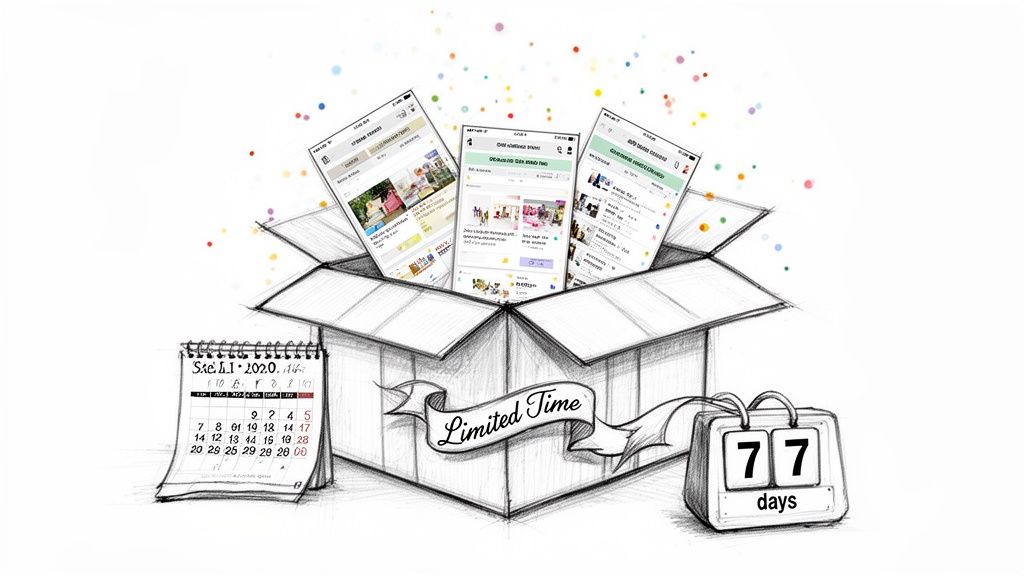
The Seasonal or Holiday Bundle is a time-sensitive strategy that packages relevant products together to capitalize on specific periods of high consumer spending, like Black Friday, New Year's, or Back-to-School season. This approach leverages urgency and scarcity to drive significant, concentrated bursts of revenue. It works by creating an offer that feels exclusive, highly relevant, and too good to miss within a limited window.
This is a classic e-commerce and digital marketing tactic because it aligns your products with the customer's mindset at a particular time of year. For instance, a "New Year, New You" bundle combining a productivity course, goal-setting templates, and a fitness planner directly meets the customer's immediate needs and aspirations, making the purchase feel both timely and essential.
Strategic Breakdown
Urgency and Scarcity: The limited-time nature of the offer is the primary psychological driver. Countdown timers, "offer ends soon" messaging, and the risk of missing out (FOMO) compel customers to make a decision quickly rather than procrastinating.
Thematic Relevance: The bundle's components are curated around a specific theme, making the collection feel cohesive and specially designed. A Black Friday bundle with high-value digital tools feels more compelling than a random assortment of discounted products.
Event-Based Excitement: This strategy taps into the existing hype and buying energy surrounding major holidays and events. You are essentially riding a wave of consumer intent that is already present in the market.
How to Implement Seasonal/Holiday Bundle Pricing
Identify Key Seasons: Pinpoint 2-4 key dates or seasons in your industry's calendar that align with your audience's needs. Examples include Black Friday/Cyber Monday, New Year, summer holidays, or industry-specific events.
Curate a Thematic Bundle: Assemble a collection of products that makes sense together for that season. For a "Holiday Sales Bundle," combine email marketing templates, social media graphics, and sales funnel blueprints to help businesses maximize their end-of-year revenue.
Build Anticipation: Don't just launch the offer. Plan a pre-launch campaign 2-3 weeks in advance using social media and your email list to build excitement and let your audience know something special is coming.
Execute a High-Urgency Launch: Use dedicated landing pages, countdown timers, and a focused email campaign (3-4 emails during the promotional window) to drive conversions. Clearly state the offer's end date and stick to it to maintain credibility for future promotions.
7. The Role-Based/Persona Bundle Strategy
The Role-Based Bundle, also known as a Persona Bundle, is a highly targeted product bundle pricing examples approach where offerings are curated for specific customer roles or job titles. Instead of a generic "Good/Better/Best" model, this strategy creates distinct packages tailored to the unique pain points, goals, and workflows of different professional segments, dramatically increasing relevance and perceived value.
This model excels because it speaks directly to the customer's identity and professional needs. A marketing agency requires different tools and templates than a solo course creator, even if they are buying from the same company. By creating bundles like a 'Coach Bundle' or an 'Agency Bundle,' you show a deep understanding of your audience's world, making your solution feel less like a product and more like a purpose-built toolkit for their success.
Strategic Breakdown
Hyper-Relevance: This strategy's core strength is its specificity. By using language, features, and case studies that resonate with a particular role (e.g., "client-deliverable templates" for agencies), you make the purchasing decision feel obvious and low-risk.
Reduced Buyer Friction: When a customer sees a bundle named after their exact job title, it eliminates the need to analyze which tier is right for them. It short-circuits the decision-making process by instantly signaling, "This one is for you."
Value-Based Pricing Justification: You can price each bundle based on the specific return on investment (ROI) that persona can expect. An agency bundle with resale rights offers a higher potential ROI than a creator bundle, justifying a higher price point.
How to Implement Role-Based/Persona Bundle Pricing
Identify Core Personas: Survey your audience or analyze customer data to identify the top 2-4 distinct professional roles you serve. Common examples include coaches, agencies, freelancers, and course creators.
Map Persona-Specific Needs: For each persona, list their primary goals, biggest challenges, and the specific resources or features that would solve their problems most effectively. A coach might need lead-generation funnels, while an agency needs client management templates.
Curate Tailored Bundles: Build a unique bundle for each persona, combining the exact mix of products, services, or templates they need. Avoid simply renaming generic tiers; the contents of the bundle must be genuinely different and specialized.
Create Dedicated Marketing Funnels: Develop separate landing pages, email sequences, and ad campaigns for each persona bundle. Use role-specific headlines, testimonials, and copy to attract and convert each segment independently.
8. The Hybrid/Hybrid Freemium Bundle (Free + Premium)
The Hybrid Freemium Bundle is a powerful customer acquisition strategy that combines a valuable free product with premium paid bundles. Unlike a simple free trial, this model provides a perpetually free tier that serves as both a lead magnet and a product demonstration, building trust and showcasing value before asking for a commitment. It effectively converts users into paying customers by making the upgrade to a premium bundle a natural next step.
This model is exceptionally effective for SaaS companies, digital product sellers, and platforms like Canva, Notion, and Slack. It works by removing the initial purchase barrier, allowing a massive number of users to experience the core product. The business then monetizes the most engaged segment of this user base who require more advanced features, collaboration tools, or higher usage limits, which are strategically packaged into premium bundles.
Strategic Breakdown
Lead Generation Engine: The free tier acts as a high-conversion lead magnet. By requiring an email for access, you build a massive marketing list of qualified, product-aware leads that you can nurture toward an upgrade.
Friction as a Feature: The limitations of the free version (e.g., storage caps, limited features, number of collaborators) are not just restrictions; they are strategic friction points. These limitations are designed to become pain points for engaged users, making the premium bundle's solution highly desirable.
Value-First Marketing: This approach demonstrates your product's value directly rather than just talking about it. Users who solve a real problem with the free version are far more likely to believe the premium version can solve an even bigger one.
How to Implement Hybrid Freemium Bundle Pricing
Define the "Free Forever" Value Proposition: Identify a core set of features that are genuinely useful on their own. The free tier must solve a real, albeit smaller, problem to avoid feeling like a crippled demo. For example, Notion allows unlimited personal use, making it incredibly valuable for individuals.
Create a Compelling Upgrade Path: Build your premium bundles around key "upgrade triggers" like collaboration, advanced analytics, enhanced security, or removing usage limits. The transition from a single user to a team is a classic and effective trigger for B2B software.
Embed Upgrade Prompts Naturally: Place clear, context-aware calls-to-action within the free product. When a user tries to access a premium feature, show a pop-up explaining the benefit and offering an easy upgrade path.
Nurture Free Users to Paid: Use email marketing sequences to educate free users on how to get the most out of the product. Simultaneously, highlight case studies and benefits of the premium features, showing them what they're missing. Offering a limited-time trial of the premium bundle to active free users is a highly effective conversion tactic.
8 Product Bundle Pricing Strategies Comparison
Strategy | Implementation Complexity | Resource Requirements | Expected Outcomes | Ideal Use Cases | Key Advantages |
|---|---|---|---|---|---|
Tiered Bundle Pricing (Good/Better/Best) | Moderate — careful positioning and pricing tests | Content/feature differentiation, packaging, marketing copy | Broader revenue capture; predictable mid-tier dominance | Infoproduct platforms with clear customer segments | Serves multiple segments; reduces decision paralysis |
Decoy Pricing Strategy (Anchoring Bundle) | Low–Moderate — design and A/B testing required | Minimal product change; analytics and UX presentation | Higher average order value with little cost | Single-offer pages or few-tier products where anchoring helps | Boosts AOV cheaply; simple behavioral leverage |
Bundling Premium Strategy (Value Stacking) | Moderate — select complementary items and price stack | Product selection, visual price comparisons, promos | Significant AOV increase; strong perceived savings | Diverse libraries or complementary product suites | Strong perceived value; clears slow-moving items |
Subscription Bundle Model (Recurring Revenue Bundle) | High — ongoing delivery, billing, retention systems | Continuous content creation, platform, billing & support | Predictable recurring revenue and higher lifetime value | Content libraries with regular new additions | Recurring revenue; improved retention and LTV |
Progressive Bundling Strategy (Expansion Bundles) | Moderate–High — staged offers and timing strategy | Multi-stage funnels, tracking, targeted upsell materials | Increased customer lifetime value via sequential upgrades | Onboarding journeys, SaaS/coaching with upgrade paths | Low barrier to entry; effective upsell pathway |
Seasonal/Holiday Bundle Pricing | Moderate — campaign planning and timing | Marketing campaigns, landing pages, limited-time assets | Short-term revenue spikes and higher seasonal conversions | Peak shopping periods (Black Friday, holidays, back-to-school) | Creates urgency; attracts price-motivated buyers |
Role-Based/Persona Bundle Strategy | High — requires deep segmentation and customization | Persona research, curated content per role, separate messaging | Higher conversion and satisfaction within segments | Platforms serving varied roles (coaches, agencies, creators) | Highly relevant offers; improved per-segment conversion |
Hybrid/Freemium Bundle (Free + Premium) | Moderate — free access + conversion funnels | Free assets, email automation, support for free users | Large lead pool; steady conversion to paid over time | Audience-building brands and products that benefit from sampling | Lowers friction; builds trust and marketing list |
From Examples to Execution: Choosing and Implementing Your Ideal Bundle Strategy
We've explored a powerful arsenal of eight distinct product bundle pricing examples, moving from the foundational Tiered and Decoy models to the more sophisticated Subscription and Persona-Based strategies. Each example, from Value Stacking Premiums to time-sensitive Seasonal Bundles, offers a unique lever to pull in your business. The journey through these real-world applications reveals a core truth: bundling is not a one-size-fits-all tactic, but a flexible, strategic art form.
The most critical takeaway is that the "best" bundle doesn't exist in a vacuum. Its success is defined by its alignment with your specific context: your product ecosystem, your audience's deepest needs, and your overarching business objectives. A solo course creator might find immediate success with a simple "Good, Better, Best" tiered bundle to guide new customers up their value ladder. In contrast, a SaaS company with multiple tools could leverage a Progressive Bundling strategy to systematically increase customer lifetime value.
Distilling the Core Principles
Across all the models we analyzed, several key principles emerged as universal drivers of success. Mastering these will give you the foundation needed to build compelling offers that customers find irresistible.
Perceived Value is Paramount: The bundle must feel like a "deal," but more importantly, it must feel like a comprehensive solution. The whole must be demonstrably greater than the sum of its parts.
Clarity Defeats Confusion: Customers must immediately understand the value proposition of each bundle. A confusing offer is an offer that won't sell. Use clear naming conventions and visually distinct tiers.
Strategic Anchoring Guides Choice: Whether using a decoy or a premium tier, you are always guiding the customer's decision-making process. Price points are relative, and your job is to frame the comparison in a way that makes your target offer the logical choice.
Your Action Plan: Moving from Insight to Implementation
Theoretical knowledge is valuable, but revenue is generated through action. Your next step is to bridge the gap between the product bundle pricing examples in this article and your own pricing page. Use this structured approach to get started.
Conduct a Product & Persona Audit: Map out your entire product suite, from lead magnets to high-ticket services. Simultaneously, review your customer personas. What are their primary goals and pain points? This is where you'll find the most natural and compelling bundling opportunities. A bundle designed to solve a specific persona's biggest problem is an easy sell.
Select Your Starting Model: Don't try to implement everything at once. Choose one bundling strategy that most closely aligns with your immediate goals. Are you trying to increase Average Order Value (AOV)? A Value Stack or Tiered Bundle is a great start. Are you focused on predictable revenue? The Subscription Bundle is your target.
Build Your Pilot Bundle & Test: Create your first bundle as a minimum viable offer. You don't need a perfect, permanent solution. Set clear prices, outline the value, and launch it to a specific segment of your audience or a portion of your website traffic.
Measure, Analyze, Iterate: Track key metrics: conversion rate, AOV, and customer feedback. Did the bundle perform as expected? What objections came up? Use this data not as a pass/fail grade, but as valuable feedback to refine your offer. Successful pricing is never static; it's an ongoing process of iteration.
As you build out these strategies, it's also crucial to be aware of the competitive landscape. Understanding broader market dynamics and the tactics used by others can provide critical context for your own decisions. In highly competitive environments like e-commerce, for instance, staying informed on winning pricing strategies for sellers can give you a significant edge.
Ultimately, mastering product bundling is about transforming your collection of individual products into a cohesive, customer-centric solution set. It’s about making it easier for your audience to buy from you, achieve their goals, and become loyal, long-term advocates for your brand.