Guide
How to Turn Ideas Into Products: A Practical Guide

Turning your idea into a real, money-making product is a journey. The good news is, it's a journey with a map. It boils down to four key stages: Validate that people actually want it, Build a simple first version, Launch it to get some real momentum, and then Scale what works.
Following this path stops you from wasting months building something nobody will ever buy. It’s all about focusing your energy on creating a profitable asset from day one.
Your Framework for Turning Ideas Into Reality
Every great product starts as a simple thought, but the path from that initial spark to a market-ready asset can feel overwhelming. The most successful creators I know don't just get lucky; they follow a repeatable system designed to minimize risk and maximize their chances of success.
This isn't about having a huge budget or a massive team. It’s about making smart, strategic moves at each stage of the game.
This framework is your roadmap from idea to income. Instead of juggling a dozen different tasks at once, you can focus on the one thing that matters most at each step. This is how you build something with genuine, built-in demand.
The Core Stages of Product Creation
The whole process really comes down to a few key milestones.
First, you have to confirm that a real audience has the problem your idea solves. This is the validation phase, and believe me, skipping it is the number one reason new products fail. A huge piece of this is nailing down who you're even talking to. If you need help with that, check out this great guide on How To Find Your Niche.
Once you've got that validation, you move into the building phase. But this isn't about creating some perfect, feature-packed behemoth. It’s about building a Minimum Viable Product (MVP)—the simplest possible version that delivers on the core promise. For entrepreneurs moving fast, our Model to Market playbook is a game-changer for getting a solid MVP out the door quickly.
This simple chart breaks down the four-step flow for turning your ideas into actual products you can sell.
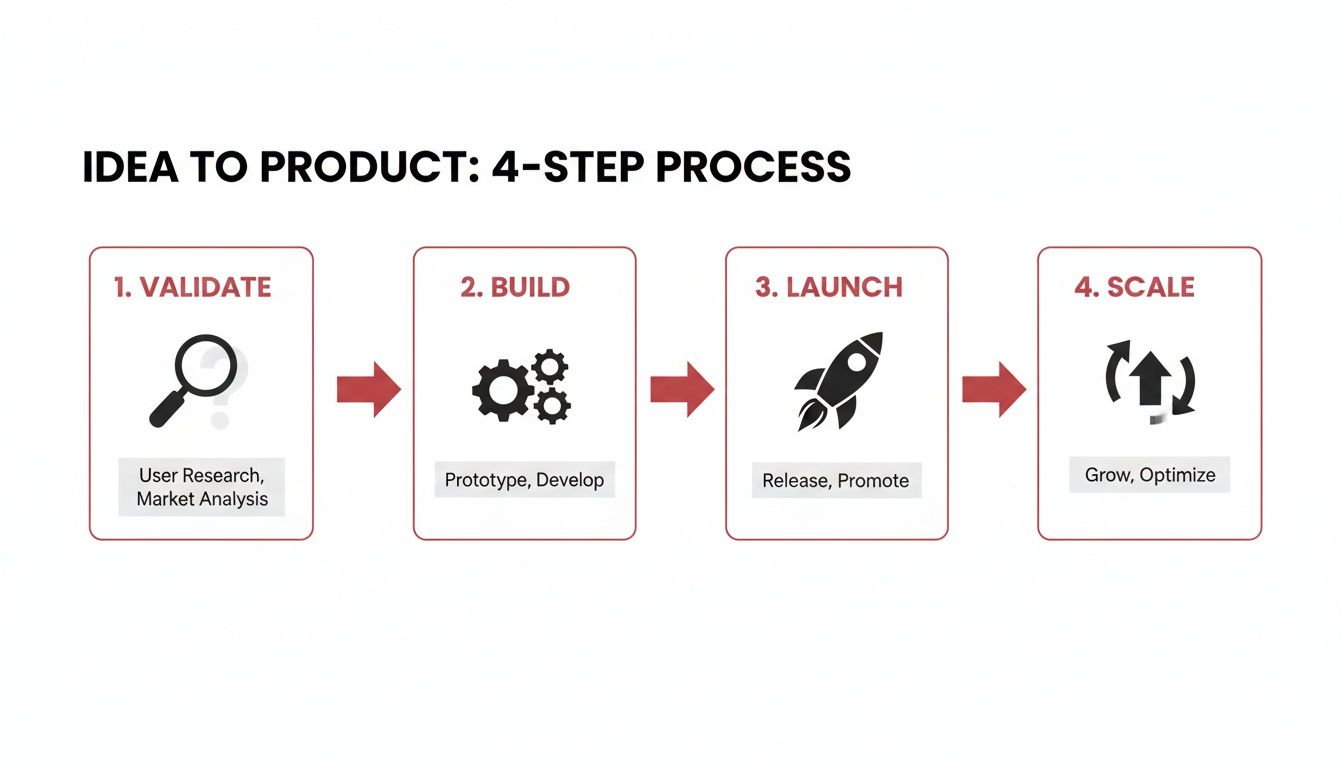
As you can see, each stage builds directly on the last, creating a clear path from a simple concept to a successful launch.
To give you a bird's-eye view, here's how these phases connect to form a complete roadmap.
The Idea-to-Income Roadmap
Phase | Key Objective | Core Activities |
|---|---|---|
1. Validate | Confirm market demand and problem-solution fit. | Audience research, surveys, interviews, competitor analysis. |
2. Build | Create the simplest version of the product (MVP). | Prototyping, content creation, defining core features, design. |
3. Launch | Generate initial sales and gather real-world feedback. | Go-to-market strategy, marketing, sales, customer onboarding. |
4. Scale | Systematize and grow your product's revenue. | Automation, creating playbooks, expanding marketing channels. |
This table lays out the entire journey, making it clear what you need to focus on at every step.
Why Speed and Strategy Matter
How fast you can move through this framework is your biggest advantage as a creator or small business owner. The market is always looking for new solutions, and the numbers don't lie. 95% of consumer product leaders see new launches as a top priority.
With the digital product market projected to smash $2.5 trillion, the opportunity for well-executed ideas is absolutely massive. This shows that moving quickly isn't just a nice-to-have; it’s a core strategy for winning. You're not just building a product; you're building a business.
How to Validate Your Idea Without Building Anything
Before you spend a single dollar or minute on development, you have to answer one question with brutal honesty: does anyone actually want this?
Skipping this step is the single biggest mistake I see creators make. They end up with beautifully designed products that solve a problem nobody has. Validation isn't about collecting opinions; it’s about gathering cold, hard evidence.
Your goal is to move beyond asking friends, "So, what do you think of my idea?" People are nice. They'll almost always say they like it. Instead, you need to become a detective, uncovering the real, deep-seated problems your target audience is desperate to solve.
Listen Before You Speak
The best way to validate an idea is to go where your potential customers are already talking about their frustrations. Instead of pitching your solution, you just listen. This approach strips away your confirmation bias and gives you raw, unfiltered insight into their actual pain points.
Reddit Communities: Find subreddits related to your niche (think r/Notion, r/freelance, or r/solotravel). Search for phrases like "how do I," "I'm struggling with," or "is there a tool for." You'll find people describing their problems in their own words—this is pure gold.
Facebook Groups: Join groups where your target audience hangs out. What questions pop up again and again? If you see the same problem surface week after week, you’ve probably hit on a genuine need.
Social Media Polls: Use Instagram Stories or Twitter polls to ask indirect questions. Don't ask, "Would you buy my meal prep ebook?" Instead, ask, "What's your biggest challenge with eating healthy during the week?" The answers will point you toward what your product should really be about.
These platforms are treasure troves of customer research. The key is to observe and document the exact language they use, the solutions they've already tried, and where those solutions are falling short.
The Power of a Smoke Test
Listening is fantastic for identifying problems, but eventually, you have to test if people are willing to act on a solution. This is where a "smoke test" comes in. A smoke test is just a simple experiment to gauge real purchase intent before you have a finished product.
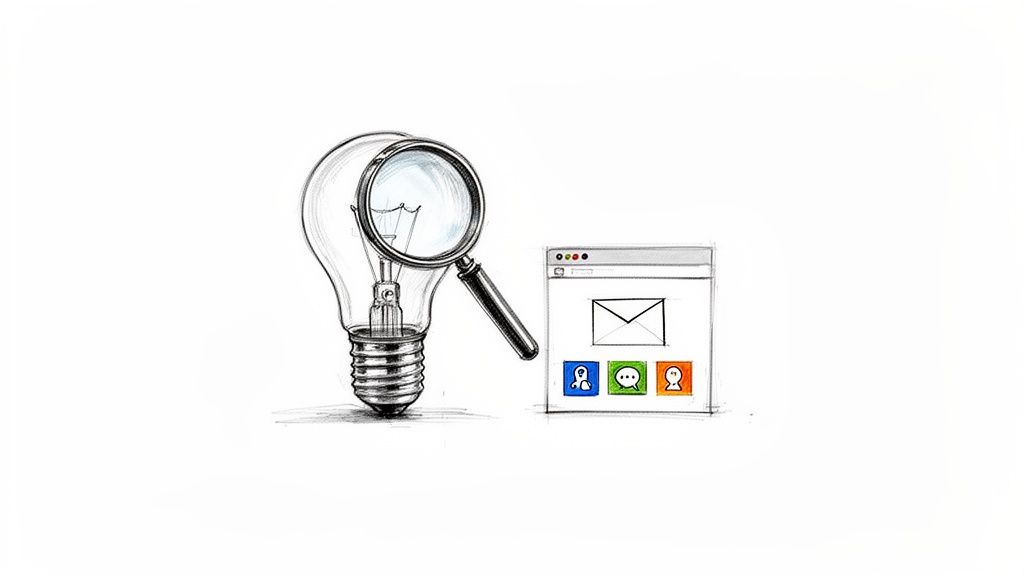
The most effective smoke test is a basic landing page. This one-page website only needs to do three things:
Nail the value proposition: What problem will your product solve?
Showcase the benefits: How will their life be better after using it?
Have a clear call-to-action: This is usually an email signup form to "Get notified when we launch" or "Join the waitlist for an early-bird discount."
An email address is a commitment. It’s a micro-transaction where someone gives you their valuable attention in exchange for a future solution. Ten email signups from total strangers are infinitely more valuable than a hundred "that's a cool idea" comments from friends.
Tools like Carrd or Mailchimp make it incredibly easy to spin up a professional-looking landing page in an afternoon. Drive a small amount of traffic to it from the communities you've been monitoring and see what happens. If you get crickets, it’s a strong signal that either your messaging or the idea itself needs a serious rethink.
For a deeper dive into this process, our guide on pre-launch product validation provides a complete step-by-step framework.
Uncovering Hidden Demand with Keyword Research
Another powerful validation technique is to see what people are actively searching for on Google. Keyword research tools can show you the exact phrases people use when they're looking for solutions to their problems.
Let's say you have an idea for a Notion template for freelance project management. You could use a free tool to see how many people are searching for terms like:
Keyword | Monthly Search Volume |
|---|---|
"notion for freelancers" | High |
"freelance project management template" | Medium |
"client tracker notion" | Medium |
"how to organize freelance projects" | Low |
Finding high search volume for these kinds of "problem-aware" keywords tells you there's a built-in audience actively looking for a solution right now. If you can find relevant keywords with decent traffic but weak or non-existent search results, you've stumbled upon a market gap.
This data-driven approach tells you not only if there's demand but also the exact language you should use in your marketing to attract those future customers.
Building Your First Version The Smart Way
You’ve confirmed there’s genuine demand for your idea. Fantastic. Now comes the biggest temptation you’ll face: the urge to build the ultimate, feature-packed, all-singing, all-dancing final version right out of the gate.
Do not do this. Resist it at all costs. The real secret to turning ideas into products people actually buy is to start small, stay focused, and move fast.
This is where you master the art of the Minimum Viable Product (MVP). It isn't about shipping something that’s broken or incomplete. It's about launching the absolute smallest, simplest version of your product that solves one core problem exceptionally well. Everything else is just noise, at least for now.
Defining Your MVP Scope
Deciding what makes the cut—and more importantly, what gets left on the cutting room floor—is the single hardest part of this process. A ruthlessly effective framework for this is the MoSCoW method. It forces you to get brutally honest about every feature on your wishlist by sorting it into one of four buckets.
Must-have: These are the non-negotiables. The product simply won't work or solve the core problem without them. For an ebook, this is the main content. That’s it.
Should-have: These are important and add a lot of value, but they aren’t critical for day one. Think of them as your version 1.1 updates. Maybe some bonus checklists or templates to go with your ebook.
Could-have: These are the "nice-to-have" extras. They’re desirable but don’t make or break the product. You can always add them later if customers ask. This could be an audio version or a companion quiz.
Won't-have: Features that are explicitly out of scope for this version. Being clear about what you're not building keeps you laser-focused and prevents scope creep. For your ebook launch, a full-blown video course is a definite "won't-have."
Once you’ve sorted your ideas, your roadmap becomes crystal clear. Your MVP is your "Must-haves" list. Nothing more. If you want a complete playbook for getting this strategy right, check out the insights in The MVP Playbook Guide.
Smart Shortcuts for Digital Products
As a creator, you can shrink the path from idea to MVP dramatically just by picking the right format. You don't need to dive into complex software development. An MVP can be a high-value digital asset you create over a weekend.
This approach plugs you directly into a massive—and still growing—market. Digital products are projected to generate a mind-boggling $2.5 trillion in global value by 2025, with the ebook market alone expected to hit $14.9 billion. These numbers, highlighted by platforms like Whop.com, confirm that turning ideas into simple, scalable digital assets is a winning strategy.
Here are a few proven MVP formats perfect for creators:
The Focused Ebook: A short, punchy guide that solves one painful problem.
A Mini-Course: Just 3-5 short videos that teach a very specific skill or system.
A Specialized Template: A pre-built Notion dashboard, a set of Canva graphics, or a spreadsheet that saves your audience hours of work.
A Content Bundle: A collection of pre-written social media posts, email scripts, or content prompts.
The key is to deliver a quick win. Your MVP should give your customer a tangible result in the shortest time possible. That's how you build trust and earn the right to sell them bigger, more expensive products down the line.
Using PLR as a Launchpad
One of the most powerful shortcuts for creating a digital product MVP is using Private Label Rights (PLR) content. It’s a total game-changer.
PLR gives you a professionally created foundation—like a complete ebook or a set of templates—that you can legally rebrand, edit, and sell as your own. Instead of staring at a blank page for weeks, you start with a high-quality draft.
This frees you up to focus on what actually matters: adding your unique branding, crafting your marketing message, and nailing your launch. You can inject your own case studies, rewrite sections to match your voice, and design a cover that reflects your brand identity. It's not about cutting corners; it's about working smarter. Using a PLR ebook as your base lets you get a polished MVP to market in a fraction of the time.
Choosing Your Launch Platform
Finally, don’t get bogged down by the tech. Your MVP needs a simple, reliable place where people can buy it. You don't need a custom-coded, bells-and-whistles website to get started.
Platforms like Gumroad or Etsy are perfect for launching your first digital product. They handle all the messy stuff—payment processing, secure file delivery, and basic sales pages—so you can set up a shop in minutes. The goal is speed. Pick a platform that gets your product into your customers' hands with the least amount of friction.
Designing a Launch That Actually Gets Noticed
A fantastic product without a thoughtful launch is like a concert with no audience. All the hard work you’ve poured into building the perfect MVP deserves a go-to-market plan that builds real, sustainable momentum.
A successful launch isn't just a one-day event; it's a strategic campaign with distinct phases. This isn't about needing a massive marketing budget, either. It’s about creating anticipation, executing with precision, and then capitalizing on that initial energy to build a loyal customer base. Let's break down the playbook for a launch that delivers results.
The Art of the Pre-Launch
The weeks leading up to your launch are arguably more important than launch day itself. This is where you build suspense and cultivate a waitlist of people who are genuinely excited to buy your product the moment it goes live.
Your goal here is to warm up your audience so they're ready to act. A great way to do this is with teaser content. Share behind-the-scenes glimpses of your process on social media. Post short video clips or screenshots showcasing a key feature. This creates a narrative that makes your audience feel like they're part of the journey.
A few pre-launch tactics I’ve seen work wonders:
Run a Countdown: Use social media stories or your email newsletter to run a simple countdown, building anticipation daily as you get closer to launch day.
Engage Influencers: Find a handful of small, highly relevant influencers in your niche. Offer them free, early access in exchange for honest feedback or a potential shout-out.
Build a Waitlist: Your smoke-test landing page should now become your official waitlist. Offer an exclusive "early-bird" discount or a special bonus only for those who sign up before the launch.
Executing a Flawless Launch Day
When launch day arrives, your primary job is to make noise and remove friction. All your pre-launch efforts have led to this moment. The key is having all your assets prepared ahead of time so you can focus on engagement and sales.
This means your sales page is polished, your checkout process is tested, and your email announcements are written and scheduled. On the day, you're not scrambling—you're executing.
A successful launch day isn't about hoping people find you. It's about confidently guiding the audience you've already built directly to the "buy" button.
This is where your marketing becomes the engine. The numbers are staggering; global digital marketing spend hit $363.05 billion in 2023 and is projected to reach over $1 trillion by 2032. For creators, tapping into social media's 33% share of ad budgets can be a game-changer, with platforms like Facebook delivering an average 28% ROI. Even a small, targeted ad campaign can seriously amplify your reach. You can dig into more of these numbers in this comprehensive report on worldwide marketing statistics.
A solid checklist is your best friend for a smooth launch. It keeps you from getting overwhelmed by tracking all the moving pieces before, during, and after you go live.
Essential Launch Checklist
Phase | Task | Status (To Do, In Progress, Done) |
|---|---|---|
Pre-Launch | Finalize sales page copy & design | To Do |
Pre-Launch | Set up email automation sequence for waitlist | To Do |
Pre-Launch | Prepare all social media content (posts, stories, ads) | To Do |
Pre-Launch | Test the complete checkout process | To Do |
Launch Day | Send "We're Live!" email to your entire list | To Do |
Launch Day | Publish all scheduled social media announcements | To Do |
Launch Day | Monitor social channels for questions & comments | To Do |
Launch Day | Activate any planned launch day ads | To Do |
Post-Launch | Send "Last Chance" email for early-bird offers | To Do |
Post-Launch | Follow up with new customers for feedback/reviews | To Do |
Post-Launch | Analyze launch data (sales, traffic, conversions) | To Do |
This checklist isn't exhaustive, but it covers the core tasks that will keep your launch on track and prevent critical details from slipping through the cracks.
Sustaining Momentum Post-Launch
The work doesn't stop once you've made your first few sales. The 30 days following your launch are critical for gathering feedback, building social proof, and setting your product up for long-term success.
The initial buzz will fade, so you need a plan to keep the energy going. Your first customers are your most valuable asset—they are your source of testimonials, case studies, and crucial feedback for version 2.0. Make them feel seen and appreciated.
Follow up with buyers a week or two after their purchase and ask for a review. Feature positive testimonials prominently on your sales page and in your marketing. This social proof is incredibly powerful for converting future customers who are on the fence.
Also, actively listen to their feedback and bug reports. Responding quickly and transparently to issues builds immense trust and shows you're committed to improving the product. This post-launch phase is where you turn initial buyers into lifelong fans.
How to Price and Package Your Product for Success

You’ve done the hard work. The idea is validated, your MVP is built, and you’re ready to go. Now comes the part that makes so many entrepreneurs freeze up: putting a price on it.
This step feels heavy because it’s the moment your idea officially becomes a real product. But pricing isn’t some dark art. It’s a strategic choice you can absolutely nail. Getting your pricing right communicates your product's value, speaks directly to your ideal customer, and decides whether all your effort pays off.
Choosing Your Monetization Model
First things first, you need to decide how you're going to charge. This isn't a random choice; it should mirror how your product delivers value.
One-Time Fee: Simple and clean. The customer pays once for lifetime access. This is perfect for digital products where the value is delivered all at once, like an ebook, a set of templates, or a batch of design assets.
Subscription: This model is your go-to for products with ongoing value. Think communities, weekly content drops, or software that gets regular updates. Customers pay monthly or annually, giving you predictable, recurring revenue.
Tiered Packages: This is where the magic happens. By offering a few different packages, you can appeal to a much wider audience—from the budget-conscious beginner to the power user who wants it all.
The Psychology of Smart Packaging
Tiered packaging is more than just offering options; it’s about psychology. A well-structured set of tiers can gently guide customers to the best choice for them while also boosting your average order value. The classic "Good, Better, Best" model is incredibly effective.
Let's imagine you've built a productivity system. Here’s how you could package it:
Package Tier | What's Included | Target Customer | Price Point |
|---|---|---|---|
Basic | The core ebook on productivity. | The DIYer who just wants the core info. | $27 |
Pro (Most Popular) | Ebook + Notion templates + video tutorials. | Someone who wants the tools and guidance to implement the system fast. | $67 |
Premium | Everything in Pro + a 1-on-1 coaching call. | The person who wants personalized support and accountability. | $197 |
This structure leverages a powerful principle called price anchoring. The $197 Premium package makes the $67 Pro option look like a fantastic deal. Suddenly, the middle tier—which is often the one you want most people to buy—becomes the obvious, high-value choice.
Your packaging shouldn't just list features; it should offer a faster or more complete transformation. Frame each tier around the outcome the customer gets, not just the files they download.
Crafting a Compelling Offer
Once your pricing is locked in, you have to sell it. This is where your product description and visuals become critical. Don't just tell people what's inside—show them the transformation they're buying.
Instead of saying, "Includes 10 video lessons," try this: "Master the entire system in under an hour with 10 bite-sized video walkthroughs."
See the difference? It’s all about the benefit, not the feature. Use crisp visuals like mockups and screenshots to make your digital product feel tangible. Your goal is to make the price feel small compared to the massive value they’re about to receive.
Turning Your First Product Into a Sustainable Business
That first successful launch is a huge milestone. It’s the moment you prove your idea has legs. But it’s not the finish line—it’s the starting block for building a real, sustainable business. This is where you shift from being just a creator to a true business owner.
The whole process of turning ideas into products doesn’t stop once you make a sale. In fact, that first wave of customers is your most valuable asset. They hold the keys to your next big idea, your next update, and your long-term growth. It all begins by listening to what they’re telling you, both directly and indirectly.
From Feedback to Your Next Big Thing
Every review, support ticket, and social media comment is a breadcrumb leading you toward your next profitable move. Think of your customer feedback as a goldmine for future revenue. Don't just collect testimonials for your sales page; actively hunt for patterns in what people are saying.
Are a bunch of customers asking for the same feature? Are they using your product in a way you never even imagined? These are powerful signals pointing directly at unmet needs. You can use some simple tools to gather this intelligence without overcomplicating things:
Post-Purchase Surveys: About a week after someone buys, send them a short, simple survey. Ask what they loved, what was missing, and what problem they’d like you to solve next.
Review Analysis: Scan your product reviews for recurring keywords. Phrases like “wish it had…” or “it would be perfect if…” are basically direct requests for your next product.
This feedback loop is your secret weapon. It takes the guesswork out of your product roadmap and ensures that whatever you build next already has an audience waiting to buy it. This is how you confidently create a powerful version 2.0 or launch a brand-new companion product.
Building a Product Ecosystem
A single product can make you money. But a product ecosystem can build you an empire. The goal here is to increase the lifetime value of every customer by offering them more ways to solve their problems. This is where you start thinking about upsells, cross-sells, and bundles.
The most profitable businesses don't just sell one thing. They create a world around their core offer, providing multiple solutions that guide a customer from one win to the next.
Let's say you sold an ebook on productivity. Your ecosystem could expand beautifully from there. Just think about what a customer who loved your book would want next.
Cross-Sell: A set of companion Notion templates that helps them immediately implement the systems from your ebook.
Upsell: A premium video course that does a deep dive into the most complex topics from the book.
Bundle: Package the ebook, templates, and course together for a high-value, no-brainer offer.
This strategy transforms a one-time transaction into a long-term relationship. Each new product you add to your ecosystem doesn't just generate its own revenue—it also makes your existing products even more valuable.
Creating Your Repeatable Playbook
Finally, to truly scale, you have to document what worked. Your first launch was an experiment. Now it's time to turn those successful experiments into a standard operating procedure—your personal launch playbook.
Write down every single step of the process. Document everything from how you validated the idea and created the content to the exact email sequence you used on launch day. Make a note of which marketing channels drove the most sales and which social media posts got the most engagement.
This playbook becomes your most valuable internal asset. It makes every future launch faster, less stressful, and more profitable. This is how you stop reinventing the wheel and start building a reliable, scalable system for turning your ideas into successful products, time and time again.
Common Questions About Turning Ideas Into Products
Taking that leap from a spark of an idea to a real, sellable product is a huge step. It's only natural that a ton of questions pop up along the way. Let’s tackle some of the most common hurdles that trip up new creators and entrepreneurs.
How Much Money Do I Need to Start?
This is probably the biggest myth out there. You absolutely do not need a pile of cash to get started, especially when it comes to digital products. Your initial costs can be shockingly close to $0.
Seriously. Think about it:
Validation: You can use free tools you probably already have. Run polls on social media, ask questions in Reddit communities, or build a survey with Google Forms.
MVP Creation: Your first product doesn't need fancy software. Write an ebook in Google Docs. Design some killer templates using Canva's free plan. It’s all right there.
Sales Platform: Forget about expensive e-commerce setups for now. Platforms like Gumroad are free to start, and they only take a small cut after you’ve actually made a sale.
The biggest investment you'll make at the very beginning is your time, not your wallet. Your main job is to create something genuinely valuable. The money can follow.
What if Someone Steals My Idea?
I get it. It’s your baby. But the fear of someone stealing your idea is almost always more damaging than the actual risk. Ideas are everywhere; what truly sets you apart is how you execute.
Keeping your idea locked away in a vault is the fastest way to build something nobody actually wants or needs.
The risk of building something nobody wants is infinitely greater than the risk of someone stealing your idea. Getting early feedback is the only way to know if you're on the right track.
Share your concept with people you trust. Get their honest feedback. Focus your energy on building a brand and connecting with an audience—that’s your real moat. Nobody can copy your unique voice, your story, or the community you build.
How Do I Know if My Product Is Good Enough?
Let’s be real: perfectionism is where great ideas go to die. Your first product—your Minimum Viable Product (MVP)—is not supposed to be a flawless masterpiece. Its only job is to solve one core problem really, really well for a specific group of people.
So instead of getting stuck on "Is it good enough?", try asking these questions instead:
Does it actually deliver on the main promise I made to my customers?
Will the user get a clear, tangible "win" from using this?
Is what I've built significantly better than them having no solution at all?
If you can confidently say "yes" to all three, then it's ready. Ship it. You can—and should—make it better over time based on what your real customers tell you they need.