Guide
How to Price Consulting Services Confidently and Profitably

Choosing the right consulting pricing model isn't just about picking a number; it's about aligning your fees with the actual value you create. This is the bedrock of a profitable consulting business. The goal is to land on a strategy—whether it's hourly, project-based, value-based, or a retainer—that makes sense for the work you do and what your client needs.
How to Choose the Right Consulting Pricing Model
Think of your pricing model as the engine of your business. It doesn't just determine how much you make; it shapes how clients see your worth and how you structure every single engagement. Getting this right means you stop trading time for money and start pricing based on your true impact.
So many consultants get stuck on hourly billing because it feels safe and simple. The problem? It penalizes you for being efficient and puts a hard cap on what you can earn. Let's move beyond that.
The Four Core Consulting Pricing Models
First things first, you need to know your options. Each model has its place, and the best consultants know when to use each one.
Hourly Rate: You charge a set rate for every hour you work. This is common for brand-new consultants or for messy projects where the scope is a moving target. It’s easy to track, but it can lead to endless debates about billable hours and scope creep.
Project-Based Fee: You charge one flat fee for a project with a crystal-clear scope and set deliverables. Clients love this because it gives them budget certainty. You’ll love it because it rewards efficiency—finish early, and your effective hourly rate skyrockets.
Value-Based Pricing: Your fee is tied directly to the value your work brings to the client's bottom line. This is where the real money is, but it requires the confidence to articulate and prove the return on investment (ROI) your services deliver.
Retainer Fee: A client pays you a recurring fee, usually monthly, to have ongoing access to your expertise. This is the dream for predictable revenue and is perfect for long-term advisory work. It completely changes the game for your financial planning.
The entire industry is shifting away from just billing for time. A recent analysis of consulting businesses found that the most popular model is a project rate (36%), with value-based pricing (26%) and hourly fees (23%) following behind.
This is a big deal. When your offer includes tangible assets—like custom playbooks or templates—you’re already aligned with project and value pricing. You're not just selling hours. The same study found that 79% of consultants are actively planning to raise their fees, which tells you the market is getting comfortable with higher, outcome-focused prices. You can dig into more of these consulting fee trends to see how you stack up.
Key Takeaway: The market is rewarding consultants who price based on outcomes (project fees) and impact (value-based), not just effort (hourly rates). Get on the right side of that trend.
This decision tree can help you figure out which model makes the most sense for your situation right now.
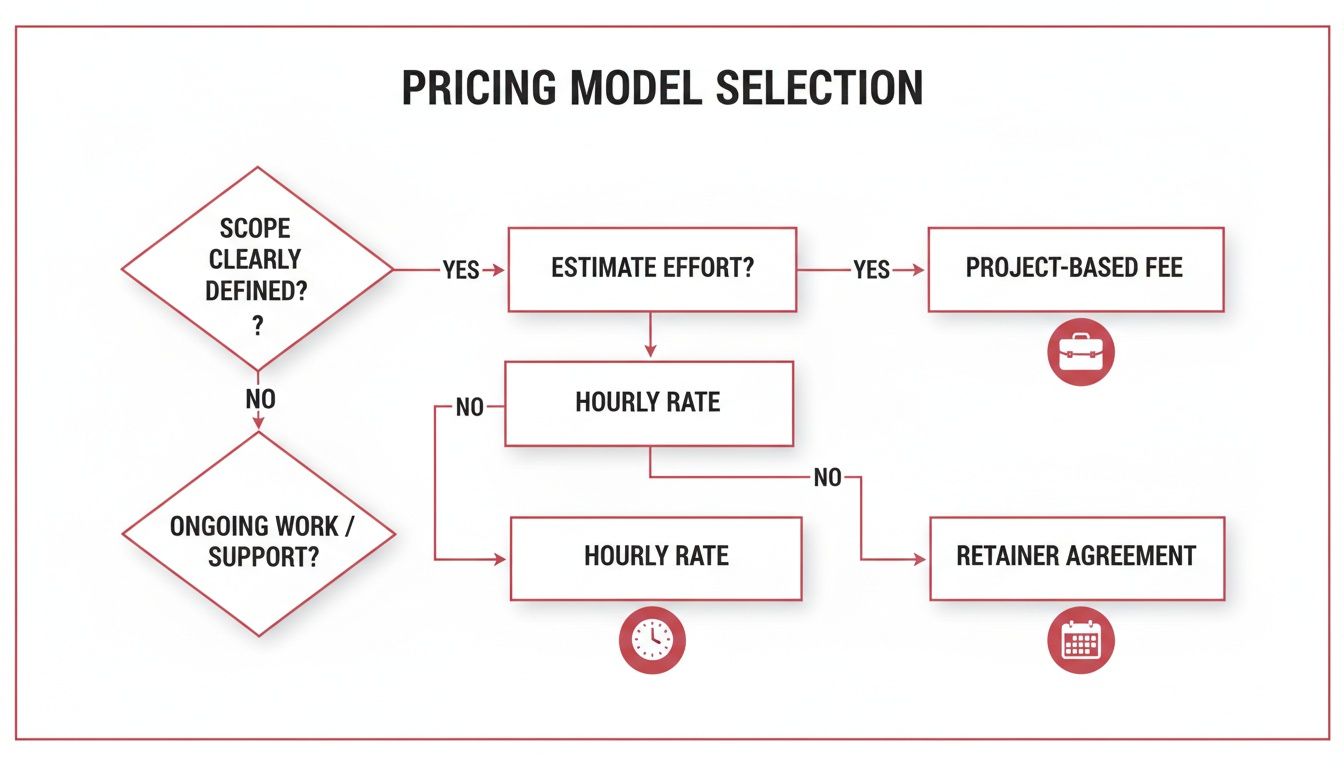
As the chart shows, it really boils down to two things: how clear the project scope is and whether the client needs ongoing support.
Consulting Pricing Models at a Glance
To make it even clearer, here’s a quick breakdown of the four models to help you see the pros and cons side-by-side.
Pricing Model | Best For | Pros | Cons |
|---|---|---|---|
Hourly Rate | Projects with undefined scope, new consultants, or quick ad-hoc tasks. | Simple to calculate and track; low risk if scope is uncertain. | Caps earning potential; punishes efficiency; clients may micromanage hours. |
Project-Based | Clearly defined projects with specific deliverables (e.g., website build, market research report). | Budget certainty for the client; rewards your efficiency; focuses on the outcome. | Requires accurate upfront scoping; scope creep can destroy your profit margin. |
Value-Based | High-impact projects where you can quantify the ROI for the client (e.g., cost savings, revenue growth). | Highest profit potential; aligns your fee with client success; positions you as a partner. | Requires strong negotiation skills and confidence; harder to sell if ROI is unclear. |
Retainer | Ongoing advisory, support, or implementation work where the client needs consistent access. | Predictable, stable monthly revenue; fosters a long-term partnership with clients. | Can lead to "scope bleed" if boundaries aren't clear; your time is committed. |
Choosing the right model is a strategic decision that directly impacts your profitability and client relationships. Think about what you're delivering and pick the structure that best reflects that value.
Matching the Model to Your Service
There’s no single "best" model. It all depends on the work.
If you’re helping a company navigate a messy, unpredictable M&A integration, an hourly or retainer fee makes sense because the scope is guaranteed to change. But if you’re hired to build a ten-page sales funnel with a clear start and end, a project-based fee is the only way to go.
For example, a client who needs ongoing SEO management and content strategy is the perfect fit for a monthly retainer. They get consistent access to your brain, and you get reliable income. It’s a much healthier partnership than nickel-and-diming them for every small, hourly task.
Value-based pricing really comes into its own when the stakes are high. If you know your supply chain optimization work will save a client $500,000 a year, charging them $50,000 for the project is a no-brainer. Your price is anchored to their massive win, not the 100-or-so hours it might take you.
Ultimately, the mark of a seasoned consultant is knowing how to be flexible. You might use a project fee for a website redesign, an hourly rate for some ad-hoc team training, and a retainer for ongoing advisory—all for the same client. That’s not being inconsistent; that’s being strategic.
Calculating Your Rates for Sustainable Profit
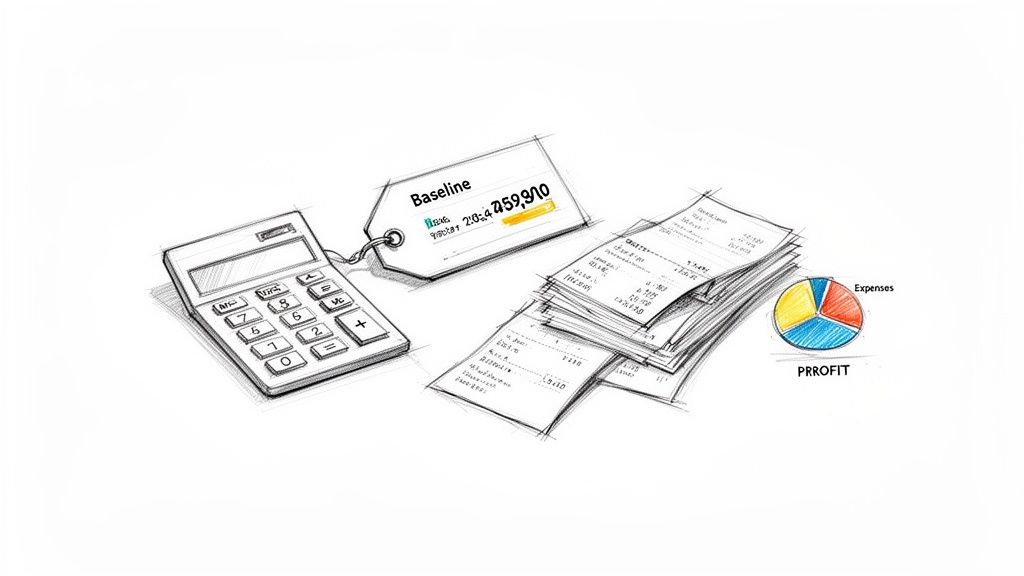
Let's get one thing straight: pricing your consulting services can't be based on a gut feeling or what you think a competitor is charging. If you want to build a business that lasts, your rates need to be rooted in a solid financial foundation. It's time to move from vague ideas to hard numbers that guarantee every project is actually profitable.
The goal here is to establish your Baseline Rate. Think of this less as what you’ll bill by the hour and more as your internal profitability benchmark. It’s the absolute minimum you need to cover all your costs, pay yourself a real salary, and still have a healthy profit left over.
Tally Up Your Total Business Expenses
Before you can set a profitable rate, you have to get brutally honest about what it costs to run your business. So many new consultants only account for the big-ticket items, completely forgetting the small, recurring expenses that bleed you dry over time.
It helps to break them into two camps:
Direct Costs: These are the expenses you can tie directly to delivering a specific client project. Think of that specialized software you need for one engagement, travel costs to meet a client, or the fees you pay subcontractors.
Overhead Costs: This is everything else—the ongoing expenses that keep the lights on, whether you have client work or not. We're talking marketing tools, insurance, office supplies, accounting software, and professional development courses.
Get granular with this. Fire up a spreadsheet and list every single monthly and annual business expense. Add them all up to get your total annual overhead. No cheating.
Determine Your Personal Salary Needs
Your business exists to support you, not the other way around. One of the most common and damaging mistakes consultants make is treating whatever is left over at the end of the month as their "pay." That’s a recipe for burnout.
Instead, you need to proactively decide on a target annual salary.
This number needs to be realistic, covering all of your personal living expenses, savings goals, and, of course, taxes. Don't peg this to a low-paying job you had in the past; set a salary that truly reflects your expertise and financial needs. This isn't a bonus—it's a fixed cost of doing business.
Once you have that number, add it to your total annual business expenses. This combined figure is your total annual revenue target, the bare minimum your business must generate before a single dollar of profit is made.
Key Insight: Your salary is a non-negotiable business expense, not a reward. By baking it into your calculations from the start, you build a pricing model that’s sustainable for you and your business.
Calculate Your Baseline Internal Rate
Okay, now that you have your total costs dialed in, you can finally calculate your baseline rate. This simple formula gives you the absolute minimum you must earn per billable hour just to keep the business afloat.
Estimate Your Billable Hours: Be honest with yourself. A 40-hour work week does not equal 40 billable hours. You're going to spend a huge chunk of your time on marketing, admin, sales, and just thinking. A conservative and realistic starting point is to assume 50% of your time is billable. That’s around 20 hours a week or 1,000 hours a year (assuming you take two weeks off).
Add a Profit Margin: A business without profit can't grow, invest in itself, or survive a slow month. You need a buffer. Aim for a healthy profit margin of 20-30% on top of your costs and salary.
Here’s what that looks like in a real-world calculation:
Annual Business Expenses: $15,000
Your Target Annual Salary: $85,000
Total Costs: $100,000
Add 20% Profit Margin: $20,000
Total Revenue Goal: $120,000
Divide by Annual Billable Hours (1,000): Your Baseline Rate is $120/hour.
This baseline is your secret weapon. It’s your internal guidepost. It ensures that whether you're putting together a five-figure project proposal or a monthly retainer, you know with confidence that it’s built on a foundation of real profit.
Of course, just calculating the rate isn't enough. The long-term health of your business depends on mastering your finances. You can explore some effective cash flow management strategies to build a more resilient operation. To take this even further, grab our handy Value-Based Pricing Implementation Checklist to really sharpen your approach.
Packaging Your Services Into High-Value Offers
Once you've done the math on your internal costs and target rates, it's time to stop thinking about your time altogether. Seriously. Clients don't buy your hours; they buy outcomes. They’re looking for a solution, a transformation, a problem to disappear.
This is where packaging your expertise into clear, high-value offers completely changes the sales conversation.
Instead of whipping up a new custom quote for every single lead, creating tiered packages makes your sales process smoother and gives clients a much easier path to saying "yes." It instantly reframes the conversation from "How much does this cost?" to "Which of these options is the right fit for me?" This subtle shift puts the client in the driver's seat and turns the decision into a choice between good, better, and best.
Structuring Tiered Consulting Packages
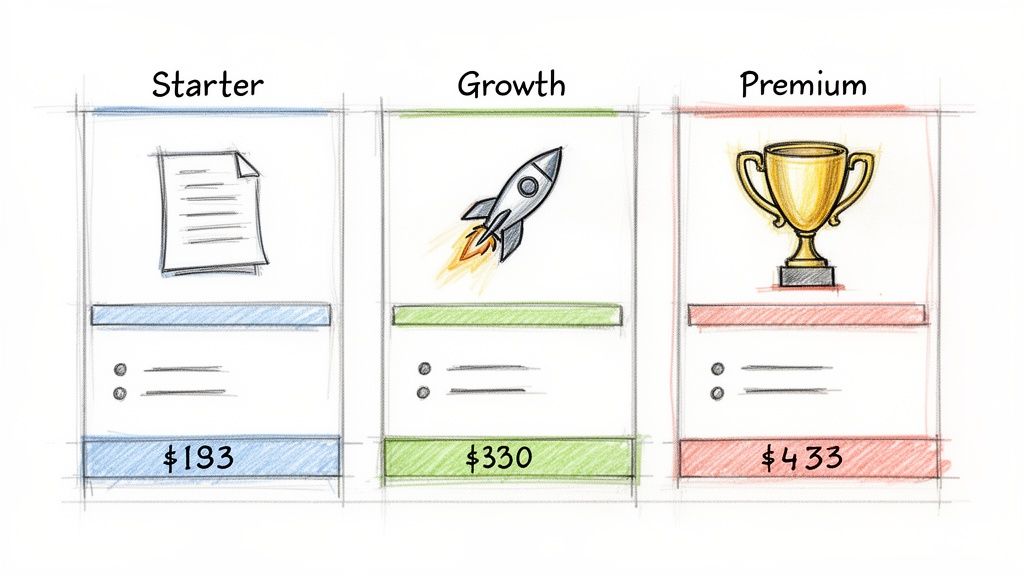
The most effective way I've seen this done—and the way I do it myself—is with a three-tiered model. You've probably seen it before: Starter, Growth, and Premium, or something similar. This approach works because it speaks to clients at different stages and with different budgets, which immediately widens your potential market.
The real key is to design each package to solve a specific level of a problem for a specific type of client.
Tier 1: The Starter Package This is your foot-in-the-door offer. It's perfect for clients who need a targeted, contained solution without a massive commitment. Think diagnostics, a strategic roadmap, or a one-off audit. The goal here is to deliver a quick, tangible win that proves your value and opens the door for bigger projects down the road.
Tier 2: The Growth Package This should be your sweet spot—the ideal solution for your target client. It bundles your core consulting with hands-on implementation support, delivering a much more complete transformation. You want this to be the package most clients choose.
Tier 3: The Premium Package This is the "white glove," all-inclusive offer. It’s built for clients who want the fastest, most comprehensive results and are willing to pay a premium for it. This package usually includes everything from the lower tiers plus things like exclusive access to you, done-for-you services, and long-term support.
Pro Tip: Always position your Tier 2 package as the "best value" or "most popular" choice. By anchoring it between a lower-cost and a high-ticket option, you make it the most logical and appealing selection for the majority of prospects. This is classic pricing psychology at work.
This tiered structure simplifies the buying process and immediately positions you as a strategic partner, not just a hired hand trading time for money.
Bundling Services to Boost Perceived Value
A great package is more than just a block of your time. It's a curated collection of deliverables that, when combined, feel far more valuable than the sum of their parts. The real magic happens when you bundle your core consulting with valuable extras that don't cost you much to add but significantly increase the perceived value.
For instance, instead of just selling "10 hours of marketing strategy consulting," you could create a "Marketing Launchpad" package that includes:
A complete marketing audit and competitor deep-dive.
A 90-day strategic action plan (this is your core deliverable).
A toolkit of custom social media templates.
One 60-minute team training workshop on how to execute the plan.
30 days of email support for any follow-up questions.
See the difference? The offer immediately feels more tangible and robust. The client isn't just buying your brain; they are buying a complete solution with tools and ongoing support.
A great way to add immense value without creating everything from scratch is to incorporate high-quality PLR content—like checklists, workbooks, or even entire courses. You can find excellent resources to create irresistible offers that clients will be excited to invest in.
I've put together a sample table to show you how this might look in practice.
Sample Tiered Consulting Package Structure
Feature/Deliverable | Tier 1 (Starter) | Tier 2 (Growth) | Tier 3 (Premium) |
|---|---|---|---|
Initial Strategy Session | 90-Minute Call | 2 x 90-Minute Calls | Full-Day Onsite Workshop |
Strategic Action Plan | Foundational Roadmap | Comprehensive 90-Day Plan | Full 12-Month Plan + Financials |
Implementation Support | Email Support (14 Days) | Bi-Weekly Calls (3 Months) | Weekly Calls + On-Demand Support |
Custom Templates | 5 Social Media Templates | Full Template Library | Library + Custom-Built Tools |
Team Training | - | 1 x 60-Minute Workshop | 3 x Workshops + Recordings |
Reporting & Analytics | - | Monthly KPI Report | Real-Time Dashboard + Weekly Report |
Direct Access | - | - | Private Slack Channel |
This structure makes it incredibly clear what the client gets at each level, helping them self-select the option that best fits their needs and budget.
Defining Clear Deliverables and Outcomes
For every package you create, you must spell out exactly what the client gets. Ambiguity is the number one enemy of a successful consulting project and the fastest way to scope creep and unhappy clients.
Your proposal needs to outline every component, leaving zero room for interpretation.
Get specific about:
Deliverables: What tangible items will they receive? (e.g., "A 25-page PDF brand strategy guide," or "A fully configured and tested CRM dashboard.")
Timelines: What's the estimated duration? (e.g., "This project will be completed within 6 weeks from our official kickoff date.")
Process: What does working with you look like? (e.g., "Four 60-minute weekly strategy calls," or "One full-day onsite workshop at your office.")
Outcomes: What result can they realistically expect? Focus on the transformation. (e.g., "Walk away with a clear brand message that attracts your ideal customer," or "Increase qualified lead generation by a projected 15-20% within the first quarter.")
This level of detail does more than just manage expectations—it builds trust and justifies your price. When a client sees exactly what they are investing in and the specific outcome it will produce, the price tag becomes secondary to the immense value you're providing.
Presenting Your Price and Navigating Negotiations
You can have the perfect pricing model and the most brilliant packages, but it all falls apart if you fumble the presentation. How you introduce your fee is just as important as the number itself.
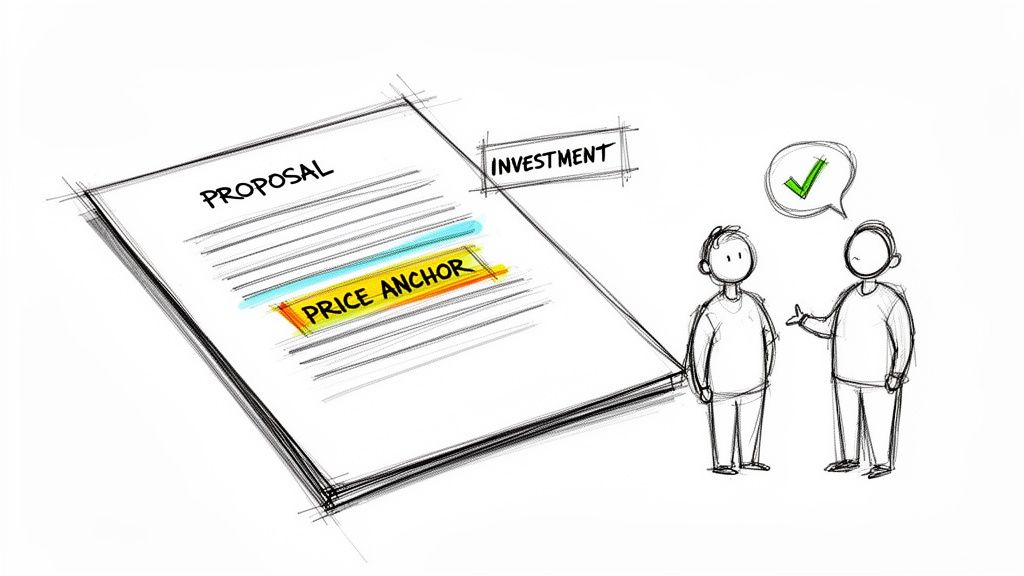
The goal is to build such a compelling case for the value you provide that by the time the client sees the price, it feels like a completely logical—and worthwhile—investment. This means shifting away from just sending a price list. Your proposal isn't a menu; it's the final chapter of a story you've been building together.
Crafting a Proposal That Sells Itself
A winning proposal tells a story that leads the client to one simple conclusion: hiring you is the best decision they can make. It needs to follow a narrative arc that puts their world front and center before you ever mention your solution.
Here’s how that story should unfold:
The Current Situation: Kick things off by summarizing their challenges, goals, and the specific pain points you discussed. Use their own language to show you were actually listening.
The Desired Future State: Paint a vivid picture of what success looks like once your work is done. What specific, tangible outcomes will they achieve? Make it real for them.
Your Proposed Solution: Now, you can detail your recommended approach, outlining the scope, deliverables, and timeline. This is where you introduce your carefully crafted packages.
The Investment: Only after you’ve built a powerful case for the transformation do you present the price.
When you structure it this way, the price is anchored to the outcome, not just a list of tasks. The conversation stops being about cost and starts being about getting them to that desired future.
Anchoring Your Price and Framing the Value
The very first number a client sees sets a powerful psychological anchor that colors their perception of everything that follows. You can use this to your advantage. When presenting your packages, always lead with your highest-tier option.
For example, you might say, "Our all-inclusive Premium package, which includes on-site workshops and a dedicated support channel, is a $25,000 investment. We also have our most popular Growth package at $15,000." Suddenly, that $15,000 price tag seems much more reasonable in comparison.
Another game-changing technique is to frame your fee against the Cost of Inaction.
What is it costing their business to not solve this problem? Put a number on it. If their issue is losing them $10,000 a month in revenue, your $15,000 project fee to fix it for good becomes an obvious, even urgent, investment.
This simple shift reframes your price from an "expense" into a solution that stops the bleeding and generates a clear return. All of a sudden, not hiring you becomes the more expensive and risky choice.
Responding to Price Pushback and Discount Requests
Sooner or later, a client will ask for a discount. It's just part of the game, and how you handle it says everything about your confidence and the value you place on your work. Cave too easily, and you signal that your price was inflated from the start.
Instead of just dropping your price, respond by opening a conversation about the scope.
Here’s a simple, professional script you can adapt:
Client: "This is a bit more than we budgeted for. Is there any flexibility on the price?"
You: "I understand completely. To help us get closer to your budget, which parts of the proposed scope would you be most comfortable removing or scaling back?"
This approach does a few critical things. It reinforces that your price is tied directly to the value and work involved. It also puts the ball back in their court, forcing them to weigh what’s most important. You’d be surprised how often, when faced with giving up a key part of the solution, clients magically find the budget for the original proposal.
Mastering these conversations is a core consulting skill. For a deeper dive, check out our resources on the art of negotiation.
Remember, you aren't just selling services; you are selling confidence and results. Holding firm on your price while being flexible on scope shows you're a serious professional who stands behind their work.
When and How to Raise Your Consulting Rates
Your consulting prices aren’t set in stone. Think of them as a living part of your business strategy. As your expertise deepens, your portfolio of wins grows, and your results start speaking for themselves, your rates have to evolve, too. Raising your prices isn't just an option; it's a necessary step to match the increasing value you bring to the table.
Keeping your prices stagnant is a classic mistake that leads straight to burnout and feeling undervalued. A lot of consultants hesitate to bump up their fees, especially with clients they already have. The fear of losing that business is real. But if you want to grow sustainably and scale your income as you scale your impact, you have to increase your rates strategically. The secret is knowing when to make the move and how to communicate it like a pro.
Clear Signals You Are Underpriced
The first step is simply recognizing you're undercharging. The signs are usually staring you right in the face once you know what to look for. These are strong indicators that demand for your expertise is starting to outrun your current price point.
Keep a close eye out for these trends:
Your calendar is constantly full. If you're booked solid for months and find yourself turning away good work, that’s the market screaming that you can command a higher fee. It's a textbook sign of high demand.
You're closing almost every proposal. A closing rate hovering near 100% might feel like a win, but it’s often a red flag. It probably means your price isn't creating any friction at all, which suggests you’re leaving money on the table.
You have a strong portfolio of results. Once you've got a solid collection of glowing testimonials and case studies that prove a clear ROI for your clients, your value is no longer just theoretical—it's proven.
Your skills and expertise have grown. Did you just finish a new certification, develop a proprietary process, or gain deep experience in a high-demand niche? Your pricing should absolutely reflect that new level of expertise.
If you’re spending 90% of your time on billable client work, you have zero time left for business development or strategic planning. Raising your prices lets you work with fewer, higher-quality clients, which frees you up to work on your business, not just in it.
Communicating Rate Increases to Existing Clients
This is the part that makes most consultants sweat, but it doesn't need to be an awkward conversation. Your goal is to be transparent, confident, and laser-focused on the incredible value you continue to provide. Remember, your best clients are with you for your results, not because you're the cheapest option they could find.
Give your existing clients plenty of advance notice—at least 30-60 days is a professional standard. This shows you respect their budgeting cycles and gives them time to adjust. It's also critical to frame the change not just as a price hike, but as a natural evolution of your service quality and commitment to their success.
Here’s a simple framework for that email or conversation:
Start with Gratitude: Thank them for their partnership. Let them know how much you genuinely value working with them.
State the Change Clearly: Be direct and confident. Announce that your rates will be updated as of a specific future date. No apologies needed.
Reinforce Your Value: Briefly remind them of the results you've achieved together. If you can, mention new skills or capabilities you're bringing to the table that will benefit them.
Provide a Grace Period: This is a powerful gesture of goodwill. Offer to honor your current rate for a limited time or for any projects that are already under discussion.
Example Talking Point: "As my services have evolved to include [New Skill/Process], my rates will be updated to reflect this added value starting October 1st. I wanted to let you know well in advance and thank you for our continued partnership. I’m excited to help you achieve [Next Goal] together."
This approach positions the rate increase as a logical and professional step forward. It reinforces your value and treats your long-term clients like the important partners they are, making the whole transition feel smooth and respectful. This is a critical skill to master when learning how to price consulting services for long-term success.
Common Questions About Pricing Consulting Services
Even with the best models and formulas, pricing can feel tricky when you're staring at a proposal draft. A few questions tend to pop up again and again, especially for consultants who are just starting out or trying to level up their business.
Let's walk through some of the most common pricing dilemmas. Think of this as your quick guide to handling those tough conversations with the confidence of someone who’s been there before. Getting these right can make a huge difference in your bottom line.
What Should I Charge When I'm Just Starting Out?
This is the classic chicken-and-egg problem for new consultants. You need clients to get case studies, but you need case studies to get clients. The temptation is to slash your rates, but that's a trap.
Instead of drastically undercutting the market—which signals a lack of confidence—frame your initial offer as a "beta" or "founding client" rate. This is a strategic discount, not a desperate one.
Offer your services at a modest discount, maybe 15-25% off what your calculations tell you your baseline rate should be. The key is what you ask for in return: a detailed testimonial and permission to use the project as a case study.
This approach does a few critical things:
It anchors your value at a professional level from day one.
It gives you a compelling, non-desperate reason for the lower price.
It helps you build the social proof you absolutely need to land future clients at your full rate.
You're essentially trading a small slice of initial revenue for invaluable marketing assets that will pay you back for years.
How Do I Handle Requests for Discounts or Free Work?
It's going to happen. A prospect will ask for a discount, "pro bono" work, or even suggest trading equity for your services. How you respond sets the tone for the entire relationship. If you give in too easily, you devalue your work and risk attracting clients who don't truly respect your expertise.
The best way to handle this isn't with a hard "no," but by redirecting the conversation back to the scope of work.
If a client asks for a lower price, your first move should always be to explore a smaller scope. Ask, "To bring the investment down to that level, what parts of the project would you be comfortable removing?" This frames your price as directly tied to the value delivered, not an arbitrary number.
When you get requests for free work, politely decline while explaining that you reserve your pro bono capacity for specific non-profit partnerships you've already committed to. This shows you're generous but also strategic and professional with your time.
Should I Adjust My Prices for Different Clients?
Not only is it acceptable to adjust your prices for different clients, it's smart business. A Fortune 500 company has a completely different budget—and perceives value differently—than a local non-profit or a scrappy startup.
Your pricing should reflect the client's ability to get a return on the value you provide. A marketing strategy that helps a large corporation generate an extra $1 million is objectively worth more than the exact same strategy that helps a small business generate $50,000.
This is where value-based pricing really proves its worth. You can keep the project scope relatively consistent but adjust your fee based on the potential ROI for that specific client. This allows you to serve a wider range of clients profitably without having a one-size-fits-all price that’s too high for some and leaves a ton of money on the table with others.