Explained
How to Develop Training Programs That Actually Work

Ever wondered how to build a training program that actually works? I mean one that delivers real, measurable change instead of just checking a box. It’s not about throwing a bunch of content together and hoping for the best.
The secret is a systematic approach that takes you from understanding the real problem to measuring the final impact. It’s a five-stage journey: Analysis, Design, Development, Implementation, and Evaluation. Following this framework is the difference between a program that’s just an expense and one that becomes a powerful engine for growth.
Your Blueprint for High-Impact Training Programs
Before you even think about curriculum outlines or fancy presentation slides, you need a solid roadmap. Without one, you’re just guessing, and that’s a surefire way to waste time and money.
A proven framework for this is the ADDIE model, which we've adapted for the fast-paced world of entrepreneurs and course creators. Don't let the name scare you off—think of it less as a stuffy academic theory and more as your go-to project management guide for creating killer learning experiences. By following this path, you ensure every module, activity, and assessment is directly tied to your bigger business goals.
The Modern ADDIE Framework
The ADDIE model gives you a reliable, step-by-step blueprint for any training you want to create, whether it's for upskilling your internal team or launching a flagship online course. Its cyclical nature is its superpower, encouraging you to constantly improve and keep your programs sharp and relevant.
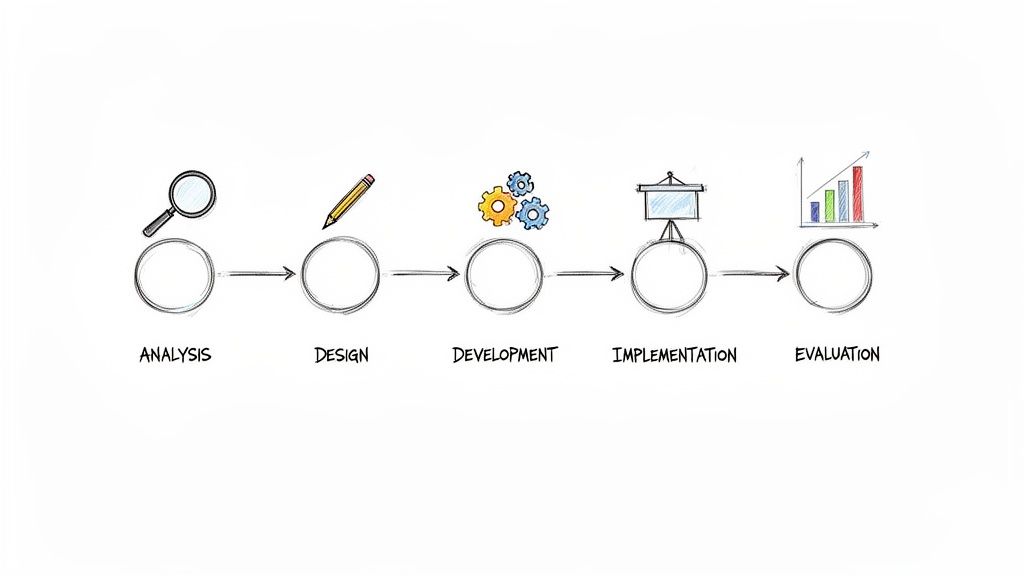
This simple flowchart breaks down the five core stages.
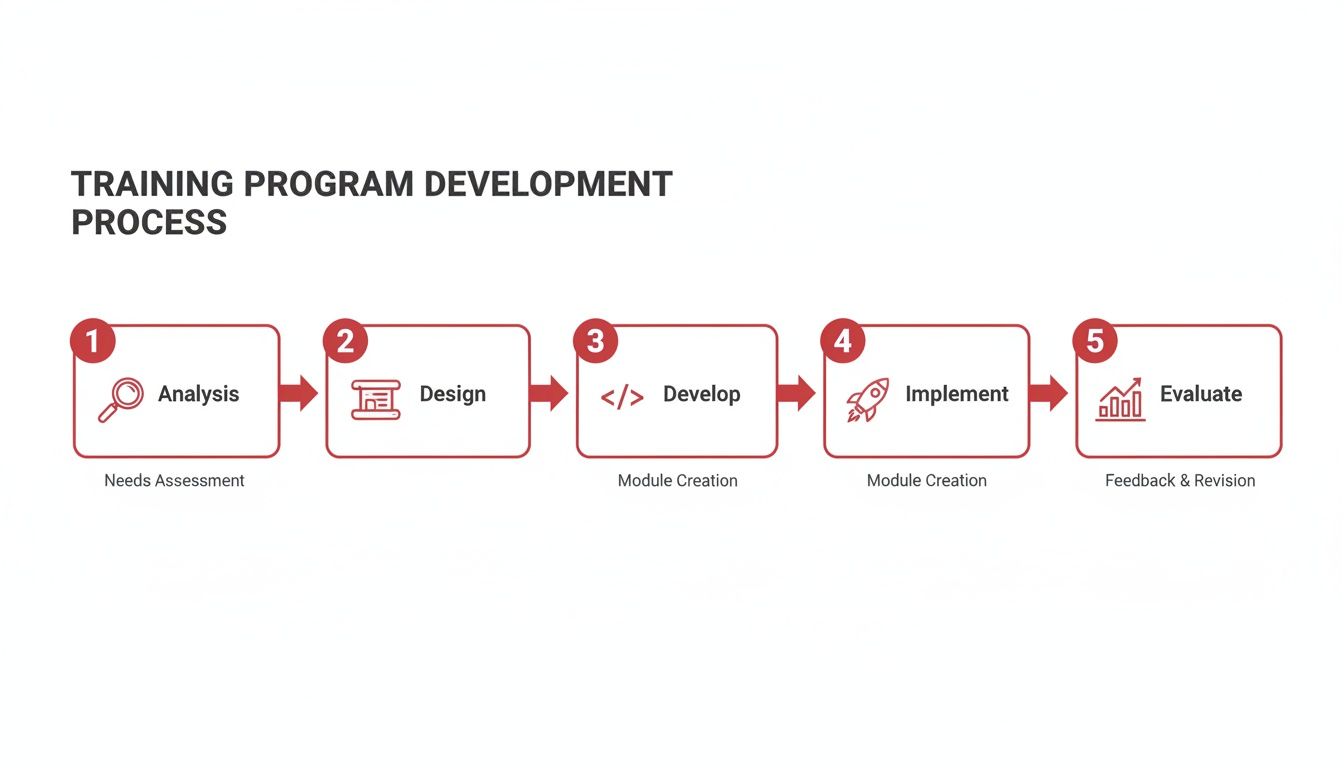
See how each phase builds on the last? This creates a logical flow from your initial idea all the way to analyzing the results.
This journey is critical. It forces you to engineer a solution, not just create content. Each phase has a distinct job to do:
Analysis: This is all about discovery. You're like a detective, diagnosing the actual performance gaps and figuring out what your learners (and the business) truly need.
Design: Now you get to be the architect. You'll draft clear learning objectives, map out the curriculum, and choose the best ways to teach and engage your audience.
Development: Time to roll up your sleeves and build. This is where your blueprint comes to life as you create the course materials, record videos, and assemble everything your learners will interact with.
Implementation: It's launch time! You'll deliver the training—whether that's through an LMS, live workshops, or a mix of both—and manage the entire learner experience from start to finish.
Evaluation: This final stage is all about measurement. You'll assess how effective the program was, gather honest feedback, and calculate its return on investment to prove its value and make the next version even better.
Key Takeaway: A structured process like ADDIE isn't optional—it's essential. It forces you to build your training on a foundation of evidence and strategy, not assumptions. That’s the real secret to creating programs that drive results.
Uncovering What Your Learners Truly Need
Here’s the single biggest mistake people make when creating a training program: they build a solution before they’ve properly diagnosed the problem. Before you even think about outlining a single module, your first job is to answer one critical question: what specific, measurable problem are we actually trying to solve?
This initial discovery phase is what we call a training needs assessment, and it's where you separate your assumptions from the cold, hard facts. It's the foundation that ensures your program addresses a genuine performance gap, not just a perceived one.
Skip this, and you risk creating a beautiful program that solves the wrong problem—a common and very expensive error.
Moving Beyond Basic Surveys
Surveys have their place, but relying on them alone usually gives you a surface-level view of what's going on. To really get to the heart of what your learners need, you have to roll up your sleeves and dig deeper.
Your goal is to pinpoint the gap between current performance and desired performance. What can people not do right now that the business needs them to do?
Here are a few powerful ways to uncover those authentic needs:
Stakeholder Interviews: Talk to the managers, team leads, and even the top performers. Ask them pointed questions about their biggest operational headaches and where they see skill gaps holding their teams back.
KPI Analysis: Dive into the business data. Are customer satisfaction scores dropping? Are sales cycles getting longer? These numbers don't lie, and they often point directly to underlying skill issues that training can fix.
Direct Observation: Go watch your learners in their natural habitat. Seeing how they handle specific tasks can reveal inefficiencies and knowledge gaps they might not even realize they have.
Conducting Revealing Stakeholder Interviews
Interviews are, without a doubt, the most valuable tool you have. They give you the context and nuance that raw data just can't provide. The key is asking open-ended questions that get people talking.
For instance, instead of asking, "Do you need sales training?" try asking, "What's the single biggest obstacle your sales team faces when trying to close a deal?" The second question uncovers a specific pain point—like handling objections or articulating value—that your training can laser-focus on. To get this right, check out our guide on building a stellar customer research interview protocol.
Expert Tip: Don't just interview managers. Talk to the end-users—the people who will actually be taking the training. Their frontline perspective is invaluable for understanding the real-world challenges and making sure your content actually lands.
This data-first approach is becoming non-negotiable. Organizations using advanced learning analytics are able to pinpoint skill gaps with 41% more accuracy and deliver training that is 37% more effective. This makes sense when you see that 90% of executives are adopting skills-based practices, especially since 84.4% of US workers in mid-sized firms now get formal training each year. You can dig into more of these employee training statistics to see how they're shaping program development.
Creating Actionable Learner Personas
Once you've gathered all this rich data, the final step is to bring it to life with learner personas. These are semi-fictional profiles of your ideal learner, but they're grounded in the real data you just collected. A good persona is way more than just demographics.
Your persona should include:
Role and Responsibilities: What does their day-to-day work actually look like?
Current Skills and Knowledge: What do they already know, and where are the specific gaps you identified?
Goals and Motivations: What's in it for them? Are they after a promotion, better efficiency, or a new skill?
Learning Preferences: Do they learn best from video tutorials, hands-on activities, or just reading?
Key Pain Points: What specific frustrations will this training program solve for them?
Developing these detailed personas ensures your training isn't a one-size-fits-all solution. It helps you tailor the content, examples, and activities to connect with your audience on a personal level, making the whole experience far more effective and engaging. This final validation step confirms you're solving a genuine need and builds a rock-solid foundation for everything that comes next.
Designing a Powerful and Engaging Learning Experience
Okay, you've done the hard work of the needs assessment. You’re no longer guessing—you have real data about what your learners need. Now, it's time to switch gears and become the architect of their learning journey. This is the design phase, where you’ll turn that raw data and those learner personas into a solid, powerful blueprint for your training program.
Your first, and arguably most important, job is to define what success actually looks like. You do this by writing clear, measurable learning objectives. Think of these as a contract with your learner: by the end of this module, they will be able to do something specific they couldn’t do before.
Crafting Crystal-Clear Learning Objectives
Vague goals like "Understand the sales process" are basically useless. They're impossible to measure and give you no clear target for your content. We need to get specific, focusing on objectives that are observable and action-oriented.
A fantastic tool for this is Bloom's Taxonomy, a framework that sorts learning into different levels of complexity. More importantly, it gives you a powerhouse of action verbs that force you to be precise about what you expect from your learners.
Remembering: Can the learner recall facts and basic concepts? (e.g., Define the three main types of customer objections.)
Understanding: Can they explain ideas or concepts? (e.g., Explain why a specific closing technique works.)
Applying: Can they use the information in new situations? (e.g., Demonstrate how to handle a price objection using the provided script.)
Analyzing: Can they draw connections among ideas? (e.g., Compare the effectiveness of two different lead nurturing strategies.)
Evaluating: Can they justify a stand or decision? (e.g., Critique a recorded sales call and identify areas for improvement.)
Creating: Can they produce new or original work? (e.g., Design a personalized follow-up email sequence for a new lead.)
When you use strong verbs like these, every single piece of your curriculum suddenly has a clear, undeniable purpose. You're not just creating content anymore; you're engineering a specific outcome.
Pro Tip: Start every learning objective with the phrase, "By the end of this module, you will be able to..." This simple trick forces you to focus on a tangible, action-based outcome for the learner, making your training more effective and easier to evaluate.
Sequencing Your Content for Maximum Impact
Once your objectives are locked in, you need to structure your content in a way that makes sense. A logical flow is critical because it helps learners build knowledge progressively, which prevents them from getting overwhelmed and dramatically boosts retention. It's like building a house—you have to lay the foundation before you can even think about putting up the walls.
For instance, a training program on social media marketing shouldn't kick off with advanced ad optimization. That's a recipe for confusion. A much more effective sequence would look something like this:
Foundational Concepts: Start with the "why." Introduce the core principles of social media marketing and get everyone on the same page with key terms.
Core Skills: Then, move to the "how." This is where you teach practical skills like creating a content calendar or writing copy that actually gets engagement.
Advanced Application: Finally, you can introduce complex topics like A/B testing ad creative or digging into performance metrics.
This simple-to-complex approach just feels intuitive, and it's incredibly effective. It builds learner confidence and ensures they have the foundational knowledge needed to tackle the tougher concepts you'll introduce later on.
Choosing the Right Curriculum Design Model
Here's the thing: there’s no single "best" way to design a curriculum. The right model really depends on your goals, your specific audience, and how complex the subject matter is. To get a better handle on what works, it’s always a good idea to check out the best practices for online courses, as they can give you some great ideas to inform your design choices.
To help you get started, here's a quick look at a few popular models.
Choosing Your Curriculum Design Model
There are several trusted frameworks instructional designers use to build effective training. The table below compares a few of the most popular models to help you find one that aligns with your program's goals and audience.
Model | Best For | Key Feature | Example Use Case |
|---|---|---|---|
Gagné's Nine Events | Structured, skill-based training where mastery of each step is critical. | A detailed, step-by-step process that covers the entire learning journey from gaining attention to assessing performance. | A technical training program on how to use a complex piece of software. |
Action Mapping | Performance-focused training designed to change on-the-job behavior and solve business problems. | Starts with a business goal and works backward to identify the specific actions and knowledge needed to achieve it. | A sales training program designed to increase the team's conversion rate by 15%. |
SAM Model | Rapidly developing and iterating on training projects, especially in fast-changing environments. | An agile, cyclical process of "Savvy Start, Iterate, and Design" that emphasizes prototyping and quick feedback loops. | Developing an onboarding program for a startup where processes are still evolving. |
Each of these models offers a different path to the same destination: a successful learning experience. Pick the one that feels like the best fit for your project.
By thoughtfully selecting your curriculum model, writing sharp objectives, and sequencing your content logically, you create something much more powerful than just a training program. You build an intentional and engaging learning experience. For those looking to dive even deeper, our 4-Phase Workshop Design Framework provides an excellent structure for live and virtual events.
Bringing Your Curriculum to Life
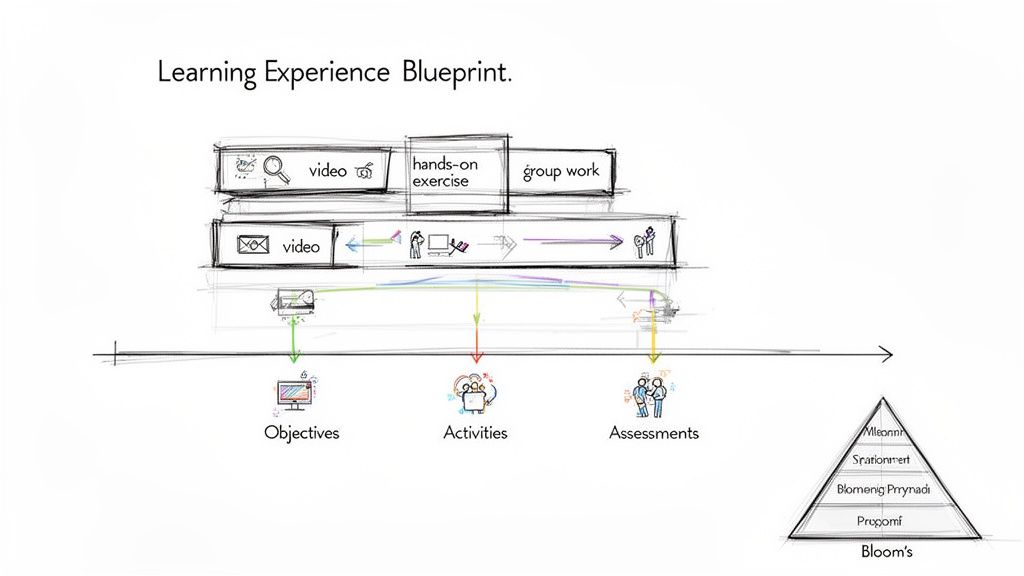
Okay, you've got your solid design blueprint in hand. Now it's time to switch hats from architect to builder. This is the development phase, where your curriculum goes from a structured outline to tangible, high-quality learning materials.
This is where your vision truly becomes a reality—something your learners can see, hear, and interact with. The goal isn't just to pump out content; it's to create assets that actually deliver on the learning objectives you’ve so carefully defined. Every video script, workbook, or quiz needs to serve a purpose.
Creating High-Quality Training Materials
First things first: are you going to create your content from scratch, customize what you already have, or curate materials from other sources? Each approach has its place.
Creating from Scratch: This gives you maximum control over the content, tone, and branding. It's the best route for proprietary topics or when you want to establish a completely unique point of view. For instance, a coach developing a signature leadership framework would build everything from the ground up to protect their IP.
Customizing Existing Assets: This is a massive time-saver. You might already have slide decks from past workshops, internal process docs, or even old blog posts that can be repurposed. A quick update with fresh stats, better visuals, and new examples can breathe new life into proven content.
Curating Content: You don't have to be the expert on everything. Curation means you strategically pull in high-quality external resources—think articles, expert videos, or relevant case studies—to supplement your core material. This can add a ton of credibility and give your learners diverse perspectives.
Whichever path you take, consistency is everything. Make sure all your materials, from videos and slides to downloadable worksheets, have a cohesive look and feel that screams your brand.
Choosing Your Training Delivery Method
How you deliver your training has a huge impact on the learner experience. The right method really comes down to your audience's needs, your budget, and how complex the skills are. It's almost never a one-size-fits-all deal.
A well-designed program is directly tied to better engagement and retention. In fact, a whopping 92% of employees believe well-designed training programs positively impact their engagement levels. What's more, 94% are more likely to stay with a company longer if it invests in their development.
Here’s a quick breakdown of the most common delivery methods:
Delivery Method | Best For | Pros | Cons |
|---|---|---|---|
In-Person Workshop (ILT) | Hands-on skills, team building, and complex problem-solving. | High engagement, immediate feedback, strong networking opportunities. | Can be costly, difficult to scale, and requires travel. |
Virtual Instructor-Led (VILT) | Dispersed teams, interactive discussions, and software demos. | Scalable, cost-effective, and offers live interaction without travel. | "Zoom fatigue" is real; requires strong facilitation to keep learners engaged. |
Self-Paced eLearning | Foundational knowledge, process training, and flexible schedules. | Highly scalable, available on-demand, and consistent delivery. | Lacks live interaction and can feel isolating if not designed well. |
Blended Learning | Comprehensive skill development combining theory and practice. | Combines the flexibility of eLearning with the engagement of live sessions. | Requires careful coordination to create a seamless learner journey. |
My Two Cents: I’m a huge fan of the blended approach. Let learners cover the foundational knowledge on their own time with self-paced modules, then use a live virtual session to focus on application, Q&A, and collaborative problem-solving. It's the best of both worlds.
Selecting the Right Technology Stack
Once your curriculum is ready, you need to deliver it effectively. Often, an LMS specifically tailored for corporate training becomes the centerpiece of your tech stack. Your Learning Management System (LMS) is the digital home for your training program—it's where you host content, enroll learners, track their progress, and hand out certificates.
Choosing an LMS can feel overwhelming, but you can narrow it down by focusing on a few critical features:
Ease of Use: Is the interface intuitive for both you (as the admin) and your learners? A clunky system just creates frustration and becomes a barrier to learning.
Content Compatibility: Can it handle the types of media you've created? Look for support for video hosting, SCORM files, PDFs, and embedded content.
Assessment and Reporting: Does it have solid quizzing features and analytics? You need to be able to track completion rates, assessment scores, and overall engagement to see if your program is actually working.
Scalability and Pricing: Will the platform grow with you? Check the pricing tiers to make sure it stays affordable as you add more learners and courses.
Think of your LMS as the engine that powers the entire learner experience. By carefully selecting your content strategy, delivery method, and technology, you’re setting yourself up to create a seamless and impactful program that truly brings your curriculum to life.
Measuring Success and Proving Your Training's ROI
You’ve designed a fantastic program, developed stellar content, and delivered it with confidence. But now comes the big question: did it actually work? This is where we move beyond gut feelings and start proving your program’s real-world impact with cold, hard data.
This isn't just about collecting feel-good feedback. It's about demonstrating a tangible return on investment (ROI). When you can draw a straight line from your training to concrete business outcomes, you stop being a "cost center" and become a strategic growth engine.
Moving Beyond Simple Smile Sheets
The most common way people "measure" training is with a simple feedback form, often called a "smile sheet." While asking learners if they enjoyed the program is a decent starting point, it barely scratches the surface. It tells you nothing about whether they learned, changed, or performed better.
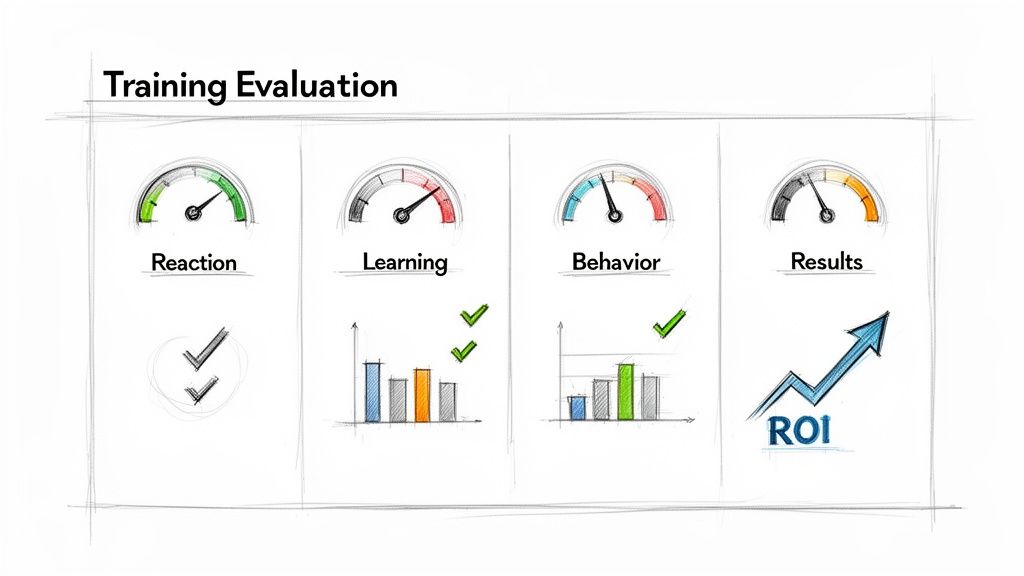
To get the full picture, we can lean on a practical version of the Kirkpatrick Model. It's a classic four-level framework that helps you measure effectiveness in a much more meaningful way, guiding you from initial reactions all the way to bottom-line business results.
The Four Levels of Training Evaluation
Think of these levels as building a case. Each one provides a piece of evidence that, when combined, tells a powerful story about your program's success.
Reaction: This is the "smile sheet" level. Did learners find the training engaging and relevant? Was it delivered well? You can nail this down with post-course surveys asking them to rate the content, instructor, and overall experience.
Learning: Okay, they liked it. But did they actually absorb the information? This is where you find out if knowledge or skills really increased. Use pre- and post-training assessments, quizzes, or skill demonstrations to test their grasp of the core concepts.
Behavior: This is the critical link between knowing and doing. Are people actually applying what they learned back on the job? This one's a bit trickier to measure and often requires manager observations, 360-degree feedback, or analyzing performance data a few months down the line.
Results: This is the ultimate goal—the ROI. Did the training move the needle on key business metrics? This could be anything from increased sales and higher customer satisfaction to fewer errors or faster project completion times.
Key Insight: Don't stop at Level 1. The real magic happens when you show that the knowledge gained (Level 2) led to a change in behavior (Level 3), which in turn produced a measurable business outcome (Level 4). That’s how you prove your ROI.
Connecting Training to Business KPIs
The secret to a powerful evaluation is linking your training directly to the key performance indicators (KPIs) the business already obsesses over. Before you even launch, you need to identify the specific metrics you expect your program to influence.
Here’s what that looks like in the real world:
Business Goal: Increase the sales team's Q3 conversion rate by 10%.
Training Program: A new workshop on advanced objection-handling techniques.
KPIs to Track:
Level 2 (Learning): Average score on a final role-play assessment simulating common objections.
Level 3 (Behavior): Manager observation scores on how well reps apply the new techniques on live sales calls.
Level 4 (Results): The team's actual sales conversion rate for Q3 compared to the previous quarter.
When you frame your evaluation this way, you create a clear, data-driven narrative that proves your program’s value beyond a shadow of a doubt. For a deeper dive into this, it's worth exploring our guide on how to measure what matters most in your business.
This isn't just theory. Companies that invest in comprehensive training programs see a staggering 218% higher income per employee compared to those without formalized training. This landmark finding shows a direct link between structured learning and revenue growth, making a powerful case for investing in quality program development. You can explore the full training study details to see how this plays out across different industries.
By systematically measuring success, you not only justify the time and money spent but also gather invaluable data on what worked and what didn't. This continuous feedback loop is what allows you to refine and improve your programs over time, ensuring they deliver ever-increasing value to your learners and your bottom line.
Common Questions About Developing Training Programs
As you start mapping out your training program, a few questions are bound to pop up. It's totally normal. Getting these common uncertainties cleared up early can save you a ton of time and headaches down the road, keeping your project on track from idea to launch.
Let's dig into some of the most frequent questions I hear from creators.
How Long Does It Typically Take to Develop a Training Program?
There’s no magic number here—the timeline for creating a training program can vary wildly depending on how big and complex it is.
A simple, one-hour live webinar with a slide deck? You could probably pull that together in a week or two. But a comprehensive, multi-module eLearning course packed with custom videos, interactive quizzes, and downloadable workbooks? That's a different beast entirely. You're easily looking at three to six months of dedicated work.
A few key things will stretch or shrink your timeline:
Depth of Analysis: A proper needs assessment takes time upfront but saves you from costly revisions later. Rushing this is a classic mistake.
Content Creation: Are you building everything from scratch or can you repurpose existing materials? Custom video production, for instance, is a massive time investment compared to polishing up a few documents.
Technical Complexity: Your choice of platform plays a big role. Building a course on a user-friendly LMS is way faster than coding a custom, gamified learning portal from the ground up.
As a rule of thumb, many instructional designers budget around 40-60 hours of development time for every single hour of finished eLearning content. Keeping that ratio in mind will help you set a much more realistic schedule.
What Is the Most Common Mistake to Avoid?
The single biggest—and most expensive—mistake is rushing or completely skipping the needs analysis. It's so tempting to just dive in and start creating content based on what you think your audience needs to learn.
But this almost always leads to a program that’s totally misaligned with the real skill gaps or business goals. The result is predictable: rock-bottom engagement, poor knowledge retention, and a terrible return on your investment.
Taking the time to accurately diagnose the problem before you build the solution is the most important thing you can do. Everything else flows from that foundational work.
How Do I Create a Realistic Budget?
A solid budget for your training program has to cover a lot more than just content creation. Forgetting about key expenses is an easy way to derail your project. A realistic budget needs to account for a few different buckets.
Start by mapping out each phase and figuring out what resources you'll need. Make sure you include:
Content Development: This is usually your biggest cost. Think about fees for subject matter experts, instructional designers, graphic designers, and maybe even a video production crew.
Technology and Tools: This bucket covers recurring costs like your Learning Management System (LMS) subscription and any one-time software licenses for authoring tools.
Implementation and Delivery: If you're running live sessions, you'll need to budget for instructor fees. For courses you plan to sell, this should also include your marketing and advertising spend.
Evaluation and Maintenance: Don't forget to account for the time and tools needed to analyze data, gather feedback, and make future updates to keep the content fresh.
It’s always a smart move to add a 10-15% contingency buffer to your total. Unexpected costs are almost guaranteed to pop up, and this cushion ensures you can handle them without cutting corners on quality.