Guide
How to Create Lead Magnets That Actually Convert

An irresistible lead magnet isn't just about giving something away for free. It’s a strategic value exchange.
You’re pinpointing a specific, urgent problem your ideal customer is struggling with and offering a quick-win solution that's so valuable, they can't wait to trade their email address for it. This simple shift in thinking transforms a basic freebie into the first critical step of a long-term customer relationship.
What Makes a Lead Magnet Irresistible
The secret to a high-converting lead magnet has less to do with the format and more to do with the psychology behind it. It works when it makes an immediate, tangible promise.
Think of your lead magnet as the perfect key, designed to unlock one specific door for your audience. It provides instant relief or a clear path forward. This is where so many marketers go wrong—they create something that's broadly useful instead of specifically essential.
To get this right, you have to go deeper than generic customer personas. You need to understand the real-world frustrations and goals of your audience. Knowing how to write compelling content that speaks directly to these precise needs is the essence of an irresistible offer.
The Power of the Quick Win
Let’s be honest, your potential customers are busy. They're drowning in information. A great lead magnet respects their time by delivering a result—fast. Forget the 30-page ebook that takes hours to get through. You want to offer something they can use in minutes.
A "quick win" accomplishes a few key things:
Delivers Immediate Value: It solves a small but nagging problem right away. This makes your new subscriber feel smart and accomplished.
Builds Instant Trust: You delivered on your promise immediately. That proves your brand is credible and worth listening to.
Creates Momentum: A positive first experience makes them far more likely to open your future emails and consider your paid offers.
For instance, a marketing consultant could offer a "5-Minute Headline Analyzer" checklist instead of another generic "Ultimate Guide to Marketing." The checklist gives them an immediate, actionable benefit they can use right now. This principle is a cornerstone of effective lead generation, and you can learn more about the mechanics behind it in our guide on https://www.entrepedia.co/blog/unlocking-the-secrets-of-conversion-psychology-boost-your-digital-marketing-success.
Understanding the Value Ladder
Your lead magnet is the very first step on your value ladder. This is a simple but powerful concept that maps out your customer's journey as a series of steps, each offering more value at a higher price.
Your free lead magnet sits at the bottom, designed to attract the right people and invite them to take that first small step with you.
A successful lead magnet isn't just a transaction; it's an invitation. It should solve one problem completely, leaving the subscriber satisfied yet aware that you hold the solution to their next, bigger problem.
This ensures you’re not just collecting random emails but are actually building a pathway to your core products or services. Each step should logically lead to the next, building trust and showcasing your expertise along the way.
This relational approach is more important than ever. Traditional lead magnets like generic ebooks are losing their punch due to content fatigue. Marketers are discovering that interactive and personalized offers that deliver immediate value are far more effective at building high-quality email lists that actually convert.
Choosing the Right Format for Your Audience
Once you've nailed down the psychology of an irresistible offer, your next big decision is how you'll package it up. The format you choose is so much more than a delivery method—it directly shapes how your audience sees its value and how easily they can actually use it. A brilliant idea in the wrong format is just going to gather digital dust.
The secret is to get three things in alignment: your audience's preferences, the specific problem you’re solving, and what you can realistically create at a high level. Busy executives, for example, would probably grab a one-page checklist they can scan in seconds over an hour-long webinar. But a group of aspiring artists? They might be dying for a detailed video tutorial.
Think of it like matching the solution to the specific situation. A B2B SaaS company trying to attract leads who are ready to buy could offer an interactive ROI calculator. That speaks directly to decision-makers who care about the bottom line. On the other hand, a wellness coach building initial awareness could run a 5-day email challenge, a format designed to build a relationship and create new habits over time.
Aligning Format With the Buyer's Journey
Different formats just work better at different stages of the customer relationship. If you get this right, you can create lead magnets that meet your audience exactly where they are.
Top of Funnel (Awareness): At this point, people are just starting to realize they have a problem. Your job is to educate and attract them. Low-commitment, high-impact formats like checklists, cheat sheets, short video guides, and fun quizzes are perfect here. They offer a quick, satisfying win.
Middle of Funnel (Consideration): Now, your audience is actively looking for solutions and comparing their options. They need more substance. Webinars, case studies, in-depth guides, and detailed templates work incredibly well because they show off your expertise and prove how your solutions work in the real world.
Bottom of Funnel (Decision): These prospects are on the verge of buying but need that final nudge. Formats that give them a direct taste of what you offer are king. Think free trials, product demos, consultations, and specialized calculators. They make your value proposition tangible.
This decision tree infographic can help you visualize the path to picking the right format based on the problem you're solving for your audience.
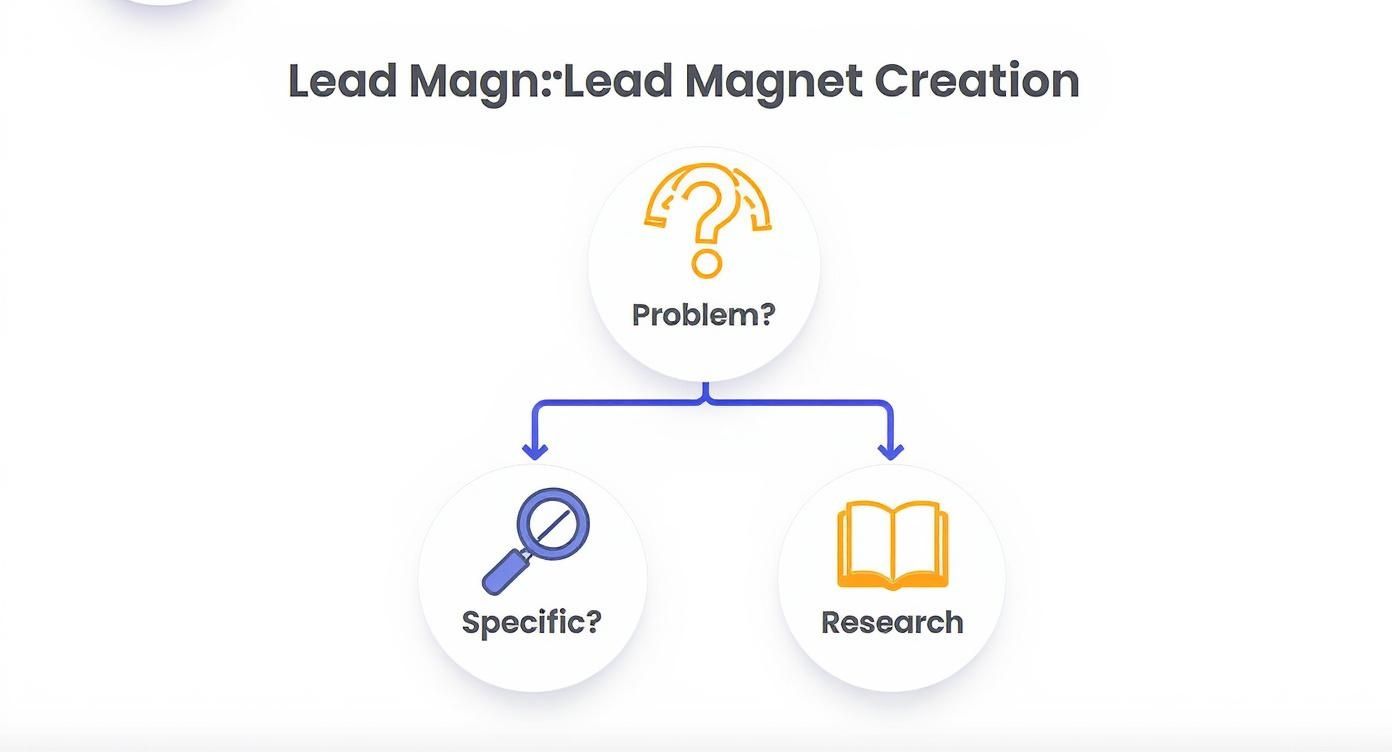
As you can see, the most critical first step is locking down a specific, well-defined problem. Get that right, and choosing a high-performing format becomes much easier.
The Conversion Power of Interactive Content
While classic PDF downloads still have their place, the data shows a massive shift toward more dynamic and engaging options. The difference in conversion rates is huge. As of 2025, the average landing page with a lead magnet converts around 18% of its visitors, but that number swings wildly depending on the format.
Interactive content, such as quizzes and calculators, converts visitors at a staggering 70%, compared to just 36% for passive content like an ebook. This shift shows that audiences crave personalized experiences that provide immediate, tailored feedback.
Even simple cheat sheets can pull in a 34% conversion rate, while quiz lead magnets consistently convert between 20% and 40% of the people who see them. This proves that choosing the right format isn't just about taste—it's a core driver of your results. If you want to dive deeper into the numbers, you can discover more insights about lead magnet conversion statistics.
Lead Magnet Format Comparison
Choosing the right format often comes down to a trade-off between effort and impact. This table breaks down some of the most popular options to help you decide where to focus your energy.
Format Type | Typical Conversion Rate | Best For (Audience/Goal) | Creation Effort |
|---|---|---|---|
Checklist/Cheat Sheet | 25-35% | Providing quick, scannable steps for a specific task. Great for busy audiences. | Low |
Template/Workbook | 20-30% | Helping users actively implement a process or framework you teach. | Medium |
Webinar/Workshop | 15-25% | Deep-dive education, direct audience engagement, and high-ticket sales. | High |
Quiz/Calculator | 30-50%+ | Offering personalized results, segmenting leads, and boosting engagement. | Medium-High |
Ebook/Guide | 10-20% | Establishing authority and providing comprehensive information on a topic. | Medium |
Email Course | 20-40% | Nurturing leads over time and building a relationship through daily value. | Medium |
Ultimately, the best format is one that delivers incredible value to your audience and is something you can realistically produce well. Don't promise a weekly webinar if you don't have the resources to pull it off.
A polished, high-value checklist will always outperform a sloppy, poorly produced video course. Your goal is to deliver on your promise and build trust from the very first interaction. That’s what sets the stage for a lasting customer relationship.
Crafting and Designing Your Lead Magnet
Alright, you've landed on a solid idea and picked the right format. Now for the fun part: actually bringing your lead magnet to life. This is where you roll up your sleeves and turn that concept into a valuable asset people are genuinely excited to get their hands on.
The goal here isn't just to share information. It's to create something that feels premium and professional, setting the right tone for your brand from the very first click.
A killer lead magnet comes down to two things: the content and the design. They’re equally important. You could have the most brilliant advice in the world, but if it’s presented in a sloppy, hard-to-read document, no one will stick around. On the flip side, a gorgeous design with flimsy, unhelpful content will just leave people feeling cheated.
Writing Copy That Converts
Your words are doing the heavy lifting here. The copy needs to instantly grab attention, spell out the value, and convince your ideal customer to act—and it has to do it all in seconds. This isn't the time for formal, academic language. You need to be clear, direct, and laser-focused on the results your reader wants.
Here’s where to pour your energy:
The Headline: This is your make-or-break moment. Be specific and promise a clear, tangible benefit. Ditch "Productivity Guide" for something like "The 5-Step Checklist to Get 10 Hours of Your Week Back." See the difference?
The Core Content: Get straight to the good stuff. Use simple language, short sentences, and make it easy to scan with bullet points and bolded text. People are busy; deliver on your promise quickly without any fluff.
The Call-to-Action (CTA): Your lead magnet is the first step, not the last. At the end of your checklist or workbook, guide them toward what’s next. This could be a link to your core product, an invitation to a discovery call, or another piece of helpful content.
For instance, a business coach might offer a "Goal Setting Workbook." The landing page headline could promise, "Download Your Free Workbook to Map Out Your Most Profitable Quarter Ever." Inside the workbook, after all the actionable prompts, the final page might say, "Ready to make this plan a reality? Let’s talk about my 1-on-1 coaching program."
Designing for High Perceived Value
You absolutely do not need to be a graphic designer to pull this off. Modern tools have made professional-level design accessible to everyone. The focus should be on creating a clean, branded document that’s a pleasure to read—something that looks like it has real monetary value.
A well-designed lead magnet does more than just look good—it instantly boosts the perceived value of the content. When a resource is visually appealing and easy to consume, subscribers feel they've received something genuinely premium, which builds immediate trust and goodwill.
A polished design sends a powerful message. It shows you care about quality and professionalism, reassuring new subscribers that giving you their email address was a smart move.
Essential Tools for Creation and Design
Getting this done is easier than you think, especially with the right tools in your corner. You can create something that looks amazing without a huge budget or a frustrating learning curve.
For Polished PDFs, Workbooks, and Checklists:
Canva: This is the undisputed champion for non-designers. It’s packed with thousands of slick, professional templates for ebooks, worksheets, and checklists. You can easily customize everything—colors, fonts, logos—to match your brand using its simple drag-and-drop editor.
For Interactive Quizzes and Assessments:
Typeform or Jotform: These platforms are perfect for building beautiful, engaging quizzes that feel more like a conversation than a form. Interactive lead magnets like these are gold because they provide personalized results, and that kind of customization drives incredibly high conversion rates.
By pairing benefit-driven copy with a clean, professional design, you’ll craft a lead magnet that does more than just capture emails. You'll make a powerful first impression that lays the groundwork for turning those new leads into loyal customers.
Building Your Promotion and Delivery System
Creating a brilliant lead magnet is a massive accomplishment, but its value is zero if it never reaches your audience. Your next critical mission is to build the infrastructure that puts your resource in front of the right people and gets it into their hands seamlessly.
This is the engine that will drive your lead generation. It’s got two main parts: the capture mechanism (how people sign up) and the delivery automation (how they instantly get what you promised).
Getting these parts right ensures a smooth, professional experience for every new subscriber, reinforcing the trust you just started to build. Without this system, even the best guide is just a file sitting on your computer.
Designing the Perfect Opt-in Experience
Your primary goal here is to make signing up as easy and compelling as possible. This happens on a dedicated landing page or through an embedded opt-in form on your site. A full landing page usually converts better because it gives you more space to be persuasive, but both need the same core elements.
It's worth understanding what a squeeze page is, as it’s a landing page built for one thing and one thing only: capturing that email address with a laser-focused offer.
Regardless of the format, your opt-in needs to have these four things:
A Benefit-Driven Headline: Don't just say "Download Our Guide." Instead, promise a result, like "Get the 5-Step Checklist to Triple Your Blog Traffic."
Persuasive Bullet Points: Quickly list the best outcomes or takeaways. Focus on results, not features. What will they be able to do after using your resource?
Compelling Visuals: Show a mockup of the lead magnet—a cover image for an ebook or a screenshot of a template. This makes the offer feel tangible and more valuable.
A Clear Call-to-Action (CTA): Use strong, action-oriented language on your button. "Get the Checklist Now" or "Send Me the Free Template" is much stronger than a generic "Submit."
Think of this page as your digital storefront. Keep it clean, focused, and irresistible. Strip out all distractions—no navigation menus, no sidebars, just a single, clear path to conversion.
Setting Up Your Automated Delivery Sequence
The moment someone gives you their email is a critical trust-building opportunity. You have to deliver on your promise instantly. Manually emailing new subscribers isn't an option; it’s slow, unprofessional, and impossible to scale.
This is where email marketing automation becomes your best friend.
Your automated sequence should do two things the second someone signs up:
Deliver the Goods: The very first email must contain the link to download or access the lead magnet. Don't make them wait.
Welcome Them Properly: This first email is also your chance for a warm introduction. Briefly thank them, remind them of the value they just received, and hint at what's coming next.
The goal of your first automated email isn't just delivery; it's confirmation. It confirms to the subscriber that they made a smart choice, that your brand is reliable, and that their inbox is now a place where they'll find real value.
Most email service providers make this incredibly easy. Whether you're using a tool like ConvertKit (https://www.entrepedia.co/resources/tools/convertkit) or another platform, you can set up a simple rule: "When a subscriber joins this list, send this welcome email immediately." It’s a single step that guarantees a professional experience for every new lead.
Promoting Your Lead Magnet to Drive Traffic
With your capture and delivery system ready to go, it's time to open the floodgates. Your lead magnet won't promote itself. You need a multi-channel strategy to consistently drive targeted traffic to your opt-in page.
Here are some of the most effective tactics I’ve used:
Content Upgrades: This is a powerhouse strategy. Find your most popular blog posts and create a lead magnet that’s hyper-relevant to that specific article. A post about SEO could offer a "Keyword Research Checklist." Because the offer is so closely tied to what they're already reading, conversion rates can be astronomical.
Homepage and Blog Placements: Don't hide your best offer. Feature it prominently on your homepage, in your website's header or footer, and at the end of every relevant blog post. Make it impossible to miss.
Social Media Campaigns: Regularly promote your lead magnet on your social channels. Create eye-catching graphics or short videos that highlight the main benefit and then pin the post to the top of your profiles for maximum visibility.
Exit-Intent Pop-Ups: I know pop-ups can be annoying, but exit-intent ones can be very effective. They trigger only when a user is about to leave your site, presenting your lead magnet as a final offer of value. Tools like OptinMonster or Sumo specialize in this.
Targeted Ad Campaigns: If you want faster results, running paid ads on platforms like Facebook or Google is the way to go. You can target users based on their interests and demographics, putting your offer in front of the most relevant audience. Start with a small budget to test your messaging before scaling up.
Measuring and Optimizing Your Lead Magnet
Getting your lead magnet out into the world isn’t the finish line—it’s just the start. While creating a killer resource is a huge win, the real growth happens when you understand how people are responding to it and make smart tweaks over time.
If you’re not measuring, you’re just guessing.
Think of your lead magnet as a living, breathing part of your marketing engine. It needs regular check-ups and fine-tuning to perform its best. This means setting up a simple feedback loop: look at the data, come up with an idea for an improvement, test it, and repeat.
Defining Your Key Performance Metrics
To figure out if your lead magnet is actually working, you need to track the right numbers. It's easy to get distracted by metrics that look good but don't mean much. Instead, focus on the data that connects directly to your business goals.
Here are the critical few you should be watching:
Landing Page Conversion Rate: This one is huge. It's the percentage of people who hit your opt-in page and actually sign up. A low number here often points to a weak headline, unconvincing copy, or an offer that just isn't hitting the mark.
Email Open Rate (for the delivery email): This tells you how many new subscribers actually opened the very first email containing your lead magnet. If this is low, your subject line might be falling flat, or your emails could be getting snagged by spam filters.
Click-Through Rate (CTR) in the delivery email: This tracks how many subscribers clicked the link inside that first email to download or access your resource. It’s a great signal of their immediate interest.
Lead Quality: This is less about a single number and more about observation. Are these new subscribers opening your follow-up emails? Are any of them eventually buying from you? A ton of sign-ups that never turn into customers might mean you're attracting the wrong crowd.
Keeping an eye on these numbers in tools like Google Analytics and your email marketing platform gives you a clear, honest picture of what's working and where you're losing people.
Diagnosing and Fixing Common Issues
Once you have the data, you get to play detective. The numbers will tell a story and point you toward the fix. For a deeper look at this process, check out our complete guide on analyzing the success of your lead magnet.
Is your landing page conversion rate looking a little sad? It’s time to start A/B testing. This is where you create two versions of your page (an "A" and a "B") and show each to half your visitors to see which one gets more sign-ups.
A/B testing takes the guesswork out of optimization. Instead of wondering what your audience wants, you let their actions tell you directly. I’ve seen a simple headline change double a page's conversion rate overnight.
Here are a few things you can test:
Headlines: Try pitting a benefit-focused headline against one that asks a provocative question.
Call-to-Action (CTA) Button: Test different colors, sizes, or text. Does "Get the Guide" work better than "Download Now"?
Images: Compare a 3D mockup of your lead magnet against a stock photo of a person who represents your ideal customer.
Copy Length: Do short, punchy bullet points outperform a more detailed paragraph?
If subscribers are signing up but then ghosting you, the problem likely lies in your follow-up sequence. Maybe your welcome email feels too generic, or there's a disconnect between the promise of your lead magnet and the content that follows. Your goal is to refine that welcome sequence to build a solid bridge from the freebie to your paid solutions.
The lead generation field is constantly shifting, especially with new technology. For example, some companies report that adopting AI in their marketing has boosted inbound leads by 99% in just six months. Why? Because AI enables a level of personalization that people now expect, making the old generic ebooks feel dated.
By staying on top of data-driven tools and focusing on continuous improvement, you can make sure your lead magnet remains a powerful engine for your business's growth.
Common Questions About Creating Lead Magnets
Once you start building your first lead magnet, you’ll inevitably run into a few questions. From the nitty-gritty tech details to bigger-picture strategy, getting these common hurdles sorted out early will make the whole process feel a lot less intimidating.
Think of this as your quick-start FAQ. We're cutting through the noise to give you straightforward answers so you can get back to creating.
How Many Lead Magnets Should I Have?
It's easy to fall into the "more is better" trap, but trust me on this: quality always beats quantity. It's far more powerful to have one single, high-converting lead magnet that perfectly tees up your main product than to have ten generic ones floating around your site.
The smart way to start is with a primary "global" lead magnet. This is your workhorse—a comprehensive guide or a killer template that speaks to the majority of your visitors, usually featured right on your homepage.
Once that’s pulling in subscribers, you can get more advanced by creating content upgrades. These are hyper-specific freebies tied to your most popular blog posts. For instance, a blog post about scheduling social media content could offer a downloadable content calendar. The offer is so ridiculously relevant to what they're already reading that conversion rates often go through the roof.
What Are the Essential Tools for Creation?
You absolutely do not need a complex or pricey tech stack to get this done. In fact, you can create a professional-looking lead magnet and get it into your subscribers' hands with just a few core tools.
For Creation & Design: A tool like Canva is a total game-changer, especially if you're not a designer. It has thousands of templates for polished PDFs, workbooks, and checklists, letting you create something that looks amazing without any design background.
For Delivery & Automation: An email marketing service isn't optional here. Platforms like Mailchimp or ConvertKit are perfect for this. They let you build the sign-up form, manage your list, and—most importantly—set up that automated email that sends the lead magnet the moment someone signs up.
For Hosting: To give your lead magnet a proper home, you can use a landing page builder like Leadpages or just create a new page on your own site with WordPress or Squarespace.
The real key is to keep it simple at first. Get comfortable with a few core tools that help you make something professional and deliver it without a hitch. You can always add more sophisticated software later on as you grow.
Why Are My Leads Not Converting Into Customers?
This is easily one of the most frustrating things to experience. If you're getting a ton of sign-ups but almost no sales, the problem nearly always comes down to a fundamental mismatch between your freebie and your paid offers.
First, check for an attraction mismatch. Is your lead magnet attracting the right kind of person, or is it too broad and pulling in an audience that was never going to be a good fit for what you sell? A freebie on "10 Cute Puppy Photos" might get tons of downloads, but it won't find qualified leads for your high-ticket dog training program. Your lead magnet must solve a problem your ideal customer is already trying to solve.
Second, look for a follow-up failure. The lead magnet is just the first handshake. Without a strategic welcome email sequence that follows up, those new leads will go cold fast. That sequence is the bridge between your freebie and your paid product. It needs to build trust, deliver more value, and then naturally introduce your paid solutions.
Can I Use AI to Help Create My Lead Magnet?
Absolutely. AI tools can be a fantastic assistant in this process, especially for breaking through writer's block or getting your ideas structured. You can use them to brainstorm topics, generate an outline, or even rough out a first draft.
But—and this is critical—you have to treat AI's output as a starting point, not the finished product. The real value of your lead magnet comes from your unique expertise, personal stories, and brand voice. AI can give you the skeleton, but you have to provide the heart and soul. Always go back to edit, refine, and inject your own authentic insights. That's what makes a resource truly valuable and uniquely yours.