Guide
Your Guide to Building a High Ticket Sales Training Program

Selling high-ticket products or services isn't like regular sales. It's a whole different ballgame. We're not just moving inventory; we're guiding people through major investment decisions, often costing thousands of dollars. This requires a specialized skill set built on consultative selling, a deep grasp of buyer psychology, and the ability to build unshakable trust.
The Pillars of a Successful High Ticket Sales Training Program
So, what separates a game-changing high-ticket sales training program from all the others? Forget the generic advice you’ve seen a dozen times. This is the blueprint that top entrepreneurs and coaches actually use to build programs that get real, measurable results. We’re moving past theory and into the tangible actions that build your authority and drive serious revenue.
The demand for this kind of expertise is absolutely booming. The global sales training market hit an impressive $10.32 billion in 2024 and is on track to nearly double to $19 billion by 2032. That's not just random growth; it signals a massive shift in how businesses are approaching sales, especially for deals over $50K that demand a higher level of skill. You can discover more insights about the sales training market growth and what it means for the industry.
To build a program that truly stands out, you need to master four foundational pillars. These are the non-negotiables.
Core Pillars of a High Ticket Sales Training Program
This table breaks down the four essential pillars that form the foundation of any elite high-ticket sales training program. Each one is critical, and we'll be diving deep into all of them throughout this guide.
Pillar | Key Components | Primary Goal |
|---|---|---|
Curriculum | Mindset, prospecting, discovery calls, objection handling, closing | To build a repeatable process that turns prospects into clients. |
Delivery | Live coaching, self-paced modules, hybrid models, role-playing | To maximize student engagement, skill retention, and real-world application. |
Technology | LMS, CRM, call recording software, payment gateways | To create a seamless, professional experience for both you and your students. |
Monetization | Pricing, packaging, sales funnels, team compensation | To build a profitable, scalable business model that delivers lasting value. |
Think of these pillars as the core components of a high-performance engine. If one part is weak, the entire system sputters. A great curriculum with poor delivery won't get results, and a slick tech stack can't save a weak business model.
A truly effective program doesn't just teach sales tactics; it transforms participants into trusted advisors who can confidently guide prospects through a significant investment decision.
Throughout this guide, we're going to unpack each one of these pillars, giving you a step-by-step approach to designing, delivering, and scaling a world-class program. This is your starting point for building an asset that produces exceptional outcomes for both you and your clients.
Designing a Curriculum That Delivers Results
A world-class curriculum is the heart of any effective high ticket sales training program. It’s the structured path that turns hesitant reps into confident closers who can actually command premium prices. A great curriculum goes beyond theory—it gives your students actionable skills they can use on their very next sales call.
To get those kinds of tangible results, your curriculum has to be built on proven methods. It should cover the top B2B sales techniques that are essential for high-value deals, making sure your content is both current and genuinely impactful. It's all about focusing on the core skills that define elite performers in a high-stakes sales game.
Foundational Modules for Core Competency
Every great training program starts with a solid foundation. Before anyone gets to touch advanced closing tactics, they need to master the internal and external fundamentals of a high-ticket conversation. These first few modules are non-negotiable for building the confidence and process needed to succeed.
Kick things off with mindset mastery. High-ticket sales is a mental game, and reps have to learn how to crush imposter syndrome, handle rejection from major prospects, and maintain an unshakable belief in the value they're offering. This module should include practical exercises on reframing negative self-talk and building the resilience needed for long, complex sales cycles.
From there, shift to advanced lead qualification. Wasting time on unqualified leads is a massive profit killer. Teach a structured framework like BANT (Budget, Authority, Need, Timeline) or something more modern to help students quickly spot prospects who are a real fit for a premium offer. Give them a qualification scorecard they can use on discovery calls.
This diagram breaks down the four pillars that hold up a successful high-ticket sales training program: Curriculum, Delivery, Tech, and Monetization.
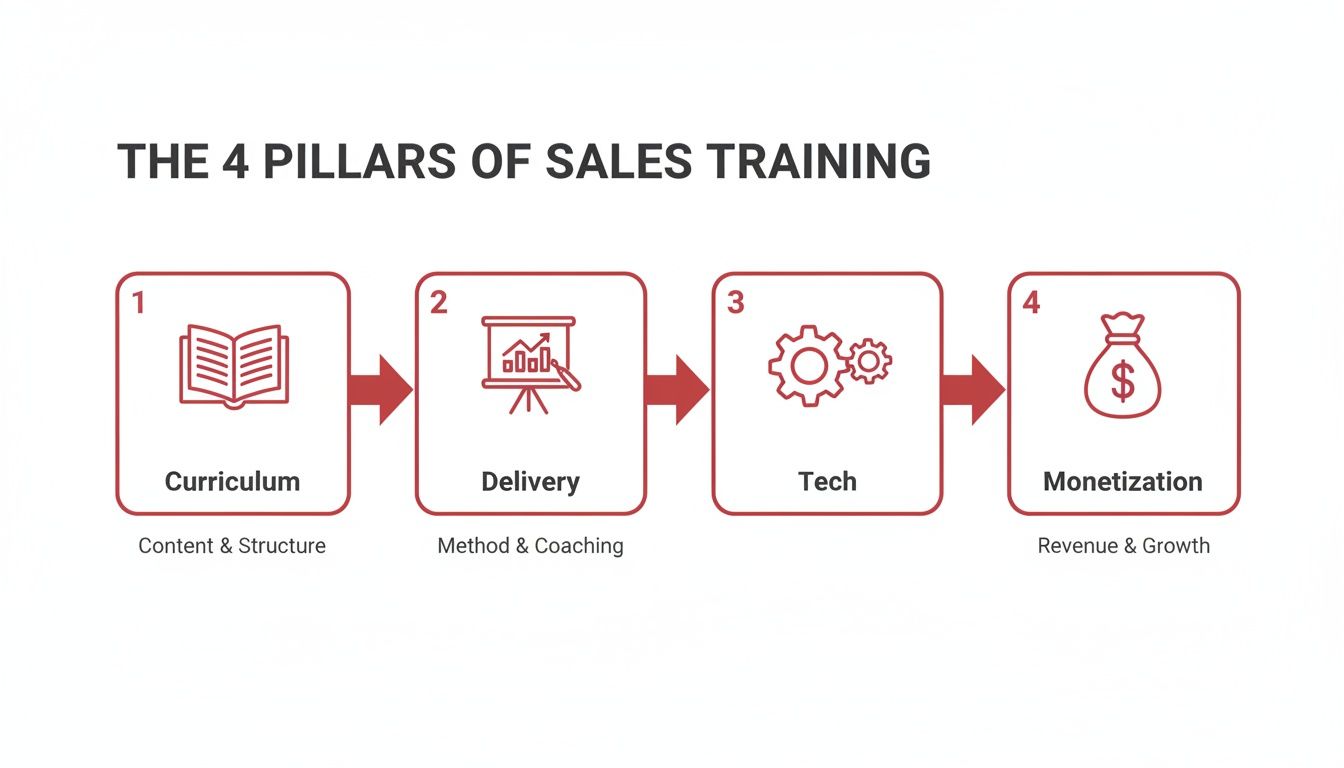
As you can see, a strong curriculum is the starting point. Everything else—how you deliver the content, the tech you use, and how you monetize it—flows directly from the curriculum you build.
Advanced Skills for High-Stakes Deals
Once the foundational skills are locked in, your curriculum needs to level up to the complex challenges unique to high-ticket sales. This is where your program will stand out from generic sales courses. These advanced modules are designed to handle the psychology and complexity of six- and seven-figure deals.
A critical topic here is navigating multi-stakeholder deals. Unlike a simple B2C sale, high-ticket B2B deals almost always involve a buying committee with competing interests—from the CFO obsessed with ROI to the IT director focused on implementation. Your training has to cover:
Stakeholder Mapping: Teach students how to identify the Champion, the Economic Buyer, the Technical Buyer, and potential Blockers within an organization.
Value Messaging: Show them how to tailor the pitch to address the unique pain points and motivations of each individual stakeholder.
Consensus Building: Provide clear strategies for getting all the key decision-makers on the same page and moving toward a collective "yes."
Another must-have module is the psychology of closing. This goes way beyond cheesy closing lines. It's about understanding cognitive biases, creating genuine urgency without being pushy, and framing the final decision as the most logical next step for the client.
True mastery in high-ticket sales isn't about having the perfect script; it's about having the perfect process to guide a complex decision, making the investment feel both safe and necessary for the client.
To make these concepts stick, build your curriculum with a mix of engaging formats. Don't just rely on video lessons. Include downloadable scripts, interactive role-play scenarios, and breakdowns of real-world case studies. Using different learning methods helps accelerate skill development. If you're looking for a structured way to design this, check out our resources on https://www.entrepedia.co/plr-digital-products/rapid-skill-acquisition-prompt-pack to help shape your training. The goal is to create an immersive experience that turns knowledge into an applied skill.
Crafting Scripts And Mastering Objections
In high-ticket sales, the quality of the conversation is everything. This is where deals are won or lost. While nobody wants a salesperson who sounds like a robot reading from a script, going into a high-stakes call without a roadmap is just as bad.
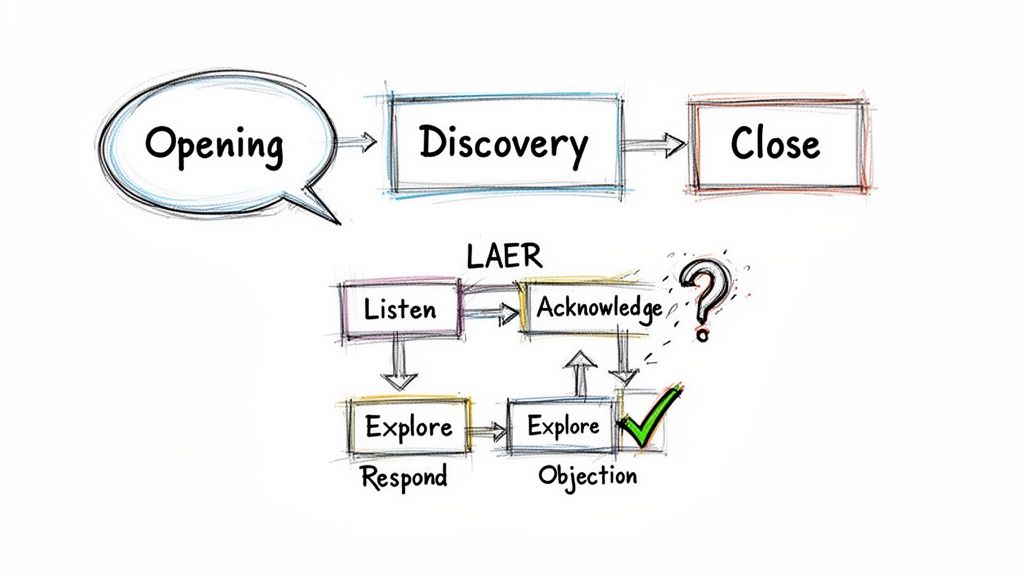
The key is a flexible framework, not a rigid script. It's about building a strategic guide that keeps the conversation on track and ensures every critical point gets covered. Think of it less as a script and more as the guardrails that prevent a multi-thousand-dollar conversation from veering off a cliff.
The Anatomy Of A High-Converting Script Framework
Your "script" shouldn't be a single, intimidating document. Instead, build it as a modular playbook with distinct phases, each designed to smoothly guide the prospect toward a decision.
A powerful framework breaks the call down into four parts:
The Compelling Opening: This is more than just "Hi, my name is..." It's about setting the tone, confirming the agenda, and immediately positioning the salesperson as an expert who is in control of the process.
Deep Discovery: Here’s where the real magic happens. This section is all about asking sharp, open-ended questions to get to the heart of the prospect's pain points, their true motivations, and what they really want to achieve.
The Value Bridge: Once you understand their problems, you connect the dots. This part of the framework is dedicated to showing exactly how your offer is the most logical, direct path from their current pain to their desired outcome.
The Confident Close: A strong close isn't a single, pushy line. It's a natural conclusion to the conversation, built on a series of questions that confirm alignment and make the final "yes" feel like the obvious next step. For a deeper dive, our guide on how to confidently close every call provides specific techniques for this crucial stage.
Moving Beyond Rebuttals To True Objection Handling
This is where most sales training completely misses the mark. They teach canned, defensive rebuttals that just create more friction. In the high-ticket world, an objection is almost never what it appears to be.
"It's too expensive" is rarely about the price tag; it's code for "I don't see the value." And "I need to think about it" almost always means there's a hidden fear or an unanswered question you failed to uncover.
Instead of teaching rebuttals, train your team on a framework like LAER (Listen, Acknowledge, Explore, Respond). This method turns a confrontation into a collaboration.
Listen: Let them talk. Hear the entire objection without cutting them off. Make them feel understood.
Acknowledge: Validate their concern. Simple phrases like, "That's a completely fair point," or "I understand why you'd feel that way," immediately lower their guard.
Explore: This is the most important step. You have to dig deeper. If they say it's too expensive, you ask, "When you say expensive, what are you comparing it to?" Uncover the real issue.
Respond: Only after you truly understand their concern do you offer a response. Now, you can reframe the conversation around value, ROI, or the long-term cost of not solving the problem.
The goal isn't to win an argument. It's to build enough trust that the prospect feels completely safe making a major investment. You aren't selling a product; you're selling certainty.
This level of skill-intensive coaching is precisely why professional high ticket sales training delivers such a massive impact. Well-run programs can generate up to a 600% ROI within six months. And with over 70% of B2B buyers comfortable closing deals over $50K entirely remotely, mastering these conversational skills is no longer optional. This is how you turn skepticism into trust and lay the foundation for a successful close.
Choosing Your Delivery Model and Tech Stack
Deciding how you'll deliver your training is just as important as the curriculum itself. Your content can be top-notch, but the wrong delivery method can sink student results and hamstring your ability to scale. The best choice for your high ticket sales training really comes down to your expertise, what your audience needs, and where you want to take your business.
There isn't a single "right" answer here—just the one that fits your goals. Let's dig into the three main ways you can structure your program.
Each model comes with its own trade-offs between how many clients you can serve, how personal the experience is, and the price you can command. Getting this right is the first step to building something that's both profitable and sustainable.
Comparison of High Ticket Training Delivery Models
To make it easier to see the differences, here’s a quick breakdown of the three main approaches. This table lays out the core trade-offs you'll be making.
Delivery Model | Scalability | Client Intimacy | Typical Price Point |
|---|---|---|---|
Self-Paced Course | Highest | Low | $$$ |
Live Group Coaching | Medium | Medium | $$$$ |
One-on-One Mentorship | Low | Highest | $$$$$ |
You can see a clear pattern: the more of your direct time a client gets, the higher the price. One-on-one mentorship is the most personalized and fetches the highest fees, but you'll hit a ceiling on how many clients you can take on. On the flip side, a self-paced course can sell to thousands, but it lacks that personal connection that often drives real transformation.
Selecting the Right Model for Your Program
Here's a tip from experience: the most successful high-ticket programs often blend these models into a hybrid approach.
Imagine offering a core curriculum of self-paced videos and worksheets, but you supplement it with weekly live group Q&A calls. Maybe you even add a VIP upgrade for one-on-one sessions. This structure gives you the best of both worlds—the scalability of a digital course and the high-touch support that justifies a premium price tag.
This isn't just a hunch; it's where the industry is heading. In 2025, US companies ramped up training investments by 4.9% to a staggering $102.8 billion, with a huge chunk of that going toward high-ticket sales strategies. A solid 53% of sales leaders have already moved to virtual training, with 24% of training hours delivered in virtual classrooms and another 22% through blended learning. The data is clear: mixing live and on-demand delivery isn't just an option anymore—it's becoming the standard. You can read the full research about these training industry trends to see the data for yourself.
Building Your Essential Tech Stack
Once you've landed on a delivery model, you need the right tools to make it happen. A clunky, pieced-together tech stack is a recipe for frustration—for both you and your students. Your goal is a smooth, seamless experience that lets you focus on coaching, not on wrestling with software.
Your tech stack doesn't have to be complicated. You just need to cover three key areas.
Learning Management System (LMS): This is the digital campus for your program. It's where you'll host your videos, worksheets, and other resources. Platforms like Kajabi, Teachable, or Thinkific are popular for a reason—they handle everything from content hosting to payments. For a deeper look, check out our guide on the best course platforms for selling digital products.
Customer Relationship Management (CRM): A good CRM is non-negotiable for managing your sales pipeline and client communications. It helps you keep track of leads, schedule enrollment calls, and stay organized. While powerful tools like Salesforce are out there, something simpler like HubSpot CRM or Pipedrive is usually all a coaching business needs to get started.
Community Platform: High-ticket programs are built on community. You need a dedicated place for students to connect, ask questions, and celebrate their wins. This is where the real magic happens. Tools like Slack, Circle, or even a well-managed private Facebook Group can foster a powerful sense of belonging that adds immense value to your offer.
Your tech stack should be a silent partner in your business. It should work so smoothly that your students barely notice it, allowing them to focus entirely on the transformation you promised.
Your delivery model and tech stack are foundational. They shape how you interact with clients, how much your business can grow, and the kind of impact you can make. Start with the simplest setup that gets the job done and invest in more sophisticated tools as you scale.
Once your program is consistently getting clients incredible results, it's time to think bigger. Real growth in the high ticket sales training game isn't about doing more one-on-one calls. It’s about building a system that scales your impact—and your revenue—without you having to be the one closing every single deal.
This is the phase where you stop being just a coach and start acting like a true business owner. It means building a team, turning your expertise into sellable assets, and setting up a sales process that doesn't depend entirely on your personal time and energy.
Hiring and Training Your First High-Ticket Closers
Bringing on your first high-ticket closer is a massive step. This person literally becomes the voice of your brand, guiding qualified leads to that final "yes." You can't afford to get this wrong, so your hiring process needs to be deliberate and razor-sharp.
Look for someone with a proven track record, sure, but what's even more important is finding someone who genuinely clicks with your company values and can connect with your ideal clients. A great closer isn't just a smooth talker; they're an incredible listener, deeply empathetic, and they have to believe in the transformation your program delivers.
Once you find them, their training has to be rock-solid. You’ll need a comprehensive sales playbook that maps out every single part of your process:
Your Ideal Client Profile: A deep dive into who you serve, what keeps them up at night, and the future they're trying to create.
Call Frameworks: Your exact scripts and the sequence of questions for both discovery and enrollment calls. No winging it.
Objection Handling Guide: A complete library of common concerns people bring up and your LAER-based responses to handle them with confidence.
CRM Protocol: Crystal-clear instructions on how to manage leads and update their status in your CRM.
This playbook isn't just for your first hire; it’s the key to making sure every future team member delivers a consistent, high-quality experience.
Designing a Compensation Plan That Drives Performance
Your compensation plan is what will attract (or repel) top-tier talent. In the high-ticket world, a commission-heavy model is the standard, but the specifics matter. A common and highly effective structure is a base salary plus commission.
The base salary offers a bit of stability, which helps you attract more seasoned pros who won't work on commission-only. The commission, of course, is what lights the fire and rewards killer performance. For high-ticket offers, commissions typically fall between 10% to 20% of the sale price, depending on how complex the sale is and the price of your program. This setup perfectly aligns your closer’s income with the company’s revenue goals.
Think of your sales process and compensation plan as the engine of your business. The playbook is the blueprint for how the engine runs, and the comp plan is the high-octane fuel that makes it go.
Productizing Your Expertise with Tiered Offers
The real secret to breaking through the ceiling is to productize your knowledge. This means packaging your expertise into scalable assets that don't require you to be personally involved in every single sale. The best way to pull this off is by creating a value ladder with different offer tiers.
This approach lets you serve a much wider audience at various price points, meeting people exactly where they are.
Offer Tier | Format | Target Audience | Primary Goal |
|---|---|---|---|
Self-Study | A DIY video course with your best templates and scripts. | People who aren't quite ready for a big investment. | Deliver entry-level value and build massive trust. |
Group Program | Your core curriculum plus live group coaching calls. | Clients who want results and crave community support. | Deliver your signature transformation at scale. |
VIP/Mastermind | All group program access plus one-on-one coaching. | High-achievers who want personalized attention and are willing to pay for it. | Maximize client results and command a premium price. |
A tiered structure like this creates a natural path for clients to follow. Someone might dip their toes in with your self-study course, get a great result, and then be eager to upgrade to the group program for direct access to you. This strategy doesn't just expand your market reach—it dramatically increases the lifetime value of every customer, building a far more sustainable and profitable business for the long haul.
Measuring Success with the Right KPIs
You can't improve what you don't measure. After putting in all the work to build a killer curriculum and a smooth delivery system for your high ticket sales training, the final piece of the puzzle is tracking performance with the right data. Gut feelings are great, but hard numbers tell the real story of what’s actually working—and where your process is quietly breaking down.
Without consistent tracking, you’re just flying blind. You’ll have no idea if that tweak to your sales script actually improved conversions, or if a new lead source is just sending you lower-quality prospects. Data is what turns all that guesswork into a predictable, profitable machine.
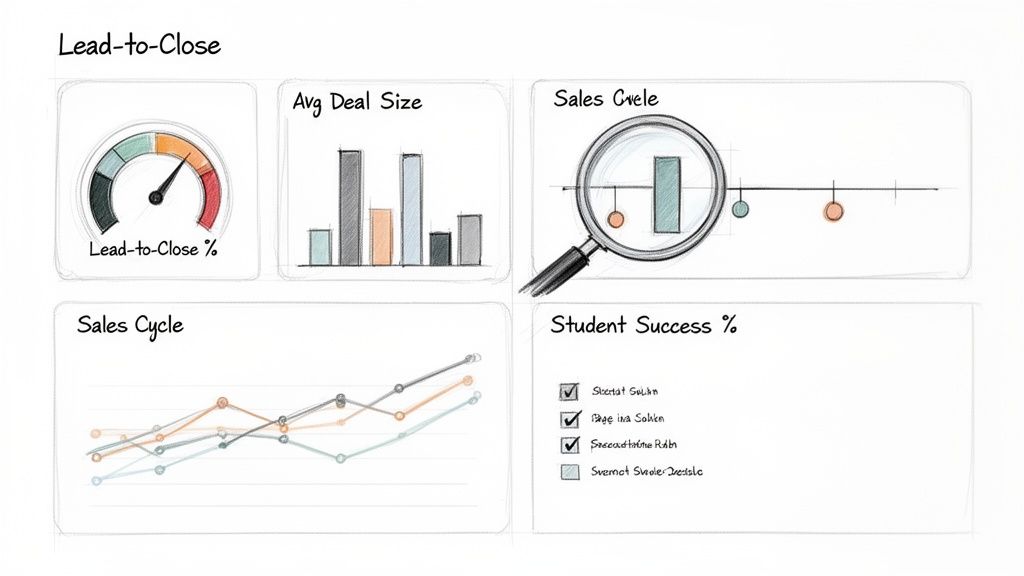
Core KPIs Beyond Vanity Metrics
First things first, forget about vanity metrics like website traffic or how many likes your latest social media post got. For a high-ticket business, you need to zero in on the KPIs that directly impact your bottom line and prove your training gets results.
These are the essential metrics to build your dashboard around:
Lead-to-Close Ratio: This is the big one. It's the ultimate measure of how effective your entire sales process is. If you get 100 qualified leads and close 10 of them, your ratio is 10%. Watching this number tells you exactly how well your team is turning genuine interest into cold, hard revenue.
Average Deal Size: Are you consistently closing deals at your target price point? This KPI shows you the real-world value of each new client and makes sure your pricing and offer structure are holding up.
Sales Cycle Length: How long does it take to guide a prospect from that first conversation to a signed contract? A shorter cycle means your process is tight and efficient. If it starts getting longer, you might have a bottleneck that needs some serious attention.
Data-driven decisions are the bedrock of scalable growth. Your KPIs don't just tell you what happened last month; they give you a clear roadmap for optimizing every single step of your sales funnel, from lead gen all the way to client onboarding.
Tracking Student Success for Powerful Testimonials
Beyond your own sales numbers, tracking the success of your students is arguably the most important metric of all. Their wins are your ultimate proof of concept. They're the fuel for all your future marketing.
You need to create a simple system to keep an eye on key student outcomes. This could be their own revenue growth, the number of high-ticket deals they’ve closed since taking your training, or any other tangible result tied directly to what you teach.
When a student hits a major milestone—like landing their first $25,000 client—document it immediately. These success stories become your most powerful marketing assets. They provide the social proof you need to attract the next wave of high-value clients. When you track this stuff consistently, you build a vault of testimonials and case studies that make selling your program infinitely easier.
Your Top Questions About High Ticket Sales Training, Answered
When you're diving into something new, it's the practical, "how-do-I-actually-do-this" questions that can stop you in your tracks. Getting clear, direct answers is the key to moving forward with confidence. So, let’s tackle the most common questions I hear about building a high ticket sales training program.
Instead of getting stuck wondering, let's get straight to the point on the concerns that can keep you from launching and scaling your offer.
What's a Realistic Price for a New Program?
Pricing is more art than science, but I'll give you a simple rule I've learned over the years: your price must reflect the value of the outcome, not the volume of your content. A classic mistake is undercharging just because a program is new. Don't do it. Anchor your price to the transformation you're providing.
For a brand-new group program focused on high ticket sales, a price point between $3,000 and $5,000 is a solid place to start. It’s high enough to attract serious, committed clients but still accessible enough for you to gather those crucial first case studies and testimonials. I strongly advise against pricing below $2,500, as it can seriously dilute the perceived value of what you're offering.
Your initial price isn't set in stone. Start with a number that feels like a slight stretch, deliver incredible results for your first group, and then you can confidently raise your rates backed by powerful social proof.
How Much Content Do I Need Before I Launch?
This is the perfectionist's trap that keeps so many amazing programs from ever seeing the light of day. The answer might surprise you: you need far less content than you think. You absolutely do not need a fully fleshed-out, 12-module video library to get started.
Here’s all you really need to launch:
A Clear Program Outline: Know the core modules and the specific transformation you promise.
Module One Content: Have the first week or two of materials ready so new clients can dive in right away.
An Onboarding Process: A simple welcome sequence and a plan for your first live call is enough.
You can build the rest of the curriculum week-by-week, right alongside your first cohort of students. This "just-in-time" content creation is actually better, because it ensures your material is directly addressing their real-time challenges.
How Do I Get My First High-Ticket Clients?
Forget about building complicated funnels for your first few clients. Your only goal right now should be to have real conversations with your ideal prospects. The most effective way to do this is by tapping into your existing network and audience with a direct, personal approach.
Reach out to people on your email list or social media followers who have shown interest in your work. Send them a personal message offering a free, high-value "strategy session" to help them solve a specific sales-related problem. On that call, if they’re a good fit, it's a natural transition to introduce your new program as the perfect next step.
For those looking for more depth on this, the guide on Mastering High Ticket Sales Training offers some great insights into building and selling these programs. This kind of manual outreach is exactly how most successful programs land their first 5-10 foundational clients.