Guide
10 Actionable Conversion Rate Optimization Best Practices for 2026

In the world of online entrepreneurship, traffic is vanity, but conversions are sanity. You can have a million visitors, but if none of them take action—buying your product, signing up for your list, or booking a call—your business won't grow. This is where conversion rate optimization (CRO) comes in. It's not about expensive ads or complex funnels; it's the science and art of turning more of your existing visitors into customers. For creators and entrepreneurs using platforms like Entrepedia to launch digital products, mastering CRO is the single most powerful lever for scaling revenue without increasing ad spend.
This guide breaks down the most impactful conversion rate optimization best practices into actionable, prioritized steps. We'll move beyond generic advice to give you a strategic framework for hypothesis-driven testing, powerful copywriting, and funnel analysis, so you can make data-backed decisions that directly impact your bottom line.
You will learn how to systematically improve every touchpoint, from your landing pages and sales funnels to your call-to-action buttons and checkout forms. We'll cover everything from building trust with social proof and optimizing for user experience to implementing personalization and identifying critical conversion bottlenecks. The goal is to provide a comprehensive yet practical blueprint that demystifies CRO and gives you the tools to create a high-performing digital presence. While our focus is broad, those looking for specific, structured workflows can find additional insights. For a concise summary and additional insights into a structured approach, explore 10 conversion optimization best practices for STRs. Let's transform your existing traffic into measurable growth.
1. A/B Testing Landing Pages and Sales Funnels
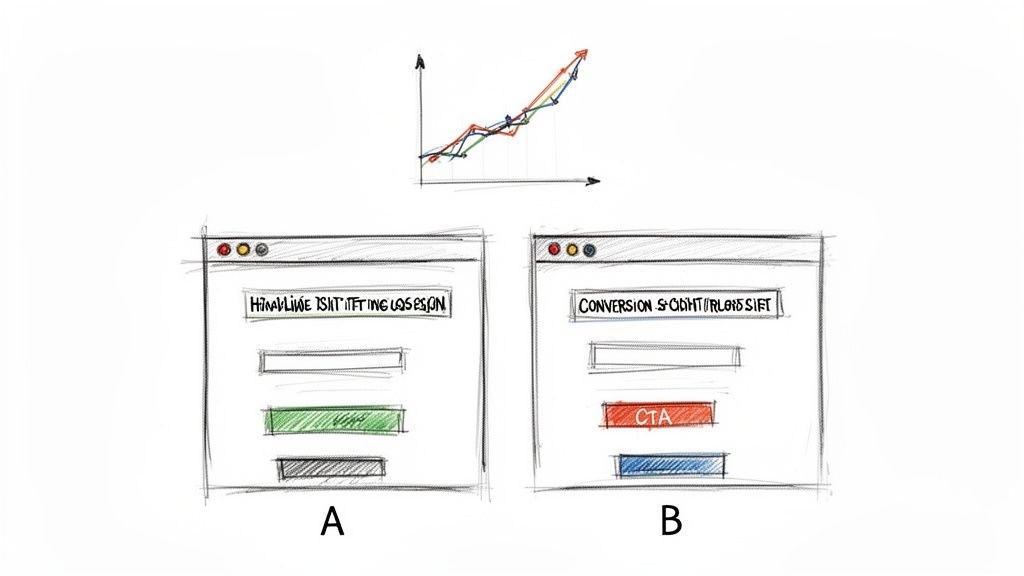
A/B testing, also known as split testing, is a fundamental practice in conversion rate optimization. It involves creating two versions of a single webpage or element, labeled 'A' (the control) and 'B' (the variation), and showing them to different segments of your audience simultaneously. The goal is to determine which version performs better against a specific metric, such as clicks, sign-ups, or sales.
By changing only one variable at a time, like a headline or a call-to-action (CTA) button, you can definitively attribute any change in performance to that specific element. This data-driven approach removes guesswork from your marketing strategy, allowing you to make incremental improvements that compound into significant conversion lifts over time.
Why It's a Top CRO Practice
This method is crucial for entrepreneurs promoting digital products or services, like PLR content libraries or custom coaching packages. For example, you could test two different headlines on your landing page. Version A might say, "Get 1,000+ Done-For-You Products," while Version B experiments with a benefit-driven angle like, "Launch Your PLR Library in 7 Days." The winning headline reveals what truly motivates your target audience to act.
Key Insight: A/B testing transforms your website from a static brochure into a dynamic laboratory, constantly learning and adapting to user behavior to maximize performance.
Actionable Tips for Implementation
Test One Element at a Time: To isolate the impact, only change one variable per test. Test high-impact elements first, such as headlines, CTAs, hero images, and pricing displays.
Run Tests Long Enough: Ensure your test runs for a minimum of two weeks or until you reach at least 100 conversions per variation to achieve statistical significance.
Segment Your Audience: Test different value propositions for specific customer segments. A message that resonates with course creators might differ from one that appeals to marketing agencies.
Document Everything: Maintain a centralized repository of all your tests, hypotheses, and results. This historical data is invaluable for future optimization efforts.
For a deeper dive into setting up your first experiment, you can get started with our guide to A/B testing.
2. Clear Value Proposition and Benefit-Focused Copy
Your value proposition is the single most important element on your homepage. It must instantly answer your visitor’s question: “What’s in it for me?” A strong value proposition clearly communicates the unique benefit your product provides, how it solves a customer’s problem, and why it’s a better choice than the competition. It’s the core of your messaging and a cornerstone of conversion rate optimization best practices.
Benefit-focused copy moves beyond describing features to highlighting the tangible outcomes your customers will achieve. Instead of just listing what your product is, you explain what your customer becomes or achieves with it. For entrepreneurs, this means emphasizing outcomes like launching faster, saving on outsourcing costs, or scaling without hiring. This shift in perspective connects directly with user motivation and dramatically increases the likelihood of conversion.
Why It's a Top CRO Practice
A clear value proposition is the hook that stops visitors from bouncing. In a crowded digital marketplace, you have only a few seconds to capture attention and convey relevance. For a digital product creator, simply stating you have “1,000+ PLR Products” is a feature. Framing it as “Launch Your Digital Product Empire in Days, Not Months” is a benefit-driven value proposition that speaks directly to their ambition and pain points.
Key Insight: People don’t buy products; they buy better versions of themselves. Your copy should focus on the transformation your offer provides, not just the technical specifications.
Actionable Tips for Implementation
Lead With the Outcome: Structure your headline around the biggest pain point you solve or the most desired result you deliver. Make it the first thing visitors see.
Use Specifics and Quantify: Vague promises are forgettable. Use concrete numbers and timeframes to make your benefits feel real, such as “Join 20,000+ creators” or “Build your course in 7 days.”
Test Segment-Specific Propositions: The value proposition for a marketing agency using your PLR content to serve clients will be different from that of a solo course creator. Test different messages for different audiences on your landing pages.
Integrate Social Proof: Weave trust signals directly into your value proposition. Phrases like “The trusted choice for 4.8/5 stars” or “As seen in Forbes” immediately add credibility to your claims.
3. Optimized Call-to-Action (CTA) Buttons and Placement
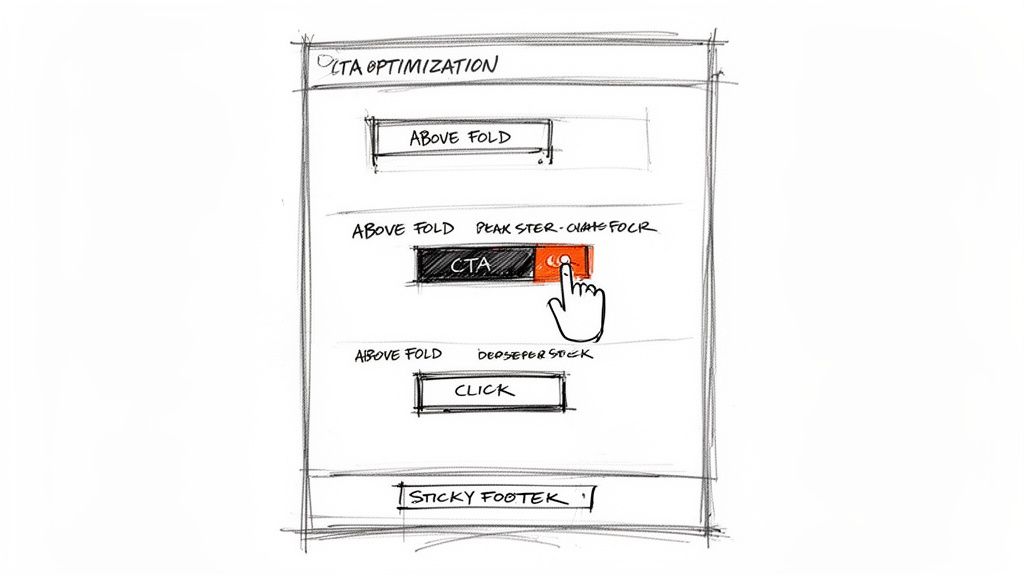
Your call-to-action (CTA) is the most critical conversion point on your page. It's the button, link, or prompt that guides visitors to take the specific action you want, whether that's signing up for a newsletter, downloading a guide, or purchasing a product. Optimizing your CTAs involves a strategic combination of compelling copy, visual design, and deliberate placement to maximize clicks.
Effective CTAs act as a bridge between the value you've presented and the action a user must take to receive it. Small changes to button text, color, or location can have a disproportionately large impact on your conversion rates by reducing friction and clarifying the user's next step.
Why It's a Top CRO Practice
For entrepreneurs selling digital products, the CTA is the final instruction before a sale. Consider an offer for a PLR library. A generic button like "Submit" creates ambiguity, but a specific CTA like "Explore 1,000+ Products" or "Get Instant Access" clearly communicates the immediate value and benefit. By testing different variations, you can uncover the language that best triggers your audience's motivation, directly impacting one of the most important conversion rate optimization best practices.
Key Insight: Your CTA is not just a button; it's the culmination of your entire sales pitch, condensed into a single, action-oriented command.
Actionable Tips for Implementation
Use Action-Oriented, First-Person Copy: Frame the CTA from the user's perspective. Instead of "Get Your Guide," test "Get My Free Guide." This creates a sense of ownership and personal connection.
Create Visual Contrast: Your primary CTA button should stand out from the rest of the page. Use a bold, contrasting color that draws the eye but still aligns with your brand. Avoid using a color that already appears frequently on the page.
Place Strategically: Position your main CTA "above the fold" so visitors see it without scrolling. For longer pages, repeat the CTA strategically after key sections of content to capture users when their motivation is high.
Optimize for Mobile: Ensure your buttons are large enough to be easily tapped on mobile devices. A minimum size of 48x48 pixels is a common best practice to prevent accidental clicks and improve user experience.
4. Strategic Form Optimization (Progressive Profiling)
Strategic form optimization is the process of reducing friction by asking for the minimum amount of information necessary to secure a conversion. Instead of overwhelming potential leads with long, intimidating forms, this method prioritizes simplicity upfront. The practice often incorporates progressive profiling, which gradually collects more user data over subsequent interactions, building a richer customer profile over time.
This approach is one of the most effective conversion rate optimization best practices because it directly addresses a major point of user drop-off. For entrepreneurs offering lead magnets like free guides or templates, a shorter form with fewer fields can dramatically increase sign-ups. By removing barriers, you make it easier for users to say "yes," moving them into your sales funnel where you can nurture the relationship and gather more information later.
Why It's a Top CRO Practice
This technique is a game-changer for digital product creators. Imagine a user lands on your page for a free PLR template. A form with nine fields asking for their name, email, company, role, and phone number creates immediate hesitation. In contrast, a simple form asking only for an email address feels like a fair exchange. ConvertKit exemplifies this by capturing just an email on initial sign-up and then asking about the user's niche or goals in subsequent emails or upon login.
Key Insight: Treat user information as a currency. By asking for less upfront, you lower the "price" of entry, making your offer more appealing and significantly boosting initial conversion rates.
Actionable Tips for Implementation
Start with the Essentials: For top-of-funnel offers like lead magnets, limit your form to just an email address, or at most, a first name and email.
Use Conditional Logic: Show different form fields based on user self-selection. For example, a user identifying as an "agency" could see different questions than a user identifying as a "solo creator."
Add Social Proof: Place trust-building elements near your form, such as "Join 20,000+ creators who use our tools" or a testimonial, to reduce anxiety.
Optimize for Mobile: Ensure your forms are mobile-friendly by stacking fields vertically, using large input areas, and minimizing the need for extensive typing.
5. Social Proof, Trust Signals, Objection Handling and Risk Reduction
This multifaceted practice leverages human psychology to build trust and dismantle purchase barriers. Social proof works on the principle that people trust the actions of others, using elements like reviews, case studies, and customer logos to build credibility. Simultaneously, you must proactively address potential customer objections and reduce perceived risk with guarantees, free trials, and clear policies.
Combining these elements creates a powerful, persuasive experience. A visitor sees that thousands of others trust you (social proof), finds answers to their biggest concerns (objection handling), and feels secure in their purchase decision (risk reduction). This comprehensive approach is essential for any list of conversion rate optimization best practices.
Why It's a Top CRO Practice
For entrepreneurs selling digital products like PLR content or high-ticket coaching, trust is non-negotiable. Displaying a "4.8/5 stars from 2,000+ creators" rating immediately validates your offer. Addressing a common objection like, "Can I really rebrand and sell this content?" with a clear FAQ and testimonials from successful users directly tackles a major conversion blocker before it takes root.
Key Insight: Don't wait for customers to ask questions or feel uncertain. Proactively provide overwhelming proof, answer their unspoken objections, and reverse the risk to make saying "yes" the easiest decision.
Actionable Tips for Implementation
Place Trust Signals Above the Fold: Display your best social proof, like star ratings or "trusted by" logos, in the initial view of your homepage for maximum impact.
Get Specific with Testimonials: Instead of generic praise, feature testimonials that show a clear transformation. For example, "Launched my course in 7 days using this PLR" is far more powerful than "Great product."
Identify and Address Objections: Analyze customer support tickets and survey data to find the top 5-10 hesitations prospects have. Create a dedicated FAQ section or weave answers directly into your sales copy.
Make Your Guarantee Prominent: Don't hide your money-back guarantee or free trial offer in the footer. Feature it as a bold trust signal right next to your primary call-to-action buttons.
For a deeper look at building credibility, explore how platforms like Trustpilot have mastered the art of social proof.
6. Urgency and Scarcity Principles (Limited-Time Offers, Inventory Signals)
Urgency and scarcity are powerful psychological triggers that motivate potential customers to take immediate action rather than delaying a decision. Urgency creates a sense of a time-sensitive opportunity, while scarcity suggests a limited supply. When applied ethically, these principles tap into the fear of missing out (FOMO) and encourage users to convert now instead of later.
Implementing tactics like countdown timers for flash sales, displaying real-time stock levels, or offering limited-time bonuses can significantly accelerate the customer's journey from consideration to purchase. These strategies create a compelling reason to act, making them a cornerstone of effective conversion rate optimization best practices.
Why It's a Top CRO Practice
For entrepreneurs selling digital products, these principles are invaluable. Imagine offering a special launch bonus, like an exclusive template pack, to the first 100 people who purchase your PLR content library. Similarly, a coach could display that they only have "3 February book slots remaining" for their custom packages. This shifts the user's mindset from "I can do this anytime" to "I need to do this now."
Key Insight: Authentic urgency and scarcity provide a legitimate reason for a user to prioritize a purchase decision, effectively overcoming procrastination and boosting conversion velocity.
Actionable Tips for Implementation
Use Authentic Deadlines: Base urgency on real events, such as a promotion end date, a webinar start time, or a course cohort launch. Fake timers that reset on page reload will erode customer trust.
Be Specific and Verifiable: Instead of a vague "limited spots," use precise numbers like "Only 47 custom book slots booked this month." This adds credibility and makes the scarcity feel real and tangible.
Pair with Countdown Timers: Visually represent the time limit with a countdown timer on your landing pages and in your emails. For an email campaign, a clear call-out like, "This offer expires Thursday at 11:59 PM EST," is highly effective.
Combine with a Benefit Reminder: Reinforce the value proposition alongside the urgency. For example, use a banner that says, "Launch your online course in 30 days - lock in founder pricing before it increases Friday!"
To see how top brands leverage these principles, explore our case study on high-converting product launches.
7. Landing Page Design and User Experience Optimization
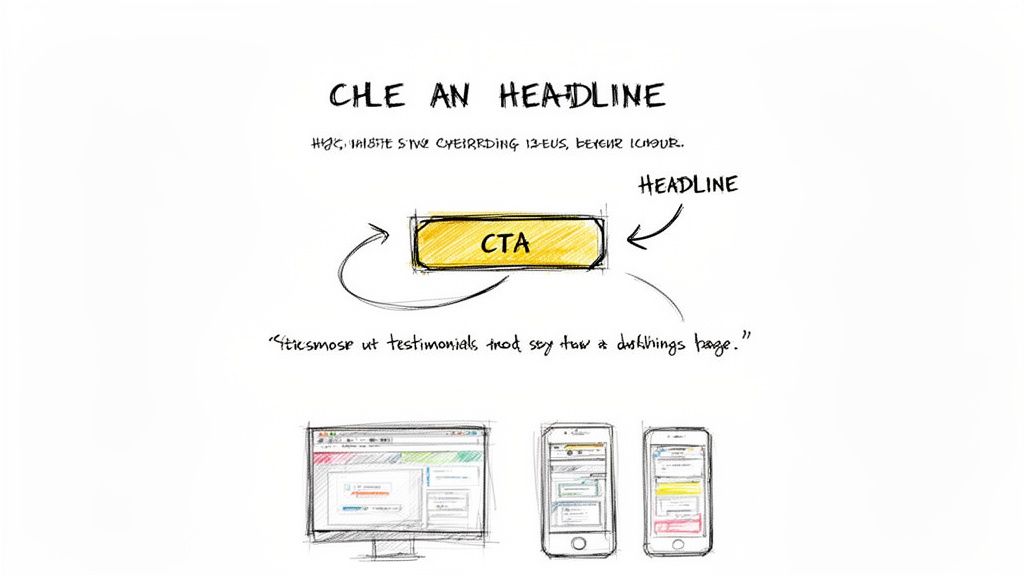
A landing page is a specialized, standalone web page created for a marketing or advertising campaign. It's where a visitor "lands" after they click on a link in an email, an ad, or another digital location. Unlike a homepage with dozens of links, a landing page is designed with a single goal in mind, dramatically increasing its effectiveness as a conversion tool.
Effective optimization involves strategic layout, a clear visual hierarchy, minimal friction, mobile responsiveness, and fast loading speeds. This focus eliminates distractions and guides the user directly toward the desired action, whether it's downloading an ebook, signing up for a masterclass, or requesting a custom quote.
Why It's a Top CRO Practice
For entrepreneurs selling digital products, a well-designed landing page is a non-negotiable asset. Instead of sending traffic to a generic products page, you can create dedicated pages for different audience segments. For instance, a coach visiting your PLR website will convert higher on a page with the headline "Client-Ready Content to Scale Your Practice," while an agency owner would respond better to "White-Label Products for Your Clients." This targeted approach ensures the messaging directly addresses each visitor's specific pain points and goals.
Key Insight: A landing page isn't just a part of your website; it's a focused conversation with a specific customer segment, designed to achieve one very specific outcome.
Actionable Tips for Implementation
One Goal, One Offer: Stick to a single objective per landing page. Remove your site's main navigation menu and any other links that could distract from your primary call-to-action (CTA).
Create Segment-Specific Pages: Tailor your headlines, copy, and images to different customer personas. A page for course creators should highlight "Ready-Made Course Assets," while a page for coaches emphasizes "Done-For-You Client Materials."
Prioritize Page Speed: A slow page is a conversion killer. Optimize images, use a Content Delivery Network (CDN), and minimize code to ensure your page loads in under three seconds.
Design for Mobile-First: Ensure your landing page uses a single-column layout on mobile devices, with font sizes of at least 16px and large, thumb-friendly CTA buttons. Beyond the visual appeal, understanding how to effectively drive action requires continuous testing and a deep dive into proven strategies for your optimizing landing pages for conversions.
For a complete walkthrough of building pages that convert, explore our guide to conversion-driven page design.
8. Email List Building and Segmentation Strategy
While many CRO efforts focus on the website itself, building a qualified email list is a foundational practice for long-term conversion optimization. This strategy involves capturing visitor information with targeted lead magnets, like free guides or templates, and then segmenting that list to deliver highly personalized and relevant content. This approach turns fleeting website traffic into a dedicated audience you can nurture over time.
Instead of treating all subscribers the same, segmentation allows you to tailor your messaging based on their interests, needs, or stage in the buyer's journey. By speaking directly to their specific problems, you build trust and significantly increase the likelihood of conversion when you eventually present an offer.
Why It's a Top CRO Practice
This strategy is powerful for entrepreneurs with diverse customer bases, such as those selling digital products to coaches, agencies, and course creators. For example, a lead magnet titled "The Complete Pricing Playbook for Coaches" will attract a specific segment. You can then follow up with a nurture sequence that addresses the unique challenges coaches face, making your paid solutions feel like the logical next step, not a generic sales pitch.
Key Insight: Your email list isn't just a broadcast channel; it's a series of personalized conversations. Segmentation ensures each subscriber feels understood, dramatically improving engagement and sales.
Actionable Tips for Implementation
Create Segment-Specific Lead Magnets: Develop valuable, free resources tailored to each core audience. A "White-Label Content Sourcing Playbook" will resonate with agencies, while a "30-Day Launch Blueprint" is perfect for course creators.
Segment Upon Signup: Use a simple question on your opt-in form, such as "What best describes your role?" to automatically tag and segment new subscribers from the very first interaction.
Develop Targeted Welcome Sequences: Craft unique email sequences for each segment. The first email should deliver the promised lead magnet, while subsequent emails build trust by providing relevant tips and insights before introducing a product.
Test Your Offers: Just like with landing pages, A/B test different lead magnet offers and headlines to discover which promises generate the highest opt-in rates for each audience segment.
9. Personalization and Dynamic Content
Personalization is the practice of tailoring a website visitor's experience based on their data, such as their location, browsing history, or how they arrived on your site. Dynamic content takes this a step further by changing elements of a webpage in real-time to match these user characteristics. Instead of showing a single, static message to everyone, you present content that is uniquely relevant to each individual.
This approach acknowledges that your audience is not a monolith. A visitor arriving from a Facebook ad for coaching tools has different needs and awareness levels than someone who found you by searching for white-label content for their agency. By dynamically adjusting headlines, offers, and images, you can create a more resonant and persuasive experience that directly addresses each visitor's specific context.
Why It's a Top CRO Practice
For entrepreneurs selling digital products, personalization is one of the most effective conversion rate optimization best practices for making prospects feel understood. For instance, you could show a returning visitor who previously viewed your "PLR for Coaches" category a homepage headline that reads, "Scale Your Coaching Practice with Proven Content." This targeted messaging is far more powerful than a generic welcome, as it immediately validates the visitor's interest and guides them toward the most relevant solution.
Key Insight: Personalization moves beyond a one-size-fits-all approach, creating a bespoke journey that speaks directly to a user's intent and significantly reduces friction in the conversion path.
Actionable Tips for Implementation
Start with Traffic Sources: The easiest way to begin is by customizing headlines based on the visitor's source. Create different versions of your landing page for traffic from Google Ads, social media, and email campaigns.
Segment by Behavior: Use visitor behavior as a trigger. For example, if a user scrolls past your pricing section and hesitates, you could trigger a pop-up offering a consultation or a special discount.
Leverage First-Party Data: Use information collected from your email list to personalize the experience. Show a logged-in user recommendations based on their past purchases, such as, "Because you bought our 'Social Media Template Pack,' you might like this."
Address Returning Visitors: Greet returning visitors with a unique message. A simple "Welcome back!" or displaying testimonials from businesses similar to theirs can build rapport and trust.
10. Conversion Rate Funnel Analysis and Bottleneck Identification
A conversion funnel maps the specific steps a user takes on the path to a desired action, such as signing up for a newsletter or making a purchase. Funnel analysis is the practice of tracking users as they move through these stages to identify where the largest drop-offs occur. These drop-off points, or "bottlenecks," represent the biggest opportunities for conversion rate optimization.
By visualizing the customer journey, you can stop guessing what to improve and start focusing your resources on the leaks that are costing you the most revenue. This approach helps you understand user behavior at a macro level, providing the context you need before diving into page-level A/B tests or user session recordings.
Why It's a Top CRO Practice
This practice is essential for entrepreneurs selling digital products, as it highlights the exact moment a potential customer loses interest. For example, if 1,000 visitors land on your PLR product page, but only 200 initiate checkout, and just 50 complete the purchase, the biggest leak is between the product page and checkout. This tells you to prioritize improving the product page’s CTA, clarity, or trust signals, rather than the checkout process.
Key Insight: Your marketing funnel is only as strong as its weakest link. Funnel analysis pinpoints that link, giving you the highest-leverage area to apply your optimization efforts for maximum impact.
Actionable Tips for Implementation
Define and Track Key Stages: Map out the critical steps in your funnel, from initial landing page visit to final conversion. For a coaching package, this could be: Landing Page → Inquiry Form Submission → Consultation Call Booked.
Calculate Stage-by-Stage Conversion: Measure the percentage of users who advance from one step to the next. Identify the stage with the most significant percentage drop-off; this is your primary bottleneck.
Segment Your Funnels: Analyze funnels separately for different customer segments (e.g., course creators vs. agencies) or traffic sources (e.g., organic search vs. social media). This can reveal that certain audiences get stuck at different points.
Investigate the "Why": Once you identify a bottleneck, use tools like heatmaps and session recordings to understand why users are dropping off at that specific stage. Is a button broken? Is the form too long? Is the value proposition unclear?
To build a high-performing customer journey from start to finish, get started with our guide to optimize your marketing funnel.
Top 10 CRO Best Practices Comparison
Tactic | Implementation complexity | Resource requirements | Expected outcomes | Ideal use cases | Key advantages |
|---|---|---|---|---|---|
A/B Testing Landing Pages and Sales Funnels | Medium — requires experiment setup and stats | Testing tools, sufficient traffic, time for runs | Measurable conversion lifts, incremental optimization | High-traffic pages, headlines, CTAs, pricing | Data-driven decisions, isolates impact of changes |
Clear Value Proposition and Benefit-Focused Copy | Low–Medium — research + copywriting | Customer research, copywriting time, iterative testing | Faster visitor understanding, reduced decision friction | Homepage, hero sections, primary landing pages | Immediately communicates relevance, supports pricing |
Optimized Call-to-Action (CTA) Buttons and Placement | Low — design and copy tweaks; easy to iterate | Design assets, simple tests, minor development | Quick conversion improvements, reduced friction | Buttons on landing pages, forms, checkout flows | High impact with small changes, easy to test |
Strategic Form Optimization (Progressive Profiling) | Medium — requires logic and CRM integration | Form builder, CRM/automation, conditional logic | Higher completion rates, better segmentation | Lead magnets, signups, qualification flows | Reduces friction, improves lead quality and personalization |
Social Proof, Trust Signals, Objection Handling and Risk Reduction | Low–Medium — collect and present proof effectively | Testimonials, reviews, case studies, review platforms | Lower perceived risk, higher conversions and AOV | New customers, high-ticket offers, credibility-sensitive offers | Builds trust, directly answers objections, reduces refunds |
Urgency and Scarcity Principles (Limited-Time Offers) | Low — campaign setup; must be authentic | Promotion calendar, timers, inventory/slot tracking | Faster purchase decisions, short-term revenue spikes | Launches, limited services, flash promotions | Increases conversion velocity, creates campaign momentum |
Landing Page Design and User Experience Optimization | Medium–High — design, copy, and technical work | Designers, developers, copywriters, page tools | Higher conversion rates, better ad ROI, targeted leads | Paid traffic, single-offer campaigns, segment-specific pages | Focused conversion funnels, clearer user journeys |
Email List Building and Segmentation Strategy | Medium — content creation and automation setup | Email platform, lead magnets, workflows, segmentation | Nurtured prospects, higher LTV, repeat engagement | Long-term acquisition, product launches, education funnels | Owned channel, enables personalized outreach and scoring |
Personalization and Dynamic Content | High — needs tracking, data, and tooling | Personalization platform, first-party data, engineering | Improved relevance, higher engagement and conversions | Returning users, multi-segment traffic, account-based marketing | Increases relevance and conversion lift through tailored content |
Conversion Rate Funnel Analysis and Bottleneck Identification | Medium–High — analytics and interpretation | Analytics tools, tracking setup, analyst time | Prioritized optimization opportunities, reduced waste | Prioritizing CRO across landing → signup → purchase | Data-driven prioritization, finds highest-leverage fixes |
From Insight to Impact: Making Optimization Your Competitive Edge
We've explored a comprehensive suite of conversion rate optimization best practices, moving from foundational principles to advanced tactics. The journey from identifying funnel bottlenecks and crafting clear value propositions to deploying strategic social proof and personalizing user experiences is not just about tweaking buttons and headlines. It's about fundamentally understanding your customer's journey and systematically removing every point of friction that stands between their initial interest and their final commitment.
The power of this roundup lies not in implementing every single idea at once, but in recognizing that each practice is a tool in your arsenal. Effective A/B testing provides the scientific method, benefit-focused copy creates the emotional connection, and a seamless user experience builds the trust necessary for a transaction to occur. The goal is to shift from a "set it and forget it" mindset to one of continuous, data-informed iteration.
Your Blueprint for Continuous Growth
True mastery of conversion rate optimization is a long-term commitment, not a short-term fix. The most successful entrepreneurs and creators treat it as a core business function, an ongoing dialogue with their audience where every test provides a new piece of insight. Think of it as a flywheel: each successful optimization builds momentum, creating a more efficient, profitable, and customer-centric business.
To make these principles stick, here are your immediate next steps:
Establish Your Baseline: Before you change anything, ensure your analytics are solid. Know your current conversion rates for key pages like your homepage, product pages, and checkout. This is your starting line.
Identify the Biggest Leak: Use funnel analysis to pinpoint where you lose the most potential customers. Is it a confusing landing page? A long and complicated form? This is your highest-impact starting point.
Formulate a Hypothesis: Based on the bottleneck you identified, create a clear, testable hypothesis. For example, "Changing the primary CTA from 'Learn More' to 'Get Your Free Guide' will increase lead magnet downloads because it states a more tangible benefit."
Launch Your First Test: Don't overthink it. Pick one variable, like the headline or a CTA button, and run a simple A/B test. The goal is to get into the habit of testing and learning.
The Real Value of Optimization
Remember, a "failed" test is never a failure; it's a learning opportunity. If your new headline doesn't outperform the original, you've just gained valuable data about what doesn't resonate with your audience. This insight is just as crucial as a win. It refines your understanding of your customer's psychology, their objections, and their motivations. This is how you build a competitive advantage that is difficult to replicate.
By consistently applying these conversion rate optimization best practices, you are doing more than just increasing a metric. You are building a more resilient, responsive, and ultimately more successful enterprise. You are transforming your digital presence from a static brochure into a dynamic engine for growth, one that adapts and improves with every visitor interaction. Your next breakthrough is waiting, hidden within the data of your next experiment.