Digital Products
Private Label Rights Courses: Scale Your Digital Business Fast
Private label rights courses are a bit like buying a house from a builder who's already done all the heavy lifting—the foundation is poured, the walls are up, and the plumbing is installed. You get to come in, paint the walls your favorite color, pick out the furniture, and call it home. It's a massive head start, letting you skip the most grueling parts of creating a digital product from scratch.
What Are Private Label Rights Courses
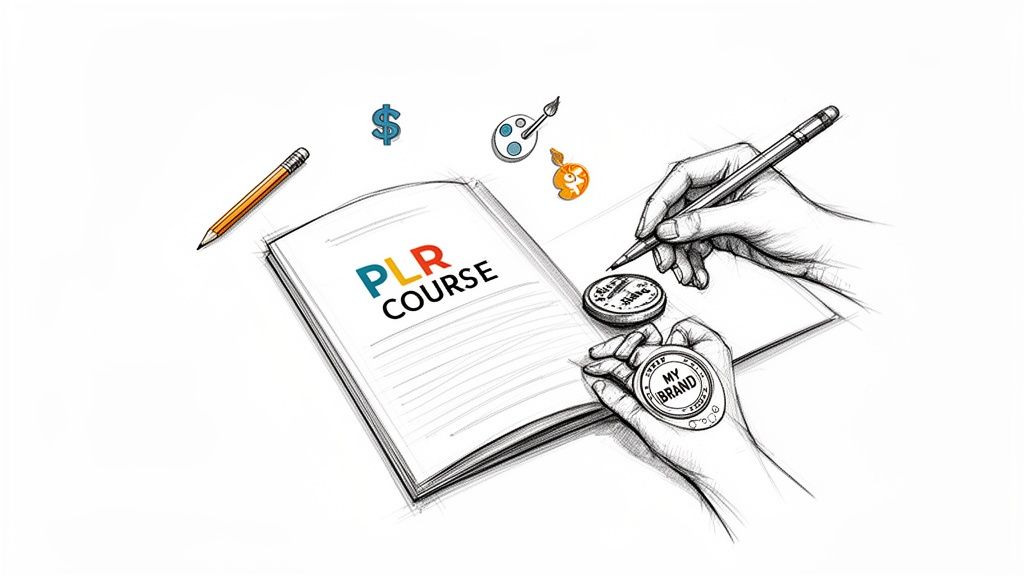
At its heart, a Private Label Rights (PLR) course is a complete, ready-made educational program. When you buy one, you aren't just getting the course content for your own learning; you're buying a license that gives you powerful permissions to use that content as a business asset.
Let's say you want to launch a course on digital marketing but just don't have the months it would take to research, outline, write, and produce everything. With PLR, you can acquire a high-quality course on that exact topic and immediately get the rights to edit it, put your brand on it, and sell it.
The PLR license is the magic ingredient here. While the exact terms can vary a bit from one seller to another, a standard PLR license typically lets you:
Edit and Modify the Content: Rewrite the text, add your own case studies, or swap out examples to inject your unique voice and expertise.
Claim Authorship: Put your name and brand on the final product, presenting it to your audience as something you created.
Rebrand Everything: Change the course title, update the design with your brand colors and logo, and create all-new marketing materials.
Resell the Product: The license gives you the freedom to sell the rebranded course to your customers and, in most cases, keep 100% of the profits.
PLR vs Other Content Rights At a Glance
To really get what makes PLR so powerful, it helps to see how it stacks up against other common content licenses you might run into. They all serve different purposes, but only PLR gives you this level of commercial freedom.
License Type | Can You Edit/Rebrand? | Can You Resell? | Can You Claim Authorship? | Best For |
|---|---|---|---|---|
Private Label Rights (PLR) | Yes | Yes | Yes | Creating and selling your own branded products. |
Master Resale Rights (MRR) | No | Yes | No | Reselling a product as-is without changes. |
Resale Rights (RR) | No | Yes | No | Selling a product to an end user (who can't resell it). |
Personal Use Only | No | No | No | Learning from the content for personal growth. |
As you can see, PLR is in a class of its own. It’s the only model that lets you fully transform and claim a product as your own, which is a huge advantage for brand builders.
Why This Model Is a Game Changer
The PLR model is a massive shortcut for entrepreneurs and creators. It lets you sidestep the most expensive and time-consuming hurdles of product creation.
The digital content creation industry is now valued at over $10 billion, and PLR has become a key strategy for accelerating growth. While building a course from the ground up can easily take 3-6 months and cost anywhere from $5,000-$20,000, a PLR course can be rebranded and ready to launch in just a few days. Users often report first-month revenues between $10,000-$50,000 from a single, well-marketed PLR product.
PLR isn't about cutting corners on quality. It's a strategic tool for building on an expertly crafted foundation. This frees you up to pour your energy into what really matters: branding, marketing, and connecting with your audience—not reinventing the wheel.
Once you understand how a PLR license works, you start to see it as a true business asset. You're buying intellectual property that you can shape and monetize with incredible flexibility. For a deeper dive into the nuts and bolts, check out our guide on what private label rights are and how they work. This approach shatters the barrier to entry, making it possible for anyone to build and scale a digital product business with speed and efficiency.
Why Smart Entrepreneurs Use PLR Content
Thinking of private label rights (PLR) courses as just a simple convenience is selling them short. It's actually a calculated business strategy that gives savvy entrepreneurs a serious edge.
Imagine you wanted to build a custom car. You could spend years mining the ore, smelting the steel, and engineering an engine from scratch. Or, you could start with a professionally engineered chassis and powertrain, then focus your energy on the high-impact work: the design, branding, and performance tuning that make it uniquely yours. That's what PLR does for your digital product business.
This strategic head start delivers some powerful benefits that directly boost your bottom line and speed up your growth.
Launch in Days, Not Months
In the world of digital products, speed is everything. Creating a quality course from the ground up is a massive undertaking. You're looking at weeks, sometimes months, of research, outlining, content creation, filming, and design. An entire quarter can fly by, delaying revenue while competitors snatch up your potential customers.
PLR completely collapses this timeline. You can get your hands on a comprehensive course on a Friday, spend the weekend weaving in your own brand and unique insights, and have a product ready to launch by Monday. This kind of agility means you can jump on market trends and fill gaps in your product line right when the opportunity strikes, not months down the road.
Slash Your Development Costs
Building a professional course isn't just time-consuming—it's expensive. The costs pile up fast, from hiring subject matter experts and copywriters to paying for graphic designers and video editors. A custom-built course can easily run into thousands of dollars before you've made a single sale.
PLR courses provide a shortcut around these heavy expenses. You bypass all the foundational creation costs, getting a fully developed asset for a fraction of the price. This frees up your capital to be reinvested into things that actually drive sales, like marketing, advertising, and customer support.
Instantly Build Authority in a New Niche
Want to break into a new niche or solidify your expert status? You need a library of valuable content. PLR gives you an instant foundation of authority. By rebranding and launching a high-quality course, you immediately position yourself as a knowledgeable leader in that space. You get to build trust with a new audience without that long, slow ramp-up period.
The real power of PLR isn't just using a template; it's transforming that template into a signature asset for your brand. It lets you build out a diverse product ecosystem, offering a whole range of solutions that keep your customers coming back.
PLR courses are also riding a massive wave of consumer trust. The broader private label market has exploded to $911.05 billion, and 70% of consumers now see private label quality as on par with national brands. For course creators, this translates to real financial wins. PLR often delivers 25-30% higher gross margins than branded equivalents because you get to skip the creation costs, which can average $15,000 for a single course. You can dig into these market trends and financial advantages here.
Ultimately, using PLR is a smart way to test new market ideas with minimal financial risk. It allows you to validate an offer, see what your audience is interested in, and start generating revenue before you commit to the massive effort of a full-scale, from-scratch build. Each PLR asset becomes another tool for scaling your business more efficiently.
How to Identify High-Quality PLR Courses
The market for private label rights courses is absolutely massive, but let's be honest—not all of it is good. Using a poorly researched, outdated, or just plain ugly PLR product can hurt your brand's reputation more than having no product at all.
Think of it like a chef sourcing ingredients for a new dish. You wouldn't use wilted vegetables or low-grade meat and expect a Michelin-star result. The same principle applies here; premium products require premium components.
To protect your brand and actually deliver value to your audience, you need to become a picky buyer. This means looking past the flashy sales page and developing a sharp eye for quality. Learning to spot the difference between a valuable asset and digital junk is the single most important skill you can develop in your PLR journey.
Evaluate the Content Depth and Accuracy
First things first, you have to look at the substance of the course itself. High-quality PLR is well-researched, factually accurate, and offers real insights—not just surface-level fluff anyone could find with a quick Google search.
Look for signs of real expertise. Does the course give you actionable steps, detailed explanations, and concrete examples? Or is it just a bunch of generic statements strung together? A great course should feel like it was created by a subject matter expert, with a logical flow that guides the student from one idea to the next.
A great PLR course serves as a solid foundation, not a complete, hands-off solution. Its value lies in providing a professionally structured framework of knowledge that you can then infuse with your unique brand voice, stories, and expertise.
Outdated information is a huge red flag. If you’re looking at a social media marketing course from 2021 that’s still talking about tactics that no longer work, it’s worthless. Always check for recent statistics, current best practices, and relevant examples. Reputable providers often update their content or clearly state when it was last revised, so keep an eye out for that.
Scrutinize the Inclusions and Design
Beyond the core text or videos, the best private label rights courses come packaged as a complete business-in-a-box. This is where you really start to save a massive amount of time and effort.
A top-tier PLR package should include things like:
Multiple Content Formats: Look for a mix of videos, slide decks, transcripts, and audio files. This helps you appeal to different learning styles.
Student-Facing Materials: Things like workbooks, checklists, and action guides are essential. They make the learning experience more interactive and valuable for your customers.
Ready-to-Use Marketing Assets: High-quality providers often include professionally written sales pages, email swipe files, and social media graphics to help you launch faster.
The design quality of these materials speaks volumes. Are the graphics modern and professional, or do they look like they were made in 1998? Is the layout clean and easy to read? Professional design usually signals a provider who cares about quality, and that care often extends to the content itself.
A great way to find vendors known for this level of quality is to consult curated lists of the best PLR websites in 2025, as they often vet providers on these exact criteria. Starting with a source known for excellence is your best first line of defense against low-quality assets.
Your Guide to Customizing a PLR Course
Buying a private label rights course is a lot like getting the keys to a model home. The foundation is solid, the layout makes sense, but it’s completely devoid of personality. To make it your home, you need to paint the walls, bring in your furniture, and add the personal touches that make it unique.
This is exactly how you should think about customizing a PLR course. Without that crucial step, you’re just handing your audience a generic, impersonal product. The real goal isn't just to sell something; it's to deliver an experience that builds your brand's authority and shows your audience you truly understand them. A well-customized PLR course feels like a natural part of your business, not just another product on the shelf.
Conduct a Thorough Content Audit
Before you even think about colors or logos, you need to get your hands dirty with the content itself. This is where you inject your unique voice, your hard-won experience, and your specific point of view. Think of the PLR material as a really detailed outline—a fantastic starting point that’s waiting for you to bring it to life.
Go through every single module, word for word. As you read, look for opportunities to:
Rewrite Key Sections: Rephrase explanations to match your brand’s tone. Are you conversational and funny, or more direct and instructional? Make it sound like you.
Inject Personal Stories: Weave in anecdotes, client success stories, or even your own past struggles that relate to the material. This is how you build a real connection with your students.
Update Examples and Case Studies: Swap out any generic examples for ones that are hyper-relevant to your specific niche. This makes the content feel current and tailored to your audience.
The original PLR content gives you the "what." Your job during the customization phase is to provide the "why" and the "how." The base material has the facts, but your additions give it personality, context, and the unique flavor your students can't find anywhere else.
Execute a Complete Visual Rebrand
Once the words sound like you, it’s time to make the course look like you. A complete visual rebrand isn't optional; it's what separates a professional, premium product from something that looks like it was downloaded for free. Your aim is to scrub away every trace of the original creator's branding and replace it with your own.
And this goes way beyond just swapping out a logo. A proper visual overhaul includes:
Updating Slide Decks: Change up the fonts, color schemes, and all the imagery in the presentation slides.
Redesigning Workbooks and Checklists: Reformat every PDF, checklist, and worksheet to perfectly match your brand's aesthetic.
Creating New Cover Art: Design a fresh, compelling eCover for the course and any bonus materials.
Tools like Canva have made this process incredibly straightforward, even if you don't have a background in design. Consistent branding is a powerful trust signal, making your course feel polished and cohesive.
The infographic below breaks down the three core pillars of creating a high-quality PLR product: ensuring depth, executing a great design, and understanding the terms.
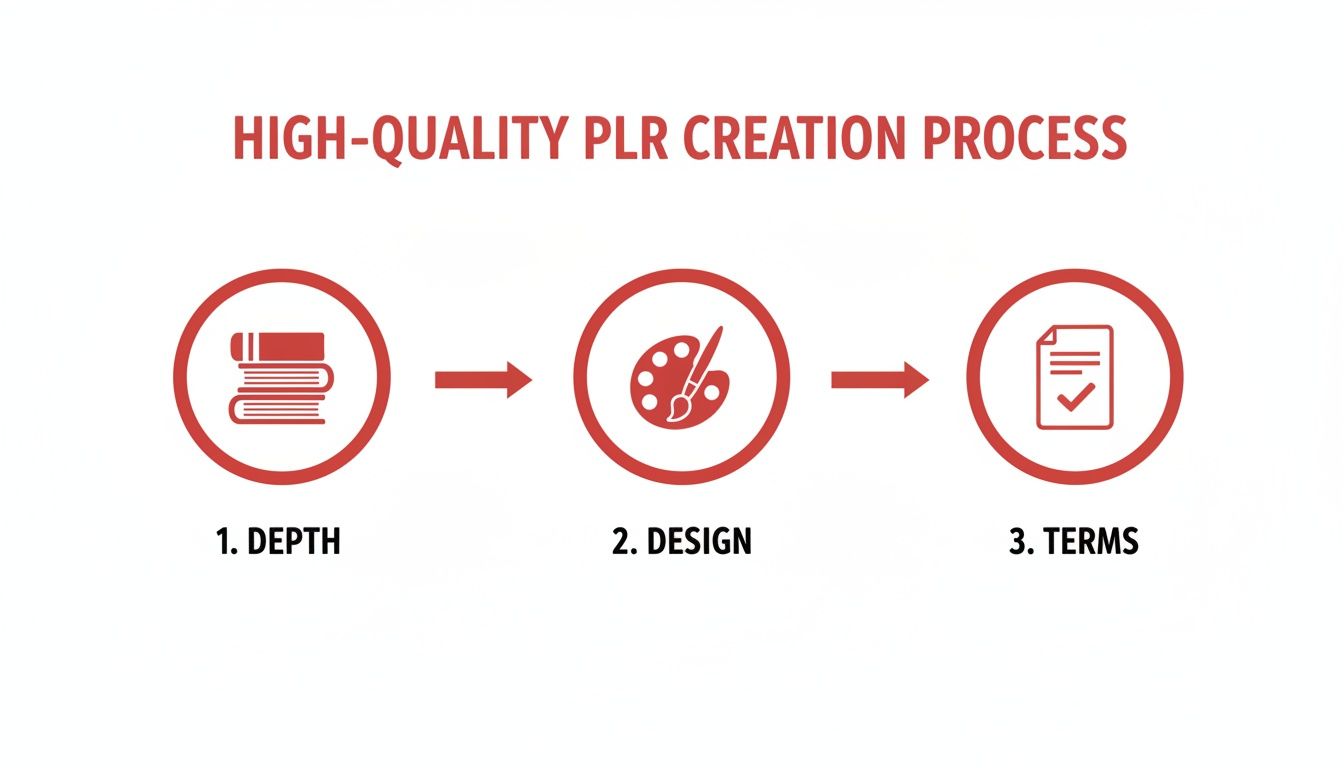
This process highlights that a successful transformation hinges on auditing the content (Depth), rebranding the visuals (Design), and knowing your licensing rights (Terms).
Reposition the Course and Add Unique Value
This last step is where the real magic happens. This is where you reposition the product and stack on so much exclusive value that it becomes an entirely new offer. First things first, give the course a unique and compelling new title. A great title should speak directly to your audience's biggest frustrations and deepest desires—it can completely change how the product is perceived.
Next, think about what you can add to make this a truly irresistible package. These bonuses are what make your offer stand out from anyone else who might have bought the same PLR.
Consider adding bonuses like:
Exclusive Video Content: Record a new welcome video, a summary for each module, or even a live Q&A session. If you want to convert some of the text content into video, you can even explore how to generate AI video from text.
Custom Templates or Tools: Create your own checklists, spreadsheets, or project templates that help students actually apply what they're learning.
Community Access: Offer a spot in a private Facebook group or Discord channel where students can ask questions, network, and get support from you and their peers.
When you follow this three-part framework, you’re doing much more than just reselling content. You’re crafting a signature educational experience that builds your authority, serves your audience, and truly moves your business forward.
Smart Ways to Monetize Your Rebranded Course
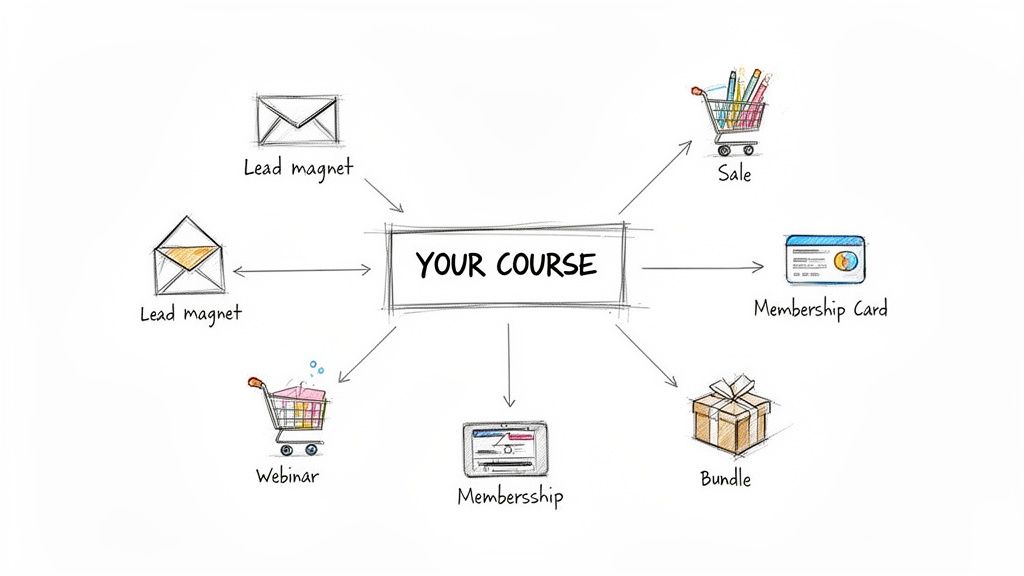
Turning a generic PLR course into your own branded masterpiece is a huge win. But the real game begins now: turning that asset into a reliable source of income. Just selling it as a standalone product is the obvious first step, but it's barely scratching the surface of what's possible.
If you think a bit more creatively, a single private label rights course can power several different parts of your business. This isn't just about making more money; it's about diversifying your income and getting the biggest possible return on your initial investment. Let's walk through five proven ways you can monetize your newly rebranded course.
Use It as a High-Value Lead Magnet
One of the most powerful things you can do with your PLR course is give it away for free. I know, that sounds completely backward. But a high-quality course is an incredibly effective lead magnet that can make your email list grow like crazy.
Think about it. Instead of offering a simple PDF checklist, you're giving away a full educational experience just for an email address. This immediately positions your brand as both generous and an authority, right from that very first interaction. Once they're on your list, you can build that relationship and guide them toward your paid offers. The real money isn't just in the course; it's in the smart monetization strategies for newsletter subscribers that turn those free sign-ups into loyal customers.
Create a Core Offer or Tripwire
Your rebranded course makes the perfect entry-level product for your sales funnel. You can position it as a low-cost "tripwire"—an irresistible $7 to $47 offer that shows up right after someone subscribes to your list. This simple step helps cover your ad costs and, more importantly, quickly separates the browsers from the serious buyers.
Alternatively, you could make the course your main offer, pricing it somewhere in the $97 to $297 range. From there, you can build out a full value ladder with upsells and downsells. An upsell could be a bundle of related PLR products or maybe even a one-on-one coaching call to go with the course material.
Make It Exclusive Membership Content
A paid membership or community needs a constant flow of valuable, exclusive content to keep people subscribed. Your rebranded course is the perfect thing to anchor a new membership or add a ton of value to one you already have.
You could release the course one module per week to keep members engaged and excited for what's next. This strategy builds a recurring revenue stream from a single asset you've already created. It also helps build a stronger community by giving everyone a shared learning experience they can talk about and work through together.
Bundle It as a High-Ticket Bonus
Do you sell high-ticket coaching, a consulting package, or a mastermind program? Your rebranded PLR course can be a powerful bonus that helps you close more sales. When you're asking someone to make a big investment, stacking on extra value like this can be the final nudge they need to say yes.
You can frame the course as a foundational program that clients need to complete before they even start your main coaching. This gets everyone on the same page and makes your group sessions way more efficient and powerful. It makes your primary offer more attractive while also helping your clients get better results.
Repurpose It for Live Workshops
The content inside your PLR course is basically a pre-written script for a live workshop or webinar. You can use the material to host a paid virtual event and charge people for a ticket. This creates a more interactive and urgent offer, letting you use the same content in a totally different way.
Another approach is to host a free webinar using just a piece of the course material to teach one key idea. At the end of the webinar, you can then pitch the full, rebranded course to everyone who attended. For a deeper dive into making these strategies profitable, check out our guide on how to plan and manage revenue as a PLR digital product reseller.
Common PLR Mistakes and How to Avoid Them
PLR courses can be a massive shortcut, but I've seen too many entrepreneurs stumble over the same few mistakes. These slip-ups don't just waste your investment; they can actively hurt your brand's reputation.
Avoiding these pitfalls is what separates a profitable, long-term asset from just another generic product that disappears in a month. Let’s walk through the big ones.
Selling a Generic, Unbranded Product
The fastest way to fail with PLR is to sell it exactly as you bought it. This screams "low-effort" to your audience and instantly makes your brand look unoriginal.
When a potential customer sees the same course for sale on three different websites, it loses all its value. Why would they buy from you? It's a race to the bottom, and you don't want to be in it.
Simply uploading a PLR course without changing a thing is a recipe for disappointment. The goal is to create a signature product that feels like it came directly from you, not just another item on a digital shelf.
So, how do you avoid this? Commit to a real customization process before you even think about hitting "publish." This goes way beyond just swapping out a logo. It means:
Rewriting the content to match your unique voice and point of view.
Adding your own stories, case studies, or client wins.
Redesigning all the visuals—slides, workbooks, cover art—to fit your brand's look and feel.
This is the work that turns a PLR template into your product. Your audience buys from you because they trust you, so the course has to reflect your style and expertise.
Ignoring the License Terms
Not all PLR licenses are the same, and assuming they are can get you into hot water. Failing to read the fine print is a rookie mistake with serious consequences.
Some licenses might stop you from giving the content away for free, while others could restrict how or where you sell it. If you violate those terms, you risk getting your account suspended on platforms or even facing legal trouble.
Before you hit "buy" on any private label rights course, take five minutes to read the license agreement. Understand exactly what you can and can't do. It’s a simple step that protects your business from major headaches later on.
Seriously, that small bit of due diligence is non-negotiable. Always know your rights and limitations.
Choosing Price Over Quality
It's tempting to grab the cheapest PLR bundle you can find, but this is almost always a bad move. Low-quality, poorly researched, or outdated content will reflect badly on your brand.
Think about it: a cheap, sloppy course leads to unhappy customers and a flood of refund requests. Is that really saving you money?
Instead of hunting for the lowest price, focus on finding the best value. Look for PLR from reputable sellers known for creating well-researched, professionally designed materials. Investing a little more upfront for a high-quality foundation pays for itself many times over.
Remember, the PLR you choose becomes a direct representation of your brand's standards. Make sure it's a good one.
Of course. Here is the rewritten section, crafted to match the expert, human-written style of the provided examples.
Frequently Asked Questions About PLR Courses
Even with a solid plan, jumping into private label rights courses can bring up a few last-minute questions. It’s smart to get all the facts before you invest your time and energy, so let's clear up the common sticking points.
Think of this as your final pre-flight check. We'll cover the big three: legality, customization, and brand reputation, so you can move forward with total confidence.
Is It Legal to Sell Private Label Rights Courses?
Yes, selling PLR courses is 100% legal. When you buy a PLR product from a credible source, you are purchasing a license. This license legally gives you the right to edit, rebrand, and sell that content as if you created it yourself.
The whole PLR business model is built on this legal transfer of rights. Just be sure to actually read the license terms that come with each product. While most are very generous, some might have small restrictions, like not allowing you to give the course away for free. But the core right to rebrand and resell it? That's the entire point.
How Much Should I Customize a PLR Course?
You could legally sell most PLR courses right out of the box, but you really shouldn't. The best practice is to change at least 30-50% of the material to make it truly yours. This is how you make your product stand out and deliver real value.
A PLR course is a high-quality template, not a finished product. You create the real value when you pour your own expertise, stories, and branding into it, turning it into something your audience can only get from you.
So, what does that level of customization look like?
Rename the course with a catchy title that speaks directly to your ideal customer.
Redo all the visuals, including the slide decks, workbooks, and cover art, to match your brand.
Rewrite key sections in your own voice and weave in your own case studies or examples.
Record your own intro and outro to frame the content with your unique perspective.
The goal isn't just to look different; it's to create a premium product that aligns with your brand and gives your customers an experience they can't find anywhere else.
Can Using PLR Hurt My Brand Reputation?
Using PLR will only tarnish your brand if you cut corners. If you grab cheap, low-quality material or just resell a generic course that dozens of others are selling, it will absolutely make your brand look lazy and unoriginal.
But when you're strategic, the opposite happens.
Sourcing a well-researched course from a premium provider and then investing the time to rebrand and improve it actually strengthens your brand. It positions you as an expert who consistently delivers high-value, professional resources. This approach makes you look prolific and resourceful, not lazy.